

Kirjahaku
Etsi kirjoja tekijän nimen, kirjan nimen tai ISBN:n perusteella.
1000 tulosta hakusanalla Forest


Well-off Kentish man Arthur Skrene adjusts to his newly-inherited farmstead in Blidworth, Nottinghamshire, by Sherwood Forest - and the locals adjust to him!
Forest-Water Interactions
Springer Nature Switzerland AG
2021
nidottu
The United Nations has declared 2018-2028 as the International Decade for Action on Water for Sustainable Development. This is a timely designation. In an increasingly thirsty world, the subject of forest-water interactions is of critical importance to the achievement of sustainability goals. The central underlying tenet of this book is that the hydrologic community can conduct better science and make a more meaningful impact to the world’s water crisis if scientists are: (1) better equipped to utilize new methods and harness big data from either or both high-frequency sensors and long-term research watersheds; and (2) aware of new developments in our process-based understanding of the hydrological cycle in both natural and urban settings. Accordingly, this forward-looking book delves into forest-water interactions from multiple methodological, statistical, and process-based perspectives (with some chapters featuring data sets and open-source R code), concluding with a chapter on future forest hydrology under global change. Thus, this book describes the opportunities of convergence in high-frequency sensing, big data, and open source software to catalyze more comprehensive understanding of forest-water interactions. The book will be of interest to researchers, graduate students, and advanced undergraduates in an array of disciplines, including hydrology, forestry, ecology, botany, and environmental engineering.
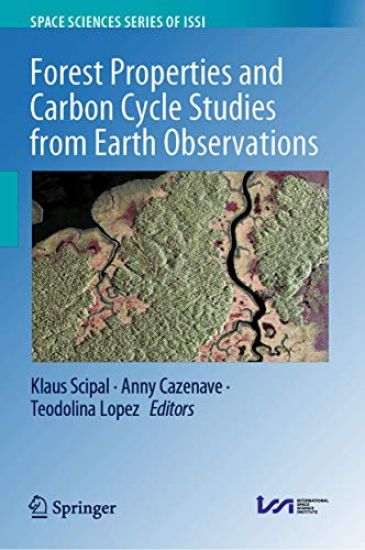
Forest Properties and Carbon Cycle Studies from Earth Observations
Springer Nature Switzerland AG
2019
sidottu
This book features a comprehensive series of the overview articles on all relevant aspects of forest structure estimation from space and related fields. The overview articles in this book discuss the importance of the derived products for earth system science and policy, the latest earth observation system and techniques, aspects of ground data collection for contextualisation and validation and the consistent generation of estimates from multiple data stream.Previously published in Surveys in Geophysics, Volume 40, Issue 4, 2019The chapters “Aspects of Forest Biomass in the Earth System: Its Role and Major Unknowns”, “The Role and Need for Space-Based Forest Biomass-Related Measurements in Environmental Management and Policy’, “Recent Advances in Forest Observation with Visual Interpretation of Very High-Resolution Imagery”, “Species Matter: Wood Density Influences Tropical Forest Biomass at Multiple Scales”, “Innovations in Ground and Airborne Technologies as Reference and for Training and Validation: Terrestrial Laser Scanning (TLS)”, “New Opportunities for Forest Remote Sensing Through Ultra-High-Density Drone Lidar”, “The Importance of Consistent Global Forest Aboveground Biomass Product Validation”, and “A Joint ESA-NASA Multi-mission Algorithm and Analysis Platform (MAAP) for Biomass, NISAR, and GEDI” are available as open access articles under a CC BY 4.0 license at link.springer.com
Forest Properties and Carbon Cycle Studies from Earth Observations
Springer Nature Switzerland AG
2020
nidottu
This book features a comprehensive series of the overview articles on all relevant aspects of forest structure estimation from space and related fields. The overview articles in this book discuss the importance of the derived products for earth system science and policy, the latest earth observation system and techniques, aspects of ground data collection for contextualisation and validation and the consistent generation of estimates from multiple data stream.Previously published in Surveys in Geophysics, Volume 40, Issue 4, 2019The chapters “Aspects of Forest Biomass in the Earth System: Its Role and Major Unknowns”, “The Role and Need for Space-Based Forest Biomass-Related Measurements in Environmental Management and Policy’, “Recent Advances in Forest Observation with Visual Interpretation of Very High-Resolution Imagery”, “Species Matter: Wood Density Influences Tropical Forest Biomass at Multiple Scales”, “Innovations in Ground and Airborne Technologies as Reference and for Training and Validation: Terrestrial Laser Scanning (TLS)”, “New Opportunities for Forest Remote Sensing Through Ultra-High-Density Drone Lidar”, “The Importance of Consistent Global Forest Aboveground Biomass Product Validation”, and “A Joint ESA-NASA Multi-mission Algorithm and Analysis Platform (MAAP) for Biomass, NISAR, and GEDI” are available as open access articles under a CC BY 4.0 license at link.springer.com
Forest Pest and Disease Management in Latin America
Springer Nature Switzerland AG
2020
sidottu
By providing multiple economic goods and ecosystem services, Latin American forests play a key role in the environmental, social and economic welfare of the region’s countries. From the tropical forests of Central America to the Mediterranean and temperate vegetation of the southern cone, these forests face a myriad of phytosanitary problems that negatively impact on both conservation efforts and forest industry. This book brings together the perspectives of several Latin American researchers on pest and disease management. Each chapter provides modern views of the status and management alternatives to problems as serious as the impact of introduced exotic insects and diseases on Pinus and Eucalyptus plantations throughout the continent, and the emergence of novel insect outbreaks in tropical and temperate native forests associated with global warming. It is a valuable guide for researchers and practitioners working on forest health in Latin America and around the world.
Forest Pest and Disease Management in Latin America
Springer Nature Switzerland AG
2021
nidottu
By providing multiple economic goods and ecosystem services, Latin American forests play a key role in the environmental, social and economic welfare of the region’s countries. From the tropical forests of Central America to the Mediterranean and temperate vegetation of the southern cone, these forests face a myriad of phytosanitary problems that negatively impact on both conservation efforts and forest industry. This book brings together the perspectives of several Latin American researchers on pest and disease management. Each chapter provides modern views of the status and management alternatives to problems as serious as the impact of introduced exotic insects and diseases on Pinus and Eucalyptus plantations throughout the continent, and the emergence of novel insect outbreaks in tropical and temperate native forests associated with global warming. It is a valuable guide for researchers and practitioners working on forest health in Latin America and around the world.
Forest, Field, and Fallow
Springer Nature Switzerland AG
2021
sidottu
This volume aims to present the essential work of geographer and historical ecologist William M. Denevan to explain the impact and influence his thinking had on the conceptual advancement not only in his own discipline, but in a range of related disciplines such as anthropology, archaeology, and environmental history. The book is organized around eight themes, demonstrating Denevan’s early and profound insights on topics that remain of current relevance today, and the scholarly impact his writing had on subsequent scholarship. The book is unique because it offers commentary from active scholars who address the impacts of Prof. Denevan's thinking and work on contemporary environmental and ecological issues, with a focus on several groundbreaking themes (e.g. historical demography, agricultural landforms, cultural plant geography, human environmental impacts, indigenous agro-ecology, tropical agriculture, livestock and landscape, and synthetic contributions). This book will be of interest to a range of scholars in geography, anthropology, archaeology, history, and ecology, as well as to environmental managers and practitioners, especially those working for non-profit organizations and government organizations tasked with finding ways to adapt to global environmental change.
Forest, Field, and Fallow
Springer Nature Switzerland AG
2022
nidottu
This volume aims to present the essential work of geographer and historical ecologist William M. Denevan to explain the impact and influence his thinking had on the conceptual advancement not only in his own discipline, but in a range of related disciplines such as anthropology, archaeology, and environmental history. The book is organized around eight themes, demonstrating Denevan’s early and profound insights on topics that remain of current relevance today, and the scholarly impact his writing had on subsequent scholarship. The book is unique because it offers commentary from active scholars who address the impacts of Prof. Denevan's thinking and work on contemporary environmental and ecological issues, with a focus on several groundbreaking themes (e.g. historical demography, agricultural landforms, cultural plant geography, human environmental impacts, indigenous agro-ecology, tropical agriculture, livestock and landscape, and synthetic contributions). This book will be of interest to a range of scholars in geography, anthropology, archaeology, history, and ecology, as well as to environmental managers and practitioners, especially those working for non-profit organizations and government organizations tasked with finding ways to adapt to global environmental change.
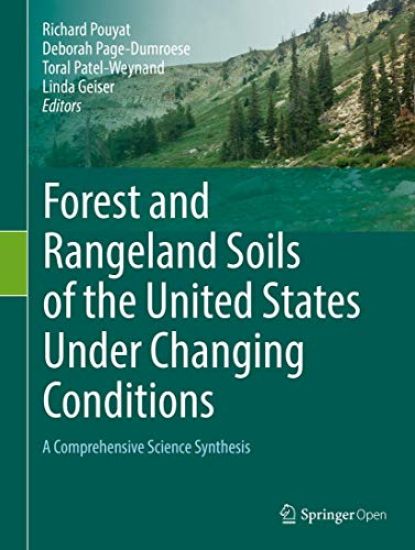
Forest and Rangeland Soils of the United States Under Changing Conditions
Springer Nature Switzerland AG
2020
sidottu
This open access book synthesizes leading-edge science and management information about forest and rangeland soils of the United States. It offers ways to better understand changing conditions and their impacts on soils, and explores directions that positively affect the future of forest and rangeland soil health. This book outlines soil processes and identifies the research needed to manage forest and rangeland soils in the United States. Chapters give an overview of the state of forest and rangeland soils research in the Nation, including multi-decadal programs (chapter 1), then summarizes various human-caused and natural impacts and their effects on soil carbon, hydrology, biogeochemistry, and biological diversity (chapters 2–5). Other chapters look at the effects of changing conditions on forest soils in wetland and urban settings (chapters 6–7). Impacts include: climate change, severe wildfires, invasive species, pests and diseases, pollution, and land use change. Chapter 8considers approaches to maintaining or regaining forest and rangeland soil health in the face of these varied impacts. Mapping, monitoring, and data sharing are discussed in chapter 9 as ways to leverage scientific and human resources to address soil health at scales from the landscape to the individual parcel (monitoring networks, data sharing Web sites, and educational soils-centered programs are tabulated in appendix B). Chapter 10 highlights opportunities for deepening our understanding of soils and for sustaining long-term ecosystem health and appendix C summarizes research needs. Nine regional summaries (appendix A) offer a more detailed look at forest and rangeland soils in the United States and its Affiliates.
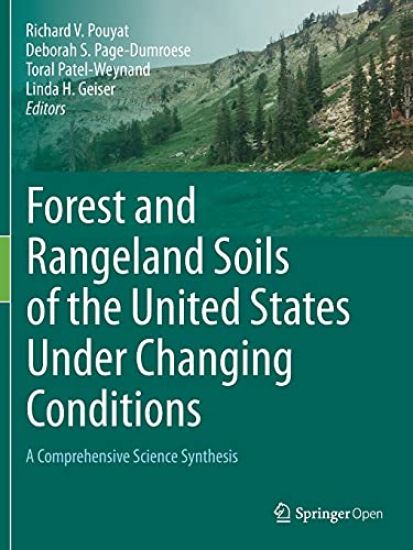
Forest and Rangeland Soils of the United States Under Changing Conditions
Springer Nature Switzerland AG
2021
nidottu
This open access book synthesizes leading-edge science and management information about forest and rangeland soils of the United States. It offers ways to better understand changing conditions and their impacts on soils, and explores directions that positively affect the future of forest and rangeland soil health. This book outlines soil processes and identifies the research needed to manage forest and rangeland soils in the United States. Chapters give an overview of the state of forest and rangeland soils research in the Nation, including multi-decadal programs (chapter 1), then summarizes various human-caused and natural impacts and their effects on soil carbon, hydrology, biogeochemistry, and biological diversity (chapters 2–5). Other chapters look at the effects of changing conditions on forest soils in wetland and urban settings (chapters 6–7). Impacts include: climate change, severe wildfires, invasive species, pests and diseases, pollution, and land use change. Chapter 8considers approaches to maintaining or regaining forest and rangeland soil health in the face of these varied impacts. Mapping, monitoring, and data sharing are discussed in chapter 9 as ways to leverage scientific and human resources to address soil health at scales from the landscape to the individual parcel (monitoring networks, data sharing Web sites, and educational soils-centered programs are tabulated in appendix B). Chapter 10 highlights opportunities for deepening our understanding of soils and for sustaining long-term ecosystem health and appendix C summarizes research needs. Nine regional summaries (appendix A) offer a more detailed look at forest and rangeland soils in the United States and its Affiliates.
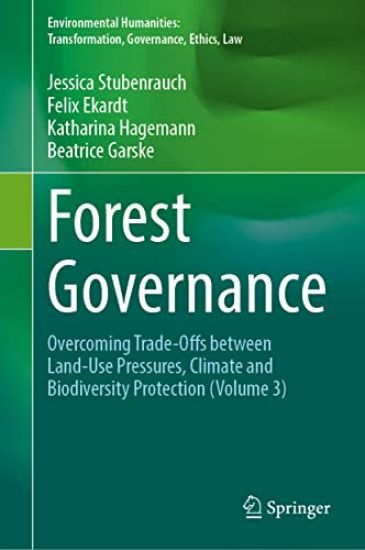
Forest Governance
Jessica Stubenrauch; Felix Ekardt; Katharina Hagemann; Beatrice Garske
Springer Nature Switzerland AG
2022
sidottu
This book analyses and develops overarching concepts for forest policy and forest governance and includes a detailed investigation into the historical discussion on forests. It examines opportunities and limits for negative emissions in a sector that – like peatlands – appears significantly less ambivalent compared to highly technical large-scale forms of climate geoengineering. The analysis shows that the binding climate and biodiversity targets under international law are much more ambitious than most people assume. Measured against that, the volume critically reviews the potentials of afforestation and reforestation for climate mitigation, which is often presented as the new saviour to fulfil the commitments of the Paris Agreement and to reach climate neutrality in the future. It becomes clear that ultimately only biodiverse and thus resilient forests can function as a carbon sink in the long term. The volume shows that the existing European and international forest governance approaches fail to comply with these targets and insights. Furthermore, the book develops a bundle of policy measures. Quantity governance systems for livestock farming, fossil fuels and similar drivers of deforestations represent the most important approach. They are most effective when not directly targeting forests due to their heterogeneity but central damaging factors. With regard to the dominant regulatory and subsidy-based governance for forests we show that it remains necessary to supplement these quantity governance systems with certain easily graspable and thus controllable regulatory and subsidy regulations such as a regulatory protection of old-growth forests with almost no exceptions; extension of the livestock-to-land-ratio established in organic farming to all farming; far-reaching restriction of bioenergy use to certain residues flanked by import bans; and a national and international complete conversion of all agricultural and forest subsidies to “public money for publicservices” to promote nature conservation and afforestation in addition to the quantity control systems.
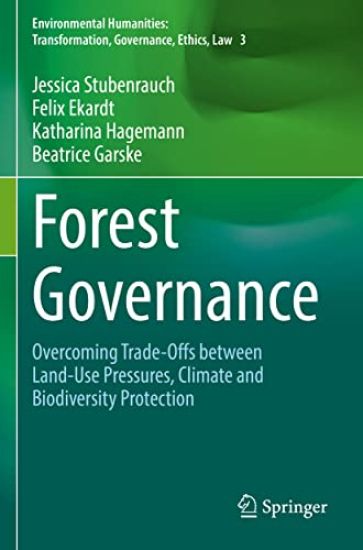
Forest Governance
Jessica Stubenrauch; Felix Ekardt; Katharina Hagemann; Beatrice Garske
Springer Nature Switzerland AG
2023
nidottu
This book analyses and develops overarching concepts for forest policy and forest governance and includes a detailed investigation into the historical discussion on forests. It examines opportunities and limits for negative emissions in a sector that – like peatlands – appears significantly less ambivalent compared to highly technical large-scale forms of climate geoengineering. The analysis shows that the binding climate and biodiversity targets under international law are much more ambitious than most people assume. Measured against that, the volume critically reviews the potentials of afforestation and reforestation for climate mitigation, which is often presented as the new saviour to fulfil the commitments of the Paris Agreement and to reach climate neutrality in the future. It becomes clear that ultimately only biodiverse and thus resilient forests can function as a carbon sink in the long term. The volume shows that the existing European and international forest governance approaches fail to comply with these targets and insights. Furthermore, the book develops a bundle of policy measures. Quantity governance systems for livestock farming, fossil fuels and similar drivers of deforestations represent the most important approach. They are most effective when not directly targeting forests due to their heterogeneity but central damaging factors. With regard to the dominant regulatory and subsidy-based governance for forests we show that it remains necessary to supplement these quantity governance systems with certain easily graspable and thus controllable regulatory and subsidy regulations such as a regulatory protection of old-growth forests with almost no exceptions; extension of the livestock-to-land-ratio established in organic farming to all farming; far-reaching restriction of bioenergy use to certain residues flanked by import bans; and a national and international complete conversion of all agricultural and forest subsidies to “public money for publicservices” to promote nature conservation and afforestation in addition to the quantity control systems.
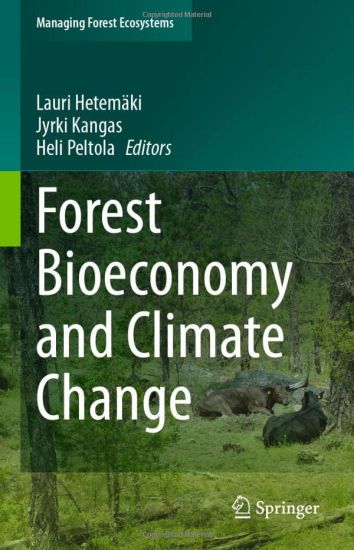
Forest Bioeconomy and Climate Change
Springer Nature Switzerland AG
2022
sidottu
This edited open access volume explores the role of forest bioeconomy in addressing climate change. The authors put a particular focus on planetary boundaries and how the linear, growth-oriented economy, is coupled with climate change and environmental degradation. Biobased products and sustainable production paths have been developed, but how can they be scaled in order to lead to an economic paradigm shift? This and other questions are discussed throughout the volume.Since science indicates that climate change will continue this century, the authors also analyse how forests can be adapted to increasing forest disturbances that changing climate are expected to cause. The authors propose climate-smart forestry as useful approach for climate mitigation and adaptation of forests to climate change, as wells as sustainable increase of economic well-being based on forestry. The book illustrates the application of climate-smart forestry in the Czech Republic, Finland, Germany and Spain, i.e., in EU countries with quite different forests and forest sectors. This proactive and inspiring volume is an essential resource for Forest Management professionals, decision makers, scientists, and forestry students.
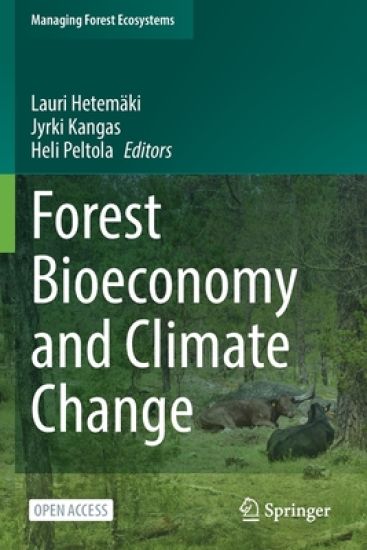
Forest Bioeconomy and Climate Change
Springer Nature Switzerland AG
2022
nidottu
This edited open access volume explores the role of forest bioeconomy in addressing climate change. The authors put a particular focus on planetary boundaries and how the linear, growth-oriented economy, is coupled with climate change and environmental degradation. Biobased products and sustainable production paths have been developed, but how can they be scaled in order to lead to an economic paradigm shift? This and other questions are discussed throughout the volume.Since science indicates that climate change will continue this century, the authors also analyse how forests can be adapted to increasing forest disturbances that changing climate are expected to cause. The authors propose climate-smart forestry as useful approach for climate mitigation and adaptation of forests to climate change, as wells as sustainable increase of economic well-being based on forestry. The book illustrates the application of climate-smart forestry in the Czech Republic, Finland, Germany and Spain, i.e., in EU countries with quite different forests and forest sectors. This proactive and inspiring volume is an essential resource for Forest Management professionals, decision makers, scientists, and forestry students.
Forest Entomology and Pathology
Springer International Publishing AG
2023
sidottu
This open access book will provide an introduction to forest entomology, the principles and techniques of forest insect pest management, the different forest insect guilds/feeding groups, and relevant forest insect pest management case studies. In addition to covering 30% of the earth, forest ecosystems provide numerous timber and non-timber products that affect our daily lives and recreational opportunities, habitat for diverse animal communities, watershed protection, play critical roles in the water cycle, and mitigate soil erosion and global warming. In addition to being the most abundant organisms in forest ecosystems, insects perform numerous functions in forests, many of which are beneficial and critical to forest health. Conversely, some insects damage and/or kill trees and reduce the capacity of forests to provide desired ecosystem services. The target audience of this book is upper-level undergraduate and graduate students and professionals interested in forest health andentomology.
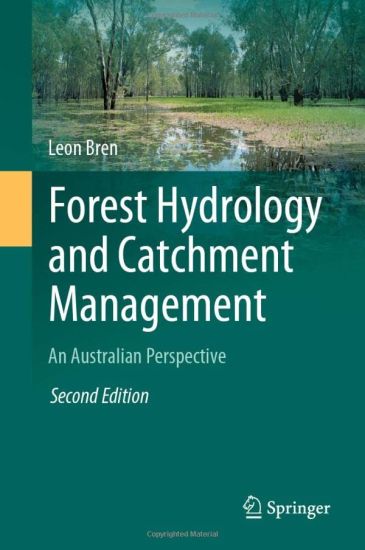
Forest Hydrology and Catchment Management
Leon Bren
Springer International Publishing AG
2023
sidottu
This book provides scientific evidence to underline the notion that forests offer the most reliable water catchments in the natural environment. The unique Australian ecosystem provides valuable information on the water yields and hydro-ecology of forests. Insights can be transferred to other climate zones and conditions. In this second edition, the author puts a particular focus on the most prominent challenges of our time, in relation to water management. Ground salinity, climate change, and droughts have all been newly added to this updated edition. One of the most important concepts is highlighting the accumulated contribution of smaller catchments and minor streams. Finally, readers will also get information on the economic dimension of water management. With its incisive, disciplined, and quantitative (and occasionally humorous) approach, this book helps scientists, students, and regulators to understand water-driven conflicts andoffers guidance on management.
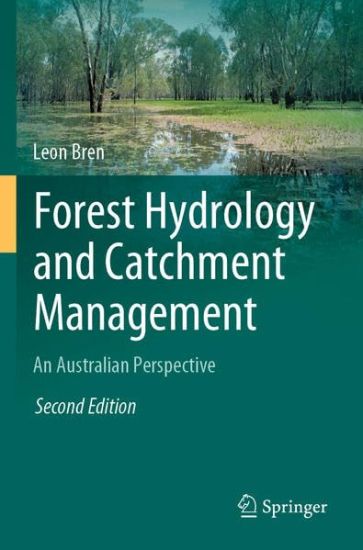
Forest Hydrology and Catchment Management
Leon Bren
Springer International Publishing AG
2024
nidottu
This book provides scientific evidence to underline the notion that forests offer the most reliable water catchments in the natural environment. The unique Australian ecosystem provides valuable information on the water yields and hydro-ecology of forests. Insights can be transferred to other climate zones and conditions. In this second edition, the author puts a particular focus on the most prominent challenges of our time, in relation to water management. Ground salinity, climate change, and droughts have all been newly added to this updated edition. One of the most important concepts is highlighting the accumulated contribution of smaller catchments and minor streams. Finally, readers will also get information on the economic dimension of water management. With its incisive, disciplined, and quantitative (and occasionally humorous) approach, this book helps scientists, students, and regulators to understand water-driven conflicts andoffers guidance on management.