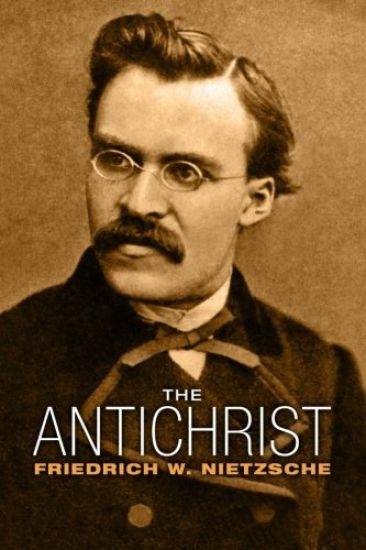
The Antichrist (German: Der Antichrist) is a book by the philosopher Friedrich Nietzsche, originally published in 1895. Although it was written in 1888, its controversial content made Franz Overbeck and Heinrich K selitz delay its publication, along with Ecce Homo. 1] The German title can be translated into English as both "The Anti-Christ" and "The Anti-Christian". 2] The book, however, is a polemic against institutionalized Christianity, not against Christ.
Das Buch besteht aus vier Teilen. Der erste Teil erschien 1883, der zweite und dritte 1884, der vierte 1885 als Privatdruck. 1886 ver ffentlichte Nietzsche die drei ersten Teile als "Also sprach Zarathustra. Ein Buch f r Alle und Keinen. In drei Teilen." Im Gegensatz zu den fr hen Werken Nietzsches handelt es sich beim Zarathustra nicht um ein Sachbuch. In hymnischer Prosa berichtet ein personaler Erz hler vom Wirken eines fiktiven Denkers, der den Namen des Persischen Religionsstifters Zarathustra tr gt. Nietzsche selbst nennt den Stil, in dem Also sprach Zarathustra geschrieben ist, halkyonisch und w nscht sich Leser, die eines "gleichen Pathos f hig und w rdig sind": "Man muss vor Allem den Ton, der aus diesem Munde kommt, diesen halkyonischen Ton richtig h ren, um dem Sinn seiner Weisheit nicht erbarmungsw rdig Unrecht zu tun". Dass Nietzsche diese Leserschaft in seiner Gegenwart nicht gesehen hat, legt der Untertitel des Werkes nahe: "Ein Buch f r Alle und Keinen".
Uno de los libros que describe mejor el pensamiento de tard o de Nietzsche. Fue el primer libro in dito que paso por las manos de Elisabeth Forster-Nietzsche quien suprimi p rrafos enteros y hasta el subt tulo que llevaba el libro: "Maldici n sobre el cristianismo"
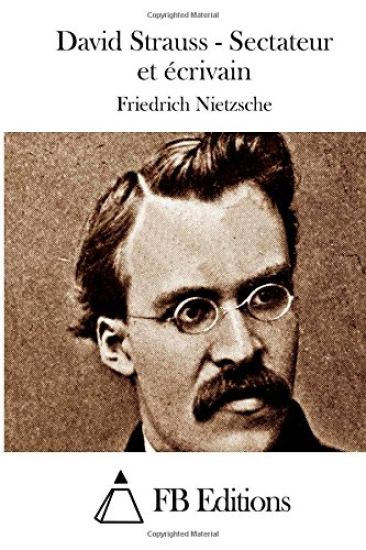
Thoughts out of Season is a classic German philosophy work by the great German philosopher, Friedrich Nietzsche. THE Editor begs to call attention to some of the difficulties he had to encounter in preparing this edition of the complete works of Friedrich Nietzsche. Not being English himself, he had to rely upon the help of collaborators, who were somewhat slow in coming forward. They were also few in number; for, in addition to an exact knowledge of the German language, there was also required sympathy and a certain enthusiasm for the startling ideas of the original, as well as a considerable feeling for poetry, and that highest form of it, religious poetry. Contents: David Strauss, the confessor and the writer -- Richard Wagner in Bayreuth.
FREDERICK NIETZSCHE was born at Rocken near Ltitzen, in the Prussian province of Saxony, on the i 5th of October 1844, at 10 a.m. The day happened to be the anniversary of the birth of Frederick-William IV., then King of Prussia, and the peal of the local church-bells which was intended to celebrate this event, was, by a happy coincidence, just timed to greet my brother on his entrance into the world. In 1 84 1, at the time when our father was tutor to the Altenburg Princesses, Theresa of Saxe-Altenburg, Elizabeth, Grand Duchess of Oldenburg, and Alexandra, Grand Duchess Constantine of Russia, he had had the honour of being presented to his witty and pious sovereign.
Ecce Homo, malgr sa bri vet , est l'un des livres les plus importants pour comprendre la pens e nietzsch enne dans son originalit . Au cours de ces quelque cent pages, Nietzsche invente un nouveau type d' criture, tonitruant et virtuose, qui lui permet de r aliser son programme de « philosophie coups de marteau . Nulle part -- hormis peut- tre dans Le Cr puscule des idoles --, Nietzsche n'est aussi clair, dense et brillant.
Thus Spoke Zarathustra A Book for All and None (German: Also sprach Zarathustra: Ein Buch f r Alle und Keinen, also translated as Thus Spake Zarathustra) is a philosophical novel by German philosopher Friedrich Nietzsche, composed in four parts between 1883 and 1885 and published between 1883 and 1891. Much of the work deals with ideas such as the "eternal recurrence of the same", the parable on the "death of God", and the "prophecy" of the bermensch, which were first introduced in The Gay Science. Origins Thus Spoke Zarathustra was conceived while Nietzsche was writing The Gay Science; he made a small note, reading "6,000 feet beyond man and time," as evidence of this. More specifically, this note related to the concept of the eternal recurrence, which is, by Nietzsche's admission, the central idea of Zarathustra; this idea occurred to him by a "pyramidal block of stone" on the shores of Lake Silvaplana in the Upper Engadine, a high alpine region whose valley floor is at 6,000 ft. Nietzsche planned to write the book in three parts over several years. He wrote that the ideas for Zarathustra first came to him while walking on two roads surrounding Rapallo, according to Elisabeth F rster-Nietzsche in the introduction of Thomas Common's early translation of the book. Although Part Three was originally planned to be the end of the book, and ends with a strong climax, Nietzsche subsequently decided to write an additional three parts; ultimately, however, he composed only the fourth part, which is viewed to constitute an intermezzo. Nietzsche commented in Ecce Homo that for the completion of each part: "Ten days sufficed; in no case, neither for the first nor for the third and last, did I require more" (trans. Kaufmann). The first three parts were first published separately, and were subsequently published in a single volume in 1887. The fourth part remained private after Nietzsche wrote it in 1885; a scant forty copies were all that were printed, apart from seven others that were distributed to Nietzsche's close friends. In March 1892, the four parts were finally reprinted as a single volume. Since then, the version most commonly produced has included all four parts. The original text contains a great deal of word-play. An example of this is the use of words beginning ber ("over" or "above") and unter ("down" or "below"), often paired to emphasise the contrast, which is not always possible to bring out in translation, except by coinages. An example is Untergang, literally "down-going" but used in German to mean "setting" (as of the sun), which Nietzsche pairs with its opposite bergang (going over or across). Another example is bermensch (overman or superman), discussed later in this article.