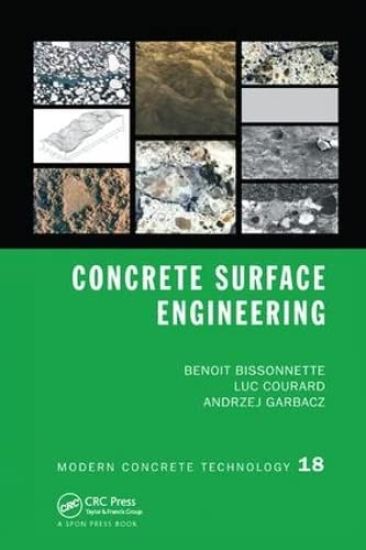
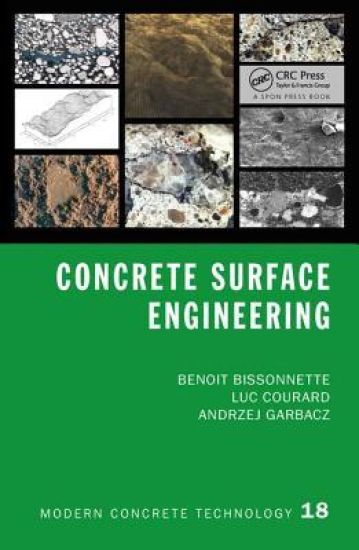
Applying any material to an existing concrete surface intrinsically entails the development of a bond. Considering the ever increasing importance of concrete repair and protection, which imply the creation of an interface between two materials, an improved knowledge of concrete surface characteristics is paramount.Surface engineering, which has evolved from the world of metallurgy, addresses all surface-related considerations, notably adhesion. It provides a fundamental understanding of what will make the contact between two materials effective or not, allowing for interactions of variable intensity. It also comes with a variety of scientific tools for characterizing the quality of the substrate, the properties of the new material layer and their interface. In the case of concrete surface treatment, this is especially important for achieving lasting results.This book addresses the essentials of concrete surface engineering in view of a wide variety of concrete surface treatments, from protective coatings to repairs. It provides a leading-edge source of information for practicing engineers, architects, repair specialists, and researchers on the following topics: Surface engineering principles applied to concreteMethods and techniques for assessing concrete surface characteristicsFundamentals of adhesion between concrete and surface repairs/treatmentsCompatibility requirements for concrete surface repairs/treatmentsReview of surface preparation techniques available for concreteAchievement and appraisal of bond between existing concrete and surface repairs/treatmentsBenoît Bissonnette is professor of civil engineering at Laval University in Quebec City, Canada.Luc Courard is professor of building materials at the University of Liège in Belgium.Andrzej Garbacz is professor of building materials engineering in the Department of Building Materials Engineering at the Warsaw University of Technology in Poland.
Applying any material to an existing concrete surface intrinsically entails the development of a bond. Considering the ever increasing importance of concrete repair and protection, which imply the creation of an interface between two materials, an improved knowledge of concrete surface characteristics is paramount.Surface engineering, which has evolved from the world of metallurgy, addresses all surface-related considerations, notably adhesion. It provides a fundamental understanding of what will make the contact between two materials effective or not, allowing for interactions of variable intensity. It also comes with a variety of scientific tools for characterizing the quality of the substrate, the properties of the new material layer and their interface. In the case of concrete surface treatment, this is especially important for achieving lasting results.This book addresses the essentials of concrete surface engineering in view of a wide variety of concrete surface treatments, from protective coatings to repairs. It provides a leading-edge source of information for practicing engineers, architects, repair specialists, and researchers on the following topics: Surface engineering principles applied to concreteMethods and techniques for assessing concrete surface characteristicsFundamentals of adhesion between concrete and surface repairs/treatmentsCompatibility requirements for concrete surface repairs/treatmentsReview of surface preparation techniques available for concreteAchievement and appraisal of bond between existing concrete and surface repairs/treatmentsBenoît Bissonnette is professor of civil engineering at Laval University in Quebec City, Canada.Luc Courard is professor of building materials at the University of Liège in Belgium.Andrzej Garbacz is professor of building materials engineering in the Department of Building Materials Engineering at the Warsaw University of Technology in Poland.
Gauging and Engaging Deviance is at once a creative and challenging work. It is not just a critique of the sociological canon, but an imaginative reconstruction that is generous to all nooks and crannies of the planet. It is also a memorial to modernity's victims, whether they were perceived to be deviant or not. Its broad historical range, its geographical spread, and its attention to race and power create a conceptual grammar through which we can speak of the key challenges, traumas and violence of the contemporary period. Through its pages the Maroon and the Pirate meet Don Quixote, the Thug and the Apostate in a journey that takes the reader through slave factories, plantations, prisons, and extermination camps, gauging the price of what it has meant to struggle to be contrary or free.
Cette tude a tent de cartographier le potentiel en eaux souterraines Zaria, au Nigeria. Les eaux souterraines constituent une source tr s importante pour l'approvisionnement en eau, mais elles sont variables dans l'espace. Dans certaines zones de la r gion tudi e, on a observ des cas fr quents d'ass chement des puits et des forages. Il est donc important d' valuer la variation des eaux souterraines dans la r gion afin d'am liorer leur exploration, ainsi que la conservation et la gestion de cette ressource. Les donn es Landsat ETM+ et GDEM fournies par ASTER, les donn es conventionnelles ainsi que les donn es m t orologiques ont t utilis es pour caract riser les ressources souterraines par observation directe des facteurs hydrologiques contr lant la surface et le sous-sol. Sur la base de ces facteurs, huit cartes th matiques ont t labor es: densit du r seau hydrographique, g ologie, g omorphologie, couverture terrestre, lin aments, pr cipitations, pente et sol. L'influence de chaque th me sur la recharge des eaux souterraines a t valu e l'aide du processus hi rarchique analytique (AHP), puis pond r e. Les eaux souterraines ont t cartographi es en cinq cat gories (tr s bonne, bonne, mod r e, faible et tr s faible) l'aide d'ArcGIS. Cet ouvrage peut int resser les personnes travaillant dans le secteur de l'approvisionnement en eau, les agences gouvernementales charg es de l'approvisionnement en eau et celles qui s'int ressent la r alisation d' tudes sur le
Multicriteria Analysis and LCA Techniques introduces the reader to the basic principles of multicriteria analysis (MCA) and life cycle assessment (LCA) techniques. The use of these tools is rapidly becoming essential in any feasibility study for comparing different solutions, selecting the most suitable ones, and for analyzing the interface of economy and environment.The main feature of Multicriteria Analysis and LCA Techniques is the application of a new approach to the analysis of energy balance and environmental impact of agro-industrial production chains. It gives detailed descriptions of a number of food and non-food agro-industrial applications of MCA and LCA, thereby providing the reader with practical examples of the implementation of these tools in the field of agro-industry.Multicriteria Analysis and LCA Techniques represents a subsidiary reference book for both undergraduate and graduate students, and can also be used for basic or applied academic research.
Multicriteria Analysis and LCA Techniques introduces the reader to the basic principles of multicriteria analysis (MCA) and life cycle assessment (LCA) techniques. The use of these tools is rapidly becoming essential in any feasibility study for comparing different solutions, selecting the most suitable ones, and for analyzing the interface of economy and environment.The main feature of Multicriteria Analysis and LCA Techniques is the application of a new approach to the analysis of energy balance and environmental impact of agro-industrial production chains. It gives detailed descriptions of a number of food and non-food agro-industrial applications of MCA and LCA, thereby providing the reader with practical examples of the implementation of these tools in the field of agro-industry.Multicriteria Analysis and LCA Techniques represents a subsidiary reference book for both undergraduate and graduate students, and can also be used for basic or applied academic research.
Fried and Sosland bring their combined experiences together to present a blueprint to reduce the pain, rage and revenge cycle of bullying. Their strategies have been captured from hands-on interaction with educators, parents and students. Their premise comes from the apocryphal village that is being ravaged by dysentery. Do you treat each person for their intestinal disorders or do you put in a sewer system? Do you work with each individual student or do you change a culture that hosts cruelty. Can you do both? The core of the book is the Student Empowerment Session that has been crafted and refined over fifteen years. This carefully organized, powerful system of questions has effected dramatic changes in children's insights about their behavior. The book also explores topics which include cyberbullying, children with disabilities, "mean girls," teachers who are bullies, parents who refuse to accept that their children are bullies, and academic vs. social emotional learning concerns to help readers change the culture and banish bully behavior.
Fried and Sosland bring their combined experiences together to present a blueprint to reduce the pain, rage and revenge cycle of bullying. Their strategies have been captured from hands-on interaction with educators, parents and students. Their premise comes from the apocryphal village that is being ravaged by dysentery. Do you treat each person for their intestinal disorders or do you put in a sewer system? Do you work with each individual student or do you change a culture that hosts cruelty. Can you do both? The core of the book is the Student Empowerment Session that has been crafted and refined over fifteen years. This carefully organized, powerful system of questions has effected dramatic changes in children's insights about their behavior. The book also explores topics which include cyberbullying, children with disabilities, 'mean girls,' teachers who are bullies, parents who refuse to accept that their children are bullies, and academic vs. social emotional learning concerns to help readers change the culture and banish bully behavior.
Peter B. Meyer; Oleksandr Sushchenko; Zehra Yakut; Paolo Bertoldi; Reimund Schwarze; Benjamin Leffel; Pedro Ninô de Carvalho; Ahmad Garba Khaleel; Joyce Coffee; Jesse M. Keenan
While global financial capital is abundant, it flows into corporate investments and real estate rather than climate change actions in cities. Political will and public pressure are crucial to redirecting funds. Studies of economic impacts underestimate the costs of climate disasters, especially in cities, so they undermine political commitments while understating potential climate-related returns. The shift of corporate approaches towards incorporating environmental, social, and governance (ESG) impacts offers promise for private-sector climate investments but are recently contested. Institutional barriers remain at all levels, particularly in African cities. Since the Global North controls the world's financial markets, new means of increasing funding for the Global South are needed, especially for adaptation. Innovative financial instruments and targeted use of environmental insurance tools can upgrade underdeveloped markets and align urban climate finance with ESG frameworks. These approaches, however, require climate impact data collection, programs to improve cities' and countries' creditworthiness, and trainings. This title is also available as open access on Cambridge Core.