Kirjojen hintavertailu. Mukana 11 244 527 kirjaa ja 12 kauppaa.

Kirjahaku

Etsi kirjoja tekijän nimen, kirjan nimen tai ISBN:n perusteella.

1000 tulosta hakusanalla Graham Patterson

The Invention of Miracles: Language, Power, and Alexander Graham Bell's Quest to End Deafness
Finalist for the PEN/Jacqueline Bograd Weld Award for Biography Finalist for the Mark Lynton History Prize "Meticulously researched, crackling with insights, and rich in novelistic detail" (Steve Silberman), this "provocative, sensitive, beautifully written biography" (Sylvia Nasar) tells the true--and troubling--story of Alexander Graham Bell's quest to end deafness. "Researched and written through the Deaf perspective, this marvelously engaging history will have us rethinking the invention of the telephone." --Jaipreet Virdi, PhD, author of Hearing Happiness: Deafness Cures in History We think of Alexander Graham Bell as the inventor of the telephone, but that's not how he saw his own career. As the son of a deaf woman and, later, husband to another, his goal in life from adolescence was to teach deaf students to speak. Even his tinkering sprang from his teaching work; the telephone had its origins as a speech reading machine. The Invention of Miracles takes a "stirring" (The New York Times Book Review), "provocative" (The Boston Globe), "scrupulously researched" (Pittsburgh Post-Gazette) new look at an American icon, revealing the astonishing true genesis of the telephone and its connection to another, far more disturbing legacy of Bell's: his efforts to suppress American Sign Language. Weaving together a dazzling tale of innovation with a moving love story, the book offers a heartbreaking account of how a champion can become an adversary and an enthralling depiction of the deaf community's fight to reclaim a once-forbidden language. Katie Booth has been researching this story for more than fifteen years, poring over Bell's papers, Library of Congress archives, and the records of deaf schools around America. But she's also lived with this story for her entire life. Witnessing the damaging impact of Bell's legacy on her family would set her on a path that overturned everything she thought she knew about language, power, deafness, and the telephone.
The Invention of Miracles: Language, Power, and Alexander Graham Bell's Quest to End Deafness
Finalist for the PEN/Jacqueline Bograd Weld Award for Biography Finalist for the Mark Lynton History Prize "Meticulously researched, crackling with insights, and rich in novelistic detail" (Steve Silberman), this "provocative, sensitive, beautifully written biography" (Sylvia Nasar) tells the true--and troubling--story of Alexander Graham Bell's quest to end deafness. "Researched and written through the Deaf perspective, this marvelously engaging history will have us rethinking the invention of the telephone." --Jaipreet Virdi, PhD, author of Hearing Happiness: Deafness Cures in History We think of Alexander Graham Bell as the inventor of the telephone, but that's not how he saw his own career. As the son of a deaf woman and, later, husband to another, his goal in life from adolescence was to teach deaf students to speak. Even his tinkering sprang from his teaching work; the telephone had its origins as a speech reading machine. The Invention of Miracles takes a "stirring" (The New York Times Book Review), "provocative" (The Boston Globe), "scrupulously researched" (Pittsburgh Post-Gazette) new look at an American icon, revealing the astonishing true genesis of the telephone and its connection to another, far more disturbing legacy of Bell's: his efforts to suppress American Sign Language. Weaving together a dazzling tale of innovation with a moving love story, the book offers a heartbreaking account of how a champion can become an adversary and an enthralling depiction of the deaf community's fight to reclaim a once-forbidden language. Katie Booth has been researching this story for more than fifteen years, poring over Bell's papers, Library of Congress archives, and the records of deaf schools around America. But she's also lived with this story for her entire life. Witnessing the damaging impact of Bell's legacy on her family would set her on a path that overturned everything she thought she knew about language, power, deafness, and the telephone.

The Quest of Sophia, The Gingerbread Woman: The Dynasty Realms VII: Lady Sophia Graham

The Quest of Sophia, The Gingerbread Woman: The Dynasty Realms VII: Lady Sophia Graham

Adrian Jevon Murphy

Createspace Independent Publishing Platform
2018
nidottu
THE DYNASTY REALMS VII: LADY SOPHIA GRAHAM "In the 7th Chapter of "the Dynasty Realms Epic Sagas" and that of "the Twilight Rose of Infinite Worlds Series" comes the enchanted tale from the dark fantasy author, Adrian Jevon Murphy, who tells the tale of "Lady Sophia Graham" involving the Sophia, the Gingerbread Woman Tales in this powerful, enriched epic adventure..." "Since May Glena Mouse and her companions won the battle but not the war. As they helped, unleashed another dreadful fury, upon the Realm of Edna Evermore, by restarting the ancient game called "the Rozen Games" into play while bringing forth, a brand new Champion, born from ginger dust." "Born from simple ingredients, Sophia finds herself in a world full of civil unrest, racial prejudices, and war, due to religious bigots and numerous dark forces, which plagues Edna Evermore, in her Pre-Darkest Hours." "However, the man she comes to love finds himself facing off against a powerful, decision that will either make him or break him while desiring that perfect Empress to rule, right beside him. As a dangerous predator, returns, upon sensing a new power source from Lady Sophia Graham known as Sophia, the Gingerbread Woman while watching everyone and everything, in the shadows." "For in the shadows, he lays out his evil plans to subdue and capture Sophia while spreading chaos and mayhem, throughout the Realm of Edna Evermore." "Yet, the question is this. Just what does the Rozen Beast have in store for Sophia, the Gingerbread Woman?" This Work of Fiction is Created By the Author, Adrian Jevon Murphy (c) 1990-2018 All Rights, Reserved by the United States Copyrights Laws of America. www.ajmurphysdynastynovel.vistaprintdigital.com
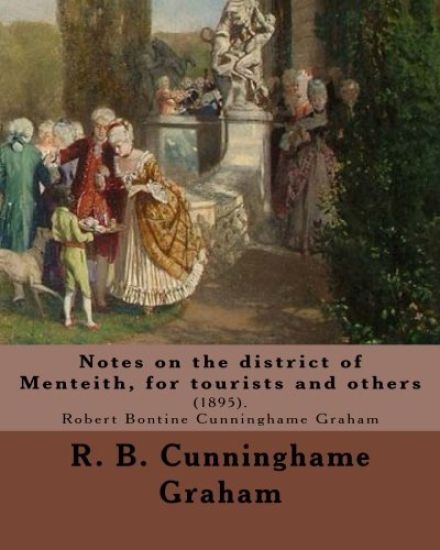
Notes on the district of Menteith, for tourists and others: (1895). By: R. B. Cunninghame Graham

Notes on the district of Menteith, for tourists and others: (1895). By: R. B. Cunninghame Graham

R. B. Cunninghame Graham

Createspace Independent Publishing Platform
2018
nidottu
Robert Bontine Cunninghame Graham (24 May 1852 - 20 March 1936) was a Scottish politician, writer, journalist and adventurer. He was a Liberal Party Member of Parliament (MP); the first ever socialist member of the Parliament of the United Kingdom; a founder, and the first president, of the Scottish Labour Party; a founder of the National Party of Scotland in 1928; and the first president of the Scottish National Party in 1934. Youth: Cunninghame Graham was the eldest son of Major William Bontine of the Renfrew Militia and formerly a Cornet in the Scots Greys with whom he served in Ireland. His mother was Hon. Anne Elizabeth Elphinstone-Fleeming, daughter of Admiral Charles Elphinstone-Fleeming of Cumbernauld and a Spanish noblewoman Do a Catalina Paulina Alessandro de Jim nez, (who, reputedly, along with her second husband Admiral James Katon), heavily influenced Cunninghame Graham's upbringing. Thus the first language Cunninghame Graham learned was his mother's maternal tongue, Spanish. He spent most of his childhood on the family estate of Finlaystone in Renfrewshire and Ardoch in Dunbartonshire, Scotland, with his younger brothers Charles and Malise. After being educated at Harrow public school in England, Robert finished his education in Brussels, Belgium before moving to Argentina to make his fortune cattle ranching. He became known as a great adventurer and gaucho there, and was affectionately known as Don Roberto. He also travelled in Morocco disguised as a Turkish sheikh, prospected for gold in Spain, befriended Buffalo Bill in Texas, and taught fencing in Mexico City, having travelled there by wagon train from San Antonio de Bexar with his young bride sic "Gabrielle Chideock de la Balmondiere" a supposed half-French, half-Chilean poet..... Author Between 1888 and 1992, Graham was a prolific contributor to small-circulation socialist journals, but his literary career took off when he was recruited by Frank Harris to write for The Saturday Review in 1895, and he continued writing for 'The Saturday' until 1926, as well as other journals. His main form was the 'sketch', or sketch-tale', mostly descriptive, atmospheric works on South America and Scotland, which gave his work a unique aesthetic, which carried a subtext of anti-colonialism, nostalgia, and loss. T. E. Lawrence (of Arabia) decribed his Scottish sketches as "the rain-in-the-air-and-on-the-roof mournfulness of Scotch music in his time-past style . . .] snap-shots - the best verbal snapshots ever taken I believe." His many works were collected into anthologies. Subject matter included history, biography, poetry, essays, politics, travel and seventeen collections of short stories or literary sketches. Titles include Father Archangel of Scotland (1896 in conjunction with his wife Gabriella), Thirteen Stories (1900), Success (1902), Scottish Stories (1914) Brought Forward (1916), Hope (1917) and Mirages (1936). Biographies included: Hernando de Soto (1903), Doughty Deeds (1925), a biography of his great-great-grandfather, Robert Graham of Gartmore and Portrait of a Dictator (1933). His great-niece and biographer, Jean, Lady Polwarth, 7] published a collection of his short stories (or sketches) entitled Beattock for Moffatt and the Best of Cunninghame Graham (1979) and Alexander Maitland added his selection under the title Tales of Horsemen (1981). Professor John Walker published collections of Cunninghame Graham's South American Sketches (1978), Scottish Sketches (1982) and North American Sketches (1986) and Kennedy & Boyd are republishing the stories and sketches in five volumes. In 1988 The Century Travellers reprinted his Mogreb-el-Acksa (1898) and A Vanished Arcadia (1901). The former was the inspiration for George Bernard Shaw's play Captain Brassbound's Conversion. The latter helped inspire the award-winning film The Mission. More recently The Long Riders Guild Press have reprinted his equestrian travel works in their Cunninghame Graham Collecti
Thirteen stories. By: R. B. Cunninghame Graham: Cruz Alta.--In a Germany tramp.--The gold fish.--A hegira.--Sidi bu Zibbala.--La pulperia.--
Robert Bontine Cunninghame Graham (24 May 1852 - 20 March 1936) was a Scottish politician, writer, journalist and adventurer. He was a Liberal Party Member of Parliament (MP); the first ever socialist member of the Parliament of the United Kingdom; a founder, and the first president, of the Scottish Labour Party; a founder of the National Party of Scotland in 1928; and the first president of the Scottish National Party in 1934. Youth: Cunninghame Graham was the eldest son of Major William Bontine of the Renfrew Militia and formerly a Cornet in the Scots Greys with whom he served in Ireland. His mother was Hon. Anne Elizabeth Elphinstone-Fleeming, daughter of Admiral Charles Elphinstone-Fleeming of Cumbernauld and a Spanish noblewoman Do a Catalina Paulina Alessandro de Jim nez, (who, reputedly, along with her second husband Admiral James Katon), heavily influenced Cunninghame Graham's upbringing. Thus the first language Cunninghame Graham learned was his mother's maternal tongue, Spanish. He spent most of his childhood on the family estate of Finlaystone in Renfrewshire and Ardoch in Dunbartonshire, Scotland, with his younger brothers Charles and Malise. After being educated at Harrow public school in England, Robert finished his education in Brussels, Belgium before moving to Argentina to make his fortune cattle ranching. He became known as a great adventurer and gaucho there, and was affectionately known as Don Roberto. He also travelled in Morocco disguised as a Turkish sheikh, prospected for gold in Spain, befriended Buffalo Bill in Texas, and taught fencing in Mexico City, having travelled there by wagon train from San Antonio de Bexar with his young bride sic "Gabrielle Chideock de la Balmondiere" a supposed half-French, half-Chilean poet.....
W. S. Graham and Lyric Self-Consciousness

W. S. Graham and Lyric Self-Consciousness

Sam Buchan-Watts

Springer International Publishing AG
2025
sidottu
This book examines the lyric poetry of the late modernist W. S. Graham. By listening closely to his body of work, it exposes the capacity of a poem to describe itself being made in the mind of a reader. The study locates an idea of lyric self-consciousness not only at the level of ego, but as a process of form. Archival material – including worksheets, manuscripts and notebooks – is used to examine Graham's spatial conception of verse in the context of his industrial background and his dialogue with artists. The book offers close readings of the adjacent poetics of William Empson and Veronica Forrest-Thomson, and concludes with a sustained analysis of Denise Riley's long-term engagement with Graham’s poetry, which suggests how Graham’s lyric experiments can be politicised.
Letters from a Self-Made Merchant to His Son;Being the Letters written by John Graham, Head of the House of Graham & Company, Pork-Packers in Chicago, familiarly known on 'Change as "Old Gorgon Graham," to his Son, Pierrepont, facetiously known to his inti
Letters from a Self-Made Merchant to His Son;Being the Letters written by John Graham, Head of the House of Graham & Company, Pork-Packers in Chicago, familiarly known on 'Change as Old Gorgon Graham," to his Son, Pierrepont, facetiously known to his intimates as "Piggy."" has been regarded as significant work throughout human history, and in order to ensure that this work is never lost, we have taken steps to ensure its preservation by republishing this book in a contemporary format for both current and future generations. This entire book has been retyped, redesigned, and reformatted. Since these books are not made from scanned copies, the text is readable and clear.
Der Roman Noir Und Die Populaere Unterwelt Moderner Literatur: Dashiell Hammett, William Faulkner Und Graham Greene
Der hartgesottene Detektiv, die Femme fatale, der Gangster - Figuren, die uns aus Hollywoods Schwarzer Serie bestens bekannt sind. Seit den fruhen zwanziger Jahren bevoelkerten sie jedoch bereits die Seiten amerikanischer Pulp-Magazine und fanden ihren Weg in das aus diesen Heften hervorgegangene Genre des Roman Noir. Dabei entwickelte sich die literarische Gattung mit ihren Protagonisten und Plots, aber auch mit ihrer Stilistik uberraschenderweise in gegenseitiger Beeinflussung mit einer oft als anspruchsvoller empfundenen "Hochliteratur". Das Ziel dieser Untersuchung ist eine Analyse der Schnittstelle eines oft elitaren erzahlerischen Modernismus und der zum Teil sensationalistischen Massenware der zwanziger und dreissiger Jahre. In diesem Zeitalter eines ausgesprochen filmischen Erzahlens auf Papier und Leinwand koennen zudem andere mediale Kontexte wie heute vergessene Filmzyklen vor der Etablierung des Motion Picture Production Code nicht als Bezugspunkte ausgeblendet werden. Unter dieser Fragestellung erscheint Dashiell Hammett nicht mehr als zufallig schreibender Pinkerton-Detektiv, sondern als bewusster Kunstler. William Faulkner, der grosse Experimentator und Erneuerer der amerikanischen Literatur, liess sich offenbar starker als bisher angenommen von popularen Genres inspirieren, und Graham Greenes Brighton Rock kann man mit Gewinn als eine britische und noch dazu anglo-katholische Antwort auf die amerikanischen Pionierleistungen des Genres lesen. Dabei zeigen sich in den Texten gewisse Ressentiments, die von dem ungewissen kulturellen Status des Roman Noir in der Literaturkritik zeugen.