Five Children and It is a children's novel by English author E. Nesbit. Plot: Like Nesbit's The Railway Children, the story begins when a group of children move from London to the countryside of Kent. The five children - Cyril, Anthea, Robert, Jane, and their baby brother, known as the Lamb - are playing in a gravel pit when they uncover a rather grumpy, ugly, and occasionally malevolent Psammead or sand-fairy, who has the ability to grant wishes. He persuades the children to take one wish each day to be shared among them, with the caveat that the wishes will turn to stone at sunset. This, apparently, used to be the rule in the Stone Age, when all that children wished for was food, the bones of which then became fossils. The five children's first wish is to be "as beautiful as the day". The wish ends at sunset and its effects simply vanish, leading the Psammead to observe that some wishes are too fanciful to be changed to stone. All the wishes go comically wrong. The children wish to be beautiful, but the servants do not recognise them and shut them out of the house. They wish to be rich, then find themselves with a gravel-pit full of gold spade guineas that no shop will accept as they are no longer in circulation, so they can't buy anything. A wish for wings seems to be going well, but at sunset the children find themselves stuck on top of a church bell tower with no way down, getting them into trouble with the gamekeeper who must take them home (though this wish has the happy side-effect of introducing the gamekeeper to the children's housemaid, who later marries him). Robert is bullied by the baker's boy, then wishes that he was bigger - whereupon he becomes eleven feet tall, and the other children show him at a travelling fair for coins. They also wish themselves into a castle, only to learn that it is being besieged, while a wish to meet real Red Indians ends with the children nearly being scalped.............. Edith Nesbit (married name Edith Bland; 15 August 1858 - 4 May 1924) was an English author and poet; she published her books for children under the name of E. Nesbit. She wrote or collaborated on more than 60 books of children's literature. She was also a political activist and co-founded the Fabian Society, a socialist organisation later affiliated to the Labour Party. Nesbit was born in 1858 at 38 Lower Kennington Lane in Kennington, Surrey (now part of Greater London), the daughter of an agricultural chemist, John Collis Nesbit, who died in March 1862, before her fourth birthday. Her sister Mary's ill health meant that the family travelled around for some years, living variously in Brighton, Buckinghamshire, France (Dieppe, Rouen, Paris, Tours, Poitiers, Angoul me, Bordeaux, Arcachon, Pau, Bagn res-de-Bigorre, and Dinan in Brittany), Spain and Germany, before settling for three years at Halstead Hall in Halstead in north-west Kent, a location which later inspired The Railway Children (this distinction has also been claimed by the Derbyshire town of New Mills). At eighteen, Nesbit met the bank clerk Hubert Bland in 1877. Seven months pregnant, she married Bland on 22 April 1880, though she did not immediately live with him, as Bland initially continued to live with his mother. Their marriage was a stormy one. Early on Nesbit discovered that another woman believed she was Hubert's fiancee and had also borne him a child.... Harold Robert Millar (1869 - 1942) was a prominent and prolific Scottish graphic artist and illustrator of the late nineteenth and early twentieth centuries.
Edith Nesbit (married name Edith Bland; 15 August 1858 - 4 May 1924) was an English author and poet; she published her books for children under the name of E. Nesbit. She wrote or collaborated on more than 60 books of children's literature. She was also a political activist and co-founded the Fabian Society, a socialist organisation later affiliated to the Labour Party. Nesbit was born in 1858 at 38 Lower Kennington Lane in Kennington, Surrey (now part of Greater London), the daughter of an agricultural chemist, John Collis Nesbit, who died in March 1862, before her fourth birthday. Her sister Mary's ill health meant that the family travelled around for some years, living variously in Brighton, Buckinghamshire, France (Dieppe, Rouen, Paris, Tours, Poitiers, Angoul me, Bordeaux, Arcachon, Pau, Bagn res-de-Bigorre, and Dinan in Brittany), Spain and Germany, before settling for three years at Halstead Hall in Halstead in north-west Kent, a location which later inspired The Railway Children (this distinction has also been claimed by the Derbyshire town of New Mills). At eighteen, Nesbit met the bank clerk Hubert Bland in 1877. Seven months pregnant, she married Bland on 22 April 1880, though she did not immediately live with him, as Bland initially continued to live with his mother. Their marriage was a stormy one. Early on Nesbit discovered that another woman believed she was Hubert's fiancee and had also borne him a child. A more serious blow came later when she discovered that her good friend, Alice Hoatson, was pregnant with Hubert's child. She had previously agreed to adopt Hoatson's child and allow Hoatson to live with her as their housekeeper. After she discovered the truth, they quarrelled violently and she suggested that Hoatson and the baby should leave; her husband threatened to leave Edith if she disowned the baby and its mother. Hoatson remained with them as a housekeeper and secretary and became pregnant by Bland again 13 years later. Edith again adopted Hoatson's child. Nesbit's children were Paul Bland (1880-1940), to whom The Railway Children was dedicated; Iris Bland (1881-1950s); Fabian Bland (1885-1900); Rosamund Bland (1886-1950), to whom The Book of Dragons was dedicated; and John Bland (1898-1971) to whom The House of Arden was dedicated. Her son Fabian died aged 15 after a tonsil operation; Nesbit dedicated a number of books to him: Five Children and It and its sequels, as well as The Story of the Treasure Seekers and its sequels. Nesbit's adopted daughter Rosamund collaborated with her on the book Cat Tales.... Harold Robert Millar (1869 - 1942) was a prominent and prolific Scottish graphic artist and illustrator of the late nineteenth and early twentieth centuries. He is best known for his illustrations of children's books and fantasy literature. 1] "His work...has a lively, imaginative charm and a distinctive sense of design." 2] A native of Dumfriesshire, Millar first pursued civil engineering before deciding upon an artistic career. He then studied at the Wolverhampton Art School and the Birmingham School of Art, and established his career as a magazine illustrator with Punch, Good Words, and other periodicals of the day. Millar illustrated fables for the Strand Magazine, and anthologies of tales, The Golden Fairy Book, The Silver Fairy Book, The Diamond Fairy Book, and The Ruby Fairy Book. He illustrated books by a wide range of British authors of his time, including Sir Arthur Quiller-Couch, Robert Louis Stevenson, and Rudyard Kipling. He had an extensive working relationship with E. Nesbit, and has been called "the most sympathetic and perhaps the most talented of her illustrators."....
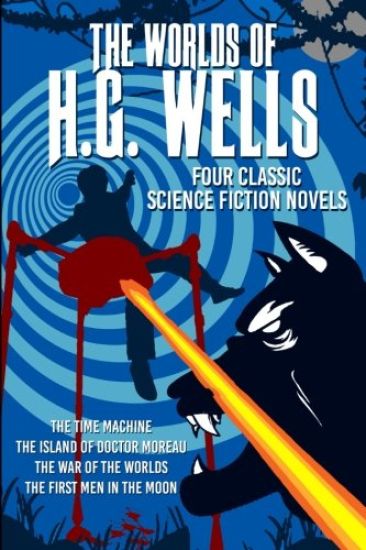
English novelist, historian and science writer Herbert George Wells (1866-1946) abandoned teaching and launched his literary career with a series of highly successful science-fiction novels. The Time Machine was the first of a number of these imaginative literary inventions. First published in 1895, the novel follows the adventures of a hypothetical Time Traveller who journeys into the future to find that humanity has evolved into two races: the peaceful Eloi - vegetarians who tire easily - and the carnivorous, predatory Morlocks.After narrowly escaping from the Morlocks, the Time Traveller undertakes another journey even further into the future where he finds the earth growing bitterly cold as the heat and energy of the sun wane. Horrified, he returns to the present, but soon departs again on his final journey.While the novel is underpinned with both Darwinian and Marxist theory and offers fascinating food for thought about the world of the future, it also succeeds as an exciting blend of adventure and pseudo-scientific romance. Sure to delight lovers of the fantastic and bizarre, The Time Machine is a book that belongs on the shelf of every science-fiction fan.
The Enchanted Castle is a children's fantasy novel by Edith Nesbit first published in 1907. PLOT: The enchanted castle of the title is a country estate in the West Country seen through the eyes of three children, Gerald, James and Kathleen, who discover it while exploring during the school holidays. The lake, groves and marble statues, with white towers and turrets in the distance, make a fairy-tale setting, and then in the middle of the maze in the rose garden they find a sleeping fairy-tale princess. The "princess" tells them that the castle is full of magic, and they almost believe her. She shows them the treasures of the castle, including a magic ring she says is a ring of invisibility, but when it actually turns her invisible she panics and admits that she is the housekeeper's niece, Mabel, and was just play-acting. The children soon discover that the ring has other magical powers. 1] The Enchanted Castle was written for both children and adults. It combines descriptions of the imaginative play of children, reminiscent of The Story of the Treasure Seekers, with a magic more muted than in her major fantasies such as The Story of the Amulet. Edith Nesbit (married name Edith Bland; 15 August 1858 - 4 May 1924) was an English author and poet; she published her books for children under the name of E. Nesbit. She wrote or collaborated on more than 60 books of children's literature. She was also a political activist and co-founded the Fabian Society, a socialist organisation later affiliated to the Labour Party. Nesbit was born in 1858 at 38 Lower Kennington Lane in Kennington, Surrey (now part of Greater London), the daughter of an agricultural chemist, John Collis Nesbit, who died in March 1862, before her fourth birthday. Her sister Mary's ill health meant that the family travelled around for some years, living variously in Brighton, Buckinghamshire, France (Dieppe, Rouen, Paris, Tours, Poitiers, Angoul me, Bordeaux, Arcachon, Pau, Bagn res-de-Bigorre, and Dinan in Brittany), Spain and Germany, before settling for three years at Halstead Hall in Halstead in north-west Kent, a location which later inspired The Railway Children (this distinction has also been claimed by the Derbyshire town of New Mills). At eighteen, Nesbit met the bank clerk Hubert Bland in 1877. Seven months pregnant, she married Bland on 22 April 1880, though she did not immediately live with him, as Bland initially continued to live with his mother. Their marriage was a stormy one. Early on Nesbit discovered that another woman believed she was Hubert's fiancee and had also borne him a child. A more serious blow came later when she discovered that her good friend, Alice Hoatson, was pregnant with Hubert's child. She had previously agreed to adopt Hoatson's child and allow Hoatson to live with her as their housekeeper. After she discovered the truth, they quarrelled violently and she suggested that Hoatson and the baby should leave; her husband threatened to leave Edith if she disowned the baby and its mother. Hoatson remained with them as a housekeeper and secretary and became pregnant by Bland again 13 years later. Edith again adopted Hoatson's child. Nesbit's children were Paul Bland (1880-1940), to whom The Railway Children was dedicated; Iris Bland (1881-1950s); Fabian Bland (1885-1900); Rosamund Bland (1886-1950), to whom The Book of Dragons was dedicated; and John Bland (1898-1971) to whom The House of Arden was dedicated. Her son Fabian died aged 15 after a tonsil operation; Nesbit dedicated a number of books to him: Five Children and It and its sequels, as well as The Story of the Treasure Seekers and its sequels. Nesbit's adopted daughter Rosamund collaborated with her on the book Cat Tales.... Harold Robert Millar (1869 - 1942) was a prominent and prolific Scottish graphic artist and illustrator of the late nineteenth and early twentieth centuries. He is best known for his illustrations of children's books and fantasy literature.
Do you believe in magic? Caroline, Charles and Charlotte do, and nothing that happens during their summer holiday at their great uncle's house does anything to diminish that belief. There the Three C.'s find a wonderful garden and some very old books, resulting in escapades which do not necessarily please the grown-ups. Edith Nesbit (married name Edith Bland; 15 August 1858 - 4 May 1924) was an English author and poet; she published her books for children under the name of E. Nesbit. She wrote or collaborated on more than 60 books of children's literature. She was also a political activist and co-founded the Fabian Society, a socialist organisation later affiliated to the Labour Party. Nesbit was born in 1858 at 38 Lower Kennington Lane in Kennington, Surrey (now part of Greater London), the daughter of an agricultural chemist, John Collis Nesbit, who died in March 1862, before her fourth birthday. Her sister Mary's ill health meant that the family travelled around for some years, living variously in Brighton, Buckinghamshire, France (Dieppe, Rouen, Paris, Tours, Poitiers, Angoul me, Bordeaux, Arcachon, Pau, Bagn res-de-Bigorre, and Dinan in Brittany), Spain and Germany, before settling for three years at Halstead Hall in Halstead in north-west Kent, a location which later inspired The Railway Children (this distinction has also been claimed by the Derbyshire town of New Mills). At eighteen, Nesbit met the bank clerk Hubert Bland in 1877. Seven months pregnant, she married Bland on 22 April 1880, though she did not immediately live with him, as Bland initially continued to live with his mother. Their marriage was a stormy one. Early on Nesbit discovered that another woman believed she was Hubert's fiancee and had also borne him a child. A more serious blow came later when she discovered that her good friend, Alice Hoatson, was pregnant with Hubert's child. She had previously agreed to adopt Hoatson's child and allow Hoatson to live with her as their housekeeper. After she discovered the truth, they quarrelled violently and she suggested that Hoatson and the baby should leave; her husband threatened to leave Edith if she disowned the baby and its mother. Hoatson remained with them as a housekeeper and secretary and became pregnant by Bland again 13 years later. Edith again adopted Hoatson's child. Nesbit's children were Paul Bland (1880-1940), to whom The Railway Children was dedicated; Iris Bland (1881-1950s); Fabian Bland (1885-1900); Rosamund Bland (1886-1950), to whom The Book of Dragons was dedicated; and John Bland (1898-1971) to whom The House of Arden was dedicated. Her son Fabian died aged 15 after a tonsil operation; Nesbit dedicated a number of books to him: Five Children and It and its sequels, as well as The Story of the Treasure Seekers and its sequels. Nesbit's adopted daughter Rosamund collaborated with her on the book Cat Tales....
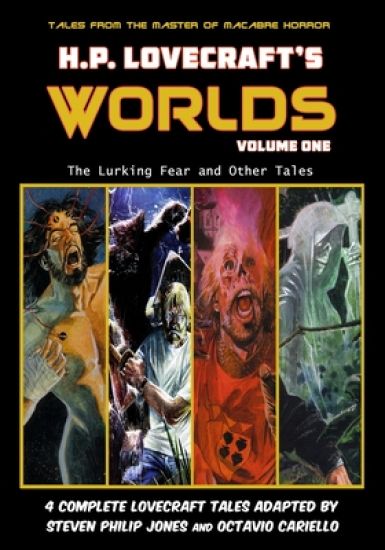
A collection of five Lovecraft tales adapted by award winning comic writer Steven Philip Jones. Lovecraft is considered one of America's most innovative and popular American horror writers. The master of the weird tale during the first decades of the 20th Century until his premature death in 1937, Lovecraft's distinctive style and canon of work has influenced many authors. Jones takes the classic tales and while remaining true to the source, brings them into the modern age which can sometimes make the horror even more terrifying. These tales are illustrated by comic artists Sergio Cariello (MARVEL's Deadpool, Captain America), Christopher Jones (DC's Young Justice, Teen Titans Go ), Aldin Baroza (Family Guy, One Fisted Tales), Rob Davis (Star Trek, Quantum Leap), and Wayne Reid (El Cid, Storyville). The five illustrated stories within this Volume are "Dagon"; the U.S.S. Augustus is a nuclear submarine, its crew is unaccustomed to picking up castaways, especially on uncharted islands in the middle of the Atlantic. But that is where the Augustus finds Emma Loveless, sole survivor of a private jet crash. "Arthur Jermyn"; the Jermyns have lived in their Gothic estate in Cambridgeshire for centuries. Explorers and adventurers, they are a wild and violent bunch with a cursed, black history of sudden murder and blood. Until the birth of Arthur Jermyn. "Picture in the House"; Lorraine Claude is fascinated with the morbid and weird, but Lorraine does not count on a sudden thunderstorm driving her into the farmhouse of a very friendly and very old cannibal. "The Statement of Randolph Carter"; Harley Warren is an expert on violent criminals and assists the FBI in their profiling and pursuit of criminals. When Warren reads a book about a location that can reveal the darkest and oldest mysteries of the stygian unknown, Warren wastes no time packing up his reluctant chronicler and assistant, Randolph Carter, to explore the site. "Music of Erich Zann"; each night when American astronomer Max Finn comes home, an old man plays haunting melodies on his violins. Melodies that plague Finn's dreams at night and give him nightmares about a cosmic land ruled by Nyarlathotep, also known as The Crawling Chaos, the messenger of the elder gods.
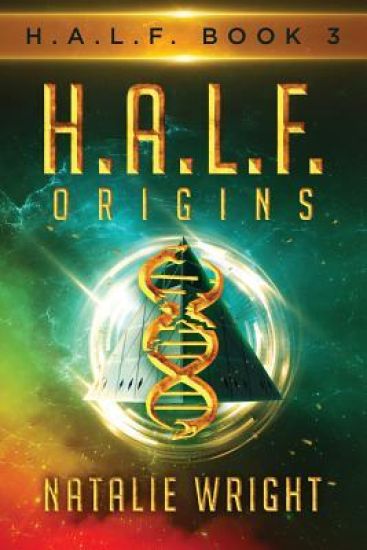
Will Tex destroy the galactic portal and end the alien attack before it's too late?Alien predators attack Europe. A deadly virus spawns an epidemic. And a clandestine organization conspires to profit from chaos and forge a New World Order.In this heart-pounding finale of the H.A.L.F. series, Tex, Erika and the rest are in a race against time. In books one and two, they fought for their lives. Now they battle to save us all.Tex and Erika are again fugitives, on the run for their lives. But when Tex falls gravely ill, a Navajo healer is Tex's only hope for survival. He emerges from the ordeal changed in body and mind and with vital information: how to stop the predatory M'Uktah from destroying those he has come to love.Erika Holt seeks a respite from the constant threats to her life but she's not about to give up. As she and Tex launch a mission to shut down the galactic highway used by invaders, she grows closer to her troubled half-alien companion. But what about her on-again, off-again boyfriend, Jack?Jack Wilson, with his new friend Anna Sturgis, is determined to put an end to the Makers' schemes for world domination. Complicating matters, the valuable medicine to counter the alien virus has been stolen.As both alien and human forces line up against them, the destiny of all humankind is hand the hands of these young warriors. And time is running out.About the Series: H.A.L.F.: The Deep Beneath (Book1): *Silver Medal, Wishing Shelf Int'l Book Awards *Runner Up, Beach Book Festival Awards *Semi-Finalist, Kindle Book Review Awards *Library Journal Pick for Curated eBook CollectionH.A.L.F.: The Makers (Book 2)H.A.L.F.: ORIGINS (Book 3)What Others Are Saying About the H.A.L.F. Series: H.A.L.F: The Deep Beneath (Book 1)"Extremely exciting and fast-paced story that sucked me in its sci-fi vortex and wouldn't let me go. H. A. L. F. 9 is probably my favorite alien hybrid of all time. Can't wait for the next book " Ms. I Read to EscapeH.A.L.F.: The Makers (Book 2): "Conflicts with alien races are given enormous depth in this engrossingly written science fiction novel. H.A.L.F.: The Makers is a compelling addition to a science fiction series sure to appeal to young adults, and its exciting progression will keep readers wanting more."(5 Stars) Clarion Forewords ReviewsH.A.L.F.: Origins (Book 3): "The latest satisfying addition to the H.A.L.F. series has something for everyone: exciting action scenes; great, complex love stories; fascinating new aliens; and relatable teen characters fighting to save the world and find their places in it." Alyssa H., Content Editor, Red Adept Editing
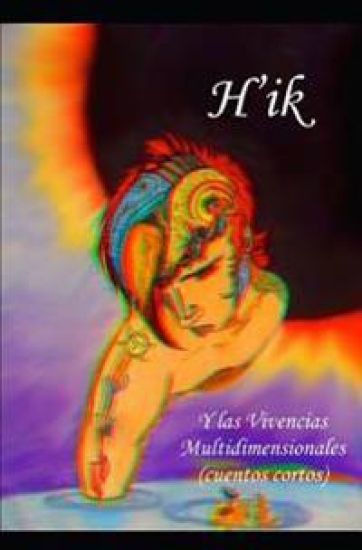
La energ a no desvanece, m s muchas veces se enfr a y se divide en miles de mol culas, quedando suspendida flotando en el inmenso y pausado universo. llevando tu aura a vivir m s de una vez en diferentes cuerpos en diferentes planetas y tiempos defferentes.
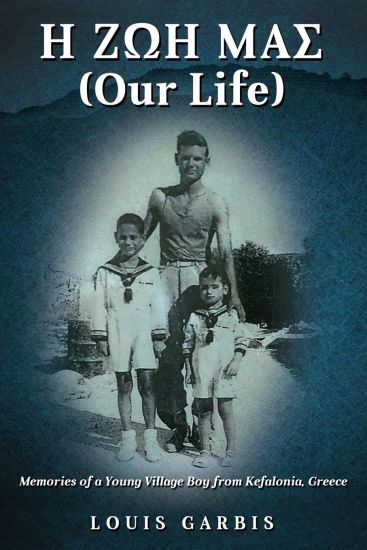
Η ΖΩΗ ΜΑΣ (our life) is a homage and a spiritual journey to our origins, our place of birth. I wanted to learn about our family's life in Kefalonia and its trials and tribulations in some very challenging times. Its occupation by the Axis Powers in WWII, the subsequent Greek Civil War, and the devasting earthquake that caused great damage to much of Kefalonia, aggravating the severe poverty that most Kefalonians were already experiencing. I also thought it would be a lost opportunity for us not to share our family's story with our descendants and the subsequent emigration to America.In addition to the family history, "Our Life" compares democracy versus communism, the American and Greek Civil Wars and their impact on each country, the fundamental issue of slavery and why it was so vile, criminal, and wrong, and the plight and betrayal of the American Indians as a result of the migration of the white men to the Americas.My book also outlines the seminal impact of the initial Greek victories over Italy in WWII and their significant ramifications to the world, and explains how a young Evzone's sacrifice reinforces and represents the strong and unconditional love of freedom of the Greek people.This book was hard for me to write as some of the discussions of our past were difficult and heart-wrenching, but our story had to be told for the benefit of our descendants. I hope you will feel these same emotions as you read Our Life and that my book will empower and motivate you and your descendants to be the best you can be.Bottom line, I want our Greek descendants not to forget us, and most important, never forget who they are and where we came from
Η ΖΩΗ ΜΑΣ (our life) is a homage and a spiritual journey to our origins, our place of birth. I wanted to learn about our family's life in Kefalonia and its trials and tribulations in some very challenging times. Its occupation by the Axis Powers in WWII, the subsequent Greek Civil War, and the devasting earthquake that caused great damage to much of Kefalonia, aggravating the severe poverty that most Kefalonians were already experiencing. I also thought it would be a lost opportunity for us not to share our family's story with our descendants and the subsequent emigration to America.In addition to the family history, "Our Life" compares democracy versus communism, the American and Greek Civil Wars and their impact on each country, the fundamental issue of slavery and why it was so vile, criminal, and wrong, and the plight and betrayal of the American Indians as a result of the migration of the white men to the Americas.My book also outlines the seminal impact of the initial Greek victories over Italy in WWII and their significant ramifications to the world, and explains how a young Evzone's sacrifice reinforces and represents the strong and unconditional love of freedom of the Greek people.This book was hard for me to write as some of the discussions of our past were difficult and heart-wrenching, but our story had to be told for the benefit of our descendants. I hope you will feel these same emotions as you read Our Life and that my book will empower and motivate you and your descendants to be the best you can be.Bottom line, I want our Greek descendants not to forget us, and most important, never forget who they are and where we came from
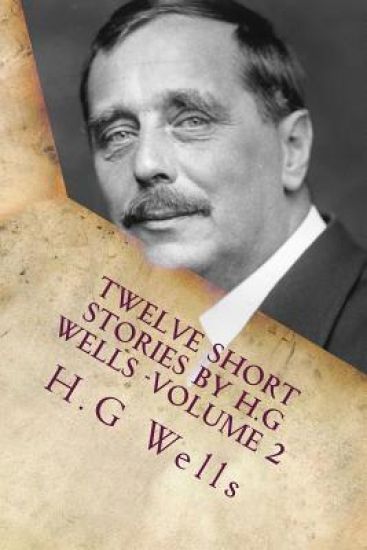
This edition of twelve selected stories features these wonderful tales by H.G Wells: A Slip Under the Microscope pyornis Island Filmer In the Avu Observatory Miss Winchelsea's Heart Mr. Bisher's Treasure Mr. Ledbetter's Vacation Mr. Skelmersdale in Fairyland The Beautiful Suit The Chronic Argonauts The Cone The Country of the Blind