Kirjojen hintavertailu. Mukana 11 244 527 kirjaa ja 12 kauppaa.

Kirjahaku

Etsi kirjoja tekijän nimen, kirjan nimen tai ISBN:n perusteella.

1000 tulosta hakusanalla Howard Fast

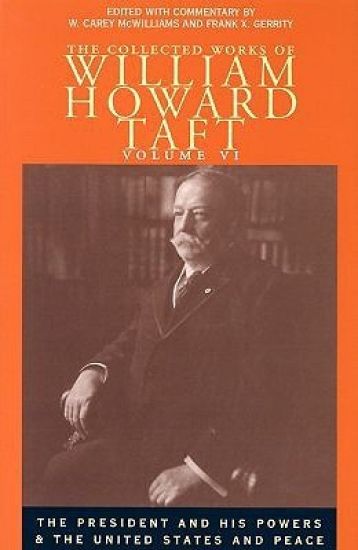
The Collected Works of William Howard Taft, Volume VI
Volume VI of The Collected Works of William Howard Taft follows the career of William Howard Taft upon his leaving the White House. It consists of two short publications from 1914 and 1915. The first, The President and His Powers, is based on a series of lectures delivered at Columbia University and draws on Taft's experience in the presidency and the executive branch. It speaks particularly to the nature of executive power and its place in the American system and is rooted in his disagreement with Theodore Roosevelt regarding presidential power. Taft believed all presidential power must be traced to some specific grant of power or be necessary to its exercise, while Roosevelt saw the presidency as a position of "steward of the people" limited only by some express provision of the Constitution. The second, The United States and Peace, reflects Taft's interest in foreign policy, which was intensified by his years as governor of the Philippines and as secretary of war, as well as by his presidency. Originally four lectures delivered in 1914, The United States and Peace discusses the Monroe Doctrine, the threat to peace presented by incidents of violence to foreigners in the United States, the maintenance of peace through international arbitration, and the trend toward federation in international affairs. Taft hoped to see the latter result in the establishment of an independent judiciary to resolve international disputes. Taft's reasoned arguments, supplemented by the commentaries of Professors McWilliams and Gerrity, will stimulate interest among historians, lawmakers, political activists, and the general public.
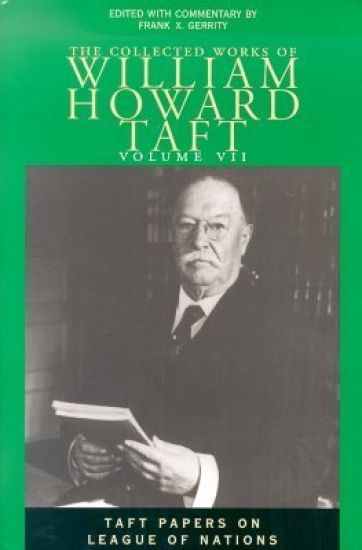
The Collected Works of William Howard Taft, Volume VII
Eager to turn the congressional election of 1918 into a confirmation of his foreign policy, President Woodrow Wilson was criticized for abandoning the spirit of the popular slogan "Politics adjourned!" His predecessor, William Howard Taft, found Wilson difficult to deal with and took issue with his version of the League of Nations, which Taft felt was inferior to the model proposed by the League to Enforce Peace. Rather than join the massive Republican opposition to the Treaty of Versailles, however, Taft instead supported Wilson's controversial decision to travel to Paris as the head of the American peace delegation, and he defended the critical tenth article in the covenant, which detractors saw as a surrender of American sovereignty. He also counseled Wilson to insert a clause concerning the Monroe Doctrine that would pacify the Senate's group of "reservationists," whose votes were essential to approval of the treaty. Volume VII in The Collected Works of William Howard Taft consists of the Taft Papers on League of Nations originally published in 1920. This is a collection ofTaft's speeches, newspaper articles, and complementary documents that reflect his consistent support for a league of nations and, eventually, for the Covenant of the League of Nations emanating from the Paris Peace Conference. Although the failure of the treaty and its League of Nations can probably be laid at the feet of an obstinate Wilson and a wily Henry Cabot Lodge, William Howard Taft can be credited with rising above partisanship to emerge as the League's most consistent supporter. As in the rest of the Collected Works, Taft Papers on League of Nations provides a window on the machinations surrounding some of the most significant decisions of the era.
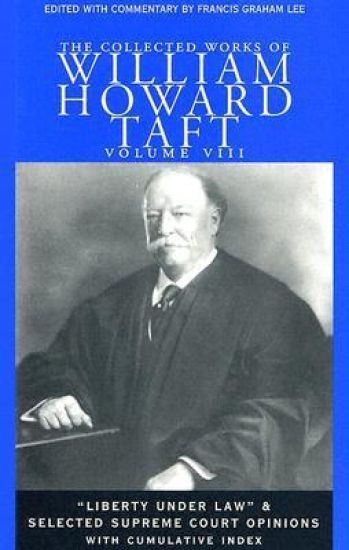
The Collected Works of William Howard Taft, Volume VIII
William Howard Taft's presidency (1909-1913), succeeding Theodore Roosevelt's, was mired in bitter partisan fighting, and Taft sometimes blundered politically. However, this son of Cincinnati assumed his true calling when President Warren G. Harding appointed him to the U.S. Supreme Court in 1921. Taft remains the only person to have served both as president of the United States and as chief justice of the Supreme Court. The Collected Works of William Howard Taft, Volume VIII, consists of "Liberty under Law" and selected Supreme Court opinions, among the most instructive accomplishments of Taft's ten years at the helm of the court. The writings reveal the sober judgments of a federalist who viewed state regulation with suspicion, championed national government, and saw an independent and powerful judiciary as the bulwark protecting the "vested rights" that the framers of the U.S. Constitution sought to guarantee. Whatever his failings as a politician, Taft was an intellectual powerhouse who knew how to use the law as a lever to encourage society to move toward more stable and productive ends. Although Taft is considered an average president at best, historians and political scientists rank him among fifteen "near greats" who have served on the high court. His ability and his love for the law shine through in Volume VIII, the concluding volume of The Collected Works of William Howard Taft. As Taft reportedly said to President Harding upon his appointment as chief justice, "I love judges and I love courts. They are my ideals on earth of what we shall meet afterward in heaven under a just God."
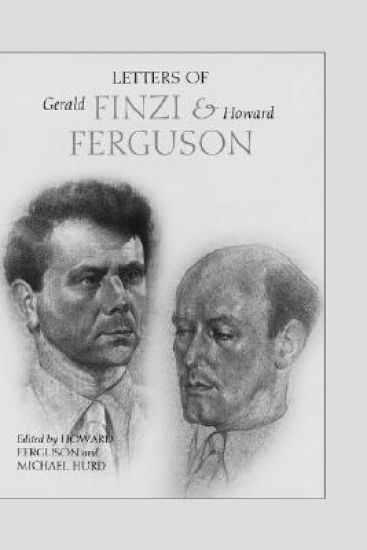
Letters of Gerald Finzi and Howard Ferguson
Biographical insights into two outstanding musical personalities and commentary on the vitality of the British musical scene of the period. The letters that passed, on an almost daily basis, between the composers Howard Ferguson and Gerald Finzi provide not only a fascinating commentary on the British musical scene of the period 1926-1956, but also what amounts to a unique dual-biography of two remarkable, though very different, personalities. Their lives, their loves, their enthusiasms and their prejudices are laid bare with a rare degree of candour, so that we learn not only what it was liketo be witness to an art that was enjoying an unprecedented explosion of creative vitality, but also how they came to explore and consolidate their own exceptional talents. Biographical background narratives provide links that make clear what intimate correspondents inevitably take for granted, and explanations are given for references that the passage of time has made obscure. Their lives are thus revealed in all their diversity - tragedy and comedy, achievement and frustration, justifiable pride and unreasoning prejudice playing equal parts in this absorbing tale of two outstanding musical personalities of the twentieth century.
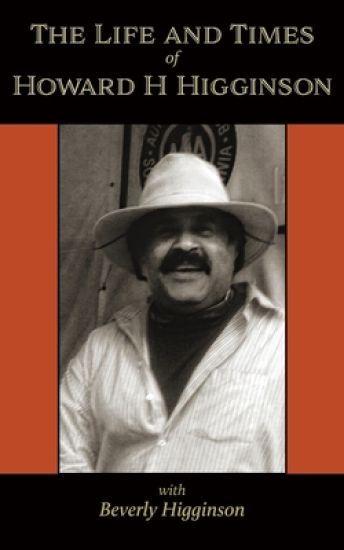
The Life and Times of Howard H Higginson

The Life and Times of Howard H Higginson

Beverly Higginson

Beverly Higginson
2019
nidottu
This is the story of one baby boomer, born of a Catholic day-worker mom and a dock worker dad, one of four kids growing up in the city of the Angels at a time when black people were still called Negroes; a boy who happened to be named after an eccentric white celebrity with a lot of money; a child who never acknowledged that the odds of becoming a success were against him, who had a belief in himself that was as strong a motivator as religious faith. His was a childhood in the early 50's and 60's that could almost be described as carefree, for it was a time when families stayed together, when neighbors knew each other, when kids played in the street without fear, and adventure in simple things was right around the corner. This is about a man whose goal was to leave a mark, a man who avoided the path of least resistance in search of his version of freedom. It took him from the streets of Los Angeles to Vietnam, to Beverly Hills, and back.Some biographies are about famous people. Others are stories just wanting to be told. This is one of those.
Another Hamlet: The Mystery of Leslie Howard
Leslie Howard may be today the least known of the best known actors / movie stars of his day (1930s-1940s). Part of that lost legacy may be because he died relatively young, but part of it may also involve his life outside of Broadway and Hollywood. Before the war Howard starred in such films as The Petrified Forest and Gone with the Wind), and on stage (Hamlet). Upon his return to England he shifted his attention to the war effort, making films that celebrated the English spirit and attacked the Nazis. In one instance he introduced the Oxfordian theory about the Shakespeare authorship question into several scenes in his popular Pimpernel Smith (the Oxfordian theory of the Shakespeare authorship is that the true author was Edward de Vere, 17th Earl of Oxford). Meanwhile, Howard was also serving as a spy for his government, a spy who wound up dying a very public and yet "mysterious" death in 1943 in the only instance of a Nazi shoot-down of a civilian airliner in the whole war. His life today remains shrouded in mystery, since some records of the shoot-down remain classified until 2025, and ---even more astonishingly--- records in Howard's personal estate will remain classified until 2056, following their reclassification in 1980 (See the Defense Media website for some background and details: defensemedianetwork.com). In this revised, second edition of Another Hamlet Charles Boyle explores this story of Leslie Howard's interest in the Earl of Oxford as Shakespeare, and how that may have played into both his role as an artist and propagandist in World War II, and, finally perhaps, as a factor in his fate at the hands of German fighter pilots in 1943. Since Goebbels had openly condemned Howard, why was he flying commercial when other prominent British celebrities flew protected on military transports? Why didn't Winston Churchill and Anthony Eden afford him more protection? In this current year (2017), with recent and older history of Britain seemingly everywhere (Dunkirk, The Darkest Hour, the Netflix series The Crown, plus PBS's Elizabeth's Secret Agents), Boyle's Another Hamlet is the perfect tale to bring these two ends of that history (16th and 20th century) together. In both Another Hamlet and a companion book on Shakespeare/Oxford's unveiling of Elizabethan "realpolitik," A Poet's Rage (which includes several other essays by Boyle, also available on amazon.com), the Oxfordian theory of the Shakespeare authorship makes clear how the politics of 400 years ago shaped both Shakespeare himself and Elizabethan England, and continues to matter centuries later. "In Another Hamlet Charles Boyle has produced a riveting political thriller that explores the life and tragic death of actor and film-maker, Leslie Howard, a British patriot drawn into a deadly propaganda duel with the Germans. Deftly interweaving the behind-the-scenes politics of World War II with the decadent showbiz world of the 1930s-1940s, Boyle makes the tantalizing suggestion that it was Howard's growing conviction that the Earl of Oxford wrote Shakespeare which sealed his doom. From Leslie Howard himself to Humphrey Bogart, Merle Oberon, Winston Churchill, Anthony Eden, and Joseph Goebbels, Boyle brings to life a fascinating and often chilling cast of characters to tell the story of a maverick artist's losing battle with the power-brokers of his age." -- Charles Beauclerk, author of Nell Gwynn and Shakespeare's Lost Kingdom. "Charles Boyle has opened a window on an amazing true story with immediate implications for our own time. His narrative essay on Leslie Howard and 'Shakespeare' is impossible to put down and I have no doubt that his screenplay, which follows, will become a stunning and important movie. I can't wait " -- Hank Whittemore, author of CNN: the Inside Story and Your Future Self.
Canadian Reciprocity Under the Administration of William Howard Taft
This work has been selected by scholars as being culturally important and is part of the knowledge base of civilization as we know it.This work is in the public domain in the United States of America, and possibly other nations. Within the United States, you may freely copy and distribute this work, as no entity (individual or corporate) has a copyright on the body of the work.Scholars believe, and we concur, that this work is important enough to be preserved, reproduced, and made generally available to the public. To ensure a quality reading experience, this work has been proofread and republished using a format that seamlessly blends the original graphical elements with text in an easy-to-read typeface.We appreciate your support of the preservation process, and thank you for being an important part of keeping this knowledge alive and relevant.
Smallwood and Allied Families of Howard County, Maryland; by Winifred & Norris Harris.
This work has been selected by scholars as being culturally important and is part of the knowledge base of civilization as we know it.This work is in the public domain in the United States of America, and possibly other nations. Within the United States, you may freely copy and distribute this work, as no entity (individual or corporate) has a copyright on the body of the work.Scholars believe, and we concur, that this work is important enough to be preserved, reproduced, and made generally available to the public. To ensure a quality reading experience, this work has been proofread and republished using a format that seamlessly blends the original graphical elements with text in an easy-to-read typeface.We appreciate your support of the preservation process, and thank you for being an important part of keeping this knowledge alive and relevant.
Life and Letters of John Howard Raymond

Life and Letters of John Howard Raymond

Harriet Raymond Lloyd

Hutson Street Press
2025
nidottu
Explore the life and legacy of John Howard Raymond in "Life and Letters of John Howard Raymond", penned by Harriet Raymond Lloyd. This biography delves into the personal and professional journey of Raymond, a prominent figure in 19th-century education and a key architect in the founding of Vassar College. Through carefully curated letters and insightful biographical narrative, the book offers a window into Raymond's thoughts, aspirations, and the challenges he faced in shaping the landscape of higher education for women. Discover the man behind the institution and his enduring contributions to American educational history. A must-read for anyone interested in the history of education, biographical studies, and the story of Vassar College. This work has been selected by scholars as being culturally important, and is part of the knowledge base of civilization as we know it. This work was reproduced from the original artifact, and remains as true to the original work as possible. Therefore, you will see the original copyright references, library stamps (as most of these works have been housed in our most important libraries around the world), and other notations in the work. This work is in the public domain in the United States of America, and possibly other nations. Within the United States, you may freely copy and distribute this work, as no entity (individual or corporate) has a copyright on the body of the work. As a reproduction of a historical artifact, this work may contain missing or blurred pages, poor pictures, errant marks, etc. Scholars believe, and we concur, that this work is important enough to be preserved, reproduced, and made generally available to the public. We appreciate your support of the preservation process, and thank you for being an important part of keeping this knowledge alive and relevant.
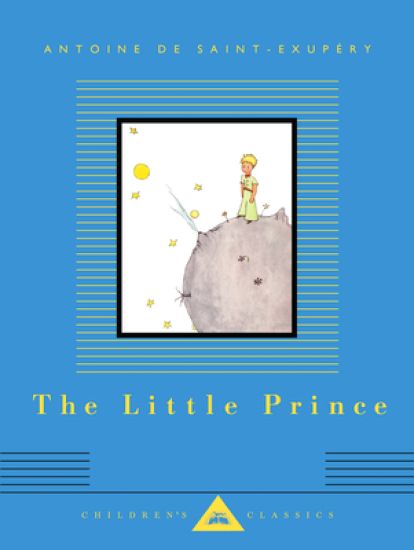
The Little Prince: Translated by Richard Howard

The Little Prince: Translated by Richard Howard

Antoine de Saint-Exupéry

Everyman's Library
2020
sidottu
A beautiful hardcover edition of one of the bestselling classic children's stories in the world--long cherished by children and adults alike. Written during World War II, The Little Prince tells of the friendship between the narrator, an aviator stranded in the Sahara desert, and a mysterious boy he encounters there. Ruler of a tiny asteroid of which he is the only inhabitant, the Little Prince chats disarmingly about his curious adventures in space and since arriving on earth; of his distant home; and of his love for a beautiful and capricious rose, to whom he longs to return. A moving and deceptively simple tale, it was described by Antoine de Saint-Exup ry as a children's story for adults, and it works on several levels as an allegory of his own life and of the human condition. Children love it for its deadpan fantasy, for its sense of baffled amusement at the grown-up world, and for the author's whimsical watercolour illustrations, which are an integral part of the book." Everyman's Library pursues the highest production standards, printing on acid-free cream-colored paper, with full-cloth cases with two-color foil stamping, decorative endpapers, silk ribbon markers, and European-style half-round spines.