

Kirjahaku
Etsi kirjoja tekijän nimen, kirjan nimen tai ISBN:n perusteella.
1000 tulosta hakusanalla Ismail Yigit Kayabas

Die Sozialökonomischen Verhältnisse Der Bäuerlichen Bevölkerung Im Küstengebirge Der Syrischen Arabischen Republik
Kamil Ismail
De Gruyter
1976
sidottu

Abu al-Qasim al-Qushayri’s (d. 465/1072) theological oeuvres remain eclipsed by his celebrated achievements in Sufism, with prevailing scholarly assertions that he is a mere repeater of Ash?arite views and that his theology plays an apologetic role within al-Risalat al-Qushayriyya, anchoring its esoteric content to orthodoxy. Against this backdrop, the present study investigates al-Qushayri’s theology, in the light of intellectual developments in the fourth-fifth/tenth-eleventh centuries. His views are critically analysed on prominent epochal issues across his three most voluminous theological creeds, Luma? fi al-i?tiqad, al-Fu?ul fi al-u?ul and al-Risala. Key topics include God’s attributes; His relationship with man; and epistemological concerns. The thesis argues that al-Qushayri’s theology is, contrary to prevailing views, neither homogenous, nor entirely Ash?arite. It reveals that his variegated theology is shaped by teleological forces. Al-Luma? shows a traditionalist bent, whereas al-Fu?ul is distinctly semi-rationalist. In al-Risala, he lays the foundations of a mystical theology that governs the Sufi schema, whilst simultaneously delimiting the relevance of Ash?arite doctrines to the mere confines of the masses.
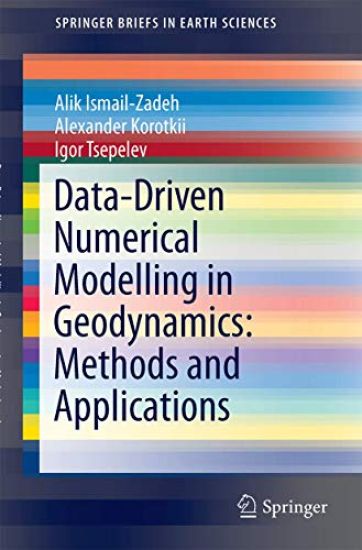
Data-Driven Numerical Modelling in Geodynamics: Methods and Applications
Alik Ismail-Zadeh; Alexander Korotkii; Igor Tsepelev
Springer International Publishing AG
2016
nidottu
This book describes the methods and numerical approaches for data assimilation in geodynamical models and presents several applications of the described methodology in relevant case studies. The book starts with a brief overview of the basic principles in data-driven geodynamic modelling, inverse problems, and data assimilation methods, which is then followed by methodological chapters on backward advection, variational (or adjoint), and quasi-reversibility methods. The chapters are accompanied by case studies presenting the applicability of the methods for solving geodynamic problems; namely, mantle plume evolution; lithosphere dynamics in and beneath two distinct geological domains – the south-eastern Carpathian Mountains and the Japanese Islands; salt diapirism in sedimentary basins; and volcanic lava flow. Applications of data-driven modelling are of interest to the industry and to experts dealing with geohazards and risk mitigation. Explanation of the sedimentary basin evolution complicated by deformations due to salt tectonics can help in oil and gas exploration; better understanding of the stress-strain evolution in the past and stress localization in the present can provide an insight into large earthquake preparation processes; volcanic lava flow assessments can advise on risk mitigation in the populated areas. The book is an essential tool for advanced courses on data assimilation and numerical modelling in geodynamics.


Edith Sitwell And The Symbolist Tradition
Sarah Ismail Al-Obaidy; S. A. A. D. Najim Al-Khafaji
Lap Lambert Academic Publishing
2018
nidottu

Hearing Profile and Postural Sensory Integration Deficits in Parkinson
Ahmed Ismail
Lap Lambert Academic Publishing
2017
nidottu

The Use of IQ-Write Program for Learning ESL Academic Writing
Noriah Ismail
Lap Lambert Academic Publishing
2017
nidottu


Advanced Mathematics for Scientists and Engineers
Mohamed Ismail Mohamed Hessein
Noor Publishing
2017
nidottu



Students' Perceptions on the Challenges of English Oral Communication
Zuraidah Ismail
Noor Publishing
2017
nidottu





Inhaltsanalyse des Lehrwerks "Von A bis Z - Alphabetisierungskurs A1" und seiner Eignung für Erwachsene
Imad Ismail
GRIN Verlag
2022
nidottu

Data Encryption Standard (DES) and Issues of DES and its Replacement
Haitham Ismail
GRIN Verlag
2022
nidottu