Kirjojen hintavertailu. Mukana 12 381 434 kirjaa ja 12 kauppaa.

Kirjahaku

Etsi kirjoja tekijän nimen, kirjan nimen tai ISBN:n perusteella.

1000 tulosta hakusanalla JAMES LINDSAY

James W.C. Pennington

James W.C. Pennington

Herman E. Thomas

CRC Press Inc
1995
sidottu
The story of James W.C. Pennington who was a former slave, then a Yale scholar, minister, and international leader of the Antebellum abolitionist movement. He escaped from slavery aged 19 in 1827 and soon became one of the leading voices against slavery before the Civil War. In 1837 he was ordained as a priest after studying at Yale and was soon traveling all over the world as an anti-slavery advocate.
James Madison

James Madison

CRC Press Inc
2017
sidottu
James Madison (1751-1836) - 'the Father of the American Constitution' - was a legal and political thinker of great originality and range. The essays by eminent scholars reprinted in this volume explore various facets and aspects of Madison's legal, constitutional and political thought. These include his views of human nature, republican political theory and practice, federalism, natural and civil rights, religious liberty, and constitutional interpretation. The volume is edited and introduced by Terence Ball whose scholarly publications include an authoritative annotated edition of Hamilton, Madison and Jay's The Federalist (Cambridge University Press, 2003).
James Ussher and John Bramhall

James Ussher and John Bramhall

Jack Cunningham

CRC Press Inc
2017
sidottu
This book examines the lives of two leading Irish ecclesiastics, James Ussher (1581-1656) and John Bramhall (1594-1663). Both men were key players in the religious struggles that shook the British Isles during the first half of the seventeenth century, and their lives and works provide important insights into the ecclesiastical history of early modern Europe. As well as charting the careers of Ussher and Bramhall, this study introduces an original and revealing method for examining post-Reformation religion. Arguing that the Reformation was stimulated by religious impulses that pre-date Christianity, it introduces a biblical concept of 'Justice' and 'Numinous' motifs to provide a unique perspective on ecclesiastical development. Put simply, these motifs represent on the one hand, the fear of God's judgement, and on the other, the sacred conception of the fear of God. These subtle understandings that co-existed in the Catholic church were split apart at the Reformation and proved to be separate poles around which different interpretations of Protestantism gathered. By applying these looser concepts to Ussher and Bramhall, rather than rigid labels such as Arminian, Laudian or Calvinist, a more subtle understanding of their careers is possible, and provides an altogether more satisfactory method of denominational categorisation than the ones presently employed, not just for the British churches but for the history of the Reformation as a whole.
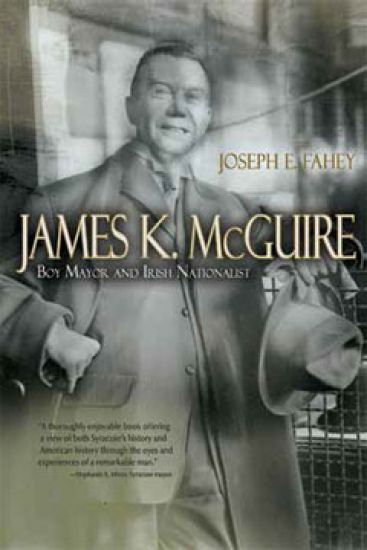
James K. McGuire

James K. McGuire

Joseph E. Fahey

Syracuse University Press
2014
sidottu
This is the story of a self-educated, charismatic, gifted leader who overcame personal tragedy in childhood and was elected the youngest mayor of a major city in America at age twenty-six. It is the story of a reformer who possessed a genius for politics. James K. McGuire (1868–1923) was elected mayor of Syracuse three times as a Democrat in a Republican bastion. As a candidate for governor in 1898, he nearly derailed the rise of Theodore Roosevelt. His ideas and positions informed the candidacy of William Jennings Bryan in his quest for the presidency and the platform of the Democratic Party in those elections. Fahey narrates McGuire’s remarkable rise to become a major figure in national politics as well as his questionable business dealings along the way. Indicted twice during his life, he was investigated by Congress and the Department of Justice for his advocacy of Irish freedom. McGuire befriended and aided Éamon de Valera and the Irish freedom fighters of that time, using his influence at the highest levels of the American government to further the cause of Ireland. This fascinating portrait reveals a complex man who earned a place on the national political stage and battled for the causes in which he deeply believed.
James Gould Cozzens - American Writers 58

James Gould Cozzens - American Writers 58

Hicks Granville

UNIVERSITY OF MINNESOTA PRESS
1966
nidottu
James Gould Cozzens - American Writers 58 was first published in 1966. Minnesota Archive Editions uses digital technology to make long-unavailable books once again accessible, and are published unaltered from the original University of Minnesota Press editions.
James Agee - American Writers 95

James Agee - American Writers 95

Larsen Erling

UNIVERSITY OF MINNESOTA PRESS
1971
nidottu
James Agee - American Writers 95 was first published in 1971. Minnesota Archive Editions uses digital technology to make long-unavailable books once again accessible, and are published unaltered from the original University of Minnesota Press editions.
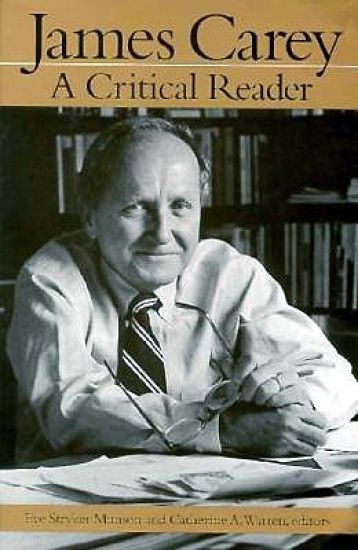
James Carey

James Carey

Eve Stryker Munson

University of Minnesota Press
1997
nidottu
An essential guide to the thought of a central figure in media studies .James Carey-scholar, media critic, and teacher of journalists-almost single-handedly established the importance of defining a cultural perspective when analyzing communications. Interspersing Carey’s major essays with articles exploring his central themes and their importance, this collection provides a critical introduction to the work of this significant figure. Long before the “interpretive turn” became the fashion in the humanities and sociology, Carey was busily studying and combining the ideas of an impressive array of philosophers, sociologists, historians, and anthropologists, including John Dewey, Clifford Geertz, Raymond Williams, Thomas Kuhn, Max Weber, C. Wright Mills, Richard Rorty, Jürgen Habermas, Harold Innis, and Lewis Mumford. In James Carey: A Critical Reader, seven scholars who have been influenced by him consider his work and how it has affected the development of media studies. Carey has demonstrated that mass communications serve a complex function in society, with one central question reflecting his concerns: How does one make democracy work in a vast country that spans a continent? In his view, symbols, language, and those who create them are reality-creating, rather than reality-reflecting. Carey has examined the roles the media and the academy have played in creating and maintaining a public sphere, as well as the ways technology helps or hinders that project. Carey’s themes range from the strains on democracy and drawbacks of technology to the critique of journalism and the politics of academe. Contributors: G. Stuart Adam, Carleton U, Canada; James Carey, Columbia U; Carolyn Marvin, U of Pennsylvania; John Pauly, St. Louis U; Jay Rosen, New York U; Michael Schudson, U of California, San Diego.
James Whale

James Whale

University of Minnesota Press
2003
nidottu
The basis for the Academy Award winning film "Gods and Monsters" Starring Ian McKellan and Brendan Fraser. James Curtis is the author of a well-received biography on Preston Sturges and a new book, W.C. FIELDS, just published by Knopf and favorably reviewed in the NYTBR.
James Hall, Literary Pioneer of the Ohio Valley

James Hall, Literary Pioneer of the Ohio Valley

John T. Flanagan

University of Minnesota Press
1941
nidottu
James Hall, Literary Pioneer of the Ohio Valley was first published in 1941. Minnesota Archive Editions uses digital technology to make long-unavailable books once again accessible, and are published unaltered from the original University of Minnesota Press editions.For generations the attention of students of American literature has been directed toward the Atlantic seaboard, but the rise of regional literature and the development of genuine artists in various parts of the United States has caused them to turn their scrutiny westward. High on the western horizon of the early 1800's stands James Hall, a literary pioneer in the Ohio Valley, one of the minor literary figures whose influence on the artistic consciousness of the frontier was widely felt.Author, critic, journalist, editor, publisher, and historian—few men have had more to do with the early cultural development of the Middle West. Every historian of the Ohio and Mississippi valleys is indebted to Hall for facts and details of life in America in the early nineteenth century.A circuit judge when there were only 55,000 people in all Illinois—he had an unparalleled opportunity to observe the life and customs of the times. A publisher of the first literary magazine west of the Ohio when there were more Indians and horse thieves in the state than there were literate readers—he had a virgin field for awakening the artistic, literary, even scientific, interest of the frontier.He organized the first State Historical Society of Illinois, was state treasurer, published two newspapers, welcomed Lafayette on his triumphal tour, edited the first literary annual in the West, awarded a prize to Harriet Beecher (Stowe) for her "New England Sketch," published in his magazine. Moving to Cincinnati when it was at the peak of its sectional importance, an intellectual and cultural oasis on the frontier, Hall continued his sponsorship of education and culture.James Hall's own published works were multitudinous in the fields of fiction, biography, poetry, criticism, history, and anthropology. His picture of the prairies in his day is still one of the best accounts ever written and his Indian Tribes of North America a monumental volume, but none of his works is of first-rate importance. Nevertheless, because of the tremendous variety of his activities and the breadth of his influence, he left his stamp upon the history and the literature of the region.Hall's work is an honest, vigorous record of the path of the American pioneer in the days of the rapid growth and expansion of a new nation, and an understanding of his contribution is obligatory for every serious student of American literature.
James Barbour, a Jeffersonian Repulican

James Barbour, a Jeffersonian Repulican

Charles Lowery

The University of Alabama Press
2004
nidottu
Barbour, a Virginia contemporary of Thomas Jefferson and James Madison, during a long public career spanning the years 1798-1842, exerted a constructive influence on the nation's history. Active in state and national politics during the formative decades of the republic, Barbour was a political nationalist who grafted to the dominant political philosophy of the day those elements of the Hamiltonian Federalist creed necessary for governing a dynamic, changing nation.Barbour's life affords a unique vantage point for viewing party politics in the South and the nation during the Jeffersonian and Jacksonian periods, for understanding Jeffersonian Republicanism, and for comprehending the difficulties a Southern agrarian had in embracing the economic and political realities at the dawn of the modern commercial age.
James Parkinson His Life and Times

James Parkinson His Life and Times

F.C. Rose

Birkhauser Boston Inc
1989
nidottu
Dr. A. D. Morris had a long interest in, and great familiarity with, the life and times of James Parkinson (1755-1824). He was an avid collector of material related to Parkinson, some of which he communicated to medi· cal and historical groups, and which he also incorporated into publica· tions, especially his admirable work, The Hoxton Madhouses. When Dr. Morris died, in 1980, he left behind a large typescript devoted to Parkinson's life. It was single·minded in its dedication to primary texts, quoting liberally from the whole range of Parkinson's writings. This was particularly valuable since so many of Parkinson's publications were tracts, pamphlets, or occasional pieces which are now very scarce. A copy of the entire manuscript has been deposited in the Library of the Well· come Institute for the History of Medicine in London, where it may be consulted. The length of the manuscript made publication of the whole impossible, especially since it would have had to include the facsimile reproduction of Morris's The Hoxton Madhouses.
James Vincent Murphy

James Vincent Murphy

James F. Barnes; Patience P. Barnes

University Press of America
1987
nidottu
A biography of Irish journalist, James Vincent Murphy, who started out as a Catholic priest, spent the twenties in Rome and Paris, and reported from Berlin on the Nazis as an official propagandist. An international lecturer and linguist, Murphy knew many of Europe's famed intellectuals. For a time, he was the official translator of Hitler's speeches into English, and it was his translation of Mein Kampf that is recognized as the first unabridged version in English.
James Bowdoin II

James Bowdoin II

Gordon E. Kershaw

University Press of America
1991
sidottu
This is the first full-length biography of James Bowdoin II (1726-1790), a leading exponent of the eighteenth-century American Enlightenment, humanitarian, patriot, governor, and advocate of strong national government. Among the least known of the American revolutionary generation, Bowdoin faded from the public consciousness soon after his death in 1790. However, his lifetime achievements were significant, enduring, and multi-faceted, and this work is an attempt to lay bare the elusive personality of this highly complex individual.
James Dickey

James Dickey

James Dickey

Wesleyan University Press
1998
nidottu
Brings together the finest work from each of the periods in an American poet's extremely controversial career, covering more than three decades of work and a wide variety of literary styles. Simultaneous. UP.
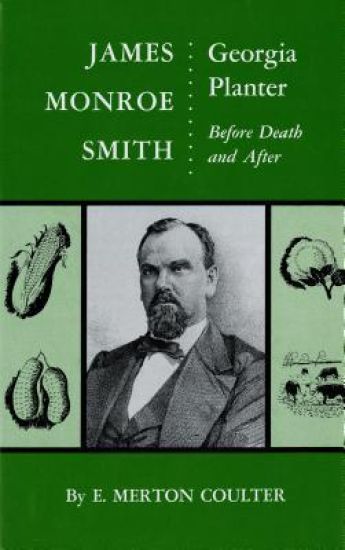
James Monroe Smith

James Monroe Smith

E. Merton Coulter

University of Georgia Press
2002
sidottu
Few men in the history of Georgia have come down to the present in hearsay and folklore as profusely and as controversially as has James Monroe Smith, who became a millionaire farmer around the turn of the twentieth century. He was born near Washington, Georgia, in 1839 and died on his plantation a few miles from Athens in 1915.Smith’s plantation “Smithonia” was measured in terms of square miles. He developed an empire of farming and allied interests, among which was a railroad to connect his plantation with other rail lines. He served terms in the state legislature in both the house and the senate, and in 1906 ran unsuccessfully for governor.The colorful career of Smith, a bachelor, did not end with his death but was kept alive in numerous claims and counter-claims in the settling of his estate. E. Merton Coulter seeks to separate fact from fiction in his account of Smith’s varied activities and the final dissolution of his wealth.