Kirjojen hintavertailu. Mukana 11 699 587 kirjaa ja 12 kauppaa.

Kirjahaku

Etsi kirjoja tekijän nimen, kirjan nimen tai ISBN:n perusteella.

1000 tulosta hakusanalla Jefferson Hack

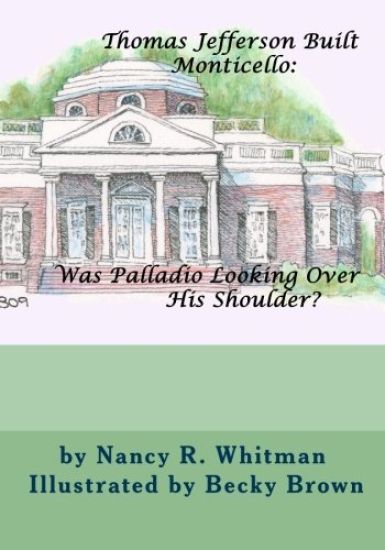
Thomas Jefferson Built Monticello: Was Palladio Looking Over His Shoulder?

Thomas Jefferson Built Monticello: Was Palladio Looking Over His Shoulder?

Nancy R. Whitman

Createspace Independent Publishing Platform
2017
nidottu
Hands-on and searching activities make classical architecture come alive in this non-fiction narrative for readers 9 and up. Thomas Jefferson's design of Monticello drew on 16th century Italian architect, Andrea Palladio. Jefferson's "conversations" with Palladio arose from reading his "Four Books of Architecture." The book features parallels in the men's lives and work, illustrated by pen and ink drawings. Readers will identify elements of Roman architecture, from columns to porticoes to capitals, as used inventively by Palladio and Jefferson.
Declaration of Independence Thomas Jefferson

Declaration of Independence Thomas Jefferson

Thomas Jefferson

Createspace Independent Publishing Platform
2017
nidottu
The United States Declaration of Independence is a statement adopted by the Continental Congress on July 4, 1776, announcing that the thirteen American colonies then at war with Great Britain were no longer a part of the British Empire. Written primarily by Thomas Jefferson, the Declaration is a formal explanation of why Congress had voted on July 2 to declare independence from Great Britain, more than a year after the outbreak of the American Revolutionary War. The birthday of the United States of America-Independence Day-is celebrated on July 4, the day the wording of the Declaration was approved by Congress.
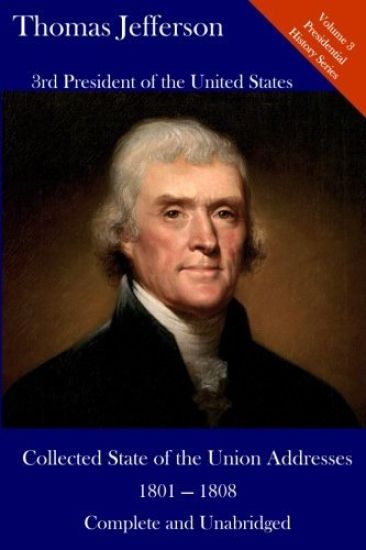
Thomas Jefferson: Collected State of the Union Addresses 1801 - 1808: Volume 3 of the Del Lume Executive History Series
Thomas Jefferson (1735-1826) was the primary author of the American Declaration of Independence, Governor of Virginia and American Ambassador to France, Jefferson served under George Washington as the nation's first Secretary of State, and as Vice-President under John Adams. Jefferson was elected to the Presidency in 1801. This work brings together the eight State of the Union Addresses which President Jefferson delivered to Congress between 1801 and 1808.
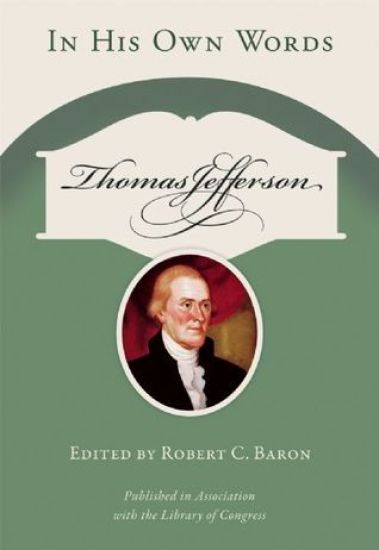
Thomas Jefferson

Thomas Jefferson

Robert C. Baron

FULCRUM INC.,US
2009
pokkari
A wonderful introduction to the man, his ideas, and his legacy through his letters and writings. Subjects range from Jefferson's ideas on exploration, freedom, and democracy to his feelings about friends, family, books, and gardening.
The Jefferson Bible

The Jefferson Bible

Thomas Jefferson

Applewood Books
2006
sidottu
Thomas Jefferson believed that the pure-principled teachings of Jesus should have been separated from the dogma and abuse of organized religion of the day. This led him to recast, by cutting and pasting from the gospels, a new narrative of the life and teachings of Jesus, where, according to Jefferson, there will be found remaining the most sublime and benevolent code of morals which has ever been offered to man.
Thomas Jefferson

Thomas Jefferson

Transaction Publishers
1996
sidottu
Over the course of more than six decades as an author, journalist, and professor, Max Lerner studied and assessed many presidents, yet Thomas Jefferson received his most sustained attention. To Lerner, Jefferson came closest in the American context to Plato's "philosopher-king," the ideal thinker and leader. Because of his keen sense of Jefferson's virtues and his unique place in United States history, Lerner began work on a book about Jefferson in 1957, rewriting it several times throughout his life, always with the intention of introducing general readers to "a thinker and public figure of enduring pertinence."In this volume, Lerner uses the facts of Jefferson's life and work as the springboard to insightful analysis and informed assessment. In considering Jefferson, Lerner combines biographical information, historical background, and analytical commentary. The result is a biographical-interpretive volume, a primer about Jefferson that not only describes his accomplishments, but discusses his problems and failures.As political figures have declined in esteem in recent decades, the media has probed deeper into previously private lives. Historians, biographers, and others have revealed personal details about deceased prominent figures. Two centuries after he helped create America, Jefferson remains a figure of enduring fascination within academic circles and beyond. Max Lerner helps explain and clarify not only this unending fascination, but the timeless relevance of the nation's devoutly democratic yet singularly authentic "philosopher-king."
The Jefferson National Forest

The Jefferson National Forest

Will Sarvis

University of Tennessee Press
2011
sidottu
The highland forests of southwestern Virginia were a sacred land to Native Americans and one they relied upon for sustenance. After European contact, this beautiful country drew successive waves of settlers and visitors, and for a brief yet intense period, industrialists rapaciously exploited its timber resources, particularly in the higher elevations where the woodlands had survived the nearby valleys' generations of agricultural use. This is the story of how various peoples have regarded this land over the centuries and how, starting in the early twentieth century, the federal government acquired 700,000 acres of it to create what is now the Jefferson National Forest (JNF). Will Sarvis's in-depth history explores the area's significance to such native tribes as the Cherokee and Shawnee, for whom it functioned as a buffer zone in late prehistory, and its attraction for nineteenth-century romantics who, arriving in stagecoaches, became the area's first tourists. Aggressive commercial logging gave way to the arrival of the U.S. Forest Service, which patched the JNF together through successive purchases of privately owned land and instituted a more regulated harvesting of various timber resources. Public support for Forest Service policy during the Depression and World War II was followed by controversies, including the use of eminent domain. In presenting this history, Sarvis probes the many complexities of land stewardship and, in analysis that is sure to spark debate, discusses how and why the JNF could abandon clear-cutting and return to traditional selective tree management. An ongoing experiment in democratic land use, the JNF contains many lessons about our relationship with the natural environment. This book delineates those lessons in a clear and compelling narrative that will be of great interest to policy makers, activists, and indeed anyone drawn to American environmental history and Appalachian studies.
Antebellum Jefferson, Texas

Antebellum Jefferson, Texas

University of North Texas Press,U.S.
2012
sidottu
Founded in 1845 as a steamboat port at the entryway to western markets from the Red River, Jefferson was a thriving center of trade until the steamboat traffic dried up in the 1870s. During its heyday, the town monopolized the shipping of cotton from all points west for 150 miles. Jefferson was the unofficial capital of East Texas, but it was also typical of boom towns in general. For this topical examination of a frontier town, Bagur draws from many government documents, but also from newspaper ads and plats. These sources provide intimate details of the lives of the early citizens of Jefferson, Texas. Their story is of interest to both local and state historians as well as to the many readers interested in capturing the flavor of life in old-time East Texas.
Thomas Jefferson

Thomas Jefferson

John Torrey Morse; George Grant

Cumberland House Publishing,US
2004
pokkari
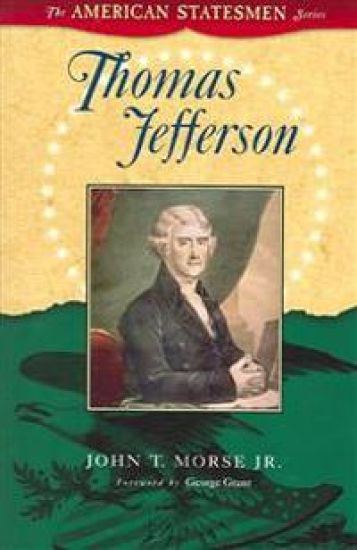
Originally published in 1898, Thomas Jefferson a classic biography of the man who so deeply ingrained the republican ideals of the Founding Fathers into American society. As such, it is the kind of work that avoids the trap of noticing everything that went unnoticed in the past while failing to notice all that the past deemed notable. Immediately lauded by the critics when it was first published, John T. Morse's biography of Jefferson was embraced by the reading public. Today, its republication is a welcome opportunity to remind leaders today of the great story of liberty that enabled the young American nation to become an undisputed world power and a beacon of freedom to oppressed people everywhere. Thomas Jefferson was a brilliant and complex man who was practically born into America's ruling elite. He served in the Virginia House of Burgesses, in the Continental Congress, as ambassador to the French court, as governor of Virginia, as secretary of state under George Washington, as vice president under John Adams, and as president. The author of the Declaration of Independence, he was also the founder of the University of Virginia and established the Library of Congress. Despite all these credentials, Jefferson was hardly considered a member of the establishment of his day. Indeed, he was best known as a revolutionary populist. When he won the presidential election of 1800, it was dubbed a kind of bloodless revolution."" He brought to the presidency a philosophy of representative government firmly rooted in the rights and liberties of individuals. As a result, he helped to dramatically change the character of the nation.""
The Jefferson Bible

The Jefferson Bible

Thomas Jefferson

Book Tree
2016
sidottu
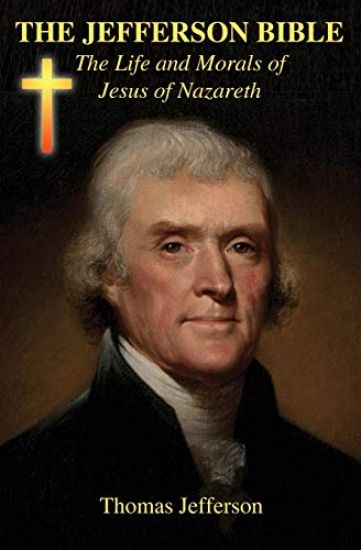
Thomas Jefferson completed this book in around 1820, when he was 77 years old. His aim was to reveal the most genuine teachings from the New Testament. He was trying to find the very essence of the Christian faith and to share it in its clearest form. This was done by carefully cutting out and pasting together chosen verses from the four main gospels into what was, in its final version, an 82-page book. Once finished, it was bound together but never produced for distribution. After Jefferson passed away the book remained hidden within his family until a man named Cyrus Adler purchased it in 1895 for the National Museum, which is known today as the Smithsonian Institution. Soon after, Iowa Representative John Lacey found it and sponsored a resolution to print it for the private use of Congressional members. This long lost, legendary book rolled off the press for the first time in 1904. When copies were distributed to Congress in 1905, it started a tradition which lasted for half a century. Each new Senator and Representative was given a copy at their swearing in ceremony with every new Congress. One no longer needs to be a member of Congress in order to experience the beliefs of this brilliant third U.S. President, Thomas Jefferson.
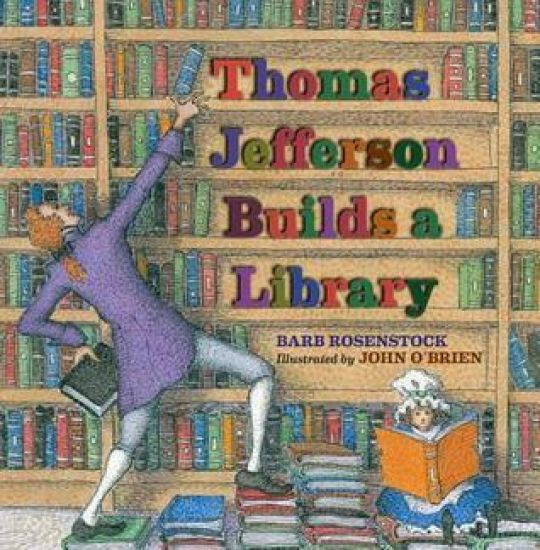
Thomas Jefferson Builds a Library

Thomas Jefferson Builds a Library

Barb Rosenstock

Calkins Creek
2013
sidottu
As soon as Thomas Jefferson learned to read, he found his passion: books, books, and more books! Before, during, and after the American Revolution, Jefferson collected thousands of books on hundreds of subjects. In fact, his massive collection eventually helped rebuild the Library of Congress now the largest library in the world. Barb Rosenstock's rhythmic words and John O'Brien's whimsical illustrations capture Jefferson's passion for the written word as well as little-known details about book collecting. Author and artist worked closely with experts to create the first picture book on Jefferson's love of reading, writing, and books. An author's note, bibliography, and source notes for quotations are also included.
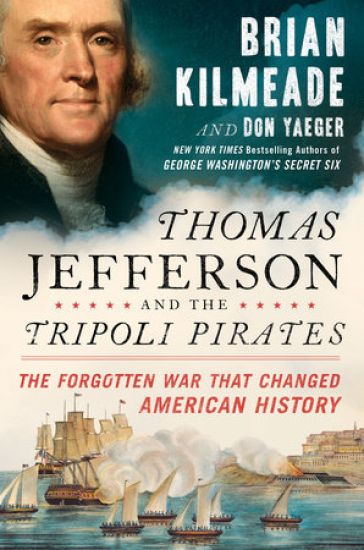
Thomas Jefferson And The Tripoli Pirates

Thomas Jefferson And The Tripoli Pirates

Brian Kilmeade; Don Yaeger

Portfolio
2015
sidottu
"Another blockbuster Thomas Jefferson and the Tripoli Pirates reads like an edge-of-your-seat, page-turning thriller. You will love this book and also wonder why so few people know this story. No one captures the danger, intrigue, and drama of the American Revolution and its aftermath like Brian Kilmeade and Don Yaeger." --Brad Thor This is the little-known story of how a newly indepen-dent nation was challenged by four Muslim powers and what happened when America's third president decided to stand up to intimidation. When Thomas Jefferson became president in 1801, America faced a crisis. The new nation was deeply in debt and needed its economy to grow quickly, but its merchant ships were under attack. Pirates from North Africa's Barbary coast routinely captured American sailors and held them as slaves, demanding ransom and tribute payments far beyond what the new coun-try could afford. Over the previous fifteen years, as a diplomat and then as secretary of state, Jefferson had tried to work with the Barbary states (Tripoli, Tunis, Algiers, and Morocco). Unfortunately, he found it impossible to negotiate with people who believed their religion jus-tified the plunder and enslavement of non-Muslims. These rogue states would show no mercy--at least not while easy money could be made by extorting the Western powers. So President Jefferson decided to move beyond diplomacy. He sent the U.S. Navy's new warships and a detachment of Marines to blockade Tripoli--launching the Barbary Wars and beginning America's journey toward future superpower status. As they did in their previous bestseller, George Washington's Secret Six, Kilmeade and Yaeger have transformed a nearly forgotten slice of history into a dramatic story that will keep you turning the pages to find out what happens next. Among the many sus-penseful episodes: -Lieutenant Andrew Sterett's ferocious cannon battle on the high seas against the treacherous pirate ship Tripoli. -Lieutenant Stephen Decatur's daring night raid of an enemy harbor, with the aim of destroying an American ship that had fallen into the pirates' hands. -General William Eaton's unprecedented five-hundred-mile land march from Egypt to the port of Derne, where the Marines launched a surprise attack and an American flag was raised in victory on foreign soil for the first time. Few today remember these men and other heroes who inspired the Marine Corps hymn: "From the Halls of Montezuma to the Shores of Tripoli, we fight our country's battles in the air, on land and sea." Thomas Jefferson and the Tripoli Pirates recaptures this forgot-ten war that changed American history with a real-life drama of intrigue, bravery, and battle on the high seas.
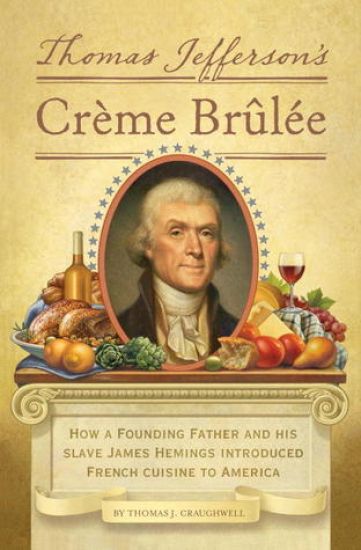
Thomas Jefferson's Creme Brulee

Thomas Jefferson's Creme Brulee

Thomas J. Craughwell

Quirk Books
2012
sidottu
In 1784, Thomas Jefferson made a deal with one of his slaves, 19-year-old James Hemings. The Founding Father was traveling to Paris to serve as ambassador to France. Jefferson wanted to bring James along for a particular purpose - to master the art of French cooking. And if James was willing to go along with the plan, Jefferson would grant his freedom. Why? Because the American diet circa 1784 was appalling. Meats were boiled. Spices were limited. Vegetables were mushy and overcooked. Bread was stale. Although Jefferson had never sampled French cuisine, he had read about it, and he wanted to bring its secrets back to the United States. So the two men journeyed to Paris. James Hemings was apprenticed under several master French chefs for three years before taking over as Chef de Cuisine in Jefferson's house on Paris' Champs d'Elysees, where he prepared extravagant meals for Jefferson's many guests. Meanwhile, Jefferson studied the cultivation of French crops (especially French grapes for winemaking), and researched how they might be replicated in American agriculture. When the men returned home in 1789, they brought Americans the gifts of: champagne (up until then, Americans had preferred sweet wines such as sherry and port); pasta (and a rudimentary pasta machine); Pomme de terre frites a cru, en petites tranches (Potatoes, fried in deep fat while raw, cut into small slices ...a.k.a. French Fries); Mac and Cheese!; Creme Brulee; and a host of other innovations. "Thomas Jefferson's Creme Brulee" tells the remarkable story of a Founding Foodie who transformed American agriculture - and the chef who transformed our dinner tables. This narrative nonfiction book includes six of James' recipes (reproduced in his own handwriting!) and six more from Jefferson himself. This rollicking adventure is great fun for fans of history, food, and France.