Kirjojen hintavertailu. Mukana 11 244 527 kirjaa ja 12 kauppaa.

Kirjahaku

Etsi kirjoja tekijän nimen, kirjan nimen tai ISBN:n perusteella.

1000 tulosta hakusanalla Jennifer Cook

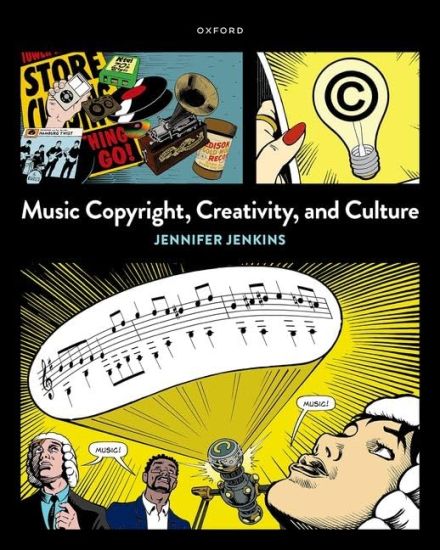
Music Copyright, Creativity, and Culture

Music Copyright, Creativity, and Culture

Jennifer Jenkins

OXFORD UNIVERSITY PRESS INC
2025
nidottu
Music Copyright, Creativity, and Culture offers a thorough introduction to copyright issues that are central to today's musicians. The book has an innovative design: half of the material is presented in the form of a graphic novel, which is coupled with accessible, insightful prose and relevant case histories. Through a series of chapters that take students step by step through the fundamentals of copyright and creativity, Jennifer Jenkins clarifies basic concepts, lays out an engaging history, points out cultural effects of legal rules, and tells scores of stories of great musical controversies, past and present. The book is paired with a series of Spotify and YouTube playlists, so that students can listen to the material under review. The end result is neither dry nor obscure. And this is as it should be, because the legal rules surrounding our musical culture are both important and captivating. Every year, thousands of students majoring in subjects such as Music, Communications, Business, Film Studies, and Entertainment Law deal with issues raised by copyright. The current textbook market serves them inadequately. There are dry, legal tomes that deluge students with legal technicalities but offer little context, illustration, or connection to our cultural history. There are breezy manuals written by non-lawyers that conflate markedly different subjects (such as copyright infringement and plagiarism, or "fair use" and unoriginality). But few offer sound legal and cultural history in a format that students will be able to use and understand. Music Copyright, Creativity, and Culture fills that gap with its marriage of text and graphic presentation. The basic question music copyright law tries to answer is a simple one: when is borrowing, or simple musical similarity, okay, and when is it illegal? But the answers to that simple question can befuddle both students and professors. Music Copyright, Creativity, and Culture lays out four short examples of the book's approach, each dealing with a question that students frequently raise. The questions are: 1. Is copyright infringement the same as plagiarism? Is it okay to copy something, so long as I give credit to the original? 2. How do I know whether one song violates the copyright of another song? What are the stages of the analysis? 3. What parts of a song are subject to exclusive ownership under copyright law and why? What aspects of music does copyright leave free for anyone to build on? 4. Can someone copy something unconsciously? What if a fragment of a tune gets stuck in your head and years later you write a song that mines that subconscious memory? Is that copyright infringement or just the normal process of creativity? Answering these questions is key to understanding the implications of copyright law and its impact on the creative arts. Music Copyright, Creativity, and Culture provides these answers in a format that will appeal to today's students in music business, entertainment law, and related courses.
Assuming Responsibility

Assuming Responsibility

Jennifer A. Herdt

Oxford University Press
2022
sidottu
Recent decades have witnessed an enthusiastic retrieval of eudaimonism, according to which the virtuous life is the happy life. But the critique launched by Kant - that eudaimonism is egoistic and distorts the character of duty or obligation - has persisted. Should I develop the virtues because these are the traits I need in order to flourish? Is it facts about my own happiness that determine my obligations to others? In this book, Jennifer Herdt deftly sifts through these debates, showing why we should embrace 'ecstatic' or 'goodness-prior' eudaimonism while rejecting 'welfare-prior' forms of eudaimonism. Grasping the character of ecstatic eudaimonism, she argues, has major implications, overcoming the common assumption of a sharp break between pagan and Christian eudaimonism, as well as of a late medieval or Protestant repudiation of eudaimonism in favor of divine command theory. Agents cannot rightly respond to the goods they encounter unless they respond to them precisely as good, and not merely as a means to promoting their own welfare; in responding well, their agency is thereby necessarily perfected. In conversation with vital strands of contemporary moral philosophy, Herdt goes on to articulate the distinctive character of obligation as a feature of accountability relations among agents. Assuming Responsibility offers a fresh point of departure for theological and philosophical approaches to virtue ethics, moral agency, and the contested relationship between the good and the right.
On Arid Ground

On Arid Ground

Jennifer Keating

Oxford University Press
2022
sidottu
On Arid Ground focuses on the relationships between empire and environment in Central Asia, using environmental history to examine the practice of Russian imperialism in Turkestan at the end of empire, from the 1860s until 1916. It reveals for the first time a comprehensive assessment of the environmental imprint of Russian colonisation, and shows how local ecologies fitted into broader repertoires of imperial rule, accommodation, and resistance. Ranging widely above and below the surface in Turkestan, from the deserts of Transcaspia to the highlands and lowlands of rural Fergana and Semirech'e, Jennifer Keating explores infrastructure development, migrant settlement, land reclamation and dispossession, the commodification of nature, and environmental violence to reveal the ways in which ecological change was central to the building and breaking of empire. Attentive to connections, synchronicities and scale, On Arid Ground makes the case for looking beyond cotton and water in Central Asian context, for the powerful material role played by animals and plants, sand, silt, and salt in human histories, and for the less visible relationships between far-flung people and things within and beyond Turkestan's borders. Laying bare the political roots and repercussions of environmental change, the volume brings fresh perspectives both to the history of Central Asia and to that of the wider Russian empire across Eurasia.
Thucydides

Thucydides

Jennifer T. Roberts

Oxford University Press
2024
nidottu
Very Short Introductions: Brilliant, Sharp, Inspiring In 432 BCE the powerful city-state of Sparta on the peninsula of the Peloponnesus in southwestern Greece declared war on Athens, head of a mighty naval coalition. The war would last until Sparta finally brough Athens to its knees in 404. The Athenian aristocrat Thucydides, suspecting the magnitude of the conflict that was unfolding before his eyes, at once undertook to record its history, exploring the causes and course of the war in the context of his great interest: human nature. An introduction to Thucydides' thought and background, this book examines Thucydides' account of the war in the context both of the international situation in the classical Greek world and of the intellectual traditions of the fifth century BCE, exploring the historian's connection to prose writers like Herodotus as well as poets like Homer and the tragedians, and investigating the complex dynamics of the war that changed the Greek world forever. ABOUT THE SERIES: The Very Short Introductions series from Oxford University Press contains hundreds of titles in almost every subject area. These pocket-sized books are the perfect way to get ahead in a new subject quickly. Our expert authors combine facts, analysis, perspective, new ideas, and enthusiasm to make interesting and challenging topics highly readable.
Criminal Testimonial Injustice

Criminal Testimonial Injustice

Jennifer Lackey

Oxford University Press
2023
sidottu
Through a detailed analysis that draws on work across philosophy, the law, and social psychology, Criminal Testimonial Injustice shows that, from the very beginning of the American criminal legal process in interrogation rooms to its final stages in front of parole boards, testimony is extracted from individuals through processes that are coercive, manipulative, or deceptive. This testimony is then unreasonably regarded as representing the testifiers' truest or most reliable selves. With chapters ranging from false confessions and eyewitness misidentifications to recantations from victims of sexual violence and expressions of remorse from innocent defendants at sentencing hearings, it is argued that there is a distinctive epistemic wrong being perpetrated against suspects, defendants, witnesses, and victims. This wrong involves brute State power targeting the epistemic agency of its citizens, extracting false testimony that is often life-shattering, and rendering the victims in question complicit in their own undoing. It is concluded that it is only through understanding what it means to respect the epistemic agency of each participant in the criminal legal system that we can truly grasp what justice demands and, in so doing, to reimagine what is possible.
Dogwhistles and Figleaves

Dogwhistles and Figleaves

Jennifer Mather Saul

Oxford University Press
2024
sidottu
Pinpoints how "dogwhistles" and "figleaves," two kinds of linguistic trick, distort political discourse and normalize racism It is widely accepted that political discourse in recent years has become more openly racist and more accepting of wildly implausible conspiracy theories. Dogwhistles and Figleaves explores ways in which such changes--both of which defied previously settled norms of political speech--have been brought about. Jennifer Saul shows that two linguistic devices, dogwhistles and figleaves, have played a crucial role. Some dogwhistles (such as "88", used by Nazis online to mean "Heil Hitler") serve to disguise messages that would otherwise be rejected as unacceptable, allowing them to be transmitted surreptitiously. Other dogwhistles (like the 1988 "Willie Horton" ad) work by influencing people in ways that they are not aware of, and which they would likely reject were they aware. Figleaves (such as "just asking questions") take messages that could easily be recognized as unacceptable, and provide just enough cover that people become more willing to accept them. Saul argues that these devices are important for the spread of racist discourse. She also shows how they contribute to the transmission of norm-violating discourse more generally, focusing on the case of wildly implausible conspiracist speech. Together, these devices have both exploited and widened existing divisions in society, and normalized racist and conspiracist speech. This book is the first full-length exploration of dogwhistles and figleaves. It offers an illuminating and disturbing view of the workings of contemporary political discourse.
Voices and Books in the English Renaissance

Voices and Books in the English Renaissance

Jennifer Richards

Oxford University Press
2022
nidottu
Voices and Books in the English Renaissance offers a new history of reading that focuses on the oral reader and the voice- or performance-aware silent reader, rather than the historical reader, who is invariably male, silent, and alone. It recovers the vocality of education for boys and girls in Renaissance England, and the importance of training in pronuntiatio (delivery) for oral-aural literary culture. It offers the first attempt to recover the voice—and tones of voice especially—from textual sources. It explores what happens when we bring voice to text, how vocal tone realizes or changes textual meaning, and how the literary writers of the past tried to represent their own and others' voices, as well as manage and exploit their readers' voices. The volume offers fresh readings of key Tudor authors who anticipated oral readers including Anne Askew, William Baldwin, and Thomas Nashe. It rethinks what a printed book can be by searching the printed page for vocal cues and exploring the neglected role of the voice in the printing process. Renaissance printed books have often been misheard and a preoccupation with their materiality has led to a focus on them as objects. Indeed, Renaissance printed books are alive with possible voices, but we will not understand this while we focus on the silent reader.
Oxford Bookworms Library: The Phantom of the Opera: Level 1: 400-Word Vocabulary
This award-winning collection of adapted classic literature and original stories develops reading skills for low-beginning through advanced students.Accessible language and carefully controlled vocabulary build students' reading confidence. Introductions at the beginning of each story, illustrations throughout, and glossaries help build comprehension. Before, during, and after reading activities included in the back of each book strengthen student comprehension. Audio versions of selected titles provide great models of intonation and pronunciation of difficult words.
Wide Angle: Level 2: Student Book with Online Practice

Wide Angle: Level 2: Student Book with Online Practice

Jennifer Carlson; Nancy Jordan

Oxford University Press
2018
muu
Wide Angle is the course that helps your adult learners to uncover and master the hidden rules of English, so when it comes to communicating in the real world, they know what to say and how to say it. The Student Book with Online Practice presents content from the real world to motivate learning, and offers students plenty of opportunities to practice responding appropriately to everyday situations.
Wide Angle: Level 1: Student Book with Online Practice
Wide Angle is the course that helps your adult learners to uncover and master the hidden rules of English, so when it comes to communicating in the real world, they know what to say and how to say it. The Student Book with Online Practice presents content from the real world to motivate learning, and offers students plenty of opportunities to practice responding appropriately to everyday situations.
Wide Angle: Level 2: Multi-Pack A with Online Practice

Wide Angle: Level 2: Multi-Pack A with Online Practice

Jennifer Carlson; Nancy Jordan; Kate Adams

Oxford University Press
2019
muu
Wide Angle is the course that helps your adult learners to uncover and master the hidden rules of English, so when it comes to communicating in the real world, they know what to say and how to say it. Multi-Pack A combines units 1-6 from the Student Book with units 1-6 from the Workbook in one book - ideal for shorter courses. Online Practice provides students with extra practice of the skills, grammar and vocabulary taught in every lesson.
Wide Angle: Level 1: Multi-Pack A with Online Practice

Wide Angle: Level 1: Multi-Pack A with Online Practice

Jennifer Carlson; Nancy Jordan

Oxford University Press
2019
muu
Wide AngleA six-level international English course for Adult and Young adult learnersA real-world viewpointA course that empowers adult learners to join any conversation, and say the right thing at the right time.Wide Angle is the course that helps your students to uncover and master the hidden rules of English, so when it comes to communicating in the real world, they know what to say and how to say it.With lessons and interactive videos that guide students on how to respond appropriately in everyday situations, vibrant photos from around the world and video interviews with the photographers on the stories behind them, and authentic reading texts from Oxford Reference, Wide Angle provides real content that's underpinned by a comprehensive syllabus.
Wide Angle: Level 1: Multi-Pack B with Online Practice

Wide Angle: Level 1: Multi-Pack B with Online Practice

Jennifer Carlson; Nancy Jordan

Oxford University Press
2019
muu
Wide Angle is the course that helps your adult learners to uncover and master the hidden rules of English, so when it comes to communicating in the real world, they know what to say and how to say it. Multi-Pack B combines units 7-12 from the Student Book with units 7-12 from the Workbook in one book - ideal for shorter courses. Online Practice provides students with extra practice of the skills, grammar and vocabulary taught in every lesson.