Kirjojen hintavertailu. Mukana 11 342 296 kirjaa ja 12 kauppaa.

Kirjahaku

Etsi kirjoja tekijän nimen, kirjan nimen tai ISBN:n perusteella.

1000 tulosta hakusanalla Jeremy Halstead

Mathematics of Big Data

Mathematics of Big Data

Jeremy Kepner; Hayden Jananthan; Charles E. Leiserson

MIT Press
2018
sidottu
The first book to present the common mathematical foundations of big data analysis across a range of applications and technologies.Today, the volume, velocity, and variety of data are increasing rapidly across a range of fields, including Internet search, healthcare, finance, social media, wireless devices, and cybersecurity. Indeed, these data are growing at a rate beyond our capacity to analyze them. The tools-including spreadsheets, databases, matrices, and graphs-developed to address this challenge all reflect the need to store and operate on data as whole sets rather than as individual elements. This book presents the common mathematical foundations of these data sets that apply across many applications and technologies. Associative arrays unify and simplify data, allowing readers to look past the differences among the various tools and leverage their mathematical similarities in order to solve the hardest big data challenges.The book first introduces the concept of the associative array in practical terms, presents the associative array manipulation system D4M (Dynamic Distributed Dimensional Data Model), and describes the application of associative arrays to graph analysis and machine learning. It provides a mathematically rigorous definition of associative arrays and describes the properties of associative arrays that arise from this definition. Finally, the book shows how concepts of linearity can be extended to encompass associative arrays. Mathematics of Big Data can be used as a textbook or reference by engineers, scientists, mathematicians, computer scientists, and software engineers who analyze big data.

Evolving Households

Evolving Households

Jeremy Greenwood

MIT Press
2019
sidottu
The transformative effect of technological change on households and culture, seen from a macroeconomic perspective through simple economic models.In Evolving Households, Jeremy Greenwood argues that technological progress has had as significant an effect on households as it had on industry. Taking a macroeconomic perspective, Greenwood develops simple economic models to study such phenomena as the rise in married female labor force participation, changes in fertility rates, the decline in marriage, and increased longevity. These trends represent a dramatic transformation in everyday life, and they were made possible by advancements in technology. Greenwood also addresses how technological progress can cause social change.Greenwood shows, for example, how electricity and labor-saving appliances freed women from full-time household drudgery and enabled them to enter the labor market. He explains that fertility dropped when higher wages increased the opportunity cost of having children; he attributes the post-World War II baby boom to a combination of labor-saving household technology and advances in obstetrics and pediatrics. Marriage rates declined when single households became more economically feasible; people could be more discriminating in their choice of a mate. Technological progress also affects social and cultural norms. Innovation in contraception ushered in a sexual revolution. Labor-saving technological progress at home, together with mechanization in industry that led to an increase in the value of brain relative to brawn for jobs, fostered the advancement of women's rights in the workplace. Finally, Greenwood attributes increased longevity to advances in medical technology and rising living standards, and he examines healthcare spending, the development of new drugs, and the growing portion of life now spent in retirement.
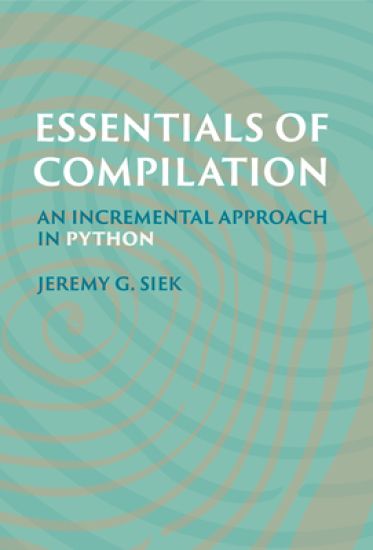
Essentials of Compilation

Essentials of Compilation

Jeremy G. Siek

MIT PRESS LTD
2023
sidottu
A hands-on approach to understanding and building compilers. Compilers are notoriously some of the most difficult programs to teach and understand. Most books about compilers dedicate one chapter to each progressive stage, a structure that hides how language features motivate design choices. By contrast, this innovative textbook provides an incremental approach that allows students to write every single line of code themselves. Essentials of Compilation guides the reader in constructing their own compiler for a small but powerful programming language, adding complex language features as the book progresses. Jeremy Siek explains the essential concepts, algorithms, and data structures that underlie modern compilers and lays the groundwork for future study of advanced topics. Already in wide use by students and professionals alike, this rigorous but accessible book invites readers to learn by doing. Deconstructs the challenge of compiler construction into bite-sized piecesEnhances learning by connecting language features to compiler design choicesDevelops understanding of how programs are mapped onto computer hardwareLearn-by-doing approach suitable for students and professionalsProven in the classroomExtensive ancillary resources include source code and solutions
Essentials of Compilation

Essentials of Compilation

Jeremy G. Siek

MIT PRESS LTD
2023
sidottu
A hands-on approach to understanding and building compilers using the programming language Python. Compilers are notoriously difficult programs to teach and understand. Most books about compilers dedicate one chapter to each progressive stage, a structure that hides how language features motivate design choices. By contrast, this innovative textbook provides an incremental approach that allows students to write every single line of code themselves. Jeremy Siek guides the reader in constructing their own compiler in the powerful object-oriented programming language Python, adding complex language features as the book progresses. Essentials of Compilation explains the essential concepts, algorithms, and data structures that underlie modern compilers and lays the groundwork for future study of advanced topics. Already in wide use by students and professionals alike, this rigorous but accessible book invites readers to learn by doing. Deconstructs the challenge of compiler construction into bite-sized piecesEnhances learning by connecting language features to compiler design choicesDevelops understanding of how programs are mapped onto computer hardwareClassroom-tested, hands-on approach suitable for students and professionalsExtensive ancillary resources include source code and solutions
Architecture Depends

Architecture Depends

Jeremy Till

MIT Press
2013
pokkari
Polemics and reflections on how to bridge the gap between what architecture actually is and what architects want it to be.Architecture depends—on what? On people, time, politics, ethics, mess: the real world. Architecture, Jeremy Till argues with conviction in this engaging, sometimes pugnacious book, cannot help itself; it is dependent for its very existence on things outside itself. Despite the claims of autonomy, purity, and control that architects like to make about their practice, architecture is buffeted by uncertainty and contingency. Circumstances invariably intervene to upset the architect's best-laid plans—at every stage in the process, from design through construction to occupancy. Architects, however, tend to deny this, fearing contingency and preferring to pursue perfection. With Architecture Depends, architect and critic Jeremy Till offers a proposal for rescuing architects from themselves: a way to bridge the gap between what architecture actually is and what architects want it to be. Mixing anecdote, design, social theory, and personal experience, Till's writing is always accessible, moving freely between high and low registers, much like his suggestions for architecture itself.
Picturing Aura

Picturing Aura

Jeremy Stolow

MIT PRESS LTD
2025
nidottu
The remarkable history of efforts to visualize the human aura and the lives of its pictures in religion, science, art, and culture. Picturing Aura is the first book of its kind: an extended historical, anthropological, and philosophical study of modern efforts to visualize the hidden radiant force encompassing the living body, known as our aura. This rich, interdisciplinary study by Jeremy Stolow chronicles the rise and global spread of modern instruments and techniques of picturing aura, from the late nineteenth century to the present day, exploring how its pictures are put to work in the diverse realms of psychical research, esotericism, art photography, popular culture, and the New Age alternative medical and spiritual marketplace. At their core, pictures of aura are boundary objects that operate simultaneously in multiple conceptual and practical realms, serving varying goals of making art, healing bodies, and exploring the cosmos. Drawing upon extensive archival as well as field research, Stolow reconstructs a global history of this boundary-crossing enterprise through its evolving media technologies, markets, and cultural arenas. It is a story shaped through exchanges among professionals and amateurs, scientists and occultists, countercultural artists and entrepreneurs, metropolitans and hinterland figures. With more than 60 full-color illustrations, Picturing Aura brings to light a remarkable, entangled history of picture-making that challenges settled assumptions about religion, art, and science.
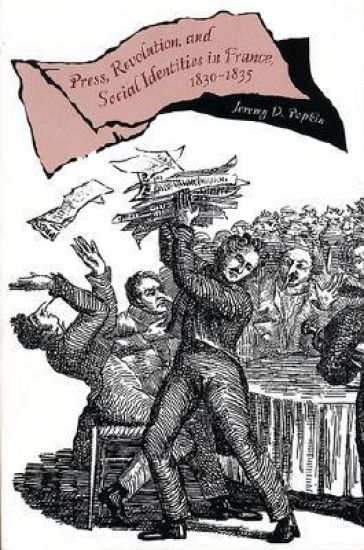
Press, Revolution, and Social Identities in France, 1830–1835

Press, Revolution, and Social Identities in France, 1830–1835

Jeremy D. Popkin

Pennsylvania State University Press
2001
sidottu
In this innovative study of the press during the French Revolutionary crisis of the early 1830s, Jeremy Popkin shows that newspapers played a crucial role in defining a new repertoire of identities—for workers, women, and members of the middle classes—that redefined Europe’s public sphere. Nowhere was this process more visible than in Lyon, the great manufacturing center where the aftershocks of the July Revolution of 1830 were strongest. In July 1830 Lyon’s population had rallied around its liberal newspaper and opposed the conservative Restoration government. In less than two years, however, Lyon’s press and its public opinion, like those of the country as a whole, had become irrevocably fragmented. Popkin shows how the structure of the "journalistic field" in liberal society multiplied political conflicts and produced new tensions between the domains of politics and culture. New periodicals appeared claiming to speak for workers, for women, and for the local interests of Lyon. The public was becoming inherently plural with the emergence of new "imagined communities" that would dominate French public life well into the twentieth century. Jeremy Popkin is well known for his earlier studies of journalism during the eighteenth century and the French Revolution. In Press, Revolution, and Social Identities in France, he not only moves forward in time but also offers a new model for a cultural history of journalism and its relationship to literature.
Press, Revolution, and Social Identities in France, 1830–1835

Press, Revolution, and Social Identities in France, 1830–1835

Jeremy D. Popkin

Pennsylvania State University Press
2001
pokkari
In this innovative study of the press during the French Revolutionary crisis of the early 1830s, Jeremy Popkin shows that newspapers played a crucial role in defining a new repertoire of identities—for workers, women, and members of the middle classes—that redefined Europe’s public sphere. Nowhere was this process more visible than in Lyon, the great manufacturing center where the aftershocks of the July Revolution of 1830 were strongest. In July 1830 Lyon’s population had rallied around its liberal newspaper and opposed the conservative Restoration government. In less than two years, however, Lyon’s press and its public opinion, like those of the country as a whole, had become irrevocably fragmented. Popkin shows how the structure of the "journalistic field" in liberal society multiplied political conflicts and produced new tensions between the domains of politics and culture. New periodicals appeared claiming to speak for workers, for women, and for the local interests of Lyon. The public was becoming inherently plural with the emergence of new "imagined communities" that would dominate French public life well into the twentieth century. Jeremy Popkin is well known for his earlier studies of journalism during the eighteenth century and the French Revolution. In Press, Revolution, and Social Identities in France, he not only moves forward in time but also offers a new model for a cultural history of journalism and its relationship to literature.
The Politics of Resentment

The Politics of Resentment

Jeremy Engels

Pennsylvania State University Press
2015
pokkari
In the days and weeks following the tragic 2011 shooting of nineteen Arizonans, including congresswoman Gabrielle Giffords, there were a number of public discussions about the role that rhetoric might have played in this horrific event. In question was the use of violent and hateful rhetoric that has come to dominate American political discourse on television, on the radio, and at the podium. A number of more recent school shootings have given this debate a renewed sense of urgency, as have the continued use of violent metaphors in public address and the dishonorable state of America’s partisan gridlock. This conversation, unfortunately, has been complicated by a collective cultural numbness to violence. But that does not mean that fruitful conversations should not continue. In The Politics of Resentment, Jeremy Engels picks up this thread, examining the costs of violent political rhetoric for our society and the future of democracy.The Politics of Resentment traces the rise of especially violent rhetoric in American public discourse by investigating key events in American history. Engels analyzes how resentful rhetoric has long been used by public figures in order to achieve political ends. He goes on to show how a more devastating form of resentment started in the 1960s, dividing Americans on issues of structural inequalities and foreign policy. He discusses, for example, the rhetorical and political contexts that have made the mobilization of groups such as Nixon’s “silent majority” and the present Tea Party possible. Now, in an age of recession and sequestration, many Americans believe that they have been given a raw deal and experience feelings of injustice in reaction to events beyond individual control. With The Politics of Resentment, Engels wants to make these feelings of victimhood politically productive by challenging the toxic rhetoric that takes us there, by defusing it, and by enabling citizens to have the kinds of conversations we need to have in order to fight for life, liberty, and equality.
The Politics of Resentment

The Politics of Resentment

Jeremy Engels

Pennsylvania State University Press
2015
sidottu
In the days and weeks following the tragic 2011 shooting of nineteen Arizonans, including congresswoman Gabrielle Giffords, there were a number of public discussions about the role that rhetoric might have played in this horrific event. In question was the use of violent and hateful rhetoric that has come to dominate American political discourse on television, on the radio, and at the podium. A number of more recent school shootings have given this debate a renewed sense of urgency, as have the continued use of violent metaphors in public address and the dishonorable state of America’s partisan gridlock. This conversation, unfortunately, has been complicated by a collective cultural numbness to violence. But that does not mean that fruitful conversations should not continue. In The Politics of Resentment, Jeremy Engels picks up this thread, examining the costs of violent political rhetoric for our society and the future of democracy.The Politics of Resentment traces the rise of especially violent rhetoric in American public discourse by investigating key events in American history. Engels analyzes how resentful rhetoric has long been used by public figures in order to achieve political ends. He goes on to show how a more devastating form of resentment started in the 1960s, dividing Americans on issues of structural inequalities and foreign policy. He discusses, for example, the rhetorical and political contexts that have made the mobilization of groups such as Nixon’s “silent majority” and the present Tea Party possible. Now, in an age of recession and sequestration, many Americans believe that they have been given a raw deal and experience feelings of injustice in reaction to events beyond individual control. With The Politics of Resentment, Engels wants to make these feelings of victimhood politically productive by challenging the toxic rhetoric that takes us there, by defusing it, and by enabling citizens to have the kinds of conversations we need to have in order to fight for life, liberty, and equality.
The Politics of James Bond

The Politics of James Bond

Jeremy M. Black

Praeger Publishers Inc
2000
sidottu
The adventures and antics of James Bond have provided the world with many of the most gripping story lines of the last half-century. Fleming's novels were best-sellers in their day, and the Bond films have been even more popular, becoming the most enduring and successful film franchise in history. By some estimates, half of the world's population—billions of people—have seen a James Bond movie, thus viewing an image of global struggle through Western eyes and obtaining a particular perception of Britain and the world. This fascinating and accessible account of the global phenomenon uses the plots and characterizations in the novels and the blockbuster films to place Bond in a historical, cultural, and political context.Black charts and explores how the settings and the dynamics of the Bond adventures have changed over time in response to shifts in the real-world environment in which the fictional Bond operates. Sex, race, class, and violence are each important factors as 007 evolves from Cold Warrior to foe of SPECTRE and eventually to world defender pitted against megalomaniacal foes. The development of Bond, his leading ladies, and the major plots all shed light on world political attitudes and reflect elements of the real espionage history of the period. This look at Bond's world and his lasting legacy offers an intriguing glimpse into both cultural history and popular entertainment.
America as a Military Power

America as a Military Power

Jeremy M. Black

Praeger Publishers Inc
2002
nidottu
How have military actions shaped the history of the United States and the country's role in world history? Noted military historian Jeremy Black examines American military exceptionalism with the critical eye of a foreign scholar. The British fought two wars with the Americans and followed American developments with keen interest. Black marshals contemporary British commentary to contextualize American military actions within a global perspective.Several major conflicts are covered:^L^DBLThe War for Independence^DBLThe War of 1812^DBLThe Mexican War^DBLWar with Native Americans^DBLThe Civil War^LThroughout this phase of America military action, one sees a shift from a state in conflict with neighboring states to a nation divided, fighting for its very survival. This study clarifies the unique combination of political, social, intellectual, and physical factors-including potential threats-that shaped, and were shaped, by the general American culture during this period.
The Age of Total War, 1860-1945

The Age of Total War, 1860-1945

Jeremy M. Black

Praeger Publishers Inc
2006
sidottu
What is total war? Definitions abound, but one thing is certain—the concept of total war has come to be seen as a defining concept of the modern age. Celebrated historian Jeremy Black explores the rise and demise of an era of total war, which he defines in terms of the intensity of the struggle, the range (geographical and/or chronological) of conflict, the nature of the goals, and the extent to which civil society was involved. He contends that this era (roughly 1860-1945) was markedly different from the warfare that characterized earlier periods; and that it is very different from the situation that has evolved since, with its emphasis on asymmetrical conflict and limited warfare.Acknowledging that various definitions are problematic and often contradictory, Black argues that 1860 to 1945 was an era in which the prospect of war and the consequences of it were crucially important for human history. He focuses primarily on conflict between Western powers, including Japanese participation in the Russo-Japanese War. Trends and developments subsequent to 1945 have combined, Black asserts, to make a return to total war unlikely.
A Military History of Britain

A Military History of Britain

Jeremy M. Black

Praeger Publishers Inc
2006
sidottu
Starting his account at a time when Britain was poised to rule the world's oceans—and much of its land as well—prolific historian Jeremy Black details the nation's involvement in global affairs from the late-18th century to the present. A Military History of Britain is an account of military structures and cultures, and relevant socio-political contexts, as well as of conflicts. As in all of his writing, Black seeks to challenge conventional assumptions and offer illuminating new perspectives. Black begins by setting the background to British military history, in particular the anti-(large) army ideology, the maritime tradition, and the growing geo-political rivalry with France. After the defeat of the French in North America, Britain would become the world's leading maritime power. The 19th Century would see tension between Britain and the new United States, France, Germany, and an increasing emphasis on imperial conquests. Organized in three parts: Britain as Imperial Parent; Britain as Imperial Rival; and Britain as Imperial Partner. A primary focus of this account will be the 20th century, examining Britain and World War I (including Britain as a world power and issues of imperial overstretch) and World War II (and the subsequent wars of Imperial Retention in Malaya, Kenya, and Cyprus). As in all of his writing, Black seeks to challenge conventional assumptions, and offer illuminating new perspectives. Black details the involvement of Britain in global affairs up to the present. Recent issues of continuing importance include Britain as a nuclear power, the end of the East of Suez policy, NATO membership; out-of-area conflict (from the Falklands to Iraq), and the adjustment to new global roles. This wide-ranging and broadly-based account is designed for students and for the general reader.
Time to Act

Time to Act

Jeremy Williams

SPCK Publishing
2020
pokkari
'The climate crisis is the biggest issue facing humanity today. . . It is only together that we can make a difference.' Amanda Khozi Mukwashi, Christian Aid Written by members and friends of Christian Climate Action, this stimulating resource book sets out the moral and religious case for joining the struggle against climate change. It reflects on the Christian tradition of non-violent direct action, and offers deeply moving testimonies by those engaged in such protests today, along with powerful sermons, prayers, liturgies and other spiritual resources. Now is the time to act! Don't let it pass you by! 'This is a landmark book. It is nothing short of an invitation to join the holy uprising of people sweeping the globe who will not be silent in the face of the destruction of God's earth.' Shane Claiborne, Red Letter Christians
The Folds of Parnassos

The Folds of Parnassos

Jeremy McInerney

University of Texas Press
2000
pokkari
Independent city-states (poleis) such as Athens have been viewed traditionally as the most advanced stage of state formation in ancient Greece. By contrast, this pioneering book argues that for some Greeks the ethnos, a regionally based ethnic group, and the koinon, or regional confederation, were equally valid units of social and political life and that these ethnic identities were astonishingly durable. Jeremy McInerney sets his study in Phokis, a region in central Greece dominated by Mount Parnassos that shared a border with the panhellenic sanctuary at Delphi. He explores how ecological conditions, land use, and external factors such as invasion contributed to the formation of a Phokian territory. Then, drawing on numerous interdisciplinary sources, he traces the history of the region from the Archaic age down to the Roman period. McInerney shows how shared myths, hero cults, and military alliances created an ethnic identity that held the region together over centuries, despite repeated invasions. He concludes that the Phokian koinon survived because it was founded ultimately on the tenacity of the smaller communities of Greece.
Conjuring Property

Conjuring Property

Jeremy M. Campbell

University of Washington Press
2015
sidottu
Winner of the 2017 James M. Blaut Award from the Cultural and Political Ecology Specialty Group of the Association of American GeographersHonorable Mention for the 2016 Book Prize from the Association for Political and Legal AnthropologySince the 1960s, when Brazil first encouraged large-scale Amazonian colonization, violence and confusion have often accompanied national policies concerning land reform, corporate colonization, indigenous land rights, environmental protection, and private homesteading. Conjuring Property shows how, in a region that many perceive to be stateless, colonists - from highly capitalized ranchers to landless workers - adopt anticipatory stances while they await future governance intervention regarding land tenure. For Amazonian colonists, property is a dynamic category that becomes salient in the making: it is conjured through papers, appeals to state officials, and the manipulation of landscapes and memories of occupation. This timely study will be of interest to development studies scholars and practitioners, conservation ecologists, geographers, and anthropologists.
Conjuring Property

Conjuring Property

Jeremy M. Campbell

University of Washington Press
2015
pokkari
Winner of the 2017 James M. Blaut Award from the Cultural and Political Ecology Specialty Group of the Association of American GeographersHonorable Mention for the 2016 Book Prize from the Association for Political and Legal AnthropologySince the 1960s, when Brazil first encouraged large-scale Amazonian colonization, violence and confusion have often accompanied national policies concerning land reform, corporate colonization, indigenous land rights, environmental protection, and private homesteading. Conjuring Property shows how, in a region that many perceive to be stateless, colonists - from highly capitalized ranchers to landless workers - adopt anticipatory stances while they await future governance intervention regarding land tenure. For Amazonian colonists, property is a dynamic category that becomes salient in the making: it is conjured through papers, appeals to state officials, and the manipulation of landscapes and memories of occupation. This timely study will be of interest to development studies scholars and practitioners, conservation ecologists, geographers, and anthropologists.