Kirjojen hintavertailu. Mukana 11 699 587 kirjaa ja 12 kauppaa.

Kirjahaku

Etsi kirjoja tekijän nimen, kirjan nimen tai ISBN:n perusteella.

1000 tulosta hakusanalla Jermoe Klinkowitz

Cocaine Addiction

Cocaine Addiction

Jerome J. Platt

Harvard University Press
2000
nidottu
It inspired written testimonials from William McKinley, Thomas Edison, and Sarah Bernhardt; merited a medal from Pope Leo XIII; produced "exhilaration and lasting euphoria" in Sigmund Freud. Once the stimulant of choice of the enlightened and the elite, cocaine has become, a century later, a plague, ravaging the lives of millions. This book is the first to draw together all the facts about this pervasive drug--from its natural occurrence in a tea-like native South American plant to its devastating appearance as crack in the inner cities of the United States.Drawing on the latest work in medicine, psychiatry, neuroscience, pharmacology, epidemiology, social work, and sociology, the volume is a highly accessible reference on the history and use of cocaine, its physical and psychological effects, and the etiology and epidemiology of cocaine addiction. It also provides a critical evaluation of the pharmaceutical agents and psychosocial interventions that have been used to treat this addiction. Author Jerome J. Platt answers such basic questions as: What is cocaine? What forms does it come in? How is it administered? What does it do? What are the medical complications of cocaine addiction? What are the treatments, and how successful are they?Uniquely comprehensive, Cocaine Addiction makes all the latest information on this urgent subject readily available to medical professionals and practitioners, social workers and scholars, and anyone who cares to know more about this perennially troubling drug.
Three Seductive Ideas

Three Seductive Ideas

Jerome Kagan

Harvard University Press
2000
nidottu
Do the first two years of life really determine a child’s future development? Are human beings, like other primates, only motivated by pleasure? And do people actually have stable traits, like intelligence, fear, anxiety, and temperament? This book, the product of a lifetime of research by one of the founders of developmental psychology, takes on the powerful assumptions behind these questions—and proves them mistaken. Ranging with impressive ease from cultural history to philosophy to psychological research literature, Jerome Kagan weaves an argument that will rock the social sciences and the foundations of public policy.Scientists, as well as lay people, tend to think of abstract processes—like intelligence or fear—as measurable entities, of which someone might have more or less. This approach, in Kagan’s analysis, shows a blindness to the power of context and to the great variability within any individual subject to different emotions and circumstances. “Infant determinism” is another widespread and dearly held conviction that Kagan contests. This theory—with its claim that early relationships determine lifelong patterns—underestimates human resiliency and adaptiveness, both emotional and cognitive (and, of course, fails to account for the happy products of miserable childhoods and vice versa). The last of Kagan’s targets is the vastly overrated pleasure principle, which, he argues, can hardly make sense of unselfish behavior impelled by the desire for virtue and self-respect—the wish to do the right thing.Written in a lively style that uses fables and fairy tales, history and science to make philosophical points, this book challenges some of our most cherished notions about human nature.
Acts of Meaning

Acts of Meaning

Jerome Bruner

Harvard University Press
1993
nidottu
Jerome Bruner argues that the cognitive revolution, with its current fixation on mind as “information processor,” has led psychology away from the deeper objective of understanding mind as a creator of meanings. Only by breaking out of the limitations imposed by a computational model of mind can we grasp the special interaction through which mind both constitutes and is constituted by culture.
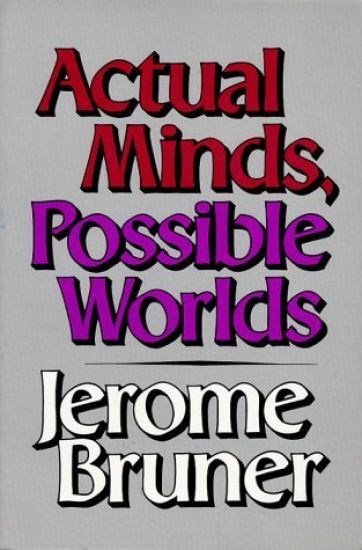
Actual Minds, Possible Worlds

Actual Minds, Possible Worlds

Jerome Bruner

Harvard University Press
1987
nidottu
In this characteristically graceful and provocative book, Jerome Bruner, one of the principal architects of the cognitive revolution, sets forth nothing less than a new agenda for the study of mind. According to Professor Bruner, cognitive science has set its sights too narrowly on the logical, systematic aspects of mental life—those thought processes we use to solve puzzles, test hypotheses, and advance explanations. There is obviously another side to the mind—a side devoted to the irrepressibly human acts of imagination that allow us to make experience meaningful. This is the side of the mind that leads to good stories, gripping drama, primitive myths and rituals, and plausible historical accounts. Bruner calls it the “narrative mode,” and his book makes important advances in the effort to unravel its nature.Drawing on recent work in literary theory, linguistics, and symbolic anthropology, as well as cognitive and developmental psychology, Professor Bruner examines the mental acts that enter into the imaginative creation of possible worlds, and he shows how the activity of imaginary world making undergirds human science, literature, and philosophy, as well as everyday thinking, and even our sense of self.Over twenty years ago, Jerome Bruner first sketched his ideas about the mind’s other side in his justly admired book, On Knowing: Essays for the Left Hand. Actual Minds, Possible Worlds can be read as a sequel to this earlier work, but it is a sequel that goes well beyond its predecessor by providing rich examples of just how the mind’s narrative mode can be successfully studied. The collective force of these examples points the way toward a more humane and subtle approach to the investigation of how the mind works.
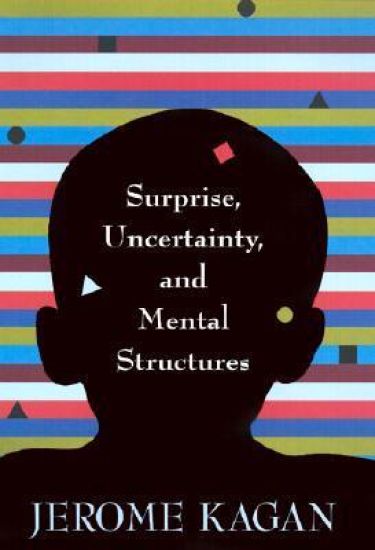
Surprise, Uncertainty, and Mental Structures

Surprise, Uncertainty, and Mental Structures

Jerome Kagan

Harvard University Press
2002
sidottu
When we are startled by the new, confronted with discrepancies, our knowing gives way to uncertainty—and changes. In the distinctive manner that has made him one of the most influential forces in developmental psychology, Jerome Kagan challenges scientific commonplaces about mental processes, pointing in particular to the significant but undervalued role of surprise and uncertainty in shaping behavior, emotion, and thought.Drawing on research in both animal and human subjects, Kagan presents a strong case for making qualitative distinctions among four different types of mental representation—perceptual schemata, visceral schemata, sensorimotor structures, and semantic networks—and describes how each is susceptible to the experience of discrepancy and the feeling of surprise or uncertainty. The implications of these findings are far-reaching, challenging current ideas about the cognitive understandings of infants and revealing the bankruptcy of contemporary questionnaire-based personality theory. More broadly, Kagan’s daring, thoroughly informed, and keenly reasoned book demonstrates the risks of making generalizations about human behavior, in which culture, context, and past experience play such paramount and unpredictable roles.
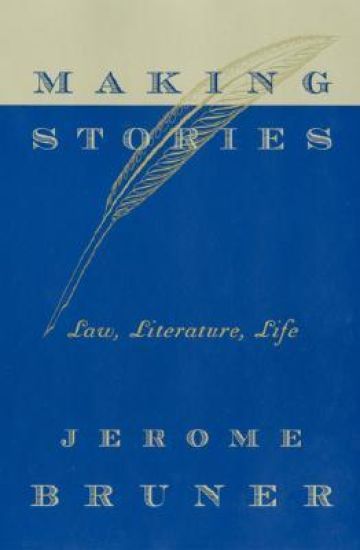
Making Stories

Making Stories

Jerome Bruner

Harvard University Press
2003
nidottu
Stories pervade our daily lives, from human interest news items, to a business strategy described to a colleague, to daydreams between chores. Stories are what we use to make sense of the world. But how does this work? In Making Stories, the eminent psychologist Jerome Bruner examines this pervasive human habit and suggests new and deeper ways to think about how we use stories to make sense of lives and the great moral and psychological problems that animate them. Looking at legal cases and autobiography as well as literature, Bruner warns us not to be seduced by overly tidy stories and shows how doubt and double meaning can lie beneath the most seemingly simple case.
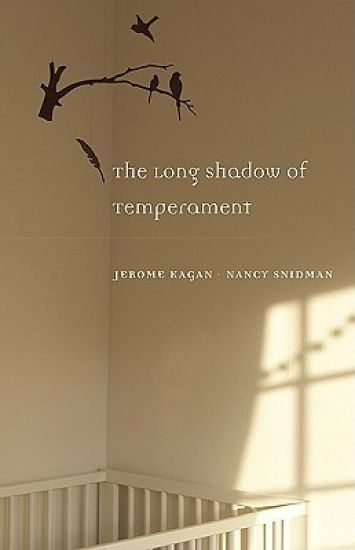
The Long Shadow of Temperament

The Long Shadow of Temperament

Jerome Kagan; Nancy Snidman

The Belknap Press
2009
nidottu
We have seen these children—the shy and the sociable, the cautious and the daring—and wondered what makes one avoid new experience and another avidly pursue it. At the crux of the issue surrounding the contribution of nature to development is the study that Jerome Kagan and his colleagues have been conducting for more than two decades. In The Long Shadow of Temperament, Kagan and Nancy Snidman summarize the results of this unique inquiry into human temperaments, one of the best-known longitudinal studies in developmental psychology. These results reveal how deeply certain fundamental temperamental biases can be preserved over development.Identifying two extreme temperamental types—inhibited and uninhibited in childhood, and high-reactive and low-reactive in very young babies—Kagan and his colleagues returned to these children as adolescents. Surprisingly, one of the temperaments revealed in infancy predicted a cautious, fearful personality in early childhood and a dour mood in adolescence. The other bias predicted a bold childhood personality and an exuberant, sanguine mood in adolescence. These personalities were matched by different biological properties. In a masterly summary of their wide-ranging exploration, Kagan and Snidman conclude that these two temperaments are the result of inherited biologies probably rooted in the differential excitability of particular brain structures. Though the authors appreciate that temperamental tendencies can be modified by experience, this compelling work—an empirical and conceptual tour-de-force—shows how long the shadow of temperament is cast over psychological development.
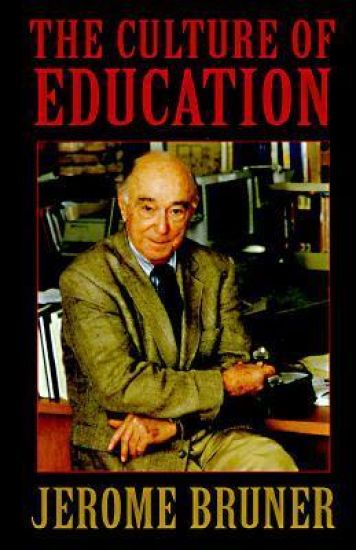
The Culture of Education

The Culture of Education

Jerome Bruner

Harvard University Press
1997
nidottu
What we don't know about learning could fill a book--and it might be a schoolbook. In a masterly commentary on the possibilities of education, the eminent psychologist Jerome Bruner reveals how education can usher children into their culture, though it often fails to do so. Applying the newly emerging "cultural psychology" to education, Bruner proposes that the mind reaches its full potential only through participation in the culture--not just its more formal arts and sciences, but its ways of perceiving, thinking, feeling, and carrying out discourse. By examining both educational practice and educational theory, Bruner explores new and rich ways of approaching many of the classical problems that perplex educators.Education, Bruner reminds us, cannot be reduced to mere information processing, sorting knowledge into categories. Its objective is to help learners construct meanings, not simply to manage information. Meaning making requires an understanding of the ways of one's culture--whether the subject in question is social studies, literature, or science. The Culture of Education makes a forceful case for the importance of narrative as an instrument of meaning making. An embodiment of culture, narrative permits us to understand the present, the past, and the humanly possible in a uniquely human way.Going well beyond his earlier acclaimed books on education, Bruner looks past the issue of achieving individual competence to the question of how education equips individuals to participate in the culture on which life and livelihood depend. Educators, psychologists, and students of mind and culture will find in this volume an unsettling criticism that challenges our current conventional practices--as well as a wise vision that charts a direction for the future.
The Second Year

The Second Year

Jerome Kagan

Harvard University Press
1981
sidottu
The second year is that daunting time when the previously docile and adorable infant inevitably develops a mind of her own. In this book, Jerome Kagan takes a provocative look at the mental developments underlying the startling transitions in the child's second year. It is Kagan's premise that the roots of self-awareness emerge in the second half of the second year of life. He also suggests that the underlying cause may be more biological than social. His book develops these ideas through a series of brilliant observations on the behavior of two-year-olds. Kagan charts, for example, the emerging sense of standards (the possibility of right and wrong) that reveals itself positively when the child suddenly begins to smile after a successful action, and negatively when the child starts to become concerned about flaws in objects and mistakes in her own behavior. When this concern with standards spreads to the child's irresistible impulse to imitate adults, Kagan observes a remarkable phenomenon: the twenty-month-old child suddenly begins to show signs of distress before she even tries to imitate an action that is beyond her ability. Kagan argues that this distress could arise only from the child's growing sense of what she can and can't do--her awareness of herself.
Plantation Slavery in Barbados

Plantation Slavery in Barbados

Jerome S Handler; Frederick W Lange

Harvard University Press
1978
sidottu
Here is the first detailed investigation of plantation slave life in Barbados from earliest times until 1838. The authors have visited slave village sites, and their intensive excavation of a slave cemetery has yielded a wealth of material pertaining to mortuary practices and other dimensions of social and material life. Handler and Lange have also examined and extensively integrated the written records to amplify and cross-check their findings. Based on the methodologies of archaeology, history, and ethnography, "Plantation Slavery in Barbados" explores new ways to reconstruct the culture of a social group that left few historical records. As a description of the organization and development of the plantation system in Barbados, it is a model work in the burgeoning fields of slavery studies, historical anthropology, and Caribbean history.
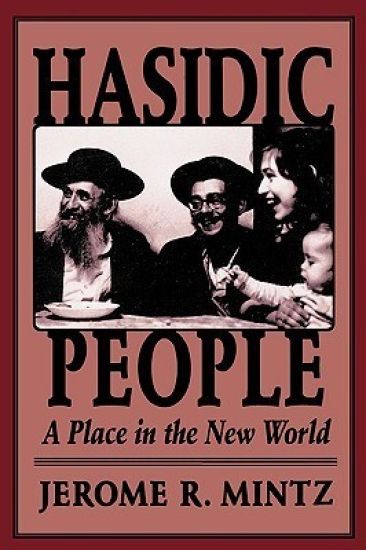
Hasidic People

Hasidic People

Jerome R. Mintz

Harvard University Press
1998
nidottu
In this engrossing social history of the New York Hasidic community based on extensive interviews, observation, newspaper files, and court records, Jerome Mintz combines historical study with tenacious investigation to provide a vivid account of social and religious dynamics. Hasidic People takes the reader from the various neighborhood settlements through years of growth to today’s tragic incidents and conflicts. In an engaging style, rich with personal insight, Mintz invites us into this old world within the new, a way of life at once foreign and yet intrinsic to the American experience.
The Poet Edgar Allan Poe

The Poet Edgar Allan Poe

Jerome McGann

Harvard University Press
2014
sidottu
The poetry of Edgar Allan Poe has had a rough ride in America, as Emerson’s sneering quip about “The Jingle Man” testifies. That these poems have never lacked a popular audience has been a persistent annoyance in academic and literary circles; that they attracted the admiration of innovative poetic masters in Europe and especially France—notably Baudelaire, Mallarmé, and Valéry—has been further cause for embarrassment. Jerome McGann offers a bold reassessment of Poe’s achievement, arguing that he belongs with Whitman and Dickinson as a foundational American poet and cultural presence.Not all American commentators have agreed with Emerson’s dim view of Poe’s verse. For McGann, a notable exception is William Carlos Williams, who said that the American poetic imagination made its first appearance in Poe’s work. The Poet Edgar Allan Poe explains what Williams and European admirers saw in Poe, how they understood his poetics, and why his poetry had such a decisive influence on Modern and Post-Modern art and writing. McGann contends that Poe was the first poet to demonstrate how the creative imagination could escape its inheritance of Romantic attitudes and conventions, and why an escape was desirable. The ethical and political significance of Poe’s work follows from what the poet takes as his great subject: the reader.The Poet Edgar Allan Poe takes its own readers on a spirited tour through a wide range of Poe’s verse as well as the critical and theoretical writings in which he laid out his arresting ideas about poetry and poetics.
Infancy

Infancy

Jerome Kagan; Richard B. Kearsley; Philip R. Zelazo

Harvard University Press
1978
nidottu
Here is a major new work on human infancy written by one of the country’s leading developmental psychologists and two distinguished colleagues. At its core is the long-awaited report of the authors’ six-year study of infant day care. Important in its own right, this experiment becomes the occasion for a wide-ranging discussion of cognitive and emotional processes in infancy, of the effects of early experience on later growth, and of the deep-seated cultural and historical assumptions that underlie our views of human development.For those concerned with social policy, the book provides the best empirical assessment now available of the effects of group care on the psychological well-being of infants. It also supplies a blueprint for quality daycare that may well stand as a model for future nurseries. For those interested in the course of cognitive and emotional development, the book provides rich information about the major growth functions that characterize human infancy. It also outlines an explanation of these growth functions that links changes in emotional behavior to the maturation of underlying cognitive processes in a new and provocative way. And for everyone interested in human nature, the book of offers a controversial thesis about the discontinuity of psychological growth that challenges some of our most fundamental assumptions about the nature of individual development.For this paperback edition, the statistical summary has been removed from the appendix to shorten the work and make it even more appealing to the general reader.
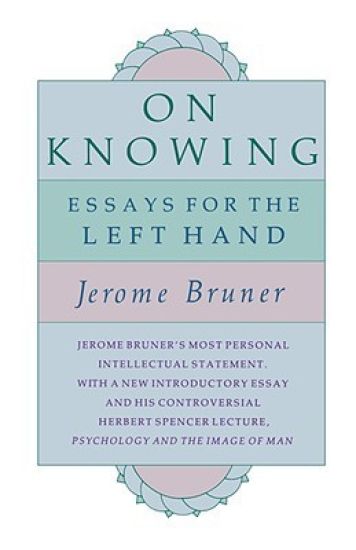
On Knowing

On Knowing

Jerome Bruner

The Belknap Press
1979
nidottu
The left hand has traditionally represented the powers of intuition, feeling, and spontaneity. In this classic book, Jerome Bruner inquires into the part these qualities play in determining how we know what we do know; how we can help others to know—that is, to teach; and how our conception of reality affects our actions and is modified by them.The striking and subtle discussions contained in On Knowing take on the core issues concerning man’s sense of self: creativity, the search for identity, the nature of aesthetic knowledge, myth, the learning process, and modern-day attitudes toward social controls, Freud, and fate. In this revised, expanded edition, Bruner comments on his personal efforts to maintain an intuitively and rationally balanced understanding of human nature, taking into account the odd historical circumstances which have hindered academic psychology’s attempts in the past to know man.Writing with wit, imagination, and deep sympathy for the human condition, Jerome Bruner speaks here to the part of man’s mind that can never be completely satisfied by the right-handed virtues of order, rationality, and discipline.
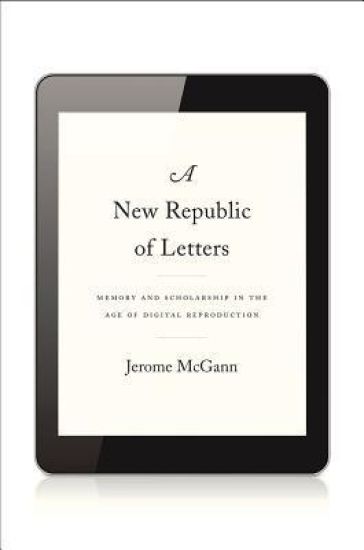
A New Republic of Letters

A New Republic of Letters

Jerome McGann

Harvard University Press
2014
sidottu
A manifesto for the humanities in the digital age, A New Republic of Letters argues that the history of texts, together with the methods by which they are preserved and made available for interpretation, are the overriding subjects of humanist study in the twenty-first century. Theory and philosophy, which have grounded the humanities for decades, no longer suffice as an intellectual framework. Jerome McGann proposes we look instead to philology--a discipline which has been out of fashion for many decades but which models the concerns of digital humanities with surprising fidelity.For centuries, books have been the best way to preserve and transmit knowledge. But as libraries and museums digitize their archives and readers abandon paperbacks for tablet computers, digital media are replacing books as the repository of cultural memory. While both the mission of the humanities and its traditional modes of scholarship and critical study are the same, the digital environment is driving disciplines to work with new tools that require major, and often very difficult, institutional changes. Now more than ever, scholars need to recover the theory and method of philological investigation if the humanities are to meet their perennial commitments. Textual and editorial scholarship, often marginalized as a narrowly technical domain, should be made a priority of humanists' attention.