Kirjojen hintavertailu. Mukana 11 244 527 kirjaa ja 12 kauppaa.

Kirjahaku

Etsi kirjoja tekijän nimen, kirjan nimen tai ISBN:n perusteella.

1000 tulosta hakusanalla Jon Edwards

Dissimulation and the Culture of Secrecy in Early Modern Europe

Dissimulation and the Culture of Secrecy in Early Modern Europe

Jon R. Snyder

University of California Press
2009
sidottu
'Larvatus prodeo', announced Rene Descartes at the beginning of the seventeenth century: 'I come forward, masked'. Deliberately disguising or silencing their most intimate thoughts and emotions, many early modern Europeans besides Descartes-princes, courtiers, aristocrats and commoners alike-chose to practice the shadowy art of dissimulation. For men and women who could not risk revealing their inner lives to those around them, this art of incommunicativity was crucial, both personally and politically. Many writers and intellectuals sought to explain, expose, justify, or condemn the emergence of this new culture of secrecy, and from Naples to the Netherlands controversy swirled for two centuries around the powers and limits of dissimulation, whether in affairs of state or affairs of the heart. This beautifully written work crisscrosses Europe, with a special focus on Italy, to explore attitudes toward the art of dissimulation in the sixteenth and seventeenth centuries. Discussing many canonical and lesser-known works, Jon R. Snyder examines the treatment of dissimulation in early modern treatises and writings on the court, civility, moral philosophy, political theory, and in the visual arts.
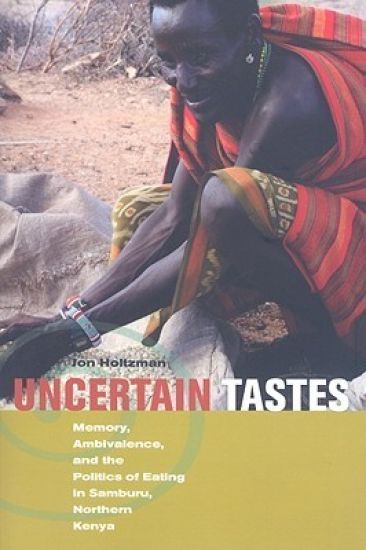
Uncertain Tastes

Uncertain Tastes

Jon Holtzman

University of California Press
2009
pokkari
This richly drawn ethnography of Samburu cattle herders in northern Kenya examines the effects of an epochal shift in their basic diet - from a regimen of milk, meat, and blood to one of purchased agricultural products. In his innovative analysis, Jon Holtzman uses food as a way to contextualize and measure the profound changes occurring in Samburu social and material life. He shows that if Samburu reaction to the new foods is primarily negative-they are referred to disparagingly as 'gray food' and 'government food' - it is also deeply ambivalent. For example, the Samburu attribute a host of social maladies to these dietary changes, including selfishness and moral decay. Yet because the new foods save lives during famines, the same individuals also talk of the triumph of reason over an antiquated culture and speak enthusiastically of a better life where there is less struggle to find food. Through detailed analysis of a range of food-centered arenas, "Uncertain Tastes" argues that the experience of food itself - symbolic, sensuous, social, and material - is intrinsically characterized by multiple, and frequently conflicting layers.
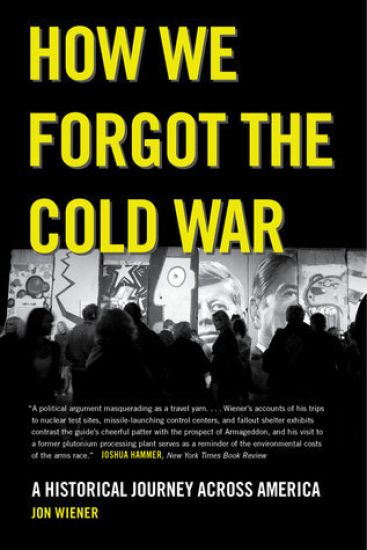
How We Forgot the Cold War

How We Forgot the Cold War

Jon Wiener

University of California Press
2012
sidottu
Hours after the USSR collapsed in 1991, Congress began making plans to establish the official memory of the Cold War. Conservatives dominated the proceedings, spending millions to portray the conflict as a triumph of good over evil and a defeat of totalitarianism equal in significance to World War II. In this provocative book, historian Jon Wiener visits Cold War monuments, museums, and memorials across the United States to find out how the era is being remembered. The author's journey provides a history of the Cold War, one that turns many conventional notions on their heads. In an engaging travelogue that takes readers to sites such as the life-size recreation of Berlin's "Checkpoint Charlie" at the Reagan Library, the fallout shelter display at the Smithsonian, and exhibits about "Sgt. Elvis," America's most famous Cold War veteran, Wiener discovers that the Cold War isn't being remembered. It's being forgotten. Despite an immense effort, the conservatives' monuments weren't built, their historic sites have few visitors, and many of their museums have now shifted focus to other topics. Proponents of the notion of a heroic "Cold War victory" failed; the public didn't buy the official story. Lively, readable, and well-informed, this book expands current discussions about memory and history, and raises intriguing questions about popular skepticism toward official ideology.
Dissimulation and the Culture of Secrecy in Early Modern Europe

Dissimulation and the Culture of Secrecy in Early Modern Europe

Jon R. Snyder

University of California Press
2012
pokkari
"Larvatus prodeo," announced Rene Descartes at the beginning of the seventeenth century: "I come forward, masked." Deliberately disguising or silencing their most intimate thoughts and emotions, many early modern Europeans besides Descartes-princes, courtiers, aristocrats and commoners alike-chose to practice the shadowy art of dissimulation. For men and women who could not risk revealing their inner lives to those around them, this art of incommunicativity was crucial, both personally and politically. Many writers and intellectuals sought to explain, expose, justify, or condemn the emergence of this new culture of secrecy, and from Naples to the Netherlands controversy swirled for two centuries around the powers and limits of dissimulation, whether in affairs of state or affairs of the heart. This beautifully written work crisscrosses Europe, with a special focus on Italy, to explore attitudes toward the art of dissimulation in the sixteenth and seventeenth centuries. Discussing many canonical and lesser-known works, Jon R. Snyder examines the treatment of dissimulation in early modern treatises and writings on the court, civility, moral philosophy, political theory, and in the visual arts.
How We Forgot the Cold War

How We Forgot the Cold War

Jon Wiener

University of California Press
2014
pokkari
Hours after the USSR collapsed in 1991, Congress began making plans to establish the official memory of the Cold War. Conservatives dominated the proceedings, spending millions to portray the conflict as a triumph of good over evil and a defeat of totalitarianism equal in significance to World War II. In this provocative book, historian Jon Wiener visits Cold War monuments, museums, and memorials across the United States to find out how the era is being remembered. The author's journey provides a history of the Cold War, one that turns many conventional notions on their heads. In an engaging travelogue that takes readers to sites such as the life-size recreation of Berlin's "Checkpoint Charlie" at the Reagan Library, the fallout shelter display at the Smithsonian, and exhibits about "Sgt. Elvis," America's most famous Cold War veteran, Wiener discovers that the Cold War isn't being remembered. It's being forgotten. Despite an immense effort, the conservatives' monuments weren't built, their historic sites have few visitors, and many of their museums have now shifted focus to other topics. Proponents of the notion of a heroic "Cold War victory" failed; the public didn't buy the official story. Lively, readable, and well-informed, this book expands current discussions about memory and history, and raises intriguing questions about popular skepticism toward official ideology.
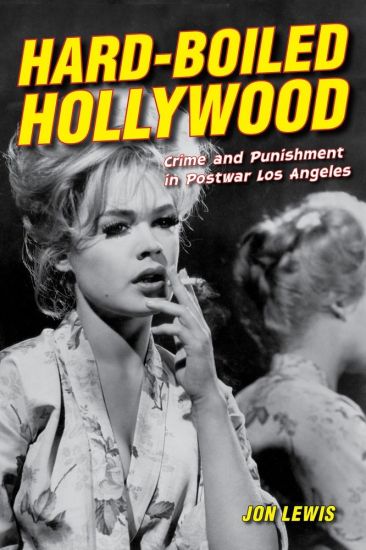
Hard-Boiled Hollywood

Hard-Boiled Hollywood

Jon Lewis

University of California Press
2017
sidottu
The tragic and mysterious circumstances surrounding the deaths of Elizabeth Short, or the Black Dahlia, and Marilyn Monroe ripped open Hollywood's glitzy facade, exposing the city's ugly underbelly of corruption, crime, and murder. These two spectacular dead bodies, one found dumped and posed in a vacant lot in January 1947, the other found dead in her home in August 1962, bookend this new history of Hollywood. Short and Monroe are just two of the many left for dead after the collapse of the studio system, Hollywood's awkward adolescence when the company town's many competing subcultures-celebrities, moguls, mobsters, gossip mongers, industry wannabes, and desperate transients-came into frequent contact and conflict. Hard-Boiled Hollywood focuses on the lives lost at the crossroads between a dreamed-of Los Angeles and the real thing after the Second World War, where reality was anything but glamorous."
Hard-Boiled Hollywood

Hard-Boiled Hollywood

Jon Lewis

University of California Press
2017
pokkari
The tragic and mysterious circumstances surrounding the deaths of Elizabeth Short, or the Black Dahlia, and Marilyn Monroe ripped open Hollywood's glitzy facade, exposing the city's ugly underbelly of corruption, crime, and murder. These two spectacular dead bodies, one found dumped and posed in a vacant lot in January 1947, the other found dead in her home in August 1962, bookend this new history of Hollywood. Short and Monroe are just two of the many left for dead after the collapse of the studio system, Hollywood's awkward adolescence when the company town's many competing subcultures-celebrities, moguls, mobsters, gossip mongers, industry wannabes, and desperate transients-came into frequent contact and conflict. Hard-Boiled Hollywood focuses on the lives lost at the crossroads between a dreamed-of Los Angeles and the real thing after the Second World War, where reality was anything but glamorous."
How Big Should Our Government Be?

How Big Should Our Government Be?

Jon Bakija; Lane Kenworthy; Peter Lindert; Jeff Madrick

University of California Press
2016
pokkari
The size of government is arguably the most controversial discussion in United States politics, and this issue won't fade from prominence any time soon. There must surely be a tipping point beyond which more government taxing and spending harms the economy, but where is that point? In this accessible book, best-selling authors Jeff Madrick, Jon Bakija, Lane Kenworthy, and Peter Lindert try to answer whether our government can grow any larger and examine how we can optimize growth and fair distribution.
Killing Your Neighbors

Killing Your Neighbors

Jon Holtzman

University of California Press
2016
sidottu
Neighboring communities who once lived together in peace have committed some of the most disturbing genocidal violence in recent decades: ethnic cleansing in the former Yugoslavia; the slaughter of Tutsis in Rwanda; or Sunni-versus-Shia violence in today's Iraq. As these instances illustrate, lethal violence does not always come at the hands of outsiders or foreigners-it can come just as easily from someone who was once considered a friend. Employing a multisited, multivocal approach to ethnography, Killing Your Neighbors examines how peaceful neighbors become involved in lethal violence. It engages with a set of interlocking case studies in northern Kenya, focusing on sometimes-peaceful, sometimes violent interactions between Samburu herders and neighboring groups, interweaving Samburu narratives of key violent events with the narratives of neighboring groups on the other side of the same encounters. The book is, on one hand, an ethnography of particular people in a particular place, vividly portraying the complex and confusing dynamics of interethnic violence through the lives, words and intimate experiences of individuals variously involved in and affected by these conflicts. At the same time, the book aims to use this particular case study to illustrate how the dynamics in northern Kenya provides comparative insights to well-known, compelling contexts of violence around the globe.
Killing Your Neighbors

Killing Your Neighbors

Jon Holtzman

University of California Press
2016
pokkari
Neighboring communities who once lived together in peace have committed some of the most disturbing genocidal violence in recent decades: ethnic cleansing in the former Yugoslavia; the slaughter of Tutsis in Rwanda; or Sunni-versus-Shia violence in today's Iraq. As these instances illustrate, lethal violence does not always come at the hands of outsiders or foreigners-it can come just as easily from someone who was once considered a friend. Employing a multisited, multivocal approach to ethnography, Killing Your Neighbors examines how peaceful neighbors become involved in lethal violence. It engages with a set of interlocking case studies in northern Kenya, focusing on sometimes-peaceful, sometimes violent interactions between Samburu herders and neighboring groups, interweaving Samburu narratives of key violent events with the narratives of neighboring groups on the other side of the same encounters. The book is, on one hand, an ethnography of particular people in a particular place, vividly portraying the complex and confusing dynamics of interethnic violence through the lives, words and intimate experiences of individuals variously involved in and affected by these conflicts. At the same time, the book aims to use this particular case study to illustrate how the dynamics in northern Kenya provides comparative insights to well-known, compelling contexts of violence around the globe.
A Diagram for Fire

A Diagram for Fire

Jon Bialecki

University of California Press
2017
sidottu
What is the work that miracles do in American Charismatic Evangelicalism? How can miracles be unanticipated and yet worked for? And finally, what do miracles tell us about other kinds of Christianity and even the category of religion? A Diagram for Fire engages with these questions in a detailed sociocultural ethnographic study of the Vineyard, an American Evangelical movement that originated in Southern California. The Vineyard is known worldwide for its intense musical forms of worship and for advocating the belief that all Christians can perform biblical-style miracles. Examining the miracle as both a strength and a challenge to institutional cohesion and human planning, this book situates the miracle as a fundamentally social means of producing change-surprise and the unexpected used to reimagine and reconfigure the will. Jon Bialecki shows how this configuration of the miraculous shapes typical Pentecostal and Charismatic religious practices as well as music, reading, economic choices, and conservative and progressive political imaginaries.
A Diagram for Fire

A Diagram for Fire

Jon Bialecki

University of California Press
2017
pokkari
What is the work that miracles do in American Charismatic Evangelicalism? How can miracles be unanticipated and yet worked for? And finally, what do miracles tell us about other kinds of Christianity and even the category of religion? A Diagram for Fire engages with these questions in a detailed sociocultural ethnographic study of the Vineyard, an American Evangelical movement that originated in Southern California. The Vineyard is known worldwide for its intense musical forms of worship and for advocating the belief that all Christians can perform biblical-style miracles. Examining the miracle as both a strength and a challenge to institutional cohesion and human planning, this book situates the miracle as a fundamentally social means of producing change-surprise and the unexpected used to reimagine and reconfigure the will. Jon Bialecki shows how this configuration of the miraculous shapes typical Pentecostal and Charismatic religious practices as well as music, reading, economic choices, and conservative and progressive political imaginaries.
The Revolt of the Hereros

The Revolt of the Hereros

Jon M. Bridgman

University of California Press
2022
pokkari
This title is part of UC Press's Voices Revived program, which commemorates University of California Press’s mission to seek out and cultivate the brightest minds and give them voice, reach, and impact. Drawing on a backlist dating to 1893, Voices Revived makes high-quality, peer-reviewed scholarship accessible once again using print-on-demand technology. This title was originally published in 1981.
Road Trip to Nowhere

Road Trip to Nowhere

Jon Lewis

University of California Press
2022
sidottu
How a new generation of counterculture talent changed the landscape of Hollywood, the film industry, and celebrity culture. By 1967, the commercial and political impact on Hollywood of the sixties counterculture had become impossible to ignore. The studios were in bad shape, still contending with a generation-long box office slump and struggling to get young people into the habit of going to the movies. Road Trip to Nowhere examines a ten-year span (from 1967 to 1976) rife with uneasy encounters between artists caught up in the counterculture and a corporate establishment still clinging to a studio system on the brink of collapse. Out of this tumultuous period many among the young and talented walked away from celebrity, turning down the best job Hollywood—and America—had on offer: movie star. Road Trip to Nowhere elaborates a primary-sourced history of movie production culture, examining the lives of a number of talented actors who got wrapped up in the politics and lifestyles of the counterculture. Thoroughly put off by celebrity culture, actors like Dennis Hopper, Christopher Jones, Jean Seberg, and others rejected the aspirational backstory and inevitable material trappings of success, much to the chagrin of the studios and directors who backed them. In Road Trip to Nowhere, film historian Jon Lewis details dramatic encounters on movie sets and in corporate boardrooms, on the job and on the streets, and in doing so offers an entertaining and rigorous historical account of an out-of-touch Hollywood establishment and the counterculture workforce they would never come to understand.
Road Trip to Nowhere

Road Trip to Nowhere

Jon Lewis

University of California Press
2022
pokkari
How a new generation of counterculture talent changed the landscape of Hollywood, the film industry, and celebrity culture. By 1967, the commercial and political impact on Hollywood of the sixties counterculture had become impossible to ignore. The studios were in bad shape, still contending with a generation-long box office slump and struggling to get young people into the habit of going to the movies. Road Trip to Nowhere examines a ten-year span (from 1967 to 1976) rife with uneasy encounters between artists caught up in the counterculture and a corporate establishment still clinging to a studio system on the brink of collapse. Out of this tumultuous period many among the young and talented walked away from celebrity, turning down the best job Hollywood—and America—had on offer: movie star. Road Trip to Nowhere elaborates a primary-sourced history of movie production culture, examining the lives of a number of talented actors who got wrapped up in the politics and lifestyles of the counterculture. Thoroughly put off by celebrity culture, actors like Dennis Hopper, Christopher Jones, Jean Seberg, and others rejected the aspirational backstory and inevitable material trappings of success, much to the chagrin of the studios and directors who backed them. In Road Trip to Nowhere, film historian Jon Lewis details dramatic encounters on movie sets and in corporate boardrooms, on the job and on the streets, and in doing so offers an entertaining and rigorous historical account of an out-of-touch Hollywood establishment and the counterculture workforce they would never come to understand.
The Revolt of the Hereros

The Revolt of the Hereros

Jon M. Bridgman

University of California Press
2022
sidottu
This title is part of UC Press's Voices Revived program, which commemorates University of California Press’s mission to seek out and cultivate the brightest minds and give them voice, reach, and impact. Drawing on a backlist dating to 1893, Voices Revived makes high-quality, peer-reviewed scholarship accessible once again using print-on-demand technology. This title was originally published in 1981.
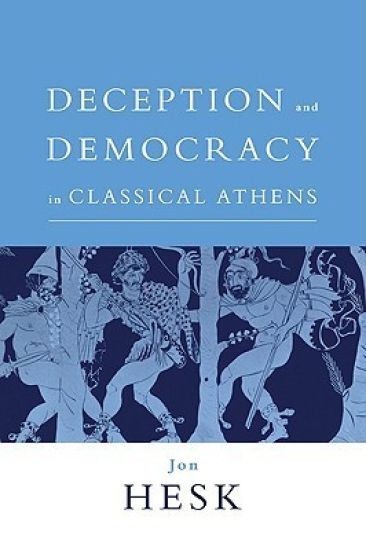
Deception and Democracy in Classical Athens

Deception and Democracy in Classical Athens

Jon Hesk

Cambridge University Press
2006
pokkari
This book, first published in 2000, is a full-length study of the representation of deceit and lies in classical Athens. Dr Hesk traces the ways in which Athenian drama, democratic oratory and elite prose-writing construct and theorize a relationship between dishonesty and civic identity. He focuses on the ideology of military trickery, notions of the 'noble lie' and the developing associations of rhetorical language with deceptive communication. Deception and Democracy in Classical Athens combines close analysis of Athenian texts with lively critiques of modern theorists and classical scholars. Athenian democratic culture was crucially informed by a nuanced, anxious and dynamic discourse on the problems and opportunities which deception presented for its citizenry. Mobilizing comparisons with twentieth-century democracies, the author argues that Athenian literature made deception a fundamental concern for democratic citizenship. This ancient discourse on lying highlights the dangers of modern resignation and postmodern complacency concerning the politics and morality of deception.
Pathways in the Workplace

Pathways in the Workplace

Jon Miller

Cambridge University Press
2006
pokkari
Rationalistic theories of the workplace and the claims typically made by organizations stress that an individual's access to the resources and advantages of an organization are determined by his or her qualifications and contributions to the collective enterprise, and that the payoffs for effort are essentially the same for all doing similar work. However, as Jon Miller shows in this book, negotiating for workplace rewards is actually far more complicated than this model allows, and he demonstrates that access to networks of organizational communication is in fact fundamentally influenced by race and gender. Comparing patterns of access to informal colleague networks and relations to the decision-making apparatus for white and non-white men and women in American public service organizations, he shows that only white males experienced a fairly close correspondence between their bureaucratic 'investments' and their workplace rewards.
Kierkegaard's Relations to Hegel Reconsidered

Kierkegaard's Relations to Hegel Reconsidered

Jon Stewart

Cambridge University Press
2007
pokkari
Jon Stewart's study is a major re-evaluation of the complex relations between the philosophies of Kierkegaard and Hegel. The standard view on the subject is that Kierkegaard defined himself as explicitly anti-Hegelian, indeed that he viewed Hegel's philosophy with disdain. Jon Stewart shows convincingly that Kierkegaard's criticism was not of Hegel but of a number of contemporary Danish Hegelians. Kierkegaard's own view of Hegel was in fact much more positive to the point where he was directly influenced by some of Hegel's work. Any scholar working in the tradition of Continental philosophy will find this an insightful and provocative book with implications for the subsequent history of philosophy in the twentieth century. The book will also appeal to scholars in religious studies and the history of ideas.
Information Flow

Information Flow

Jon Barwise; Seligman Jerry

Cambridge University Press
2008
pokkari
Information is a central topic in computer science, cognitive science and philosophy. In spite of its importance in the 'information age', there is no consensus on what information is, what makes it possible, and what it means for one medium to carry information about another. Drawing on ideas from mathematics, computer science and philosophy, this book addresses the definition and place of information in society. The authors, observing that information flow is possible only within a connected distribution system, provide a mathematically rigorous, philosophically sound foundation for a science of information. They illustrate their theory by applying it to a wide range of phenomena, from file transfer to DNA, from quantum mechanics to speech act theory.