Kirjojen hintavertailu. Mukana 11 238 394 kirjaa ja 12 kauppaa.

Kirjahaku

Etsi kirjoja tekijän nimen, kirjan nimen tai ISBN:n perusteella.

1000 tulosta hakusanalla Jon Stratton

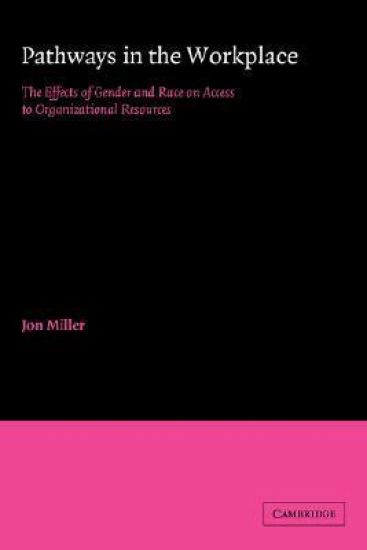
Pathways in the Workplace

Pathways in the Workplace

Jon Miller

Cambridge University Press
2006
pokkari
Rationalistic theories of the workplace and the claims typically made by organizations stress that an individual's access to the resources and advantages of an organization are determined by his or her qualifications and contributions to the collective enterprise, and that the payoffs for effort are essentially the same for all doing similar work. However, as Jon Miller shows in this book, negotiating for workplace rewards is actually far more complicated than this model allows, and he demonstrates that access to networks of organizational communication is in fact fundamentally influenced by race and gender. Comparing patterns of access to informal colleague networks and relations to the decision-making apparatus for white and non-white men and women in American public service organizations, he shows that only white males experienced a fairly close correspondence between their bureaucratic 'investments' and their workplace rewards.
Kierkegaard's Relations to Hegel Reconsidered

Kierkegaard's Relations to Hegel Reconsidered

Jon Stewart

Cambridge University Press
2007
pokkari
Jon Stewart's study is a major re-evaluation of the complex relations between the philosophies of Kierkegaard and Hegel. The standard view on the subject is that Kierkegaard defined himself as explicitly anti-Hegelian, indeed that he viewed Hegel's philosophy with disdain. Jon Stewart shows convincingly that Kierkegaard's criticism was not of Hegel but of a number of contemporary Danish Hegelians. Kierkegaard's own view of Hegel was in fact much more positive to the point where he was directly influenced by some of Hegel's work. Any scholar working in the tradition of Continental philosophy will find this an insightful and provocative book with implications for the subsequent history of philosophy in the twentieth century. The book will also appeal to scholars in religious studies and the history of ideas.
Information Flow

Information Flow

Jon Barwise; Seligman Jerry

Cambridge University Press
2008
pokkari
Information is a central topic in computer science, cognitive science and philosophy. In spite of its importance in the 'information age', there is no consensus on what information is, what makes it possible, and what it means for one medium to carry information about another. Drawing on ideas from mathematics, computer science and philosophy, this book addresses the definition and place of information in society. The authors, observing that information flow is possible only within a connected distribution system, provide a mathematically rigorous, philosophically sound foundation for a science of information. They illustrate their theory by applying it to a wide range of phenomena, from file transfer to DNA, from quantum mechanics to speech act theory.
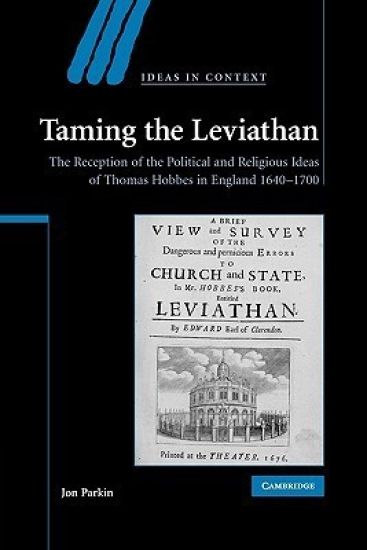
Taming the Leviathan

Taming the Leviathan

Jon Parkin

Cambridge University Press
2010
pokkari
Thomas Hobbes is widely acknowledged as the most important political philosopher to have written in English. Originally published in 2007, Taming the Leviathan is a wide-ranging study of the English reception of Hobbes's ideas. In the first book-length treatment of the topic for over forty years, Jon Parkin follows the fate of Hobbes's texts (particularly Leviathan) and the development of his controversial reputation during the seventeenth century, revealing the stakes in the critical discussion of the philosopher and his ideas. Revising the traditional view that Hobbes was simply rejected by his contemporaries, Parkin demonstrates that Hobbes's work was too useful for them to ignore, but too radical to leave unchallenged. His texts therefore had to be controlled, their lessons absorbed and their author discredited. In other words the Leviathan had to be tamed. Taming the Leviathan significantly revised our understanding of the role of Hobbes and Hobbism in seventeenth-century England.
The Economic Status of Australian Aborigines

The Economic Status of Australian Aborigines

Jon C. Altman; John Nieuwenhuysen

Cambridge University Press
1979
sidottu
In recent years there has been a substantial growth in the literature of Australian Aboriginal Studies. While much of this has touched on past and present economic issues from a historical, political or social viewpoint, its result has been to emphasize the need for a synthesis of the available information on the economic status of Aborigines in Australia. This book provides a survey of studies so far made on various aspects of current Aboriginal economic life in different environments in Australia, and raises questions of economic policy which follow from their results. In this the authors break new ground in the breadth of their canvass and by their extension of issues previously limited to the realm of social welfare to that of economic policy. This book is prefaced by a brief description of the historical background to the Aboriginal 'economy', and introduced by an overview of the relatively unequal economic status of Aborigines in the Australian economy today.
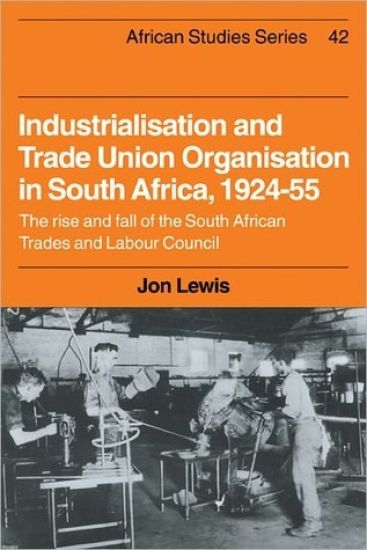
Industrialisation and Trade Union Organization in South Africa, 1924–1955
This major 1984 study of South African trade unionism traces the history of the South African Trades and Labour Council (TLC) from its origins in the 1920s to its demise in the early 1950s. The book focuses on South Africa's secondary industrialisation and subsequent changes in work organization. By analysing trade union structures and strategies Dr Lewis shows how divisions within the labour movement were bound up with the development of production processes and the division of labour, rather than being the inevitable outcome of racial antagonisms. The early chapters analyse the emergence of different trade union strategies. As work processes were transformed by the rapid industrialisation of the 1940s, the traditional craftsmen lost their technical indispensability and increasingly performed supervisory functions. Faced with dilution and undercutting, and increasingly hostile to the majority of black production workers, the craft unions responded by redefining membership on the basis of race rather than skill.
Explaining Technical Change

Explaining Technical Change

Jon Elster

Cambridge University Press
1983
pokkari
Technical change, defined as the manufacture and modification of tools, is generally thought to have played an important role in the evolution of intelligent life on earth, comparable to that of language. In this volume, first published in 1983, Jon Elster approaches the study of technical change from an epistemological perspective. He first sets out the main methods of scientific explanation and then applies those methods to some of the central theories of technical change. In particular, Elster considers neoclassical, evolutionary, and Marxist theories, whilst also devoting a chapter to Joseph Schumpeter's influential theory.
Catholicism and the Shaping of Nineteenth-Century America
Offers a series of fresh perspectives on America's encounter with Catholicism in the nineteenth-century. While religious and immigration historians have construed this history in univocal terms, Jon Gjerde bridges sectarian divides by presenting Protestants and Catholics in conversation with each other. In so doing, Gjerde reveals the ways in which America's encounter with Catholicism was much more than a story about American nativism. Nineteenth-century religious debates raised questions about the fundamental underpinnings of the American state and society: the shape of the antebellum market economy, gender roles in the American family, and the place of slavery were only a few of the issues engaged by Protestants and Catholics in a lively and enduring dialectic. While the question of the place of Catholics in America was left unresolved, the very debates surrounding this question generated multiple conceptions of American pluralism and American national identity.
The Economic Status of Australian Aborigines

The Economic Status of Australian Aborigines

Jon C. Altman; John Nieuwenhuysen

Cambridge University Press
2006
pokkari
In recent years there has been a substantial growth in the literature of Australian Aboriginal Studies. While much of this has touched on past and present economic issues from a historical, political or social viewpoint, its result has been to emphasize the need for a synthesis of the available information on the economic status of Aborigines in Australia. This book provides a survey of studies so far made on various aspects of current Aboriginal economic life in different environments in Australia, and raises questions of economic policy which follow from their results. In this the authors break new ground in the breadth of their canvass and by their extension of issues previously limited to the realm of social welfare to that of economic policy. This book is prefaced by a brief description of the historical background to the Aboriginal 'economy', and introduced by an overview of the relatively unequal economic status of Aborigines in the Australian economy today.
Industrialisation and Trade Union Organization in South Africa, 1924–1955
This major 1984 study of South African trade unionism traces the history of the South African Trades and Labour Council (TLC) from its origins in the 1920s to its demise in the early 1950s. The book focuses on South Africa's secondary industrialisation and subsequent changes in work organization. By analysing trade union structures and strategies Dr Lewis shows how divisions within the labour movement were bound up with the development of production processes and the division of labour, rather than being the inevitable outcome of racial antagonisms. The early chapters analyse the emergence of different trade union strategies. As work processes were transformed by the rapid industrialisation of the 1940s, the traditional craftsmen lost their technical indispensability and increasingly performed supervisory functions. Faced with dilution and undercutting, and increasingly hostile to the majority of black production workers, the craft unions responded by redefining membership on the basis of race rather than skill.
Pathways in the Workplace

Pathways in the Workplace

Jon Miller

Cambridge University Press
1986
sidottu
Rationalistic theories of the workplace and the claims typically made by organizations stress that an individual's access to the resources and advantages of an organization are determined by his or her qualifications and contributions to the collective enterprise, and that the payoffs for effort are essentially the same for all doing similar work. However, as Jon Miller shows in this book, negotiating for workplace rewards is actually far more complicated than this model allows, and he demonstrates that access to networks of organizational communication is in fact fundamentally influenced by race and gender. Comparing patterns of access to informal colleague networks and relations to the decision-making apparatus for white and non-white men and women in American public service organizations, he shows that only white males experienced a fairly close correspondence between their bureaucratic 'investments' and their workplace rewards.
Natural Resource Economics

Natural Resource Economics

Jon M. Conrad; Colin Whitcomb Clark

Cambridge University Press
1987
sidottu
In this book, Jon Conrad and Colin Clark develop the theory of resource economics. To begin, they provide an introduction to the required techniques of dynamic optimization. Throughout the book they build the reader’s understanding with many fully-worked problems and numerical examples. The authors have written this text in the belief that the theory and concepts of resource are more quickly learned, more effectively made operational, and more truly understood if the reader is exposed to carefully explained numerical examples. By working through the problems at the end of each chapter, students will learn the techniques to be used in empirical studies of natural resource systems. The first chapter provides an introduction to optimization, including constrained optimization, dynamic allocation problems, dynamic programming, continuous time problems, and the maximum principle, and a discussion of various numerical and graphical techniques. The remaining chapters deal in depth with the economics of renewable resources, nonrenewable resources, with environmental management and with stochastic resource models.
Natural Resource Economics

Natural Resource Economics

Jon M. Conrad; Colin Whitcomb Clark

Cambridge University Press
1987
pokkari
In this book, Jon Conrad and Colin Clark develop the theory of resource economics. To begin, they provide an introduction to the required techniques of dynamic optimization. Throughout the book they build the reader’s understanding with many fully-worked problems and numerical examples. The authors have written this text in the belief that the theory and concepts of resource are more quickly learned, more effectively made operational, and more truly understood if the reader is exposed to carefully explained numerical examples. By working through the problems at the end of each chapter, students will learn the techniques to be used in empirical studies of natural resource systems. The first chapter provides an introduction to optimization, including constrained optimization, dynamic allocation problems, dynamic programming, continuous time problems, and the maximum principle, and a discussion of various numerical and graphical techniques. The remaining chapters deal in depth with the economics of renewable resources, nonrenewable resources, with environmental management and with stochastic resource models.
From Peasants to Farmers

From Peasants to Farmers

Jon Gjerde

Cambridge University Press
1989
pokkari
This book examines a trans-Atlantic chain migration from a Norwegian fjord district to settlements in the nineteenth-century rural Upper Middle West and considers the social and economic conditions experienced in Europe as well as the immigrants' cultural adaptations to America.
Nuts and Bolts for the Social Sciences

Nuts and Bolts for the Social Sciences

Jon Elster

Cambridge University Press
1989
pokkari
This book is intended as an introductory survey of the philosophy of the social sciences. It is essentially a work of exposition which offers a tool-box of mechanisms - nuts and bolts, cogs and wheels - that can be used to explain complex social phenomena. Within a brief compass, Jon Elster covers a vast range of topics. His point of departure is the conflict we all face between our desires and our opportunities. How can rational choice theory help us understand our motivation and behaviour? More significantly, what happens when the theory breaks down but we still cleave to a belief in the power of the rational? Elster describes the fascinating range of forms of irrationality - wishful thinking, the phenomenon of sour grapes, discounting the future in non-cooperative behaviour. He shows how these issues bear very directly upon our lives in such concrete situations as wage bargaining, economic cartels, political strikes, voting in elections, and court decisions involving child custody. This is a remarkably lucid and comprehensive introduction to the social sciences for students of political science, philosophy, sociology and economics. It will also prove fascinating to any non-academic readers who want to understand a little better the forces governing human behaviour in its social context.
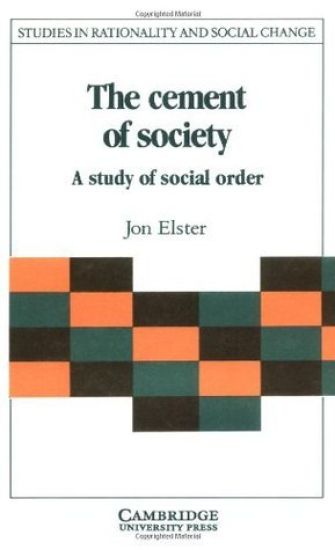
The Cement of Society

The Cement of Society

Jon Elster

Cambridge University Press
1989
pokkari
The question Jon Elster addresses in this challenging new book is what binds societies together and prevents them from disintegrating into chaos and war. He analyses two concepts of social order: stable, predictable patterns of behaviour, and co-operative behaviour. The book examines various aspects of collective action and bargaining from the perspective of rational-choice theory and the theory of social norms. It is a fundamental assumption of the book that social norms provide an important kind of motivation for action that is irreducible to rationality. The book represents a major new statement by Elster which will be of particular interest to political scientists, political philosophers, sociologists, and economists.
Solomonic Judgements

Solomonic Judgements

Jon Elster

Cambridge University Press
1989
pokkari
This volume of essays is very much a sequel to the two earlier collections by Jon Elster, Ulysses and the Sirens and Sour Grapes. His topic is rationality - its scope, its limitations, and its failures. Elster considers rational responses to the insufficiency of reason itself, and to the ‘indeterminacies’ in deploying rational-choice theory and discusses the irrationality of not seeing when, where, and what these are. A key essay which gives the collection its title examines disputes in cases of child custody, which are paradigmatically indeterminate. Leaving aside cases where one parent is patently unfit and assuming that protracted dispute is against the immediate interests of the child, Elster argues that three options present themselves: a strong presumption in favour of the mother, a strong presumption in favour of the primary caretaker (also likely to be the mother), and tossing a coin. Though the first two options may be preferable in the short/medium term, Elster argues that there is a case for randomisation in the long term. The book will be read with interest by anyone concerned with political and social science.
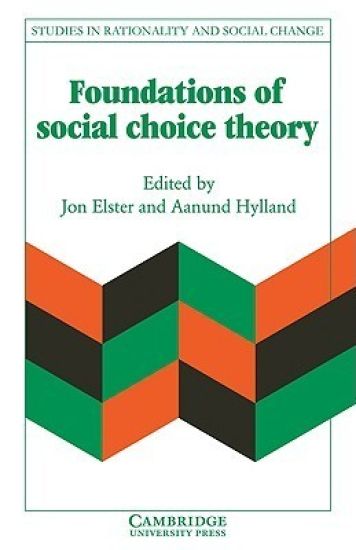
Foundations of Social Choice Theory

Foundations of Social Choice Theory

Jon Elster; Aanund Hylland

Cambridge University Press
1989
pokkari
The essays in this volume, first published in 1986, examine the philosophical foundations of social choice theory. This field, a modern and sophisticated outgrowth of welfare economics, is best known for a series of impossibility theorems, of which the first and most crucial was proved by Kenneth Arrow in 1950. That has often been taken to show the impossibility of democracy as a procedure for making collective decisions. However, this interpretation is challenged by several of the contributors here. Other central issues discussed in the volume include the possibility of making interpersonal comparisons of utility, the question of whether all preferences are equally to be valued, and the normative individualism underlying the theoretical tradition. Criticisms of social choice theory are advanced and suggestions for alternative approaches are developed.
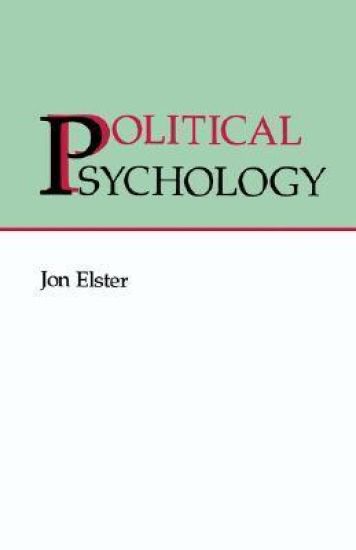
Political Psychology

Political Psychology

Jon Elster

Cambridge University Press
1993
sidottu
This provocative new textbook takes up and develops the themes of rationality and irrationality in Jon Elster's earlier work. Its purposes are threefold. First, Elster shows how belief and preference formation in the realm of politics are shaped by social and political institutions. Second, he argues for an important distinction in the social sciences between mechanisms and theories. Third, he illustrates those general principles of political psychology through readings of three outstanding political psychologists: the French classical historian, Paul Veyne; the Soviet dissident writer, Alexander Zinoviev; the great French political theorist, Alexis de Tocqueville.
Political Psychology

Political Psychology

Jon Elster

Cambridge University Press
1993
pokkari
This provocative new textbook takes up and develops the themes of rationality and irrationality in Jon Elster’s earlier work. Its purposes are threefold. First, Elster shows how belief and preference formation in the realm of politics are shaped by social and political institutions. Second, he argues for an important distinction in the social sciences between mechanisms and theories. Third, he illustrates those general principles of political psychology through readings of three outstanding political psychologists: the French classical historian, Paul Veyne; the Soviet dissident writer, Alexander Zinoviev; the great French political theorist, Alexis de Tocqueville.