How did two men move the world away from wars for land and treasure to wars over ideas and ideologies--a change that would go on to kill millions?In April 1917, Woodrow Wilson--champion of American democracy but also of segregation, advocate for free trade and a new world order based on freedom and justice--thrust the United States into the First World War in order to make the "world safe for democracy"--only to see his dreams for a liberal international system dissolve into chaos, bloodshed, and betrayal.That October, Vladimir Lenin--communist revolutionary and advocate for class war and "dictatorship of the proletariat"--would overthrow Russia's earlier democratic revolution that had toppled the powerful czar, all in the name of liberating humanity--and instead would set up the most repressive totalitarian regime in history, the Soviet Union. In this incisive, fast-paced history, the New York Times bestselling author Arthur Herman brilliantly reveals how Lenin and Wilson rewrote the rules of modern geopolitics. Prior to and through the end of World War I, countries marched into war only to advance or protect their national interests. After World War I, countries began going to war over ideas. Together Lenin and Wilson unleashed the disruptive ideologies that would sweep the world, from nationalism and globalism to Communism and terrorism, and that continue to shape our world today.Our new world disorder is the legacy left by Wilson and Lenin, and their visions of the perfectibility of man. One hundred years later, we still sit on the powder keg they first set the detonator to, through war and revolution.
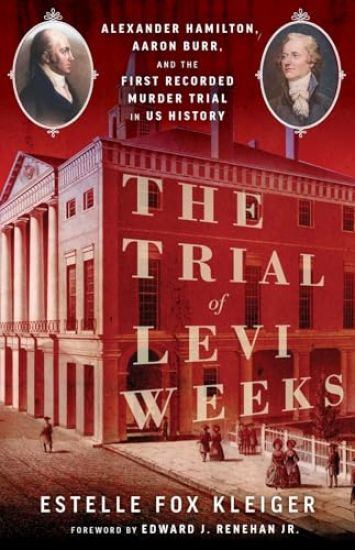
In January 1800, just weeks after the death of George Washington, the body of a young New York woman was recovered from the depths of Manhattan Well--so called because it had been dug by Aaron Burr's Manhattan Company. The woman was Gulielma "Elma" Sands, who on December 22 had left the boardinghouse where she lived, never to return. Suspicion immediately fell on another boarder, Levi Weeks, who according to Sands's cousin and landlady was to marry the victim the very night she disappeared. By the time Weeks went on trial for Sands's murder a few months later, the crime had become the talk of New York City. So many New Yorkers came to visit Sands's body before her funeral that her open coffin was displayed in the street, and crowds jammed the thoroughfares around the courthouse shouting for Weeks to be hanged. The fate of the accused lay in the hands of a defense team recruited by his brother, prominent builder Ezra Weeks, from the upper ranks of New York society. Weeks's team of star lawyers--which included both Alexander Hamilton and Aaron Burr--had to work together to defend a client whom all of New York seemed to have already decided was guilty. This book tells the full story of the trial of Levi Weeks and includes the entire transcript of the first American murder trial ever recorded. It is at once a riveting retelling of a true crime in which the voices of early New Yorkers come to us freshly from over two centuries in the past, and a riveting legal and social history of New York in the early years of the Republic.
Dit Es Die Historie Ende Leven Vanden Heilyghen Heremijt Sint Jan Van Beverley presents the life and times of Saint John of Beverley, a prominent figure in medieval England. This historical account, rendered in Dutch, recounts the saint's history, including the tale of how he, through the instigation of the devil, violated and murdered his sister. The narrative delves into the religious and moral landscape of the period, offering readers a glimpse into the spiritual beliefs and challenges of the time. This edition, published in 1903, makes available a significant historical and religious text, preserving the language and storytelling traditions of the past. This work has been selected by scholars as being culturally important, and is part of the knowledge base of civilization as we know it. This work was reproduced from the original artifact, and remains as true to the original work as possible. Therefore, you will see the original copyright references, library stamps (as most of these works have been housed in our most important libraries around the world), and other notations in the work. This work is in the public domain in the United States of America, and possibly other nations. Within the United States, you may freely copy and distribute this work, as no entity (individual or corporate) has a copyright on the body of the work. As a reproduction of a historical artifact, this work may contain missing or blurred pages, poor pictures, errant marks, etc. Scholars believe, and we concur, that this work is important enough to be preserved, reproduced, and made generally available to the public. We appreciate your support of the preservation process, and thank you for being an important part of keeping this knowledge alive and relevant.
This is the first book to offer a translation into English-as well as a critical study-of a Spanish treatise written around 1650 by Rabbi Saul Levi Morteira, whose most renowned congregant was Baruch Spinoza. Aimed at encouraging the practice of halachic Judaism among the Amsterdam-based descendants of conversos, Spanish and Portuguese Sephardic Jews who had been forced to convert to Christianity, the book stages a dialogue between two conversos that ultimately leads to a vision of a Jewish homeland-an outcome that Morteira thought was only possible through his program for rejudaisation.
The 18th century was a wealth of knowledge, exploration and rapidly growing technology and expanding record-keeping made possible by advances in the printing press. In its determination to preserve the century of revolution, Gale initiated a revolution of its own: digitization of epic proportions to preserve these invaluable works in the largest archive of its kind. Now for the first time these high-quality digital copies of original 18th century manuscripts are available in print, making them highly accessible to libraries, undergraduate students, and independent scholars.The Age of Enlightenment profoundly enriched religious and philosophical understanding and continues to influence present-day thinking. Works collected here include masterpieces by David Hume, Immanuel Kant, and Jean-Jacques Rousseau, as well as religious sermons and moral debates on the issues of the day, such as the slave trade. The Age of Reason saw conflict between Protestantism and Catholicism transformed into one between faith and logic -- a debate that continues in the twenty-first century.++++The below data was compiled from various identification fields in the bibliographic record of this title. This data is provided as an additional tool in helping to insure edition identification: ++++British LibraryT067163With a final leaf of advertisements.London: printed for Aaron Ward; and sold by T. Cox, 1725. 42, 2]p.; 8
*Includes pictures of Lenin, Stalin, Trotsky and important people, places, and events in their lives. *Explains each man's role in the Revolution and its aftermath. *Discusses the conspiracy theories surrounding Stalin's death and how Stalin came to power against Lenin's wishes. *Includes a bibliography for further reading. Among the leaders of the 20th century, arguably none shaped the course of history as much as Vladimir Lenin (1870-1942), the Communist revolutionary and political theorist who led the Bolshevik Revolution that established the Soviet Union. In addition to shaping the Marxist-Leninist political thought that steered Soviet ideology, he was the first Soviet premier until his death and set the Soviet Union on its way to becoming one of the world's two superpowers for most of the century, in addition to being the West's Cold War adversary. As it turned out, the creation of the Soviet Union came near the end of Lenin's life, as he worked so hard that he had burned himself out by his 50s, dying in 1924 after a series of strokes had completely debilitated him. Near the end of his life, he expressly stated that the regime's power should not be put in the hands of the current General Secretary of the Communist Party, Joseph Stalin. Of course, Stalin managed to do just that, modernizing the Soviet Union at a breakneck pace on the backs of millions of poor laborers and prisoners. If Adolf Hitler had not inflicted the devastation of World War II upon Europe, it's quite likely that the West would consider Joseph Stalin (1878-1953) the 20th century's greatest tyrant. Before World War II, Stalin consolidated his position by frequently purging party leaders (most famously Leon Trotsky) and Red Army leaders, executing hundreds of thousands of people at the least. In one of history's greatest textbook examples of the idea that the enemy of my enemy is my friend, Stalin's Soviet Union allied with Britain and the United States to defeat Hitler in Europe, with the worst of the war's carnage coming on the eastern front during Germany's invasion of Russia. Nevertheless, the victory in World War II established the Soviet Union as of the world's two superpowers for nearly 50 years, in addition to being the West's Cold War adversary. Along with Vladimir Lenin, Trotsky led the October Bolshevik Revolution of 1917 and held crucial posts in the early Soviet governments, but after Lenin's death Trotsky was exiled, persecuted and finally murdered at the behest of his arch-rival, Joseph Stalin. For the final decade of his life, Trotsky was a man trapped in between two worlds. A communist seeking refuge in the capitalist West, Trotsky was deemed a secret agent of the capitalist powers by Stalin's propaganda, but the Soviet Union's enemies also viewed him with suspicion. In the initial aftermath of Lenin's death, Trotsky had been his ally's heir apparent, and for those inclined to believe the Soviet experiment had started promisingly but gone astray, Trotsky became the embodiment of the betrayed promise of the early Bolshevik revolution. There were certain ironies in this widespread sympathetic interpretation of Trotsky's legacy. For the Marxists and Marxist sympathizers appalled by Stalin's paranoid police state, Gulag concentration camps, and strict suppression of dissent, Trotsky was viewed as a humane and cosmopolitan opposite to Stalin. But Trotsky himself had overseen and spearheaded campaigns of persecution against Russians suspected of "counterrevolutionary" leanings, and he had written a long tract defending these "terroristic" measures as necessary safeguards of the revolution. The Soviet Union's Big Three explores the lives and legacies of Lenin, Trotsky and Stalin before the Bolshevik Revolution, as well as the crucial roles they played in establishing the Soviet Union and turning it into a modern superpower.
Known to most readers as author of Leviticus in the Jewish Publication Society Torah Commentary series and Numbers 1-20 in the Anchor Bible series, as well as numerous essays in Bible dictionaries and encyclopedias, Baruch Levine holds the place of honor in this collection. The volume has been compiled by the students, colleagues, and friends known to him over his many years of professorship at New York University. Included in the festschrift are 36 essays in English and 5 essays in Hebrew.
6" x 9" 110-page Journal - NotebookThis 110-page Journal features: 110 pages6"x 9"white-color papercover pagea matte-finish cover an elegant, professional look and feelJournals - notebooks are the perfect gift for any occasion: Mother's Day GiftBirthday GiftsTeacher GiftsCo-worker GiftsChristmas GiftsGraduation Gifts for StudentsJournal & Planner LoversMindful Gifts