Kirjojen hintavertailu. Mukana 11 342 296 kirjaa ja 12 kauppaa.

Kirjahaku

Etsi kirjoja tekijän nimen, kirjan nimen tai ISBN:n perusteella.

1000 tulosta hakusanalla Louis Legrand

Louis Comfort Tiffany: Hibiscus and Parrots (Foiled Journal)
A FLAME TREE NOTEBOOK. Beautiful and luxurious the journals combine high-quality production with magnificent art. Perfect as a gift, and an essential personal choice for writers, notetakers, travellers, students, poets and diarists. Features a wide range of well-known and modern artists, with new artworks published throughout the year. BEAUTIFULLY DESIGNED. The highly crafted covers are printed on foil paper, embossed then foil stamped, complemented by the luxury binding and rose red end-papers. The covers are created by our artists and designers who spend many hours transforming original artwork into gorgeous 3d masterpieces. PRACTICAL, EASY TO USE. Flame Tree Notebooks come with practical features too: a pocket at the back for scraps and receipts; two ribbon markers to help keep track of more than just a to-do list; robust ivory text paper, printed with lines; and when you need to collect other notes or scraps of paper the magnetic side flap keeps everything neat and tidy. THE ARTIST. Tiffany was highly skilled in jewellery design, ceramics, enamels, and metalwork but he is best known for his beautiful stained-glass designs. Using opalescent glass in a variety of colours and textures, he created a stunning range of jewel-like Art Nouveau works. THE FINAL WORD. As William Morris said, "Have nothing in your houses that you do not know to be useful, or believe to be beautiful."

Louis Dumont and Hierarchical Opposition

Louis Dumont and Hierarchical Opposition

Robert Parkin

Berghahn Books
2009
pokkari
The work of Louis Dumont, who died in 1998, on India and modern individualism represented certain theoretical advances on the earlier structuralism of Claude Lévi-Strauss. One such advance is Dumont's idea of hierarchical opposition, which he proposed as a truer representation of indigenous ideologies than Lévi-Strauss's binary opposition. In this book the author argues that, although structuralism is often thought to have gone out of fashion, Dumont's greater concern with praxis and agency makes his own version of structuralism more contemporary. The work of his followers and fellow travelers, as well as his own, indicates that hierarchical opposition is capable of taking structuralism in new and more realistic directions, reminding us that it has never been the preserve of Lévi-Strauss alone.
Louis XIV

Louis XIV

Vincent Cronin

The Harvill Press
2011
nidottu
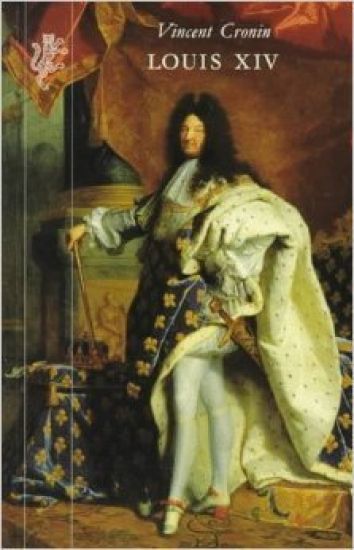
First published 25 years ago, this biography of the Sun King uses contemporary sources to examine what sort of monarch Louis XIV really was. The author's researches reveal a portrait of the man and an account of the principal events of his long reign (1642-1715). The book provides an overview of the entire civilization inspired by and reflecting the glory of the Sun King. Thus, while Louis occupies the foreground, artists like Racine, Moliere, Lully and Mansart, the architect of Versailles, share the middleground with politicians such as Cardinal Mazarin and Nicolas Fouquet and courtiers such as the king's mistress, Louise de La Valliere.
Louis Armstrong

Louis Armstrong

Stephane Olliver

Moonlight Publishing Ltd
2016
muu
This illustrated biography of Louis Armstrong tells the life of the greatest jazz musician and singer of his age, and gives an introduction to his music. Born in New Orleans in 1901, Louis Armstrong loved the gospel singing he heard every week as a boy in his neighbourhood church. He was also inspired by the marching bands and the musicians and singers who celebrated mardi gras in the streets, and performed at funerals and in the many cabarets. The trumpet was his favorite instrument, and he taught himself to play it. From his teenage years on, music was his life. He started as a professional musician playing on the Mississippi river boats before joining various bands. He soon established himself as the best musician of his generation, and at the age of 25 created his own jazz group—the Hot Five. Soon all of America would discover his other extraordinary talent—his unique deep singing voice. The book contains a CD with the narrative of the book and 14 highlights of Louis Armstrong recordings.
Louis XV's Army (1)

Louis XV's Army (1)

René Chartrand

Osprey Publishing
1996
nidottu
France had a population of between 22 and 25 million at this time, and maintained the largest standing army in Europe. In peacetime it might have amounted to about 200,000 men; in times of war, it could be anything up to half a million. A substantial part of Louis XV's army consisted of numerous regiments of guard cavalry, heavy cavalry and dragoon regiments, which were considered the best and noblest part. These many units form the subject matter in this first of five fascinating volumes [Men-at-Arms 296, 302, 304, 308 & 313] by René Chartrand covering the army of Louis XV's.
Louis XV's Army (3)

Louis XV's Army (3)

René Chartrand

Osprey Publishing
1997
nidottu
On account of long-standing tradition as well as sheer numbers, the importance of foreign regiments in the French army had become considerable by the time of Louis XV. Since the Middle Ages, the rulers of France had called upon mercenaries from various neighbouring nations to form units which were often among the finest in the army. In this third of five volumes covering the army of Louis XV [Men-at-Arms 296, 302, 304, 308 & 313], René Chartrand examines the organisation and uniforms of the foreign infantry and artillery troops in a text containing a wealth of illustrations including eight full page colour plates by Eugène Lelièpvre.
Louis XV's Army (4)

Louis XV's Army (4)

René Chartrand

Osprey Publishing
1997
nidottu
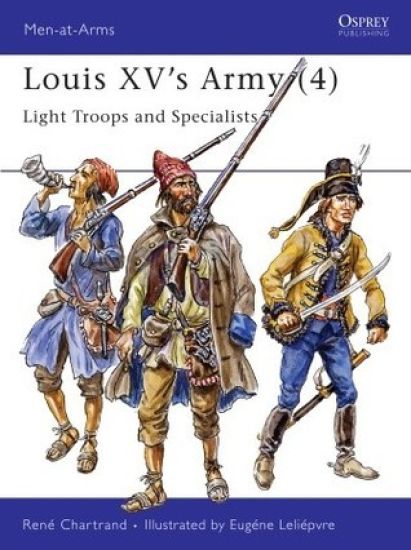
The emergence of light troops at the time of Louis XV's reign is a sign of the search for better intelligence of the enemy and rapid tactical moves on battlefields. This fourth instalment of René Chartrand's review of Louis XV's army reveals an extraordinary variety of units, most now long forgotten, who had a dazzling assortment of uniforms, equipment and weapons, as is revealed by this interesting text and its numerous accompanying illustrations, which include eight full page colour plates by Eugène Lelièpvre.
Louis XV's Army (2)

Louis XV's Army (2)

René Chartrand

Osprey Publishing
1997
nidottu
In Louis XV's army the classification of 'French' infantry denoted troops recruited from men born and raised in France. These regiments were called, naturally enough, infanterie francaise as opposed to the mercenary 'foreign' infantry recruited elsewhere. Making up the bulk of the army, all officers and men were to be of the Roman Catholic faith, the official state religion. Regimental recruiting parties went to towns and villages looking for likely young volunteers, inducing them to enlist with the usual promises – quick money, fast women, good wines and great glory.
Louis XV's Army (5)

Louis XV's Army (5)

René Chartrand

Osprey Publishing
1997
nidottu
In 1715 France had a sizeable overseas empire in America, Africa and Asia, its colonies garrisoned by thousands of regular officers and soldiers who belonged to the Navy's colonial establishment or by the French East India Company's troops. Though these troops are not usually covered in histories of the French forces, since the end of the 17th century, they saw considerable action against the enemy overseas. This last volume in a series of five (Men-at-Arms 296, 302, 304, 308 and 313) details the uniforms, arms and accoutrements of Louis XV's colonial and naval troops. The text is accompanied by numerous photographs and illustrations, including eight full colour plates.
Louis I. Kahn

Louis I. Kahn

Zhang Jing

Images Publishing Group Pty Ltd
2020
sidottu
In architecture, as in many fields, the best method of learning is to learn from the experts. Here, the author, using modern drawing software, has redrawn the plans, elevations, sections, and axonometric drawings from 138 architectural works by the renowned Louis I. Kahn, one of the most important architects of the 20th century in the United States. In so doing, the author arrives at a new and objective perspective to understanding Kahn and his work, creating an invaluable resource for future study. By working through and observing the sketches in a chronological order, Kahn's spatial characteristics and variations can be seen in a holistic way. This book provides an innovative and intimate new look at Kahn and his architectural work.
Louis Botha

Louis Botha

Richard Steyn

Jonathan Ball Publishers SA
2018
pokkari
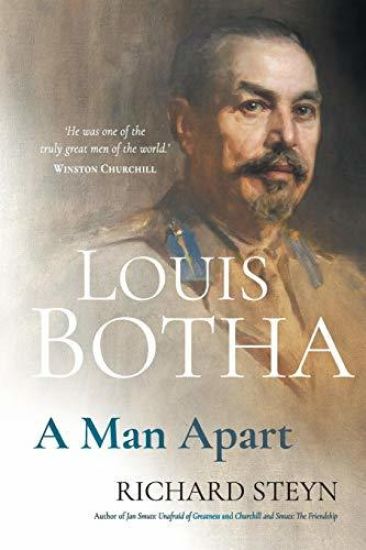
In A Man Apart Richard Steyn once again brings to life a South African icon. Louis Botha was the first Prime Minister of the Union of South Africa, a union he did much to create in the decade after the devastation of the Anglo-Boer War. During the war Botha was a brilliant young Boer general who through his battlefield strategy won significant victories over the British in the early stages of the war. When the weight of British arms overhelmed the Boers, Botha along with Smuts did much to encourage peace between English and Afrikaner and led the country to Union in 1910 and dominion status. Botha was a big-hearted and generous man who showed magnanimity in his dealings with all, including former enemies. He led the South African troops to victory and the capture of German South West Africa prior to this he had to put down a revolt of pro-German Afrikaners. At the Peace of Versailles, representing South Africa, he pleaded unsuccessfully for magnanimity towards the Germans. Botha was a globally respected figure he and Smuts effectively operated as a double act in South Africa and on the international stage before Bothas untimely death in August 1919 at only 57. In A Man Apart this tragically short life is illuminated in full.
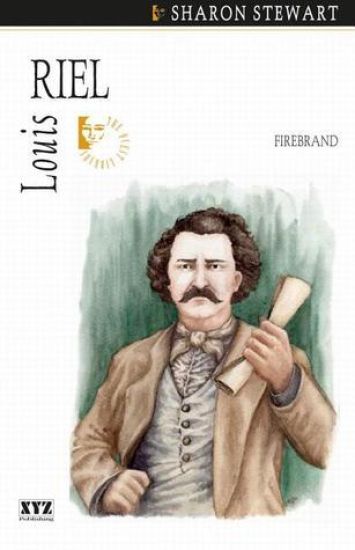
Louis Riel

Louis Riel

Sharon Stewart

XYZ Publishing
2007
pokkari
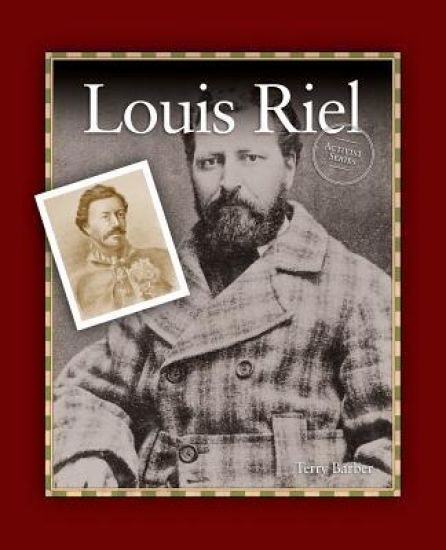
Louis Riel devoted his life to the Metis cause. A fiery activist, he struggled against injustice as he saw it. He was a pioneer in the field of Aboriginal rights and land claims but was branded an outlaw in his own time. In 1885, he was executed for treason. In 1992, the House of Commons declared Riel a founder of Manitoba. November 16 is now designated Louis Riel Day in Canada.
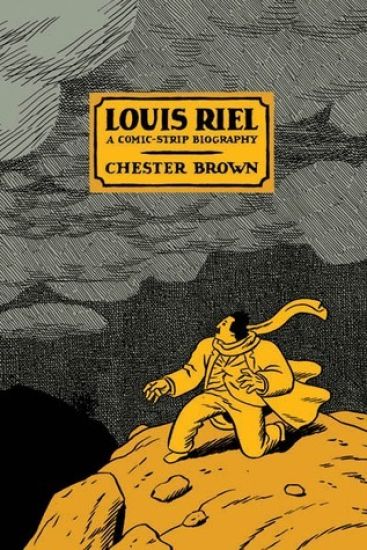
Louis Riel - a Comic-Strip Biography

Louis Riel - a Comic-Strip Biography

Chester Brown

Drawn and Quarterly
2006
nidottu
"It has the thoroughness of a history book yet reads with the personalized vision of a novel." -TimeChester Brown reinvents the comic-book medium to create the critically acclaimed historical biography Louis Riel, winning the Harvey Awards for best writing and best graphic novel for his compelling, meticulous, and dispassionate retelling of the charismatic, and perhaps insane, nineteenth-century M tis leader. Brown coolly documents with dramatic subtlety the violent rebellion on the Canadian prairie led by Riel, who some regard a martyr who died in the name of freedom, while others consider him a treacherous murderer.
Louis Jacobs and the Quest for a Contemporary Jewish Theology

Louis Jacobs and the Quest for a Contemporary Jewish Theology

Miri Freud-Kandel

The Littman Library of Jewish Civilization
2023
sidottu
For Louis Jacobs, the quest—the process of engaging with and thinking about Jewish faith—was a lifelong pursuit. He offered a model in the 1960s, a period characterized by general religious crisis, of an observant, committed, but intellectually curious Judaism that empowered individual seekers to address challenges to faith. In Orthodox Judaism at the time a battle was under way for religious control. Generating a widespread controversy in British Jewry known as the ‘Jacobs Affair’, his thought offers a lens for examining the trajectory of Orthodoxy. In a contemporary context marked by the changing cultural and intellectual concerns of a ‘post-secular’ age, the focus of some of these debates over religious control has shifted. Yet Jacobs’ emphasis on a personal quest is as relevant as ever, perhaps more so. This first book-length analysis of his theology unpacks the building blocks of his thought. It argues that, despite its particularities and limitations, his approach can provide a powerful model for contemporary religious seekers in the context of a growing impetus away from established, denominationally bound forms of religion. Many orthodox believers across a range of faiths continue to prefer the certainty of unquestionable religious truth claims rather than pursuing a subjective search for religious meaning. For those seeking alternative models for the contemporary Jewish quest, a reconsideration of Jacobs’ theology can offer valuable tools.
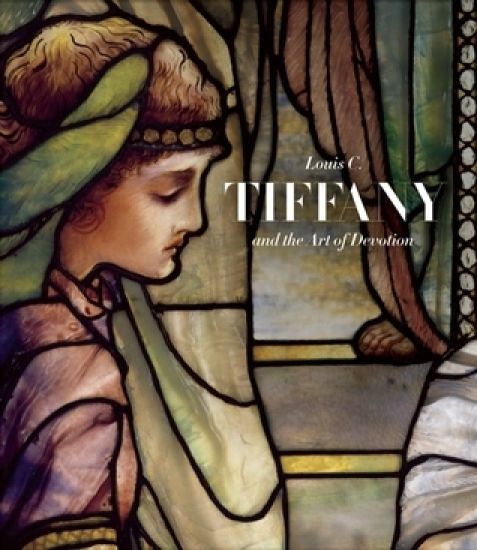
Louis C. Tiffany and the Art of Devotion
'Louis C. Tiffany and the Art of Devotion' is the first volume to explore the vast assortment of church decorations and memorials produced by Louis C. Tiffany (1848-1933) and the Tiffany Studios. For over 50 years Tiffany oversaw the production and marketing of a multitude of decorative elements for numerous chapels, churches and synagogues, afforded by the late 19th century American boom in religious building. Although an important part of the ecclesiastical business consisted of the vibrantly coloured leaded-glass windows most famously associated with his name, Tiffany was interested in the bigger picture and employed designers, draftsmen, and craftspeople to produce a complete interior design, including mosaics, windows, floors,lighting, furniture, altarpieces, pulpits, candlesticks, headstones and mausolea, vestments and jewellery. This beautifully illustrated volume includes preliminary designs, cartoons, watercolour sketches and archival photographs designs and products, many never published before. In numerous cases these are the only surviving remnants of buildings which have long since been demolished.