Kirjojen hintavertailu. Mukana 12 416 423 kirjaa ja 12 kauppaa.

Kirjahaku

Etsi kirjoja tekijän nimen, kirjan nimen tai ISBN:n perusteella.

1000 tulosta hakusanalla Malcolm Lowry

Cities and Cultures

Cities and Cultures

Malcolm Miles

Routledge
2007
sidottu
Cities and Cultures is a critical account of the relations between contemporary cities and the cultures they produce and which in turn shape them. The book questions received ideas of what constitutes a city's culture through case studies in which different kinds of culture - the arts, cultural institutions and heritage, distinctive ways of life - are seen to be differently used in or affected by the development of particular cities. The book does not mask the complexity of this, but explains it in ways accessible for undergraduates.The book begins with introductory chapters on the concepts of a city and a culture (the latter in the anthropological sense as well as denoting the arts), citing cases from modern literature. The book then moves from a critical account of cultural production in a metropolitan setting to the idea that a city, too, is produced through the characteristic ways of life of its inhabitants. The cultural industries are scrutinised for their relation to such cultures as well as to city marketing, and attention is given to the European Cities of Culture initiative, and to the hybridity of contemporary urban cultures in a period of globalisation and migration. In its penultimate chapter the book looks at incidental cultural forms and cultural means to identify formation; and in its final chapter, examines the permeability of urban cultures and cultural forms. Sources are introduced, positions clarified and contrasted, and notes given for selective further reading. Playing on the two meanings of culture, Miles takes an unique approach by relating arguments around these meanings to specific cases of urban development today. The book includes both critical comment on a range of literatures - being a truly inter-disciplinary study - and the outcome of the author's field research into urban cultures.
Cities and Cultures

Cities and Cultures

Malcolm Miles

Routledge
2007
nidottu
Cities and Cultures is a critical account of the relations between contemporary cities and the cultures they produce and which in turn shape them. The book questions received ideas of what constitutes a city's culture through case studies in which different kinds of culture - the arts, cultural institutions and heritage, distinctive ways of life - are seen to be differently used in or affected by the development of particular cities. The book does not mask the complexity of this, but explains it in ways accessible for undergraduates.The book begins with introductory chapters on the concepts of a city and a culture (the latter in the anthropological sense as well as denoting the arts), citing cases from modern literature. The book then moves from a critical account of cultural production in a metropolitan setting to the idea that a city, too, is produced through the characteristic ways of life of its inhabitants. The cultural industries are scrutinised for their relation to such cultures as well as to city marketing, and attention is given to the European Cities of Culture initiative, and to the hybridity of contemporary urban cultures in a period of globalisation and migration. In its penultimate chapter the book looks at incidental cultural forms and cultural means to identify formation; and in its final chapter, examines the permeability of urban cultures and cultural forms. Sources are introduced, positions clarified and contrasted, and notes given for selective further reading. Playing on the two meanings of culture, Miles takes an unique approach by relating arguments around these meanings to specific cases of urban development today. The book includes both critical comment on a range of literatures - being a truly inter-disciplinary study - and the outcome of the author's field research into urban cultures.
Urban Utopias

Urban Utopias

Malcolm Miles

Routledge
2007
sidottu
Utopia tends to generate a bad press - regarded as impracticable, perhaps nostalgic, or contradictory when visions of a perfect world cannot accommodate the change that is necessary to a free and self-organizing society. But people from diverse backgrounds are currently building a new society within the old, balancing literal and metaphorical utopianism, and demonstrating plural possibilities for alternative futures and types of settlement. Thousands of such places exist around the world, including intentional communities, eco-villages, permaculture plots, religious and secular retreats, co-housing projects, self-build schemes, projects for low-impact housing, and activist squats in urban and rural sites. This experience suggests, however, that when planning and design are not integral to alternative social formations, the modern dream to engineer a new society cannot be realized.The book is structured in four parts. In part one, literary and theoretical utopias from the early modern period to the nineteenth-century are reconsidered. Part two investigates twentieth-century urban utopianism and contemporary alternative settlements focusing on social and environmental issues, activism and eco-village living. Part three looks to wider horizons in recent practices in the non-affluent world, and Part four reviews a range of cases from the author’s visits to specific sites. This is followed by a short conclusion in which a discussion of key issues is resumed. This book brings together insights from literary, theoretical and practical utopias, drawing out the characteristics of groups and places that are part of a new society. It links today’s utopian experiments to historical and literary utopias, and to theoretical problems in utopian thought.
Urban Utopias

Urban Utopias

Malcolm Miles

Routledge
2007
nidottu
Utopia tends to generate a bad press - regarded as impracticable, perhaps nostalgic, or contradictory when visions of a perfect world cannot accommodate the change that is necessary to a free and self-organizing society. But people from diverse backgrounds are currently building a new society within the old, balancing literal and metaphorical utopianism, and demonstrating plural possibilities for alternative futures and types of settlement. Thousands of such places exist around the world, including intentional communities, eco-villages, permaculture plots, religious and secular retreats, co-housing projects, self-build schemes, projects for low-impact housing, and activist squats in urban and rural sites. This experience suggests, however, that when planning and design are not integral to alternative social formations, the modern dream to engineer a new society cannot be realized.The book is structured in four parts. In part one, literary and theoretical utopias from the early modern period to the nineteenth-century are reconsidered. Part two investigates twentieth-century urban utopianism and contemporary alternative settlements focusing on social and environmental issues, activism and eco-village living. Part three looks to wider horizons in recent practices in the non-affluent world, and Part four reviews a range of cases from the author’s visits to specific sites. This is followed by a short conclusion in which a discussion of key issues is resumed. This book brings together insights from literary, theoretical and practical utopias, drawing out the characteristics of groups and places that are part of a new society. It links today’s utopian experiments to historical and literary utopias, and to theoretical problems in utopian thought.
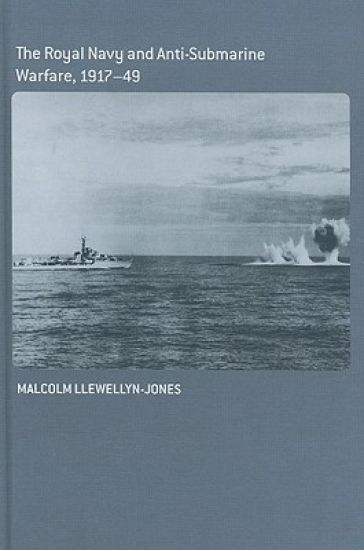
The Royal Navy and Anti-Submarine Warfare, 1917-49
An essential new account of how anti-submarine warfare is conducted, with a focus on both historic and present-day operations. This new book shows how until 1944 U-boats operated as submersible torpedo craft which relied heavily on the surface for movement and charging their batteries. This pattern was repeated in WWII until Allied anti-submarine countermeasures had forced the Germans to modify their existing U-boats with the schnorkel. Countermeasures along also pushed the development of high-speed U-boats capable of continuously submerged operations. This study shows how these improved submarines became benchmark of the post-war Russian submarine challenge. Royal Navy doctrine was developed by professional anti-submarine officers, and based on the well-tried combination of defensive and offensive anti-submarine measures that had stood the press of time since 1917, notwithstanding considerable technological change. This consistent and holistic view of anti-submarine warfare has not been understood by most of the subsequent historians of these anti-submarine campaigns, and this book provides an essential and new insight into how Cold War, and indeed modern, anti-submarine warfare is conducted.
Banking Reform in Southeast Asia

Banking Reform in Southeast Asia

Malcolm Cook

Routledge
2008
sidottu
This book empirically examines banking reform in the economies of Southeast Asia as they sought to adapt to major developments in the global economic system over the past three decades, including the globalisation of finance, the debt crisis of the 1980s and the 1997-1998 Asian financial crisis. Focusing in particular on the turbulent decade of financial boom and bust from 1994 to 2004, it explores the ways in which states respond to powerful external shocks and the implications for policy choices, demonstrating how different political systems shape economic performance and policy choices. It sets out a detailed comparative analysis of the experiences of the five major regional economies, Malaysia, Singapore, Thailand, Indonesia and the Philippines, considering how banking reform responded to the challenges posed by global economic integration. The countries least affected by the crisis, Singapore and the Philippines, used the crisis effectively to further liberalise long-protected domestic banking sectors. The countries the most affected by the crisis, Indonesia, Thailand and Malaysia, all resisted external pressure to liberalise their protected banking sectors even when they experienced changes in leadership. In all five cases, the nature of the political system and their previous commitment to nationalist banking policies, more than the depth of the crisis or extent of foreign pressure, was the key determining factor in their crisis response and in the post-crisis changes to banking policy that are still playing out today.
Management Training and Development in China

Management Training and Development in China

Malcolm Warner; Keith Goodall

Routledge
2009
sidottu
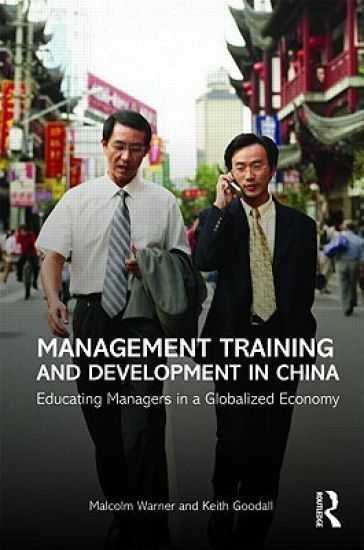
One of the critical issues facing both the Chinese government and businesses operating in China is the lack of trained managers. This book, with contributions by internationally-known scholars from a wide range of countries, examines the Chinese response to the challenges of management training and development. It considers the development of business schools in the PRC and the impact of foreign partnerships on their operation. It summarizes the current trends in management training and development and outlines the likely course of future developments. Overall, this book is a comprehensive account of management training and development in China, and is an important resource in an area that has hitherto seen little substantive research.
Fashion Theory

Fashion Theory

Malcolm Barnard

Routledge
2007
sidottu
From its beginnings in the fifteenth century, intensified interest in fashion and the study of fashion over the last thirty years has led to a vast and varied literature on the subject. This collection of essays surveys and contextualizes the ways in which a wide range of disciplines have used a variety of theoretical approaches to explain, and sometimes to explain away, the astonishing variety, complexity and beauty of fashion. Themes covered include individual, social and gender identity, the erotic, consumption and communication. By collecting together some of the most influential and important writers on fashion and exposing the ideas and theories behind what they say, this unique collection of extracts and essays brings to light the presuppositions involved in the things we think and say about fashion.
Land, Water and Development

Land, Water and Development

Malcolm Newson

Routledge
2008
sidottu
Water is newsworthy: there is, or will be, a world water crisis. Aggravated by climate change, we are approaching the limits of human exploitation of freshwater resources, notably in growing essential food. The complexities and uncertainties associated with improving our management of fresh water take the potential remedies out of the hands of simple, local, hard engineering and into much larger units – the basin, the ecosystem and the global context, and also require longer term perspectives. The Third Edition follows the same structure as its predecessors, presenting the historical and scientific backgrounds to land-water interactions and establishing the links with development processes and policies. Throughout, its two major messages are that our new philosophy should be one of ‘humans in the ecosystem’ and that the guidance from science, being uncertain and contested, must be operationalized in a participatory system of governance based on participation. Following a review of progress towards these elements in the developed world, the international case studies update the situation in the developing world following the Millennium Development Goals, our new emphasis on poverty and on global food supplies.This book covers the multitude of scientific research findings, development of ‘tools’ and spatial/temporal scale challenges which have emerged in the last decade. Tensions are highlighted in the current and future role of large dams, country studies are retained (and considerably updated) and development contexts are explored in greater depth as a dividing line in capacity to cope with land and water stress. "Technical issues" have been expanded to cover major droughts, environmental flows and the restoration of rivers and wetlands. A separate chapter picks up these themes under terms of their relationship with uncertainty and the widespread perception that a new ethos of adaptive management is needed in the water sector.For students of geography, environmental science, hydrology, and development studies this innovative edition provides a reasoned, academic basis of evidence for sustainable, adaptive management of rivers and related large-scale ecosystems using more than 600 new sources. It will also prove invaluable for lecturers and practitioners.
Land, Water and Development

Land, Water and Development

Malcolm Newson

Routledge
2008
nidottu
Water is newsworthy: there is, or will be, a world water crisis. Aggravated by climate change, we are approaching the limits of human exploitation of freshwater resources, notably in growing essential food. The complexities and uncertainties associated with improving our management of fresh water take the potential remedies out of the hands of simple, local, hard engineering and into much larger units – the basin, the ecosystem and the global context, and also require longer term perspectives. The Third Edition follows the same structure as its predecessors, presenting the historical and scientific backgrounds to land-water interactions and establishing the links with development processes and policies. Throughout, its two major messages are that our new philosophy should be one of ‘humans in the ecosystem’ and that the guidance from science, being uncertain and contested, must be operationalized in a participatory system of governance based on participation. Following a review of progress towards these elements in the developed world, the international case studies update the situation in the developing world following the Millennium Development Goals, our new emphasis on poverty and on global food supplies.This book covers the multitude of scientific research findings, development of ‘tools’ and spatial/temporal scale challenges which have emerged in the last decade. Tensions are highlighted in the current and future role of large dams, country studies are retained (and considerably updated) and development contexts are explored in greater depth as a dividing line in capacity to cope with land and water stress. "Technical issues" have been expanded to cover major droughts, environmental flows and the restoration of rivers and wetlands. A separate chapter picks up these themes under terms of their relationship with uncertainty and the widespread perception that a new ethos of adaptive management is needed in the water sector.For students of geography, environmental science, hydrology, and development studies this innovative edition provides a reasoned, academic basis of evidence for sustainable, adaptive management of rivers and related large-scale ecosystems using more than 600 new sources. It will also prove invaluable for lecturers and practitioners.
Naval Warfare 1919-45

Naval Warfare 1919-45

Malcolm H. Murfett

Routledge
2008
sidottu
Naval Warfare 1919–45 is a comprehensive history of the war at sea from the end of the Great War to the end of World War Two. Showing the bewildering nature and complexity of the war facing those charged with fighting it around the world, this book ranges far and wide: sweeping across all naval theatres and those powers performing major, as well as minor, roles within them. Armed with the latest material from an extensive set of sources, Malcolm H. Murfett has written an absorbing as well as a comprehensive reference work. He demonstrates that superior equipment and the best intelligence, ominous power and systematic planning, vast finance and suitable training are often simply not enough in themselves to guarantee the successful outcome of a particular encounter at sea. Sometimes the narrow difference between victory and defeat hinges on those infinite variables: the individual’s performance under acute pressure and sheer luck. Naval Warfare 1919–45 is an analytical and interpretive study which is an accessible and fascinating read both for students and for interested members of the general public.
Fashion Theory

Fashion Theory

Malcolm Barnard

Routledge
2014
sidottu
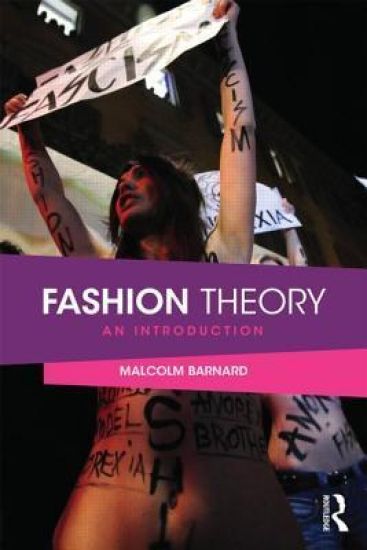
Fashion is both big business and big news. From models’ eating disorders and sweated labour to the glamour of a new season's trends, statements and arguments about fashion and the fashion industry can be found in every newspaper, consumer website and fashion blog. Books which define, analyse and explain the nature, production and consumption of fashion in terms of one theory or another abound. But what are the theories that run through all of these analyses, and how can they help us to understand fashion and clothing? Fashion Theory: an introduction explains some of the most influential and important theories on fashion: it brings to light the presuppositions involved in the things we think and say about fashion every day and shows how they depend on those theories. This clear, accessible introduction contextualises and critiques the ways in which a wide range of disciplines have used different theoretical approaches to explain – and sometimes to explain away – the astonishing variety, complexity and beauty of fashion. Through engaging examples and case studies, this book explores: fashion and clothing in historyfashion and clothing as communicationfashion as identityfashion, clothing and the bodyproduction and consumptionfashion, globalization and colonialismfashion, fetish and the erotic.This book will be an invaluable resource for students of cultural studies, sociology, gender studies, fashion design, textiles or the advertising, marketing and manufacturing of clothes.
Fashion Theory

Fashion Theory

Malcolm Barnard

Routledge
2014
nidottu
Fashion is both big business and big news. From models’ eating disorders and sweated labour to the glamour of a new season's trends, statements and arguments about fashion and the fashion industry can be found in every newspaper, consumer website and fashion blog. Books which define, analyse and explain the nature, production and consumption of fashion in terms of one theory or another abound. But what are the theories that run through all of these analyses, and how can they help us to understand fashion and clothing? Fashion Theory: an introduction explains some of the most influential and important theories on fashion: it brings to light the presuppositions involved in the things we think and say about fashion every day and shows how they depend on those theories. This clear, accessible introduction contextualises and critiques the ways in which a wide range of disciplines have used different theoretical approaches to explain – and sometimes to explain away – the astonishing variety, complexity and beauty of fashion. Through engaging examples and case studies, this book explores: fashion and clothing in historyfashion and clothing as communicationfashion as identityfashion, clothing and the bodyproduction and consumptionfashion, globalization and colonialismfashion, fetish and the erotic.This book will be an invaluable resource for students of cultural studies, sociology, gender studies, fashion design, textiles or the advertising, marketing and manufacturing of clothes.
Understanding Management in China

Understanding Management in China

Malcolm Warner

Routledge
2013
sidottu
China has become one of the fastest-growing economies ever seen in the world in recent times. In the last three decades, China has transformed itself from a command economy to a market one, albeit a nominally socialist one, and its management systems have been reformed accordingly. In the light of these changes, Malcolm Warner, one of the leading authorities on management in China, explores the past, present and future of Chinese management. The first part of the work examines the history of management practices in the ‘Middle Kingdom’, outlining the influence of traditional Chinese values, especially the Confucian inheritance, and the legacy of the imperial bureaucracy with its meritocratic examination system, as well as the role of industrialization and the influx of foreign-owned businesses in the late nineteenth century and the twentieth century. It next goes on to consider the current state of China’s management, showing how a new breed of manager has evolved since the beginning of Deng Xiaoping’s reforms in the late 1970s and 1980s. The resulting impact of this strategy which has continued into the 1990s and the 2000s, up to the present day, is then examined. The final part of the book concludes with reflections on how management in China is likely to develop in the near future, especially on how far it will converge with global practices or to what degree an indigenous form of management 'with Chinese characteristics' will prevail.
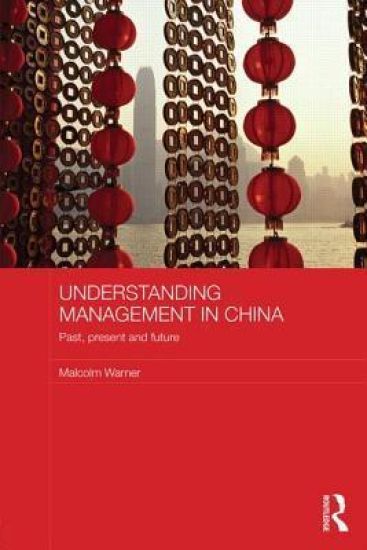
Understanding Management in China

Understanding Management in China

Malcolm Warner

Routledge
2013
nidottu
China has become one of the fastest-growing economies ever seen in the world in recent times. In the last three decades, China has transformed itself from a command economy to a market one, albeit a nominally socialist one, and its management systems have been reformed accordingly. In the light of these changes, Malcolm Warner, one of the leading authorities on management in China, explores the past, present and future of Chinese management. The first part of the work examines the history of management practices in the ‘Middle Kingdom’, outlining the influence of traditional Chinese values, especially the Confucian inheritance, and the legacy of the imperial bureaucracy with its meritocratic examination system, as well as the role of industrialization and the influx of foreign-owned businesses in the late nineteenth century and the twentieth century. It next goes on to consider the current state of China’s management, showing how a new breed of manager has evolved since the beginning of Deng Xiaoping’s reforms in the late 1970s and 1980s. The resulting impact of this strategy which has continued into the 1990s and the 2000s, up to the present day, is then examined. The final part of the book concludes with reflections on how management in China is likely to develop in the near future, especially on how far it will converge with global practices or to what degree an indigenous form of management 'with Chinese characteristics' will prevail.
Event Policy

Event Policy

Malcolm Foley; David McGillivray; Gayle McPherson

Routledge
2011
sidottu
As the event management field expands, there has been an emergence of a distinctive ‘events’ policy field of study and a need for more advanced texts that look at this subject with a multidisciplinary research and theoretical orientation. Events Policy: From Theory to Strategy is the first text to embrace this new direction in the field of events management. Its main aim is to locate the phenomena of events (and festivity) within a theoretical and strategic framework and, in doing so, demonstrate the links between the development of events in policy-making and the theoretical exploration of the role of events as policy. Building on a strong coherent framework, the book explores the conceptual terrain in which events and festivities are located, evaluates the range of theoretical perspectives pertinent to the study of events policy, appraises the socio-economic and socio-cultural implications of event-led policies internationally and draws together the main theoretical and event policy issues for the future. It utilizes a good range of international cases, from Dubai, Singapore, New Orleans and Glasgow, to help demonstrate the relationships between theory and strategy, and includes useful features to help students understand the subject and deepen their knowledge of the events policy terrain. This groundbreaking volume will be essential reading for students, researchers and academics of events and other related disciplines.
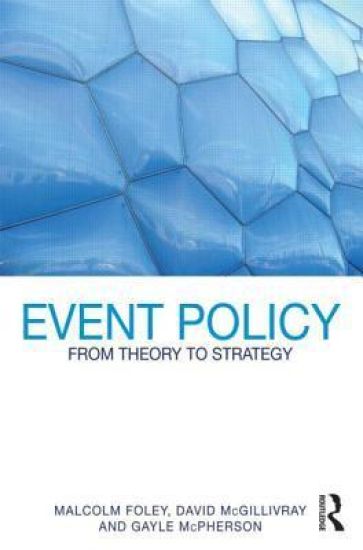
Event Policy

Event Policy

Malcolm Foley; David McGillivray; Gayle McPherson

Routledge
2011
nidottu
As the event management field expands, there has been an emergence of a distinctive ‘events’ policy field of study and a need for more advanced texts that look at this subject with a multidisciplinary research and theoretical orientation. Events Policy: From Theory to Strategy is the first text to embrace this new direction in the field of events management. Its main aim is to locate the phenomena of events (and festivity) within a theoretical and strategic framework and, in doing so, demonstrate the links between the development of events in policy-making and the theoretical exploration of the role of events as policy. Building on a strong coherent framework, the book explores the conceptual terrain in which events and festivities are located, evaluates the range of theoretical perspectives pertinent to the study of events policy, appraises the socio-economic and socio-cultural implications of event-led policies internationally and draws together the main theoretical and event policy issues for the future. It utilizes a good range of international cases, from Dubai, Singapore, New Orleans and Glasgow, to help demonstrate the relationships between theory and strategy, and includes useful features to help students understand the subject and deepen their knowledge of the events policy terrain. This groundbreaking volume will be essential reading for students, researchers and academics of events and other related disciplines.