A discursive-sociological approach to the Europeanization of gender and other equality policies. Using largely unpublished empirical data covering twenty-nine European countries this book adopts a pluralistic perspective to explore the complex and often divergent gender and other equality policy outputs of Europeanization.
Isomorphic JavaScript, often described as the holy grail of web application development, refers to running JavaScript code on both the browser client and web application server. This application architecture has become increasingly popular for the benefits of SEO, optimized page load and full control of the UI, and isomorphic libraries are being used at companies like Walmart, Airbnb, Facebook, and Netflix. With this practical book, authors Jason Strimpel and Maxime Najim provide the knowledge you need to build and maintain your own isomorphic JavaScript apps. This book includes: Part 1 identifies different classifications of isomorphic JavaScript apps, and shows you how to set up a development environment Part 2 takes you from theory to practice by showing you how to build out your own isomorphic app Part 3 takes you through existing solutions in the market today, providing you with the knowledge you need to bring isomorphic solutions into your development workflow
In today’s fast-paced retail world, consumers face an overwhelming array of product choices, and retailers are constantly seeking new ways to steer their purchasing decisions. Behavioral Retail Operations: Tactics to Win Customers delves into the intricate relationship between consumer psychology and strategic retail tactics. Drawing on decades of research, the authors explore how factors such as pricing, promotions, and store layout influence shopper behavior in both physical and online settings. From understanding the subtle psychological effects of price framing to uncovering how sensory elements like music and color shape the shopping experience, this monograph provides a comprehensive look at the tools retailers use to maximize profitability. Offering a deep dive into the art of influencing consumer behavior, this monograph is essential for both researchers and practitioners aiming to bridge the gap between theory and real-world retail strategy.
Modernist Cuisine is an interdisciplinary team in Bellevue, Washington, founded and led by Nathan Myhrvold. The group includes scientists, research and development chefs, and a full editorial team all dedicated to advancing the state of culinary art through the creative application of scientific knowledge and experimental techniques. Change the way you think about food: Modernist Cuisine at Home opens up a new world of culinary possibility and innovation for passionate and curious home cooks. In this vibrantly illustrated 456-page volume you'll learn how to stock a modern kitchen, to master Modernist techniques, and to make hundreds of stunning new recipes, including pressure-cooked caramelized carrot soup, silky smooth mac and cheese, and sous-vide braised short ribs. You'll also learn about the science behind your favorite dishes, what's really happening when you roast a chicken, and why pressure cookers are perfect for making soup. -- Nathan Myhrvold
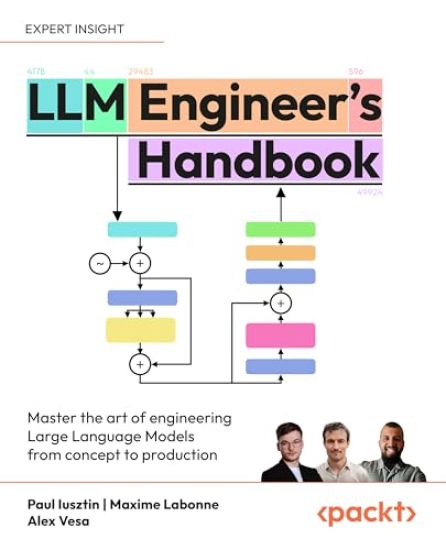
Step into the world of LLMs with this practical guide that takes you from the fundamentals to deploying advanced applications using LLMOps best practices Key Features Build and refine LLMs step by step, covering data preparation, RAG, and fine-tuning Learn essential skills for deploying and monitoring LLMs, ensuring optimal performance in production Utilize preference alignment, evaluation, and inference optimization to enhance performance and adaptability of your LLM applications Book DescriptionArtificial intelligence has undergone rapid advancements, and Large Language Models (LLMs) are at the forefront of this revolution. This LLM book offers insights into designing, training, and deploying LLMs in real-world scenarios by leveraging MLOps best practices. The guide walks you through building an LLM-powered twin that’s cost-effective, scalable, and modular. It moves beyond isolated Jupyter notebooks, focusing on how to build production-grade end-to-end LLM systems. Throughout this book, you will learn data engineering, supervised fine-tuning, and deployment. The hands-on approach to building the LLM Twin use case will help you implement MLOps components in your own projects. You will also explore cutting-edge advancements in the field, including inference optimization, preference alignment, and real-time data processing, making this a vital resource for those looking to apply LLMs in their projects. By the end of this book, you will be proficient in deploying LLMs that solve practical problems while maintaining low-latency and high-availability inference capabilities. Whether you are new to artificial intelligence or an experienced practitioner, this book delivers guidance and practical techniques that will deepen your understanding of LLMs and sharpen your ability to implement them effectively.What you will learn Implement robust data pipelines and manage LLM training cycles Create your own LLM and refine it with the help of hands-on examples Get started with LLMOps by diving into core MLOps principles such as orchestrators and prompt monitoring Perform supervised fine-tuning and LLM evaluation Deploy end-to-end LLM solutions using AWS and other tools Design scalable and modularLLM systems Learn about RAG applications by building a feature and inference pipeline Who this book is forThis book is for AI engineers, NLP professionals, and LLM engineers looking to deepen their understanding of LLMs. Basic knowledge of LLMs and the Gen AI landscape, Python and AWS is recommended. Whether you are new to AI or looking to enhance your skills, this book provides comprehensive guidance on implementing LLMs in real-world scenarios
Dans presque toutes les langues, le mot banque et le mot banquier d rivent du vocable qui signifie table ou comptoir. Le banquier a t primitivement un changeur; il venait s'installer sur la place publique avec un banc sur lequel il exposait les monnaies diverses qu'on pouvait avoir lui demander; peu peu il prit les fonds en d p t, fit des avances sur caution, sur marchandises, sur gages, sur titres de propri t , sur papiers de famille et devint bien r ellement ce que nous nommons aujourd'hui un banquier. Lorsqu'il avait manqu ses engagements, que, par suite de sa mauvaise foi ou de sp culations hasardeuses, il causait un tort manifeste ses cr anciers, on brisait son comptoir. On disait de lui alors qu'il tait l'homme du banc rompu: banco rotto, d'o nous avons fait le mot banqueroute. Quelle est l'histoire de la banque de France et son d veloppement ? Pourquoi la France, dont le g nie financier s'est si clairement et brillamment manifest , avait t en retard par rapport d'autres pays pour l'organisation de sa banque d' mission?
"Maxime Coton approaches love through the tropes of language and landscape, provisional approaches to a provisional state. His gaze closes in and moves away to great distances, together. At times the voice is almost aphoristic, possible only in a poet who tends towards courage and insight. "The point is not just to live, but to find the fissure, the absence of death for instance." Coton's language is transparent yet unsimple. There is sustained discovery in its lines and their unpredictability. Imperfect Tongues offers us a voice to follow for the future." - Sharmistha Mohanty
One characteristic of modern society is that individuals no longer share a common or unique conception of good and evil. Social cohesion is maintained by a general agreement to live together which requires impartiality towards everyone and which takes precedence over the different conceptions of the good. This is what the authors call the priority of justice. This book highlights this priority and provides a new approach to moral choices in modern societies. The book focuses on two objectives. Firstly, it examines how and why modern individuals give priority to the right over the good. Opinion polls are the basis of this examination, through the model of a 'fair spectator' giving priority to the reasonable over the rational. Secondly, it analyses what constitutes the principle of justice an individual applies. This book is about resolving conflicts and social justice. It takes account of the plurality of moral values and looks at norms from a fair standpoint, avoiding the famous 'anything goes' and paying attention to what people think.
“The most important book in the culinary arts since Escoffier.” —Tim ZagatA revolution is underway in the art of cooking. Just as French Impressionists upended centuries of tradition, Modernist cuisine has in recent years blown through the boundaries of the culinary arts. Borrowing techniques from the laboratory, pioneering chefs at world-renowned restaurants such as elBulli, The Fat Duck, Alinea, and wd~50 have incorporated a deeper understanding of science and advances in cooking technology into their culinary art. The authors and their 20-person team at The Cooking Lab—scientists, inventors, and accomplished cooks in their own right—have achieved astounding new flavors and textures by using tools such as water baths, homogenizers, and centrifuges, and ingredients such as hydrocolloids, emulsifiers, and enzymes. Modernist Cuisine is a work destined to reinvent cooking. How do you make an omelet light and tender on the outside, but rich and creamy inside? Or French fries with a light and fluffy interior and a delicate, crisp crust that doesn’t go soggy? Imagine being able to encase a mussel in a gelled sphere of its own sweet and briny juice. Or to create a silky-smooth pistachio cream made from nothing more than the nuts themselves. Modernist Cuisine offers step-by-step, illustrated instructions, as well as clear explanations of how these techniques work. Through thousands of original photographs and diagrams, the lavishly illustrated books make the science and technology of the culinary arts clear and engaging. Stunning new photographic techniques take the reader inside the food to see cooking in action all the way from microscopic meat fibers to an entire Weber grill in cross section. You will view cooking—and eating—in a whole new light.A sampling of what you’ll discover: Why plunging food in ice water doesn’t stop the cooking process When boiling cooks faster than steaming Why raising the grill doesn’t lower the heat Why baking is mostly a drying process Why deep-fried food tastes best and browns better when the oil is older How modern cooking techniques can achieve ideal results without the perfect timing or good luck that traditional methods demand Many invaluable features include: Insights into the surprising science behind traditional food preparation methods such as grilling, smoking, and stir-frying The most comprehensive guide yet published on cooking sous vide, including the best options for water baths, packaging materials, and sealing equipment; cooking strategies; and troubleshooting tips More than 250 pages on meat and seafood and 144 pages on fruits, vegetables, and grains, including dozens of parametric recipes and step-by-step techniques Extensive chapters explaining how to achieve amazing results by using modern thickeners, gels, emulsions, and foams, including example recipes and many formulas Some 300 pages of new recipes for plated dishes suitable for service at top-tier restaurants, plus recipes adapted from master chefs including Grant Achatz, Ferran Adrià, Heston Blumenthal, David Chang, Wylie Dufresne, David Kinch, and many others Volume 1: History and Fundamentals Volume 2: Techniques and Equipment Volume 3: Animals and Plants Volume 4: Ingredients and Preparations Volume 5: Plated-Dish Recipes Volume 6: Kitchen Manual with example recipes and extensive reference tables, printed on washable paper