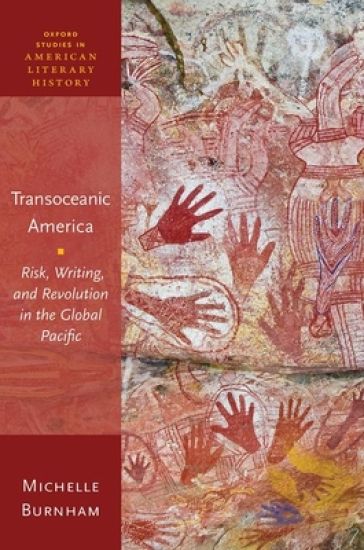
Transoceanic America offers a new approach to American literature by emphasizing the material and conceptual interconnectedness of the Atlantic and Pacific worlds. These oceans were tied together economically, textually, and politically, through such genres as maritime travel writing, mathematical and navigational schoolbooks, and the relatively new genre of the novel. Especially during the age of revolutions in the late eighteenth and early nineteenth centuries, long-distance transoceanic travel required calculating and managing risk in the interest of profit. The result was the emergence of a newly suspenseful form of narrative that came to characterize capitalist investment, political revolution, and novelistic plot. The calculus of risk that drove this expectationist narrative also concealed violence against vulnerable bodies on ships and shorelines around the world. A transoceanic American literary and cultural history requires new non-linear narratives to tell the story of this global context and to recognize its often forgotten textual archive.
One of Fichte's most important ideas - that nature can place limits on our ability to govern ourselves, and that anyone who values autonomy is thereby committed to the value of basic research and of the development of autonomy-enhancing technologies - has received little attention in the interpretative literature on Fichte, and has little currency in contemporary ethics. This volume aims to address both deficits. Beginning from a reconstruction of Fichte's theory of rational agency, this volume examines his arguments for the thesis that rational agency must have two constitutive ends: substantive and formal independence. It argues for a novel interpretation of Fichte's conception of substantive independence, and shows how Fichte's account of moral duties is derived from the end of substantive independence on that conception. It also argues for a new interpretation of Fichte's conception of formal independence, and explains why the usual understanding of this end as providing direct guidance for action must be mistaken. It encompasses a systematic reconstruction of Fichte's first-order claims in normative ethics and the philosophy of right.
While the domestic sphere might seem tangential to the dire political situation and humanitarian crises of interwar Europe, it was nevertheless at the forefront of debates about cultural identity and economic policy in the Viennese press, culture, and arts. Vienna and the New Wohnkultur, 1918-1938 explores why and how the Viennese design landscape was set apart--aesthetically and theoretically--from other European explorations of modern design. Jackson-Beckett examines interior design exhibitions, press, and debates about modern living in interwar Vienna, an overlooked area of modern European architecture and design history, arguing for a reconsideration of the contours of European modernism. The text analyses varied interpretations of modern domestic culture (Wohnkultur) in Vienna, and explores why these interpretations were distinct from other strands of European modernism. Vienna and the New Wohnkultur introduces new research and translation of primary sources on flexible, adaptable, and affordable design by architects, designers, and retailers. Vienna's design discourse also prefigured important postmodern and contemporary discussions on historicism, eclecticism, empathy, and user experience. Through extensive new research in archival and period sources, Jackson-Beckett illustrates how design ideas, taste, and portrayals of domestic culture of fin-de-siècle Viennese Modernism (Wiener Moderne) were also deployed as forms of cultural and national identity both during the early years of the Social Democratic government in Vienna (1918-1934) and later under the fascist state (1934-1938).
The non-use of biological weapons has been described as the 'great mystery of biological warfare.' The Biological Weapons Taboo solves that mystery by analysing the bioweapons taboo, in the first comprehensive study of the concept. Bentley explains precisely why bioweapons are perceived as repulsive and how this sentiment is consequently expressed in the form of political behaviours, including the refusal to engage in biological aggression. Drawing on extensive archival evidence, this volume looks back on United States' foreign policy decision-making (particularly in relation to the Geneva Protocol and the Biological Weapons Convention) to demonstrate how and why the taboo has comprised a decisive factor in shaping both biowarfare strategy and political rhetoric - and why the taboo needs to be recognised as a necessary consideration in the study of bioweapons. In analysing a taboo, the volume also takes the debate on international norms forward by questioning and challenging the wider analytic comprehension of 'taboo' itself. Rejecting current definitions of the concept as inadequate, Bentley proposes a new and original model of understanding based on the normative characteristics of disgust, stigmatization, and fetishization.
What did work mean to Shakespeare? And what does it mean to work in Shakespeare's plays? Work was a quintessential part of early modern society, as it is today. But the meanings attached to different forms of work were changing in important ways during the sixteenth and seventeenth centuries in England. Developments such as the enclosure movement, the growth of venture capitalism, and the diversification of the wage-labour market transformed England's labour economy and helped reshape the everyday lives of men and women in both rural and urban communities. These socio-economic shifts had a direct effect on the professional theatres of Shakespeare's day. The world of work, including the people at all social levels who performed it, was vital to Shakespeare's drama, both because the theatre was a highly successful business enterprise in its own right and because work significantly influences the plots, language, and structures of Shakespeare's plays throughout his career. Shakespeare and Work introduces readers to the rich working world of Shakespeare's plays. Opening chapters provide an overview of working conditions in Shakespeare's England and in the theatre and discuss Shakespeare's own practices as a working playwright. Subsequent chapters examine a range of plays from multiple genres, including Twelfth Night, Othello, The Tempest, Titus Andronicus, Love's Labour's Lost, Macbeth, The Winter's Tale, 2 Henry VI, and A Midsummer Night's Dream, and consider several types of work that are either staged directly (such as service) or, more frequently, alluded to (such as agricultural work). Offering an accessible and wide-ranging account of how Shakespeare engaged with the working world around him, Shakespeare and Work demonstrates that we can come to a richer understanding of Shakespeare's dramatic output and cultural legacy if we attend to how the everyday world of work shapes both the action and the language of his plays.
What did work mean to Shakespeare? And what does it mean to work in Shakespeare's plays? Work was a quintessential part of early modern society, as it is today. But the meanings attached to different forms of work were changing in important ways during the sixteenth and seventeenth centuries in England. Developments such as the enclosure movement, the growth of venture capitalism, and the diversification of the wage-labour market transformed England's labour economy and helped reshape the everyday lives of men and women in both rural and urban communities. These socio-economic shifts had a direct effect on the professional theatres of Shakespeare's day. The world of work, including the people at all social levels who performed it, was vital to Shakespeare's drama, both because the theatre was a highly successful business enterprise in its own right and because work significantly influences the plots, language, and structures of Shakespeare's plays throughout his career. Shakespeare and Work introduces readers to the rich working world of Shakespeare's plays. Opening chapters provide an overview of working conditions in Shakespeare's England and in the theatre and discuss Shakespeare's own practices as a working playwright. Subsequent chapters examine a range of plays from multiple genres, including Twelfth Night, Othello, The Tempest, Titus Andronicus, Love's Labour's Lost, Macbeth, The Winter's Tale, 2 Henry VI, and A Midsummer Night's Dream, and consider several types of work that are either staged directly (such as service) or, more frequently, alluded to (such as agricultural work). Offering an accessible and wide-ranging account of how Shakespeare engaged with the working world around him, Shakespeare and Work demonstrates that we can come to a richer understanding of Shakespeare's dramatic output and cultural legacy if we attend to how the everyday world of work shapes both the action and the language of his plays.
Written by experts, this is the most complete, issues-led textbook on European Union politics. With contemporary issues and debates presented alongside thorough coverage of the theory, institutions, policies, and history of the EU, European Union Politics effortlessly guides students to a clear understanding of this complex area. Key Features: - With its comprehensive exploration of the EU's history, theories, institutions, policies, and ongoing debates, European Union Politics is appropriate for a wide range of Politics and International Relations modules. - Straightforward writing style and useful learning tools in European Union Politics make it the perfect introduction for students new to the subject. - New contributors to this edition add to the already established pool of contributors of European Union Politics, consisting of leading academics and scholars in EU politics, offering readers an authoritative perspective on key debates. - Divided into sections like "Issues and Debates" and "Policies and Policy-making", the book's structure helps students critically engage with EU studies and simplifies complex themes. - Case and example boxes throughout the text demonstrate the relevance of EU theories, institutions, and policies, and help students to understand the workings of the EU in practice. New to this Edition: - A thorough and extensive empirical updating of content, which takes account of recent developments in the European Union. - Three brand new chapters cover gender and sexuality in the European Union, digital policy in the EU, and the war in Ukraine. - Two newly authored and completely rewritten chapters cover trade and the EU, and the future of the EU. Digital Formats and Resources: The eighth edition is available for students and institutions to purchase in a variety of formats: The e-book and Politics Trove offer a mobile experience and convenient access, along with multiple-choice questions, answer guidance, a flashcard glossary, functionality tools, navigation features, and links that offer extra learning support. For more information about e-books, please visit: www.oxfordtextbooks.co.uk/ebooks.
In the decades either side of 1700, England witnessed a major public debate about the immortality of the soul. At its centre were two unlikely figures: the lawyer Henry Layton and the physician William Coward. Across numerous publications, both argued that the soul's immortality was a pagan invention absent from early scripture and only later absorbed into Christianity. Their detailed histories of the soul aimed to recast it as an inescapably human creation, rather than a natural and revealed truth. Though often seen as the product of radical freethinking circles, Layton and Coward's histories drew directly on scholarly commonplaces that they simply reassembled and repurposed. Economic, social, and cultural shifts across the seventeenth century had made academic scholarship more accessible than ever, enabling a growing number of non-specialists to participate in scholarly debates that were now more firmly in the public sphere. The derivative nature of their work should not see writers like Layton and Coward dismissed as mere hacks. Technical proficiency does not automatically confer historical significance, nor does its absence preclude it. Layton and Coward's contributions to the debate about the soul were amateurish and, to specialist scholars at the time, unsurprising. Yet they helped push scholarship in new directions. The impact of ideas depends as much on the context of their circulation as on their originality and rigour. Rather than portraying the heterodox publications of the period c.1700 as the 'unintended consequences' of scholarship, this book presents a more dynamic model: a feedback loop between lay and specialist knowledge, in which amateur contributions actively shaped scholarly debates. The early Enlightenment, this book suggests, may be best understood less in terms of substantive new ideas, and more in the repackaging of older ones, with different targets, by different sorts of people, for different audiences.
The Oxford Studies in Postcolonial Literatures series offers stimulating and accessible introductions to definitive topics and key genres and regions within the rapidly diversifying field of postcolonial literary studies in English. The first book of its kind, Pacific Islands Writing offers a broad-ranging introduction to the postcolonial literatures of the Pacific region. Drawing upon metaphors of oceanic voyaging, Michelle Keown takes the reader on a discursive journey through a variety of literary and cultural contexts in the Pacific, exploring the Indigenous literatures of Polynesia, Melanesia, and Micronesia, and also investigating a range of European or Western writing about the Pacific, from the adventure fictions of Herman Melville, R. L. Stevenson, and Jack London to the Päkehä (European) settler literatures of Aotearoa/New Zealand. The book explores the relevance of 'international' postcolonial theoretical paradigms to a reading of Pacific literatures, but it also offers a region-specific analysis of key authors and texts, drawing upon Indigenous Pacific literary theories, and sketching in some of the key socio-historical trajectories that have inflected Pacific writing. Well-established Indigenous Pacific authors such as Albert Wendt, Witi Ihimaera, Alan Duff, and Patricia Grace are considered alongside emerging writers such as Sia Figiel, Caroline Sinavaiana-Gabbard, and Dan Taulapapa McMullin. The book focuses primarily upon Pacific literature in English - the language used by the majority of Pacific writers - but also breaks new ground in examining the growing corpus of francophone and hispanophone writing in French Polynesia, New Caledonia, and Easter Island/Rapa Nui.
An analysis of the policies and institutions used by the EU to create a single market. Drawing upon literature from several disciplines, this book develops an account of the regulatory strategies and institutional arrangements adopted, providing an evaluation of the process involved.
The Oxford Studies in Postcolonial Literatures series offers stimulating and accessible introductions to definitive topics and key genres and regions within the rapidly diversifying field of postcolonial literary studies in English. The first book of its kind, Pacific Islands Writing offers a broad-ranging introduction to the postcolonial literatures of the Pacific region. Drawing upon metaphors of oceanic voyaging, Michelle Keown takes the reader on a discursive journey through a variety of literary and cultural contexts in the Pacific, exploring the Indigenous literatures of Polynesia, Melanesia, and Micronesia, and also investigating a range of European or Western writing about the Pacific, from the adventure fictions of Herman Melville, R. L. Stevenson, and Jack London to the Päkehä (European) settler literatures of Aotearoa/New Zealand. The book explores the relevance of 'international' postcolonial theoretical paradigms to a reading of Pacific literatures, but it also offers a region-specific analysis of key authors and texts, drawing upon indigenous Pacific literary theories, and sketching in some of the key socio-historical trajectories that have inflected Pacific writing. Well-established Indigenous Pacific authors such as Albert Wendt, Witi Ihimaera, Alan Duff, and Patricia Grace are considered alongside emerging writers such as Sia Figiel, Caroline Sinavaiana-Gabbard, and Dan Taulapapa McMullin. The book focuses primarily upon Pacific literature in English - the language used by the majority of Pacific writers - but also breaks new ground in examining the growing corpus of francophone and hispanophone writing in French Polynesia, New Caledonia, and Easter Island/Rapa Nui.
This timely book provides in-depth analytical comparison of the nineteenth century evolution of the American single market with corresponding political, economic, and social developments in post-WWII European efforts to create a single European market. Building the regulatory framework needed for successful adoption of an integrated single market across diverse political units represents one of the most important issues in comparative political economy. What accounts for the political success or failure in creating integrated markets in their respective territories? When social discontent threatens market integration with populist backlash, what must be done to create political support and greater legitimacy? Single Markets focuses on the creation of integrated economies, in which the United States and European Union experienced sharply contested ideas about the operation of their respective markets, conflict over the allocation of institutional authority, and pressure from competing political, economic, and social forces over the role and consequences of increased competition. Drawing upon four case studies, the book highlights the contestation surrounding the US and EUs efforts to create common currencies, expand their borders and territories, and deal with the pressures of populist parties, regional interests and varied fiscal and economic challenges. Theoretically, the book draws on work in European integration and American Political Development (APD) to illustrate that the consolidation of markets in the US and EU took place in conjunction with the expansion of state regulatory power and pressure for democratic reform. Single Markets situates the consolidation of single markets in the US and EU in a broader comparative context that draws on research in economics, public administration, political science, law, and history.
Michelle Kosch's book traces a complex of issues surrounding moral agency - how is moral responsibility consistent with the possibility of theoretical explanation? is moral agency essentially rational agency? can autonomy be the foundation of ethics? - from Kant through Schelling to Kierkegaard. There are two complementary projects here. The first is to clarify the contours of German idealism as a philosophical movement by examining the motivations not only of its beginning, but also of its end. In tracing the motivations for the transition to mid-19th century post-idealism to Schelling's middle and late periods and, ultimately, back to a problem originally presented in Kant, it shows the causes of the demise of that movement to be the same as the causes of its rise. In the process it presents the most detailed discussion to date of the moral psychology and moral epistemology of Schelling's work after 1809. The second project - which is simply the first viewed from a different angle - is to trace the sources of Kierkegaard's theory of agency and his criticism of philosophical ethics to this same complex of issues in Kant and post-Kantian idealism. In the process, Kosch argues that Schelling's influence on Kierkegaard was greater than has been thought, and builds a new understanding of Kierkegaard's project in his pseudonymous works on the basis of this revised picture of their historical background. It is one that uncovers much of interest and relevance to contemporary debates.
What should public prosecutors do when victims withdraw support for domestic violence prosecutions? The answer to this question that motivates the investigation undertaken in this book defends the claim that (other things being equal) domestic violence prosecutors should respond as feminists. This claim is intended as a provocative formulation of the proposition that domestic violence prosecutors should act for reasons generated by the value of reconstituting communities as less patriarchal. This thesis is defended first by developing a general theory of prosecutorial practical reasoning, and then by considering the prosecution of domestic violence offences in particular. Along the way, this book provides an original account of the nature of prosecutorial action, the values that can be realised through such action, and the relationship between these values and the practical reasoning of criminal prosecutors. Moreover, it provides original analyses of two key concepts, domestic violence and patriarchy, and explains the relevance of the latter to a proper understanding of the former. These insights are put to work in answering the motivating question stated above, and provide answers both in terms of what prosecutors would be justified in doing, and what prosecutors should do in order to be effective
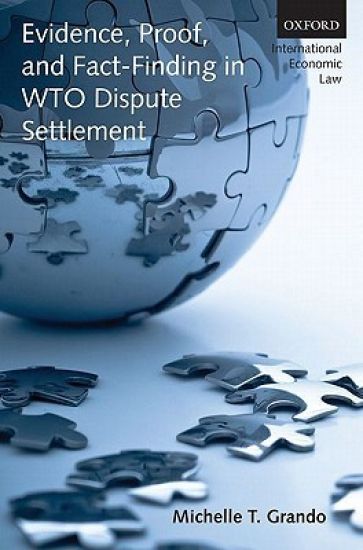
This book examines the process through which a World Trade Organization (WTO) dispute settlement panel formulates its conclusions with respect to the facts of a case, i.e. the process of fact-finding or process of proof. The Dispute Settlement Understanding provides general guidance but few direct answers to specific questions regarding the process of fact-finding, which has placed upon panels and the Appellate Body the responsibility to provide answers to those questions as they have arisen in the cases. This book reviews the extensive jurisprudence developed in the 14 years of operation of the WTO dispute settlement system with a view to (a) determining whether panels and the Appellate Body have set out optimal rules to govern the process of fact-finding and, to the extent that that is not the case, (b) to make suggestions for improvement. This book analyses questions such as (i) which party bears the responsibility of ultimately convincing the panel of the truth of a fact (burden of proof); (ii) what quantum of proof is necessary to convince the panel (standard of proof); (iii) the role of the panel, disputing parties, and non-disputing parties (e.g. experts, international organizations, private parties) in the development of the evidentiary record on which the panel bases its decision; (iv) the consequences of a party's failure to cooperate in the process of fact-finding; (v) how the parties can access the information which is necessary to prove their allegations; and (vi) the treatment of confidential business and governmental information. In assessing and making suggestions to improve the answers provided by panels to these questions, the book draws on the approaches followed in the two major legal systems of the world, the common law and the civil law, and to the extent possible the approaches adopted by other international courts and tribunals.
Michelle Kosch's book traces a complex of issues surrounding moral agency - how is moral responsibility consistent with the possibility of theoretical explanation? is moral agency essentially rational agency? can autonomy be the foundation of ethics? - from Kant through Schelling to Kierkegaard. There are two complementary projects here. The first is to clarify the contours of German idealism as a philosophical movement by examining the motivations not only of its beginning, but also of its end. In tracing the motivations for the transition to mid-19th century post-idealism to Schelling's middle and late periods and, ultimately, back to a problem originally presented in Kant, it shows the causes of the demise of that movement to be the same as the causes of its rise. In the process it presents the most detailed discussion to date of the moral psychology and moral epistemology of Schelling's work after 1809. The second project - which is simply the first viewed from a different angle - is to trace the sources of Kierkegaard's theory of agency and his criticism of philosophical ethics to this same complex of issues in Kant and post-Kantian idealism. In the process, Kosch argues that Schelling's influence on Kierkegaard was greater than has been thought, and builds a new understanding of Kierkegaard's project in his pseudonymous works on the basis of this revised picture of their historical background. It is one that uncovers much of interest and relevance to contemporary debates.
Embodied Selves and Divided Minds examines how research in embodied cognition and enactivism can contribute to our understanding of the nature of self-consciousness, the metaphysics of personal identity, and the disruptions to self-awareness that occur in case of psychopathology. It begins with the assumption that if we take embodiment seriously, then the resulting conception of the self (as physically grounded in the living body) can help us to make sense of how a minded subject persists across time. However, rather than relying solely on puzzle cases to discuss diachronic persistence and the sense of self, this work looks to schizophrenia and dissociative identity disorder as case studies. Here we find real-life examples of anomalous phenomena that signify disruptions to embodied self-experience and appear to indicate a fragmentation of the self. However, rather than concluding that these disorders count as genuine instances of multiplicity, the book's discussion of the self and personal identity allows us to understand the characteristic symptoms of these disorders as significant disruptions to self-consciousness. The concluding chapter then examines the implications of this theoretical framework for the clinical treatment of schizophrenia and dissociative identity disorder. Embodied Selves and Divided Minds reveals how a critical dialogue between Philosophy and Psychiatry can lead to a better understanding of important issues surrounding self-consciousness, personal identity, and psychopathology.
In The Victimization of Women, Michelle Meloy and Susan Miller present a balanced, comprehensive, and objective summary of the most significant research on the victimizations, violence, and victim politics that disproportionately affect women. They examine the history of violence against women, the surrounding debates, the legal reforms and justice system outcomes, the related media and social-service responses, and the current science on intimate partner violence, stalking, sexual harassment, sexual assault, and rape. Plus, they augment these victimization findings with original research on women convicted of domestic battery and men convicted of sexual abuse and other sex-related offenses. In these new data the authors explore the unanticipated consequences associated with changes to the laws governing domestic violence and the newer forms of sex-offender legislation. Both of these investigations are based on qualitative data that involve in-depth offender-based interviews that probe the circumstances surrounding the arrests and victimizations involved in the cases, the significant legal issues, and their experiences with the criminal justice system.
In The Victimization of Women, Michelle Meloy and Susan Miller present a balanced, comprehensive, and objective summary of the most significant research on the victimizations, violence, and victim politics that disproportionately affect women. They examine the history of violence against women, the surrounding debates, the legal reforms and justice system outcomes, the related media and social-service responses, and the current science on intimate partner violence, stalking, sexual harassment, sexual assault, and rape. Plus, they augment these victimization findings with original research on women convicted of domestic battery and men convicted of sexual abuse and other sex-related offenses. In these new data the authors explore the unanticipated consequences associated with changes to the laws governing domestic violence and the newer forms of sex-offender legislation. Both of these investigations are based on qualitative data that involve in-depth offender-based interviews that probe the circumstances surrounding the arrests and victimizations involved in the cases, the significant legal issues, and their experiences with the criminal justice system.
How the NIH Can Help You Get Funded takes a novel, non-formulaic approach in teaching readers how to "write a grant" -- and much more. The authors draw on their decades of experience working with both investigators and NIH personnel to anticipate their questions and concerns and help establish a comfortable, productive partnership between them. With this book's focus on applying this knowledge to their personal grant strategy, readers will learn: · how the NIH operates at the corporate level, as well as the culture and policies of individual institutes and centers · how the NIH budget evolves over the course of a fiscal year and why the timing is important · how to customize NIH Web site searches and use the data to increase chances of success · how to identify appropriate program officers, study sections, and funding opportunities The authors advise readers on developing each component of the grant application in order of the components' influence on the final impact score. Individual funding mechanisms are reviewed along with grantsmanship tips specific to each. Readers learn the importance of reviewer-friendly formatting and organization of the text. The final chapters cover next steps after the application has been submitted-before, during, and after the review and funding decision. Strategies for resubmitting or repurposing applications are provided for those readers whose applications do not receive awards. The authors likewise anticipate the needs of readers who do receive funding but have questions on managing and maintaining their award. Amid ever-increasing competition for government research grants, How the NIH Can Help You Get Funded is an invaluable manual for how to pursue -- and sustain -- NIH funding.