This book dissectsfrom both philosophical and empirical viewpointsthe peculiar developmental challenges, geopolitical contexts, and dystopic stalemates that post-Soviet societies face during their transition to new political and cultural orders. The principal geographical focus of the essays is Ukraine, but most of the assembled texts are also relevant and/or refer to other post-Soviet countries. Mikhail Minakov describes how former Soviet nations are trying to re-invent, for their particular circumstances, democracy and capitalism while concurrently dealing with new poverty and inequality, facing unusual degrees of freedom and responsibility for their own future, coming to terms with complicated collective memories and individual pasts. Finally, the book puts forward novel perspectives on how Western and post-communist Europe may be able to create a sustainable pan-European common space. These include a new agenda for pan-European political communication, new East-Central European regional security mechanisms, a solution for the chain of separatist-controlled populations, and anti-patronalist institutions in East European countries.
In his timely book, Mikhail Suslov discusses contemporary Russian geopolitical culture and argues that a better knowledge of geopolitical concepts and fantasies is instrumental for understanding Russias policies. Specifically, he analyzes such concepts as Eurasianism, Holy Russia, Russian civilization, Russia as a continent, Novorossia, and others. He demonstrates that these concepts reached unprecedented ascendance in the Russian public debates, tending to overshadow other political and domestic discussions. Suslov argues that the geopolitical imagination, structured by these concepts, defines the identity of post-Soviet Russia, while this complex of geopolitical representations engages, at the same time, with the broader, international criticism of the Western liberal world order and aligns itself with the conservative defense of cultural authenticity across the globe. Geopolitical ideologies and utopias discussed in the book give the post-Soviet political mainstream the intellectual instruments to think about Russias exclusion -- imaginary or otherwise -- from the processes of a global world which is re-shaping itself after the end of the Cold War; they provide tools to construct the self-perception of Russia as a sovereign great-power, a self-sufficient civilisation, and as one of the poles in a multipolar world; and they help to establish the Messianic vision of Russia as the beacon of order, tradition, and morality in a sea of chaos and corruption.
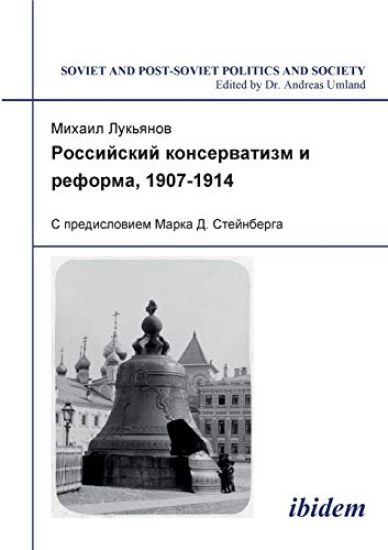
Conservatives displayed deep dissatisfaction with the state of affairs in Russia in 1907-1914. A critical attitude toward reality was expressed more strongly by extreme right-wing supporters of the All-Russian Dubrovinist Union of Russian People and less strongly by relatively moderate sympathizers of the All-Russian National Union. Over time, dissatisfaction spread from the right to the left, capturing even representatives of the left flank of Russian conservatism by the beginning of World War I. Their negative mood increased especially after the death of Stolypin, who was accepted as a symbol of conservative reform implemented in a national spirit. Conservatives of various persuasions, advocates and opponents of reform, came together in a negative evaluation of the current uncertain situation which satisfied neither.An explanation for this must be sought above all in the conservatives' attitude toward Russian modernization. Although Russian conservatism did not, in principle, reject the need to adapt to new realities, it was extremely difficult for conservatives to accept that variant of socioeconomic and political modernization that was taking place in Russia in practice.The social base of Russian conservatism was patently inadequate for the new trends. According to statistical data about the deputies of the Third and Fourth Duma conservative factions attracted individuals from the dominating ethno-confessional group, who, at the same time due to poverty, low level of education, and connection with stagnating agriculture were deprived of real chances for success in a quickly modernizing Russia. Russian conservatism had become the political expression of the interests of social strata that were losing their influence and were those least adapted to the new conditions.There existed another, ideological-value dimension to the conflict between conservatives and the status quo. The ideals of Russian conservatives on the eve of World War I were openly archaic and, in essence, presented themselves as variations of the notorious Uvarov's triad orthodoxy, autocracy, nationality. Describing their vision of an optimal political organization, they allotted the central place to autocracy, insisted on the necessity to secure the dominant position for the Russian and Orthodox majority. They argued that agriculture was destined to remain eternally the key branch of national economy.The introduction of representative legislative institutions, rise of economic influence of some national minorities, rapid industrial growth, and serious problems in agriculture directly contradicted the conservatives' notion of the optimal model for the state's structure. Political and socio-economic modernization was looked at as at mortal danger to the old regime, or even as the beginning of a G tterd mmerung. In this situation, conservatives worked out a series of political and socio-economic programs which became alternatives to official policies. Their rejection gave rise to a wave of gloomy forecasts and eschatological expectations; the famous Durnovo memorandum was only one example of documents expressing emotions of this kind. Conservative viewed the future with pessimism, and this pessimistic mood turned to be justified by the catastrophic events in a few years.Before the Great War, conservatives had stopped viewing themselves as buttresses of the Russian political system. This condition, no less than pressure from the left, brought about the quick and irreversible disintegration of the 3rd-of-June Regime. The pre-1917 status-quo definitely did not suit socialists or liberals, but neither did it satisfy the conservatives.