Kirjojen hintavertailu. Mukana 11 244 527 kirjaa ja 12 kauppaa.

Kirjahaku

Etsi kirjoja tekijän nimen, kirjan nimen tai ISBN:n perusteella.

1000 tulosta hakusanalla Monet Thompson

Money and the Rise of the Modern Papacy

Money and the Rise of the Modern Papacy

John F. Pollard

Cambridge University Press
2008
pokkari
This is a pioneering study of the finances and financiers of the Vatican between 1850 and 1950. Dr Pollard, a leading historian of the modern papacy, shows how until 1929 the papacy was largely funded by 'Peter's Pence' collected from the faithful, and from the residue the Vatican made its first capitalistic investments, especially in the ill-fated Banco di Roma. After 1929, the Vatican received much of its income from the investments made by the banker Bernadino Nogara in world markets and commercial enterprises. This process of coming to terms with capitalism was arguably in conflict both with Church law and Catholic social teaching and becoming a major financial power led the Vatican into conflict with the Allies during the Second World War. In broader terms, the ways in which the papacy financed itself helped shape the overall development of the modern papacy.
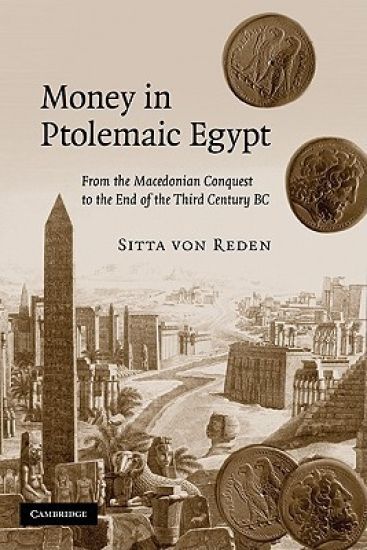
Money in Ptolemaic Egypt

Money in Ptolemaic Egypt

Sitta von Reden

Cambridge University Press
2010
pokkari
This book explores the impact of Alexander the Great's introduction of coined money on the economy and society of Egypt and its political implications for the formation of the Ptolemaic state. It argues that the introduction of coinage happened slowly, spreading gradually from Alexandria into the chora. Under Ptolemy II, however, Egypt was aggressively monetised. Using both numismatic and papyrological evidence, the workings of a rural monetary economy are reconstructed where coinage was in high demand, but in short supply. It is argued that by the middle of the third century BC Egypt was much more thoroughly monetised than is usually assumed, but that the degree of monetisation was sustained only by an extensive credit economy as well as ad hoc commutation of monetary payments into kind. Contextualising the complexities of credit and banking in rural Egypt, the book offers a fresh picture of their function in the ancient economy.
Money Employment and Inflation

Money Employment and Inflation

Robert J. Barro; Herschel I. Grossman

Cambridge University Press
1976
sidottu
This is a textbook on macroeconomic theory that attempts to rework the theory of macroeconomic relations through a re-examination of their microeconomic foundations. In the tradition of Keynes's General Theory of Employment, Interest and Money (published in 1936), and Patinkin's Money, Interest, and Prices, published in 1956 and revised in 1965, this book represents a third generation of macroeconomic theory. This book presents a comprehensive choice-theoretic analysis of the determination of the level of employment and the rate of inflation. A central feature of the book is the recasting of macroeconomic analysis in terms of a theory of exchange under non-market-clearing conditions. In addition, the analysis incorporates other aspects of the current reformulation of macroeconomic theory, including the relation between inflationary expectations, rates of return, and unemployment, the dynamics of aggregate demand, and the significance of incomplete information regarding the spatial distribution of wages and prices.
Money and Value

Money and Value

Grandmont Jean-Michel Grandmont

Cambridge University Press
1983
sidottu
This book addresses the controversial issue of whether a competitive monetary economy has built-in price adjustment mechanisms strong enough to remove excess demands and supplies on all markets.
Money: in Disequilibrium

Money: in Disequilibrium

Douglas Gale

Cambridge University Press
1984
pokkari
This 1983 book is a wide-ranging study of the macroeconomic side of monetary theory. Traditional macroeconomics uses simple, aggregative models to analyse monetary and fiscal policy. Gale argues that we cannot do without it but also that it rarely attains the standards of rigour required of modern theory. This book can be seen as an attempt to do it properly. The early chapters are critical and reconstructive. They take a fresh look at standard topics such as wealth effects, money and growth and the long-run effects of monetary and fiscal policy. Later chapters develop different themes. The questions raised are drawn from traditional macroeconomics but there are plenty of surprises. The conventional view is frequently turned on its head or shown to be unsatisfactory or not robust. This and other exciting ideas enliven a book which will continue to be of interest to students and theorists alike.
Money

Money

Douglas Gale

Cambridge University Press
1982
pokkari
As the title suggests, this book deals mainly with what can be described as the general-equilibrium approach to monetary theory. The author does not attempt an encyclopaedic treatment, but investigates the central problems and ideas in the development of contemporary monetary theory.
Money and Value

Money and Value

Jean-Michel Grandmont

Cambridge University Press
1985
pokkari
This book addresses one of the major theoretical issues that underlies, implicitly or explicitly, some recurrent controversies in macroeconomics - namely, whether a competitive monetary economy has built-in mechanisms that are strong enough to remove excess demands and supplies on all markets, through an automatic adjustment of the price system. Jean-Michel Grandmont sheds light on this complex subject by using the analytical techniques of general equilibrium theory alongside the methods of monetary analysis. The book warns against the indiscriminate use of the rational expectations hypothesis when approaching this topic, and conversely stresses the common-sense observation that short-run learning processes are among the most important characteristics of economic agents. Grandmont argues that such processes are deserving of careful theoretical study, and the result is a clear and rigorous analysis of all the issues involved.
Money and Liberty in Modern Europe

Money and Liberty in Modern Europe

William M. Reddy

Cambridge University Press
1987
pokkari
The concept of class, along with its correlates -m class interest, class conflict, class consciousness - ramain indispensable tools of historical explanation. Yet research over the last twenty-five years, especially on the histories of England, France, and Germany, has revealed an increasingly poor fit between these concepts and the reality they purport to explain. Some historians have reacted by rejecting class; others have proposed bold revisions in our understanding of it that enable it to encompass new research findings. This study does neither. Instead, building on interpretive method Professor Reddy proposes to replace class with an alternative concept that seeks to capture from a new angle the fundamental relations of exchange and authority that have shaped social life in modern Europe.
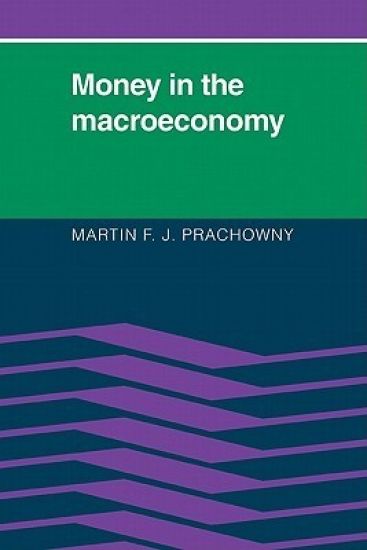
Money in the Macroeconomy

Money in the Macroeconomy

Martin F. J. Prachowny

Cambridge University Press
1986
pokkari
This is a textbook designed for senior undergraduate courses in monetary economics, advanced macroeconomics, or macroeconomic policy. Students will feel comfortable with this material if they have completed an intermediate course in macroeconomics, relying on one of the more demanding texts in this field. The prime focus of the book is on the role of money in the macroeconomy and on the place of monetary policy as an instrument for controlling inflation and unemployment. There are only three important macrovariables that are features: the rate of inflation, the interest rate, and output or income. Behavioural relationships in the goods, money, and labor markets determine these variables, using only the now common IS-LM-AS model. The model is not ideological, but opposing views of the efficiacy of stabilization policy are allowed to confront each other. There is a great deal of emphasis on relating the theoretical propositions to recent Canadian and U.S. macroeconomic performance. To expose students to diversity of experience, both countries receive equal treatment, one to serve as an example of a closed economy and the other as an example of an open economy. The book relies mostly on verbal and diagrammatical exposition; equations are used to show why and how curves shift in the diagrams. Also, numerical examples are provided in 'boxes' at appropriate places in the text, and exercises are given at the end of most chapters. A booklet containing answers to these exercises is available to instructors on request to the author.
Money Capital in the Theory of the Firm

Money Capital in the Theory of the Firm

Douglas Vickers

Cambridge University Press
1987
sidottu
The place of money capital in the theory of the firm has remained a relatively neglected question in traditions of economic analysis. In this highly integrative work, issues in production, pricing, capital investment, and financial theory are brought to new levels of interdependence. Developing a three-part argument, Money Capital in the Theory of the Firm deals successively with the theoretical issues and analytic motivation, the neoclassical tradition and postclassical perspectives. In doing so, it presents a self-contained foundation in the basic structures of microeconomic analysis relating to optimization decision making in the firm and in the accounting concepts and statistical apparatus of probability theory relevant to the neoclassical aspects of the argument. Additionally, the book provides the essential mathematical development of such advanced topics as utility functions defined over stochastic arguments, the equilibrium theory of financial asset prices and yields, the cost of money capital, and investment decision criteria. Money Capital in the Theory of the Firm makes an important contribution to the formation of new and analytically richer perspectives in the important area of economics it addresses. It will be of particular interest to those working in economic theory and microeconomics, and their advanced students.
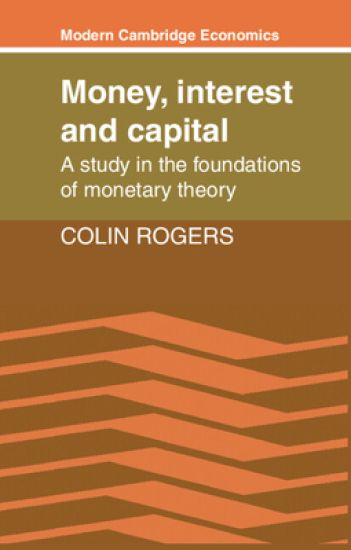
Money, Interest and Capital

Money, Interest and Capital

Colin Rogers

Cambridge University Press
1989
pokkari
This book presents a study in the foundations of monetary theory with several unique features. It consists of two parts: a critique of the varieties of neoclassical monetary theory, and a rigorous statement of the foundations of Post Keynesian monetary theory. The two parts reflect Joseph Schumpeter’s distinction between monetary theories in the divergent traditions of Real and Monetary Analysis. Part I offers a novel critique of Wicksellian and neo-Walrasian general equilibrium versions of Real analysis. The critique of Wicksell's monetary theory demonstrates the general impossibility of defining the natural rate of interest without which the loanable funds theory collapses. The critique of neo-Walrasian monetary theory, on the other hand, exploits the inessential role of ‘money’ in temporary equilibrium and overlapping generations models and develops a novel interpretation of the Patinkin controversy and the Clower finance constraint. The implications of these developments are then traced through the debates between monetarists and Keynesians. Part II presents a rigorous argument for securing the foundations of Post Keynesian monetary theory in the tradition of Monetary Analysis. In the context of the evolution of the monetary system from commodity money to credit money. Wicksell’s natural rate of interest is replaced by Keynes's marginal efficiency of capital which is in turn applied to Myrdal’s notion of monetary equilibrium to derive a formal definition of Keynes’s point of effective demand. This leads to the most novel feature of the book: the demonstration of the existence of a long-run unemployment equilibrium without the assumptions of rigid wages. The principle of effective demand is shown to break Say’s Law by placing a limit on the profitable expansion of output before full employment is reached.
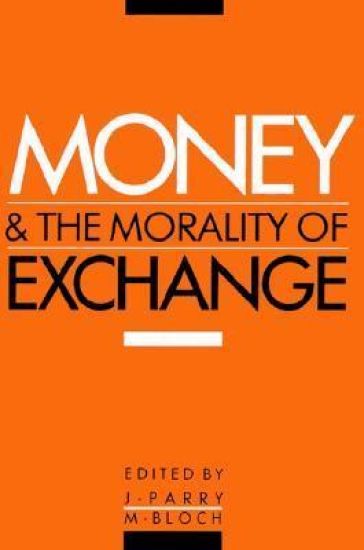
Money and the Morality of Exchange

Money and the Morality of Exchange

Cambridge University Press
1989
sidottu
This volume deals with the way in which money is symbolically represented in a range of different cultures, from South and South-east Asia, Africa and South America. It is also concerned with the moral evaluation of monetary and commercial exchanges as against exchanges of other kinds. The essays cast radical doubt on many Western assumptions about money: that it is the acid which corrodes community, depersonalises human relationships, and reduces differences of quality to those of mere quantity; that it is the instrument of man’s freedom, and so on. Rather than supporting the proposition that money produces easily specifiable changes in world view, the emphasis here is on the way in which existing world views and economic systems give rise to particular ways of representing money. But this highly relativistic conclusion is qualified once we shift the focus from money to the system of exchange as a whole. One rather general pattern that then begins to emerge is of two separate but related transactional orders, the majority of systems making some ideological space for relatively impersonal, competitive and individual acquisitive activity. This implies that even in a non-monetary economy these features are likely to exist within a certain sphere of activity, and that it is therefore misleading to attribute them to money. By so doing, a contrast within cultures is turned into a contrast between cultures, thereby reinforcing the notion that money itself has the power to transform the nature of social relationships.
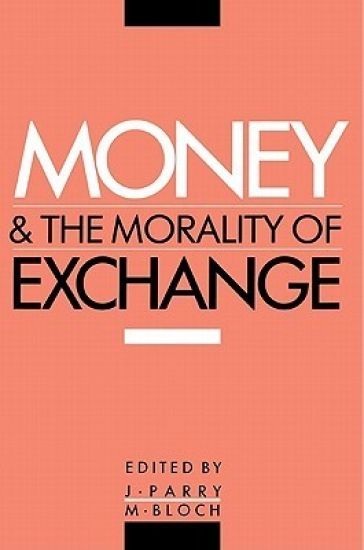
Money and the Morality of Exchange

Money and the Morality of Exchange

Cambridge University Press
1989
pokkari
This volume deals with the way in which money is symbolically represented in a range of different cultures, from South and South-east Asia, Africa and South America. It is also concerned with the moral evaluation of monetary and commercial exchanges as against exchanges of other kinds. The essays cast radical doubt on many Western assumptions about money: that it is the acid which corrodes community, depersonalises human relationships, and reduces differences of quality to those of mere quantity; that it is the instrument of man’s freedom, and so on. Rather than supporting the proposition that money produces easily specifiable changes in world view, the emphasis here is on the way in which existing world views and economic systems give rise to particular ways of representing money. But this highly relativistic conclusion is qualified once we shift the focus from money to the system of exchange as a whole. One rather general pattern that then begins to emerge is of two separate but related transactional orders, the majority of systems making some ideological space for relatively impersonal, competitive and individual acquisitive activity. This implies that even in a non-monetary economy these features are likely to exist within a certain sphere of activity, and that it is therefore misleading to attribute them to money. By so doing, a contrast within cultures is turned into a contrast between cultures, thereby reinforcing the notion that money itself has the power to transform the nature of social relationships.
Money and its Use in Medieval Europe

Money and its Use in Medieval Europe

Peter Spufford

Cambridge University Press
1989
pokkari
This is a full-scale study of the history of money, not merely of coinage, to have been written for medieval Europe. The book is not limited to one country, or to any one period or theme, but extracts the most important elements for the historian across the broadest possible canvas. Its scope extends from the mining of precious metals on the one hand, to banking, including the use of cheques and bills of exchange, on the other. Chapters are arranged chronologically, rather than regionally or thematically, and offer a detailed picture of the many and changing roles played by money, in all its forms, in all parts of Europe throughout the Middle Ages. Thus money is seen as having differing values for differing parts of individual societies. The book shows money moving and changing as a result of war and trade and other political, economic and ecclesiastical activities without regard for national barriers or the supposed separation between 'East' and 'West'.
Money and Security

Money and Security

Hubert Zimmermann

Cambridge University Press
2011
pokkari
This study links two fundamental political structures of the Cold War era, the transatlantic security system and the international monetary system. Central to this issue is a problem which soured relations between the Federal Republic and its allies from the 1950s to the 1970s: who was to bear the enormous cost of British and American troops in Germany? Both Washington and London identified this cost as a major reason for the decline of their currencies, whereas Germany reluctantly paid and traded 'Money for Security'; a fundamental pattern of its postwar foreign policy. The interweaving of money and security leads toward a more complete understanding of transatlantic history during the Cold War, one which provides an incisive comment on the pattern of simultaneous conflict and cooperation in the interaction of modern states, demonstrates the influence of domestic politics on foreign policies, and comments on the relative nature of American hegemony.
Money in Classical Antiquity

Money in Classical Antiquity

Sitta von Reden

Cambridge University Press
2010
sidottu
This book was the first to undertake a comprehensive analysis of the impact of money on the economy, society and culture of the Greek and Roman worlds. It uses new approaches in economic history to explore how money affected the economy in antiquity and demonstrates that the crucial factors in its increasing influence were state-formation, expanding political networks, metal supply and above all an increasing sophistication of credit and contractual law. Covering a wide range of monetary contexts within the Mediterranean over almost a thousand years (c.600 BC–AD 300), it demonstrates that money played different roles in different social and political circumstances. The book will prove an invaluable introduction to upper-level students of ancient money, while also offering perspectives for future research to the specialist.
Money in Classical Antiquity

Money in Classical Antiquity

Reden Sitta von

Cambridge University Press
2010
pokkari
This book was the first to undertake a comprehensive analysis of the impact of money on the economy, society and culture of the Greek and Roman worlds. It uses new approaches in economic history to explore how money affected the economy in antiquity and demonstrates that the crucial factors in its increasing influence were state-formation, expanding political networks, metal supply and above all an increasing sophistication of credit and contractual law. Covering a wide range of monetary contexts within the Mediterranean over almost a thousand years (c.600 BC–AD 300), it demonstrates that money played different roles in different social and political circumstances. The book will prove an invaluable introduction to upper-level students of ancient money, while also offering perspectives for future research to the specialist.
Manet's 'Le Déjeuner sur l'herbe'

Manet's 'Le Déjeuner sur l'herbe'

Cambridge University Press
1998
pokkari
Edouard Manet’s controversial painting ‘Le Déjeuner sur l’herbe’ is one of the best known images in French art. The subject of critical analysis for more than a century, it still defies singular interpretation. This book offers six different readings of the painting. Based on new ideas about its context, production, meaning, and reception, these essays, written specially for this volume by the leading scholars of French modern art, incorporate close examinations of its radical style and novel subject, relevant historical developments and archival material, as well as biographical evidence that prompts psychological inquiries. Shedding new light on the artist and the touchstone work of modernism, this title also introduces readers to current methodologies in art history and to the multiple ways that this complex painting can be framed.