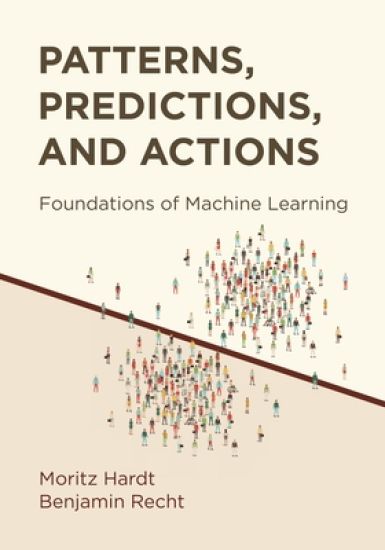
An authoritative, up-to-date graduate textbook on machine learning that highlights its historical context and societal impactsPatterns, Predictions, and Actions introduces graduate students to the essentials of machine learning while offering invaluable perspective on its history and social implications. Beginning with the foundations of decision making, Moritz Hardt and Benjamin Recht explain how representation, optimization, and generalization are the constituents of supervised learning. They go on to provide self-contained discussions of causality, the practice of causal inference, sequential decision making, and reinforcement learning, equipping readers with the concepts and tools they need to assess the consequences that may arise from acting on statistical decisions.Provides a modern introduction to machine learning, showing how data patterns support predictions and consequential actionsPays special attention to societal impacts and fairness in decision makingTraces the development of machine learning from its origins to todayFeatures a novel chapter on machine learning benchmarks and datasetsInvites readers from all backgrounds, requiring some experience with probability, calculus, and linear algebraAn essential textbook for students and a guide for researchers
Badger decides to give himself a treat and only do things that he enjoys But from the moment he gets out of bed and nearly knocks over his lamp, everything goes wrong. When he visits each of his friends, he discovers something surprising . . . Could everyone be having a miserable day? But Badger's biggest surprise of all happens when he gets back home.
Sometimes a bad mood can be contagious Badger got up one morning feeling very grumpy. "Humph " Badger said to himself. What was the point of being in a bad mood if nobody noticed? he thought. So Badger headed out, slamming the door behind him. Badger spreads his bad mood far and wide, greeting all his friends with angry, rude remarks that put them in bad moods, too. A comical, cautionary tale for anyone who has ever gotten up on the wrong side of the bed.
Fun is just a fresh perspective away in this entertaining book about boredom. What a boring day Badger doesn't feel like doing anything. Unfortunately, Fox, Squirrel, Blackbird, and Rabbit feel the same way. One after the other, they appear at Badger's door. Even together they don't know what to do. But when Mouse comes over wearing an eye patch, she gets the ball rolling--or rather a pirate ship in motion--and the treasure hunt begins Badger and his friends are finally on an adventure. Grumpy Badger is back in Moritz Petz's humorous story--that could take place in any children's room--reminding us that boredom often gives rise to the best ideas. Am lie Jackowski's illustrations keep the laughs coming with her unique and humorous details. Praise for The Day Everything Went Wrong "Amelie Jackowski's illustrations are wonderful."-- Youth Services Book Review "This sweet Swiss import gives a fresh take on altruism and friendship."--Booklist
This is an enthralling personal account of the secret Nazi project, Operation Bernhard, devised to destabilize the British and, later, American economies by creating and putting into circulation millions of counterfeit banknotes. A team of typographers and printers was pulled out of the rows of prisoners on their way to the gas chambers and transferred to the strictly isolated Block 19 in Sachsenhausen concentration camp. There they were presented with the enormous task of producing almost perfect counterfeits to the value of hundreds of millions of pounds sterling. These notes were to be dropped from bombers over London, with the aim of causing financial chaos. When the time came the Luftwaffe's resources were fully committed in other campaigns and theaters but some of the currency was successfully used to fund operations in Germany's secret war.
Aa classic color theory reference in Europe for several years, available now, for the first time, in English translation. The book is arranged to follow light from a stimulus outside the human body, through the reaction of the visual organs of the body and ultimately to the occurrence of the visual experience in the brain. Colorful schematic drawings and photographs presented with explanatory captions demonstrate many elements of color theory from the organization of color to the perception of a rainbow. Beyond as explanation of the actual processes, Mr Zwimpfer demonstrates the total relationship which takes the perception of color beyond a mere passive registering, such as in photography, to a three-dimensional perception of our world. The book will fascinate and inform artists, photographers, students and others who are interested in color theory.
What does it mean to see oneself as free? And how can this freedom be attained in times of conflict and social upheaval? In this ambitious study, Moritz Föllmer explores what twentieth-century Europeans understood by individual freedom and how they endeavoured to achieve it. Combining cultural, social, and political history, this book highlights the tension between ordinary people's efforts to secure personal independence and the ambitious attempts of thinkers and activists to embed notions of freedom in political and cultural agendas. The quest to be a free individual was multi-faceted; no single concept predominated. Men and women articulated and pursued it against the backdrop of two world wars, the expanding power of the state, the constraints of working life, pre-established moral norms, the growing influence of America, and uncertain futures of colonial rule. But although claims to individual freedom could be steered and stymied, they could not, ultimately, be suppressed.
Social media giants like Meta and transnational regulators such as the European Union are transforming private governance by creatively emulating public law frameworks. Drawing on exclusive interviews and in-depth analysis of Meta's Oversight Board and the EU's Digital Services Act, this book explores how these approaches blend European and American perspectives, bridging distinct legal traditions to address the challenges of platform governance. Analysis of content moderation practices and their implications uncovers a critical pattern in the evolution of governance for industries that will define the future, from digital platforms to emerging technologies. Combining public and private law in innovative ways, the book sheds light on bold governance experiments that will shape the digital world-for better or worse. This study offers crucial insights for understanding the next chapter of global governance in an increasingly interconnected and privatized world. This title is also available as Open Access on Cambridge Core.
This work has been selected by scholars as being culturally important and is part of the knowledge base of civilization as we know it.This work is in the public domain in the United States of America, and possibly other nations. Within the United States, you may freely copy and distribute this work, as no entity (individual or corporate) has a copyright on the body of the work.Scholars believe, and we concur, that this work is important enough to be preserved, reproduced, and made generally available to the public. To ensure a quality reading experience, this work has been proofread and republished using a format that seamlessly blends the original graphical elements with text in an easy-to-read typeface.We appreciate your support of the preservation process, and thank you for being an important part of keeping this knowledge alive and relevant.