Kirjojen hintavertailu. Mukana 11 244 527 kirjaa ja 12 kauppaa.

Kirjahaku

Etsi kirjoja tekijän nimen, kirjan nimen tai ISBN:n perusteella.

1000 tulosta hakusanalla Muhammad H. Rashid

The Life and Times of Elijah Muhammad

The Life and Times of Elijah Muhammad

Claude Andrew Clegg III

The University of North Carolina Press
2014
sidottu
Elijah Muhammad was one of the most significant and controversial black leaders of the twentieth century. His followers called him the Messenger of Allah, while his critics labeled him a teacher of hate. Southern by birth, Muhammad moved north, eventually serving as the influential head of the Nation of Islam for over forty years. Claude Clegg III not only chronicles Muhammad's life, but also examines the history of American black nationalists and the relationship between Islam and the African American experience.In this authoritative biography, which also covers half a century of the evolution of the Nation of Islam, Clegg charts Muhammad's early life, his brush with Jim Crow in the South, his rise to leadership of the Nation of Islam, and his tumultuous relationship with Malcolm X. Clegg is the first biographer to weave together speeches and published works by Muhammad, as well as delving into declassified government documents, insider accounts, audio and video records, and interviews, producing the definitive account of an extraordinary man and his legacy.
Charles Darwin's Lost Race and Muhammad's Lost Tribes
Before Charles Darwin was born, his grandfather, Erasmus, wrote a book titled Zoonomia, exploring the subject of evolution. Erasmus was a polymath who was a founder member of the Derby Philosophical Society and a member of the Birmingham Lunar Society. It was, however, to fall to his grandson to put flesh on his ideas and take the accolades. As Charles Darwin's ideas have been elaborated upon, and confirmed, his denial of God's existence has caused most of the people in England to welcome his apostasy. It has given them a freedom to express themselves, but that has had costs. A country advances by means of its disciplines, and that includes universities that found belief in God an encumbrance. If only they had taken to psychiatrist Karl Gustav Jung, who famously said he believed in God, rather than atheists Sigmund Freud and Immanuel Kant, things may have been different. Boys in particular need disciplining to reach their true potential, so that they smarten their genes rather than allow them, and their offspring, to become flaccid. The book suggests retired soldiers; particularly those who have overcome serious injuries inflicted in conflicts should play a part in their education in the quest to achieve a virtuous manhood. The book also reflects on fourteen hundred years of Islam and how it continues to plague the world with terrorism.
Charles Darwin's Lost Race and Muhammad's Lost Tribes
Before Charles Darwin was born, his grandfather, Erasmus, wrote a book titled Zoonomia, exploring the subject of evolution. Erasmus was a polymath who was a founder member of the Derby Philosophical Society and a member of the Birmingham Lunar Society. It was, however, to fall to his grandson to put flesh on his ideas and take the accolades. As Charles Darwin's ideas have been elaborated upon, and confirmed, his denial of God's existence has caused most of the people in England to welcome his apostasy. It has given them a freedom to express themselves, but that has had costs. A country advances by means of its disciplines, and that includes universities that found belief in God an encumbrance. If only they had taken to psychiatrist Karl Gustav Jung, who famously said he believed in God, rather than atheists Sigmund Freud and Immanuel Kant, things may have been different. Boys in particular need disciplining to reach their true potential, so that they smarten their genes rather than allow them, and their offspring, to become flaccid. The book suggests retired soldiers; particularly those who have overcome serious injuries inflicted in conflicts should play a part in their education in the quest to achieve a virtuous manhood. The book also reflects on fourteen hundred years of Islam and how it continues to plague the world with terrorism.
American Legends: The Life of Muhammad Ali

American Legends: The Life of Muhammad Ali

Charles River

Createspace Independent Publishing Platform
2013
nidottu
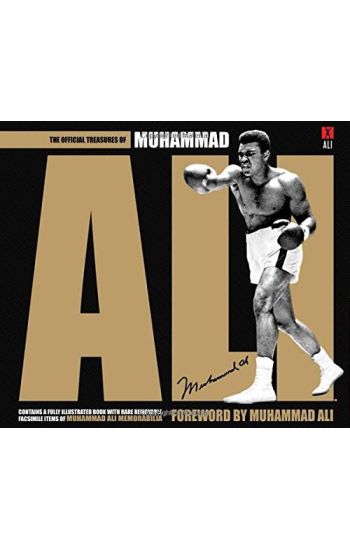
*Includes Ali's most colorful quotes. *Includes pictures of Ali and other boxers he fought. "To prove I am great, he will fall in eight." - Muhammad Ali A lot of ink has been spilled covering the lives of history's most influential figures, but how much of the forest is lost for the trees? In Charles River Editors' American Legends series, readers can get caught up to speed on the lives of America's most important men and women in the time it takes to finish a commute, while learning interesting facts long forgotten or never known. The sports world has never suffered from a shortage of self-promoters, but none have ever walked the walk and backed up the talk like Muhammad Ali, boxing's greatest icon and possibly history's most famous athlete. Indeed, even referring to Ali just as a boxer does a disservice to the transcendent figure he has become around the world as a living legend. Of course, the legend of Ali begins in the squared circle, where a young, brash kid named Cassius Clay rose to the top of the boxing world with a style so unorthodox that anyone else attempting it would all but assure he'd get knocked out. But Ali became the heavyweight champ by keeping his hands low, "floating like a butterfly and stinging like a bee", and outboxing heavyweight champions like Sonny Liston, Joe Frazier, George Foreman, and Floyd Patterson. In his early years, Muhammad Ali truly was the Greatest, and he could only be stopped by the Vietnam War, when his refusal to enter the armed forces resulted in his arrest and the stripping of his title. Ali also lost 3 years of his fighting prime before returning to the ring, but his most iconic fights were still ahead of him, including the "The Thrilla in Manilla" and "The Rumble in the Jungle". By now, Ali's outspoken nature had earned him both praise and scorn in the boxing world and outside of it; Smokin Joe Frazier spent decades infuriated by Ali's disparaging comments about him during their clashes. In fact, it's unclear whether Ali would be as idolized as he is now if he hadn't suffered Parkinson's Disease, likely a result of all his fights and the longevity of his career. Since his retirement, Ali has remained a pop culture fixture and global icon, and he has been honored with too many awards to count. Held in awe just about everywhere, Ali has lit the torch at the Olympics, received the Presidential Medal of Freedom, and received the Presidential Citizens Medal, among other honors. American Legends: The Life of Muhammad Ali looks at the life and career of boxing's greatest icon, his colorful quotes, and his lasting legacy. Along with pictures of important people, places, and events, you will learn about Ali like you never have before, in no time at all.
Sting Like a Bee: The Muhammad Ali Story

Sting Like a Bee: The Muhammad Ali Story

Philip Brown

Createspace Independent Publishing Platform
2016
nidottu
Nobody had a life quite like Muhammad Ali. He won an Olympic Gold Medal at 18, the world heavyweight championship at 22. Outside the ring he was charismatic, hugely talented and a gifted self publicist.He put his career and whole future at risk when he refused the draft for the Vietnam War and took the Muslim faith. When he got his boxing license back he won the title again and his fights became world events. The Rumble in the Jungle and The Thrilla in Manila were watched by billions. Li's fast hands and faster tongue set him apart - he gave boxing a new lease of life. He fought for respect and equal opportunity for African Americans and campaigned globally for humanitarian causes. In retirement he used his fame to help oppressed people everywhere, even after he was cruelly hit by illness. His life made us richer.
The Quest for the Historical Muhammad
More than one hundred years ago Western scholars began to investigate the origins of Islam, using the highest standards of objective historical scholarship of the time. Their aim was to determine what could be known about Muhammad and the rise of early Islam quite apart from the pious and totally unobjective traditions preserved by the Muslim religious community. In some ways this research was inspired by a similar investigation of Christianity made famous by Albert Schweitzer's Quest of the Historical Jesus. Today although much has been learned about early Christianity, little comparable progress has been made in the field of Islamic Studies. Here objective historical research has long been severely handicapped both by the resistance of Muslim societies to Western analysis of their sacred traditions and by the apologetic approaches of many Western scholars, who have compromised their investigations for fear of offending Muslim sensibilities. It is in this context that Ibn Warraq presents this important anthology of the best studies of Muhammad and early Islam ranging from the very beginnings of Islamic Studies in the nineteenth century to contemporary research. In his selection and in an introductory essay, Warraq makes it clear that some very serious scholarly controversies lie at the heart of Islam. First, the Koran itself, the Muslim sacred scripture and the foundation of Islamic culture, is called into question as the basis for objective historical knowledge of Muhammad. Some scholars have also questioned the reliability of most of the other early Arabic documents that supposedly attest to events in the life of Muhammad and his followers. Was the Koran dictated by Muhammad at all? Was it actually compiled any earlier than a hundred years after the Prophet's death? How much of Muslim sacred tradition, in the light of objective historical analysis, must be dismissed as unreliable hearsay? Were the motives of the first Muslim conquerors during the Jihad truly religious in nature or largely mercenary? These disturbing questions, long suppressed throughout the history of Islamic scholarship, are here raised again in these erudite and thoroughly researched essays by noted scholars.
The First Muslim: The Story of Muhammad

The First Muslim: The Story of Muhammad

Lesley Hazleton

Riverhead Books
2014
nidottu
The extraordinary life of the man who founded Islam, and the world he inhabited--and remade. Lesley Hazleton's new book, Agnostic: A Spirited Manifesto, is out now from Riverhead Books. Muhammad's was a life of almost unparalleled historical importance; yet for all the iconic power of his name, the intensely dramatic story of the prophet of Islam is not well known. In The First Muslim, Lesley Hazleton brings him vibrantly to life. Drawing on early eyewitness sources and on history, politics, religion, and psychology, she renders him as a man in full, in all his complexity and vitality. Hazleton's account follows the arc of Muhammad's rise from powerlessness to power, from anonymity to renown, from insignificance to lasting significance. How did a child shunted to the margins end up revolutionizing his world? How did a merchant come to challenge the established order with a new vision of social justice? How did the pariah hounded out of Mecca turn exile into a new and victorious beginning? How did the outsider become the ultimate insider? Impeccably researched and thrillingly readable, Hazleton's narrative creates vivid insight into a man navigating between idealism and pragmatism, faith and politics, nonviolence and violence, rejection and acclaim. The First Muslim illuminates not only an immensely significant figure but his lastingly relevant legacy.
Understanding the Hadeeth (Sayings) of Prophet Muhammad in the context of the Qur'an
The Qur'an and the Sayings of Prophet Muhammad (PBUH) are the two main sources of knowledge in Islam. The Qur'an is a divine revelation inspired to Prophet Muhammad (PBUH), that guides us to the truth, and has principles that improves our character and behavior. Prophet Muhammad (PBUH) applied Qur'anic teachings in his character and behavior, and therefore became an example to follow. The Prophet (PBUH) lived more than 1400 years ago, in an environment different from our society today. He addressed issues, and answered questions, and gave advice that is relevant today. His sayings need to be understood in historical context and in the context of the Qur'an. This book examines some sayings of the Prophet and explains the concepts and morals in his Hadeeth (sayings) in the context of the Qur'an, and how we can apply these principles and teachings in our life. Both the Qur'an and the Sunnah (tradition) of Prophet Muhammad (PBUH) guide to what is right, and improve our character and behavior, and make us better human beings, aware of our accountability to God.
Understanding the Hadeeth (Sayings) of Prophet Muhammad in the context of the Qur'an
The Qur'an and the Sayings of Prophet Muhammad (PBUH) are the two main sources of knowledge in Islam. The Qur'an is a divine revelation inspired to Prophet Muhammad (PBUH), that guides us to the truth, and has principles that improves our character and behavior. Prophet Muhammad (PBUH) applied Qur'anic teachings in his character and behavior, and therefore became an example to follow. The Prophet (PBUH) lived more than 1400 years ago, in an environment different from our society today. He addressed issues, and answered questions, and gave advice that is relevant today. His sayings need to be understood in historical context and in the context of the Qur'an. This book examines some sayings of the Prophet and explains the concepts and morals in his Hadeeth (sayings) in the context of the Qur'an, and how we can apply these principles and teachings in our life. Both the Qur'an and the Sunnah (tradition) of Prophet Muhammad (PBUH) guide to what is right, and improve our character and behavior, and make us better human beings, aware of our accountability to God.