Kirjojen hintavertailu. Mukana 11 244 527 kirjaa ja 12 kauppaa.

Kirjahaku

Etsi kirjoja tekijän nimen, kirjan nimen tai ISBN:n perusteella.

1000 tulosta hakusanalla Nigel Robson

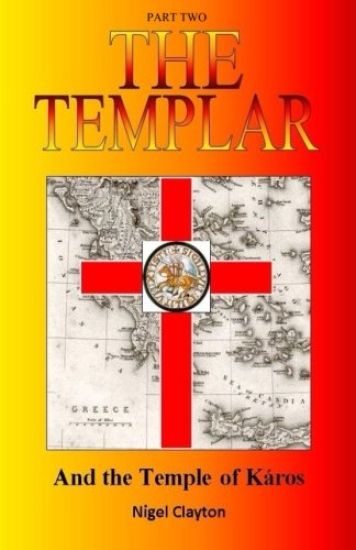
The Templar: And the Temple of Káros

The Templar: And the Temple of Káros

Nigel Brian James Clayton

Nigel Clayton
2015
nidottu
This is part two of The Templar series, part one being 'The Templar: And the City of God'. In part two the adventure continues. Just yesterday, Stephen was fighting to defend The City of God against the Muslim invaders; now, in the pursuing days, where living is as fierce by night, as it is by day, he must fight to preserve that, which he does not fully understand. From the novel, The Templar: and the City of God, comes the second novel of the continued journey of Stephen. Will he be delivered salvation? Will he secure a fuller understanding of his place in life? His first step of many is to provide aid to others, but over the coming days he must make decisions that will affect the future of mankind, not just the souls he has laid pledge to protect. The very religion that he holds so dear to his heart will be questioned, as too will the motives behind his decisions. K ros holds the key, the key to everlasting life, the key to the rules of life, and life's meaning. It is for him to decide what will become of his future, and of the Christian religion. At all costs, he must preserve that which he has been passed onto him; the secret of the chest; and above all, the key must always be protected and never surrendered.
Templar, Assassination, Trial and Torture

Templar, Assassination, Trial and Torture

Nigel Clayton

Zuytdorp Press
2020
pokkari
This book in a novel, whereby 'Song of the Templar' is the same, basic story but written in poetic verse - the covers are almost identical.Bernard de Beauvais is a Knights Templar, accused of many things, including cowardice. We follow Bernard during his trial; through the ages; the Battle of Tripoli, the Battle of Acre, and the Battle of Bannockburn. He's tortured and ransomed, fights like the devil and protects the innocent as though they are his own children; but one day his world comes crashing down around him, all because of King Philip, King of France. But France is his home and it comes to pass that the French Exchequer needs the help of Bernard, and together something heinous is plotted; but history will never know of Bernard's ultimate service to the people of his beloved country.
Peru – Yaguas–Cotuhé

Peru – Yaguas–Cotuhé

Nigel Pitman; Corine Vriesendorp; Debra K. Moskovits; Rudolf Von May; Diana Alvira

Field Museum of Natural History,U.S.
2011
nidottu
In 2010, a team of experts conducted a rapid social and biological inventory of the Yaguas, Cotuhe, and lower Putumayo watersheds of northeastern Peru. They assessed the geology, vegetation, fishes, amphibians, reptiles, birds, and mammals at four wilderness sites. This report offers recommendations for sustaining healthy towns and forests in the areas, and it is provided here in Spanish and English.
Perú: Cerros de Kampankis – Rapid Biological and Social Inventories: 24
The Kampankis Mountains are a knife-thin ridge in northern Peru that rises 1,435 meters above the surrounding Amazon lowlands. For three weeks, a group of researchers explored both the biological diversity and cultural values of the Cerros de Kampankis landscape, with the aim of promoting the long-term conservation of the area by the local Awajun and Wampis indigenous peoples. Field Museum and Peruvian scientists recorded over 1,700 species of plants, fishes, amphibians, reptiles, birds, and mammals, including twenty-five species that appear to be new to science. The report is presented in Spanish and English, and includes conservation recommendations, a technical report on the biological and social findings, appendices, and an executive summary in Wampis and Awajun.
Perú: Ere–Campuya–Algodón – Rapid Biological and Social Inventories: 25
In October 2012, an international and multidisciplinary team of experts conducted a rapid social and biological inventory of the Ere, Campuya, and Algodon watersheds of northern Amazonian Peru. Team members working on the social inventory studied the connections between local communities and their natural surroundings, while team members working on the biological inventory surveyed geology, plants, fishes, amphibians, reptiles, birds, and mammals at three wilderness sites. Based on these studies, the team and its local partners drew up a detailed series of recommendations for sustaining healthy towns and forests in the area. This volume contains the team's full report and results in both Spanish and English, as well as overviews in Murui and Kichwa.
Perú: Cordillera Escalera–Loreto – Rapid Biological and Social Inventories: 26
The Cordillera Escalera mountain range on the Loreto-San Martín border in Amazonian Peru was barely known to scientists until the September 2013 expedition described in this report. Richly illustrated with twenty four color plates featuring more than one hundred photographs, this volume contains the full results of the expedition's rapid inventories of the geology, plants, fishes, amphibians, reptiles, birds, and mammals in the Cordillera Escalera, as well as in-depth descriptions of the history, daily life, and natural resource use of local Shawi communities. Contributors also discuss threats to and opportunities for the landscape and its people and offer recommendations for sustaining biodiversity and human well-being in this megadiverse region of Peru. This volume contains the expedition team's full report in both Spanish and English, as well as an overview in Shawi.
Perú: Tapiche–Blanco – Rapid Biological and Social Inventories Report 27
In October 2014 an interdisciplinary team of geologists, biologists, and social scientists carried out a rapid inventory of the biological and cultural diversity of the remote Tapiche and Blanco watersheds of Amazonian Peru. This report summarizes their findings on the region's rich biological communities of plants, fishes, amphibians, reptiles, birds, and mammals, as well as what the team learned in conversations with local indigenous and campesino communities about resource use and quality of life. A trilingual volume featuring both Spanish and English text with a summary in Capanahua, Peru: Tapiche-Blanco is designed for a broad range of readers-from scientists to decision-makers, from fishermen to local schoolchildren-and offers at its heart a series of recommendations for protecting the region's extraordinary diversity.
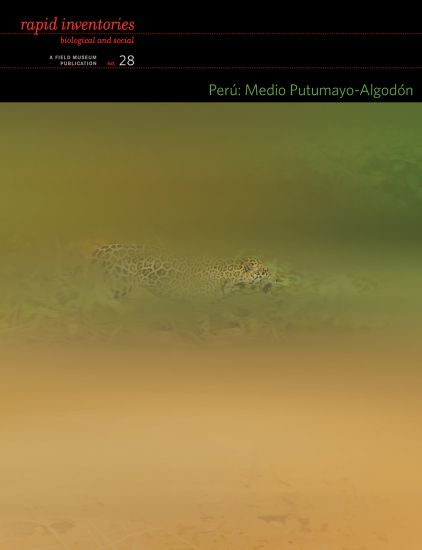
Perú: Medio Putumayo–Algodón – Rapid Biological and Social Inventories Report 28
In February 2016, a multidisciplinary team of geologists, biologists, social scientists, and local residents explored the rivers, forests, and human communities of a remote area in northern Amazonian Peru, along the Putumayo, Algodón, and Mutún rivers. This report describes the current status of the region’s plant, fish, amphibian, reptile, bird, and mammal communities, as well as the current and historical use of its rich natural resources by local indigenous and campesino communities. At the heart of the report is a series of recommendations for protecting the Putumayo region’s extraordinary cultural and biological diversity. The main text is in both Spanish and English, with executive summaries in Ocaina, Murui, and Maijuna.
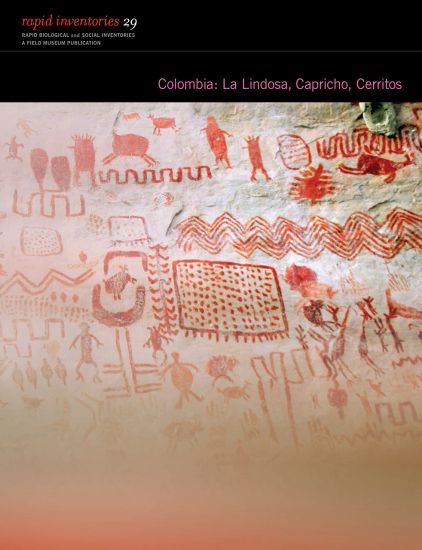
Colombia: La Lindosa, Capricho, Cerritos – Rapid Biological and Social Inventories Report 29

Colombia: La Lindosa, Capricho, Cerritos – Rapid Biological and Social Inventories Report 29

Nigel Pitman; Corine Vriesendorp; Diana Alvira Reyes; Ashwin Ravikumar; Álvaro Del Campo

Field Museum of Natural History,U.S.
2018
nidottu
In October 2016 a multidisciplinary team of geologists, biologists, social scientists, and local residents explored the rivers, forests, and human communities in and around the La Lindosa, Capricho, and Cerritos outcrops in lowland Amazonian department of Guaviare, Colombia. This report describes the current status of the region’s plant, fish, amphibian, reptile, bird, and mammal communities, as well as the present-day and historical use of its rich natural resources by human communities. At the heart of the report is a series of recommendations for protecting these extraordinary outcrops and the region’s natural resources in partnership with local residents. The text is in Spanish, with an executive summary in English.