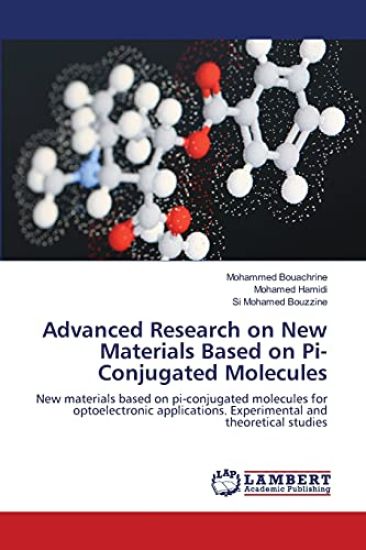
Materials based on pi-Conjugated molecules have attracted a considerable attention as a novel class of semi-conductors and are frequently studied because of their interesting optical and electronic properties which make them a good candidate for Opto-electronic applications. Because the importance of this type of materials in science and technology, a considerable effort has been made in their physico-chemical properties and modeling analysis and intensive research works stimulated by the above mentioned discoveries not only gave rise to a Nobel Prize (2000) in chemistry, but also to the several papers, devoted to the synthesis, characterization, theoretical studies and processing of these new generations of organic semi-conductors. It is difficult to prepare a review covering in details various aspects of these materials (design, synthesis, characterization and properties)We will, therefore, concentrate our discussion in this work on the different interesting papers published by our research group in several international journals.
This research project extensively investigates the process of selecting the most suitable gains for a Proportional-Integral (PI) controller to effectively manage a Buck-Boost Converter powered by a Photovoltaic (PV) Array. The rationale behind choosing a Buck-Boost Converter for this application is its capability to regulate the PV array's output voltage dynamically. The research methodology employs the state-space averaging method to derive the transfer function of the Buck-Boost converter. The mathematical model of the dynamic system is validated using MATLAB/Simulation software for analysis, enabling the derivation of the appropriate transfer function. To determine the optimal gains for the PI controller, the Particle Swarm Optimization (PSO) algorithm is employed, which has demonstrated its effectiveness and reliability in recent times. A MATLAB script is developed for PSO, which is utilized to obtain the suitable values of kp and ki.