Kirjahaku
Etsi kirjoja tekijän nimen, kirjan nimen tai ISBN:n perusteella.
1000 tulosta hakusanalla ROSENTHAL MICHAEL
Drawing on a close reading of nearly forty years' worth of personal letters and her will, and incorporating new archival material, Margaret Paston emerges from this study as the best example we have of how lay piety was negotiated and integrated into daily medieval life.
One of the great challenges facing historians of any era is to make the strangeness of the past comprehensible in the present. This task is especially difficult for scholars of the Middle Ages, a period that can seem particularly alien to modern sensibilities. In Telling Tales, Joel Rosenthal takes us on a journey through some familiar sources from fourteenth- and fifteenth-century England to show how memories and recollections can be used to build a compelling portrait of daily life in the late Middle Ages. Rosenthal is a senior medievalist whose work over the years has spanned several related areas, including family history, women’s history, the life cycle, and memory and testimony. In Telling Tales, he brings all of these interests to bear on three seemingly disparate bodies of sources: the letters of Margaret Paston, depositions from a dispute between the Scropes and Grosvenors over a contested coat of arms, and Proof of Age proceedings, whereby the legal majority of an heir was established.In Rosenthal’s hands these familiar sources all speak to questions of testimony, memory, and narrative at a time when written records were just becoming widespread. In Margaret Paston, we see a woman who helped hold family and family business together as she mastered the arduous and complex task of letter writing. In the knights whose tales were elicited for the Scrope and Grosvenor case, we witness the bonding of men-at-arms in the Hundred Years War. From the Proofs of Age, we have brief tales that are rich in the give-and-take of daily life in the village—memories of baptisms, burials, a trip to market, a fall from a roof, or marriage to another juror’s sister. From a historian at the top of his craft, Telling Tales shows how medievalists can turn scraps of recollection into a synthetic story, one that enables us to recapture the strange and lost country of the European Middle Ages.
Medical Microbiology and Immunology Flash Cards
Ken S. Rosenthal
Elsevier - Health Sciences Division
2016
muu
Completely revised to correlate to Murray's Medical Microbiology, 8th Edition, these beautifully illustrated, clinically focused flash cards by Ken S. Rosenthal, PhD, cover the essential microbiology, immunology, and infectious diseases concepts you need to know for course exams and the USMLE Step 1. Perfect for individual or group study, they're ideal for quickly mastering must-know information in this challenging field. Reviews each microbial organism's special features, the diseases it can cause, and the available treatment options. Emphasizes the clinical relevance of microbiology, and provides sample case studies on most cards. Presents USMLE-style study questions for extra exam preparation assistance. Offers outstanding full-color artwork and authoritative content derived from the 6th Edition of the best-selling Medical Microbiology text by Murray, Pfaller, and Rosenthal. Includes Student Consult online access to an interactive version of the flash cards! Completely revised to correlate to Murray's Medical Microbiology, 8th Edition.
With a clear explanation of drug prototypes and how they work, Lehne's Pharmacology for Nursing Care, 10th Edition gives you the background you need to understand drugs currently on the market, and those not yet released. This perennial favorite of students and teachers simplifies complex concepts while distinguishing need-to-know content from the material that's merely nice to know. The 10th edition includes updated drug content to reflect the very latest FDA approvals, withdrawals, and therapeutic uses, as well as corresponding updated nursing content. It also includes an updated prototype drugs section, summarizing their major uses, and an updated table detailing care throughout the lifespan of the patient. Additionally, each chapter ends with a nursing implications summary to help you fully understand the material and apply it to clinical nursing practice. Prototype Drugs features serve as a quick-reference learning aid so you can apply your understanding to related drugs currently on the market as well as drugs that will be released in the future. UNIQUE! Engaging writing style with clear explanations makes difficult pharmacology concepts easy to grasp and even enjoyable to learn. Nursing implications of drug therapy are integrated throughout the text to reinforce the integral relationship between drug therapy and nursing care. UPDATED Special Interest Topic boxes focus on currently trending issues in pharmacology, eliminating out-of-date content. Large print highlights essential, need-to-know information, and small print indicates nice-to-know information. QSEN focus includes Patient-Centered Care Across the Life Span features highlighting safe and appropriate patient care during different phases of life. Safety Alert features emphasize the QSEN competency relating to patient safety. Student-friendly features make learning easier with concise drug summary tables, chapter outlines, key points, and a visual guide to the prototype drugs in each class. Concise drug summary tables present detailed information for individual drugs, including drug class, generic and trade names, dosages, routes, and indications. Selected Canadian drug names are indicated with a maple-leaf icon throughout the text. Separate Bioterrorism chapter discusses the clinical manifestations and treatment of biological weapon attacks. NEW! Thoroughly updated drug content reflects the very latest FDA drug approvals, withdrawals, and therapeutic uses, as well as corresponding updated nursing content NEW! Additional images included to accompany difficult concepts. NEW! Inclusion of more student practice questions provide additional help for learning the material.
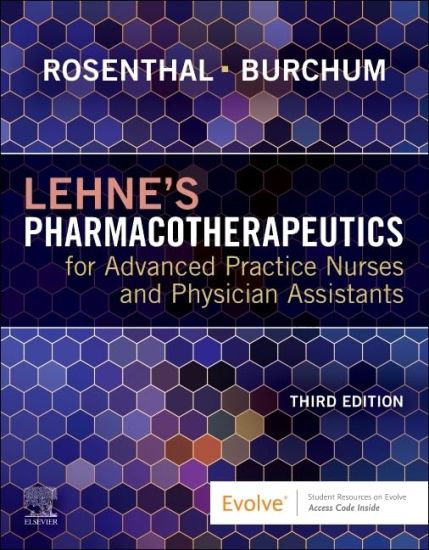
Lehne's Pharmacotherapeutics for Advanced Practice Nurses and Physician Assistants
Laura D. Rosenthal; Jacqueline Rosenjack Burchum
Saunders
2020
nidottu
**Selected for Doody’s Core Titles® 2024 in Pharmacology** Lehne's Pharmacotherapeutics for Advanced Practice Nurses and Physician Assistants, 2nd Edition builds on the same foundation of clearly explained, up-to-date, and clinically current content as the trusted Lehne undergraduate text, while focusing on the information that advanced practice nurses and Physician Assistants specifically need for safe and effective prescribing. Three introductory chapters provide foundational content for new prescribers in the areas of prescriptive authority, rational drug selection, prescription writing, and promoting positive outcomes of drug therapy. Core drug chapters are focused on the drugs that prescribers will most commonly see in clinical practice. A sharp focus is also placed on pharmacotherapeutic decision-making, with Black Box Warnings and new bulleted Key Prescribing Considerations features. The second edition features completely new chapters on Genetic and Genomic Considerations, Muscarinic Antagonists and Immunomodulators, and updated content throughout. It’s everything advanced practice nursing and Physician Assistant students need to be safe and effective prescribers! Introductory chapters tailored to the specific needs of prescribers cover topics such as prescriptive authority, rational drug selection and prescription writing, and promoting positive outcomes of drug therapy. Carefully focused pharmacotherapeutic content reflects the drugs most commonly seen and used by prescribers, with emphasis not on the first drug discovered or developed in each class but on the agents most often used today. Primary care drugs are addressed first in each chapter as appropriate, followed by acute care drugs. UNIQUE! Prescriber-focused pedagogical aids further reinforce the most important information for prescribers. Integrated coverage of Canadian trade names appears throughout the text and is highlighted with a familiar maple-leaf icon. Integrated coverage of interprofessional collaboration addresses the growing global interest in interprofessional collaboration and incorporates opportunities for interprofessional collaborative practice throughout. NEW! Genetic and Genomic Considerations chapter addresses our growing understanding of the importance of genetics and genomics in pharmacotherapeutic management of disease. NEW! Immunomodulators chapter covers the growing role of this innovative therapy in cancer treatment. NEW! Increased emphasis on the needs of prescribers includes new Key Prescribing Considerations specifically tailored for advanced practice nurses (APNs) and Physician Assistants (PAs), revised introductory disease content, and refocused illustrations. NEW! Expanded delineation of acute care drugs now extends to the cardiac, neurologic, hypertension, and male and female reproductive chapters. NEW! Significantly revised content on laboratory drug monitoring has been refocused on the needs of APNs and PAs NEW! Updated content on drug legislation, opioid addiction, and legalized marijuana addresses these key areas of change for prescribers. NEW! Illustrations, tables, and boxes have been substituted for text to highlight treatment guidelines (including decision-making algorithms) and drug mechanisms of action. NEW! Improved legibility includes the elimination of "small type" and a more user-friendly graphic design. NEW! Updated content covers the areas of drug legislation, opioid addiction, marijuana.
Lehne's Pharmacotherapeutics for Advanced Practice Nurses and Physician Assistants
Laura D. Rosenthal; Jacqueline Rosenjack Burchum
Elsevier - Health Sciences Division
2024
nidottu
**Selected for 2025 Doody’s Core Titles® with "Essential Purchase" designation in Advanced Practice** Lehne's Pharmacotherapeutics for Advanced Practice Nurses and Physician Assistants, Third Edition builds on the same foundation of clearly explained, up-to-date, and clinically current content as Lehne’s trusted undergraduate text, while focusing on the information that advanced practice nurses and Physician Assistants specifically need for safe and effective prescribing. Introductory chapters provide foundational content in the areas of prescriptive authority, rational drug selection, prescription writing, and promoting positive outcomes of drug therapy. Core drug chapters focus on the drugs that you will most commonly see in clinical practice. Pharmacotherapeutic decision-making is emphasized, with Black Box Warnings and new Drug Decision Guide boxes. This edition features completely updated content with new chapters on drugs for sexual dysfunction and drugs for transgender health. It’s everything you need to be a safe and effective prescriber! UPDATED! Content throughout reflects the latest drug information and evidence-based treatment guidelines and protocols NEW! Drugs for Sexual Dysfunction and Drugs for Transgender Health chapters in a newly combined Reproductive Health unit promote health equity NEW! Drug Decision Guide boxes for selected drugs emphasize a rational process for drug selection NEW! Clinical Pearls boxes highlight expert tips for rational drug prescription NEW! Chapter-opening Evolve links and “Top 300” drug icons throughout identify drugs that appear on the Top 300 prescribed drug list to help you focus your study time ENHANCED! Introductory chapters emphasize prescriber-level pharmacokinetics and pharmacodynamics content NEW! Coverage addresses immunizations and therapeutics (e.g., Regeneron, Resdemivir, dexamethasone) for SARS-CoV-2 infection (COVID-19) UPDATED! Enhanced coverage of sexually transmitted infections reflects the latest evidence-based guidelines NEW! Drug content addresses medications for ectoparasite infestations Introductory chapters tailored to the specific needs of beginning prescribers cover topics such as prescriptive authority, rational drug selection and prescription writing, and promoting positive outcomes of drug therapy Carefully focused pharmacotherapeutics content reflects the drugs most commonly seen and used by primary and acute care prescribers, with an emphasis not on the first drug discovered or developed in each drug class, but on the agents most often used today Chapters address primary care drugs first, as appropriate, followed by acute care drugs Prescriber-focused pedagogical aids further reinforce the most important information for prescribers UNIQUE! Summary of Key Prescribing Considerations at the end of each drug chapter provides a concise summary of essential prescriber information Coverage of interprofessional collaboration addresses the growing global emphasis on interprofessional collaboration and incorporates opportunities for interprofessional collaborative practice throughout Integrated coverage of Canadian trade names appears throughout and is highlighted with a familiar maple-leaf icon
Originally published in 1972, The Purchase of Paradise is an account of medieval philanthropy and looks at the late medieval aristocracy as a social, rather than political group. The book analyses their voluntary behaviour, their gift giving and the Church, and addresses the nature of charity in the Middle Ages, providing an insight into the noble families of the time. The book depicts charitable practices within the family, such as the buying of prayers for relatives, and the family traditions of support for favoured houses lasting through several generations. The book shows that the family was the most operative unit for most forms of benefaction and ecclesiastical contact, and that the hard necessities of baronial politics were often ignored when men turned their thoughts to philanthropy and prayers for their immortal souls. The book will of value to historians and sociologists alike, as well as those working in the field of anthropology.
First published in 1976, Nobles and the Noble Life, 1295-1500 offers a rounded picture of aristocratic life in England from the time Edward I began to call his great councillors together in ‘House of Lords’ through to the end of the Middle Ages. Professor Rosenthal’s treatment of the aristocracy takes full note of political and economic as well as personal aspects of nobility including the importance of status and the quest for security. He argues that in order to understand the nobility fully the student should consider it in the context of more modern views of elite groups and class structures. This book will be of interest to students of history primarily but also achieve a wider readership among academics more concerned with historical or political sociology than with medieval studies in their strictest sense.
Master Lecture Series for the NCE, CPCE, CECE, and State Counseling Exams
Unknown Author; Howard Rosenthal
TAYLOR FRANCIS LTD
2023
nidottu
WHO ELSE WANTS TO SAY, "I PASSED"?The Master Lecture Series Boosts Exam Scores While Reducing Test Anxiety and Study TimeSay goodbye to boring study sessions. Dr. Rosenthal’s Master Lecture Series makes learning enjoyable. Revolutionize your exam prep and have fun doing it! This study guide will transform your comprehensive exam journey into an engaging adventure that you'll actually enjoy!The Master Lecture Series is a great standalone exam prep guide and the perfect companion to the Encyclopedia of Counseling and the Human Services Dictionary. The new edition includes updated and expanded lectures on every exam area and questions and answers on all major topics, including those frequently asked by users of Dr. Rosenthal’s materials. The book includes a complete test anxiety prevention program, with hundreds of never-before published tiny test hints for effective micro-study sessions, exclusive memory devices, and the most advanced Super Review Boot Camp he has ever created.This is the perfect study tool for every counselor wanting to take their career to the next level.
Master Lecture Series for the NCE, CPCE, CECE, and State Counseling Exams
Unknown Author; Howard Rosenthal
TAYLOR FRANCIS LTD
2023
sidottu
WHO ELSE WANTS TO SAY, "I PASSED"?The Master Lecture Series Boosts Exam Scores While Reducing Test Anxiety and Study TimeSay goodbye to boring study sessions. Dr. Rosenthal’s Master Lecture Series makes learning enjoyable. Revolutionize your exam prep and have fun doing it! This study guide will transform your comprehensive exam journey into an engaging adventure that you'll actually enjoy!The Master Lecture Series is a great standalone exam prep guide and the perfect companion to the Encyclopedia of Counseling and the Human Services Dictionary. The new edition includes updated and expanded lectures on every exam area and questions and answers on all major topics, including those frequently asked by users of Dr. Rosenthal’s materials. The book includes a complete test anxiety prevention program, with hundreds of never-before published tiny test hints for effective micro-study sessions, exclusive memory devices, and the most advanced Super Review Boot Camp he has ever created.This is the perfect study tool for every counselor wanting to take their career to the next level.
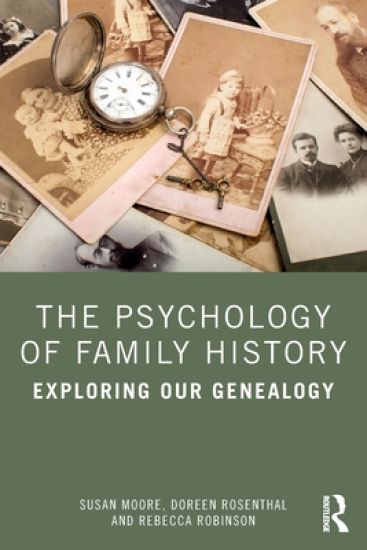
The Psychology of Family History
Susan Moore; Doreen Rosenthal; Rebecca Robinson
Routledge
2020
sidottu
This important book examines the motives that drive family historians and explores whether those who research their ancestral pedigrees have distinct personalities, demographics or family characteristics. It describes genealogists’ experiences as they chart their family trees including their insights, dilemmas and the fascinating, sometimes disturbing and often surprising, outcomes of their searches. Drawing on theory and research from psychology and other humanities disciplines, as well as from the authors’ extensive survey data collected from over 800 amateur genealogists, the authors present the experiences of family historians, including personal insights, relationship changes, mental health benefits and ethical dilemmas. The book emphasises the motivation behind this exploration, including the need to acknowledge and tell ancestral stories, the spiritual and health-related aspects of genealogical research, the addictiveness of the detective work, the lifelong learning opportunities and the passionate desire to find lost relatives. With its focus on the role of family history in shaping personal identity and contemporary culture, this is fascinating reading for anyone studying genealogy and family history, professional genealogists and those researching their own history.
The Psychology of Family History
Susan Moore; Doreen Rosenthal; Rebecca Robinson
Routledge
2020
nidottu
This important book examines the motives that drive family historians and explores whether those who research their ancestral pedigrees have distinct personalities, demographics or family characteristics. It describes genealogists’ experiences as they chart their family trees including their insights, dilemmas and the fascinating, sometimes disturbing and often surprising, outcomes of their searches. Drawing on theory and research from psychology and other humanities disciplines, as well as from the authors’ extensive survey data collected from over 800 amateur genealogists, the authors present the experiences of family historians, including personal insights, relationship changes, mental health benefits and ethical dilemmas. The book emphasises the motivation behind this exploration, including the need to acknowledge and tell ancestral stories, the spiritual and health-related aspects of genealogical research, the addictiveness of the detective work, the lifelong learning opportunities and the passionate desire to find lost relatives. With its focus on the role of family history in shaping personal identity and contemporary culture, this is fascinating reading for anyone studying genealogy and family history, professional genealogists and those researching their own history.
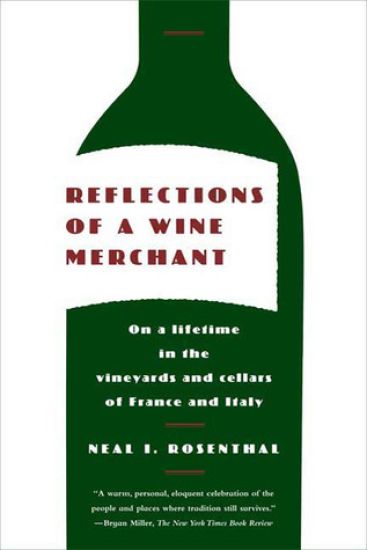
In the late 1970s, Neal I. Rosenthal set out to learn everything he could about wine. Today, he is one of the most successful importers of traditionally made wines produced by small family owned estates in France and Italy. Rosenthal has immersed himself in the culture of Old World wine production, working closely with his growers for two and sometimes three generations. He is one of the leading exponents of the concept of 'terroir' - the notion that a particular vineyward site imparts distinct qualities of bouquet, flavour, and colour to a wine. In "Reflections of a Wine Merchant", Rosenthal brings us into the cellars, vineyards, and homes of these vignerons, and his delightful stories about his encounters, relationships, and explorations - and what he has learned along the way - give us an unequalled perspective on winemaking tradition and what threatens it today. Rosenthal was featured in the documentary film "Mondovino" and is one of the more outspoken figures against globalization, homogenization, and the 'critic-ization' of the wine business. He was also a major subject in Lawrence Osborne's "The Accidental Connoisseur".Rosenthal's is an important voice in defense of the individual and the artisanal, and their contribution to our quality of life.
Cytologic Detection of Urothelial Lesions
Dorothy L. Rosenthal; Stephen S. Raab
Springer-Verlag New York Inc.
2005
nidottu
Dr. Rosenthal and Dr. Raab correctly place urinary cytology in the backwater of the ?eld, noting the dif?culties many of us encounter when assessing urinary specimens or washes of the urinary tract. For a variety of reasons, these specimens are saved for the end of the day, cause the most trouble and frustration, and are the least successful from the standpoint of the pathologist, the urologist, or the patient. This book represents, in keeping with the philosophy behind the series, Essentials in Cytopathology, a systematic description of - croscopic ?ndings in urinary specimens, whether normal, reactive, or neoplastic, accompanied by an extensive collection of photo- crographs (in color) illustrative of the full range of lesions. Drawing upon their personal collections and the diagnostic resources of s- eral major cytologic laboratories, they have assembled examples of the common diagnostic entities in the ?eld plus an assortment of confounding circumstances, which contribute to the dif?culties presented by urinary specimens. Handy tables accompany the p- tographs, offering help where needed. This is particularly relevant because the subtlety of urinary cytology de?es the dependable - agnostic categorization obtained with samples from other sites.
Simultaneous Triangularization
Heydar Radjavi; Peter Rosenthal
Springer-Verlag New York Inc.
2000
nidottu
A collection of matrices is said to be triangularizable if there is an invertible matrix S such that S1 AS is upper triangular for every A in the collection. This generalization of commutativity is the subject of many classical theorems due to Engel, Kolchin, Kaplansky, McCoy and others. The concept has been extended to collections of bounded linear operators on Banach spaces: such a collection is defined to be triangularizable if there is a maximal chain of subspaces of the Banach space, each of which is invariant under every member of the collection. Most of the classical results have been generalized to compact operators, and there are also recent theorems in the finite-dimensional case. This book is the first comprehensive treatment of triangularizability in both the finite and infinite-dimensional cases. It contains numerous very recent results and new proofs of many of the classical theorems. It provides a thorough background for research in both the linear-algebraic and operator-theoretic aspects of triangularizability and related areas. More generally, the book will be useful to anyone interested in matrices or operators, as many of the results are linked to other topics such as spectral mapping theorems, properties of spectral radii and traces, and the structure of semigroups and algebras of operators. It is essentially self-contained modulo solid courses in linear algebra (for the first half) and functional analysis (for the second half), and is therefore suitable as a text or reference for a graduate course.
Simultaneous Triangularization
Heydar Radjavi; Peter Rosenthal
Springer-Verlag New York Inc.
2000
sidottu
A collection of matrices is said to be triangularizable if there is an invertible matrix S such that S1 AS is upper triangular for every A in the collection. This generalization of commutativity is the subject of many classical theorems due to Engel, Kolchin, Kaplansky, McCoy and others. The concept has been extended to collections of bounded linear operators on Banach spaces: such a collection is defined to be triangularizable if there is a maximal chain of subspaces of the Banach space, each of which is invariant under every member of the collection. Most of the classical results have been generalized to compact operators, and there are also recent theorems in the finite-dimensional case. This book is the first comprehensive treatment of triangularizability in both the finite and infinite-dimensional cases. It contains numerous very recent results and new proofs of many of the classical theorems. It provides a thorough background for research in both the linear-algebraic and operator-theoretic aspects of triangularizability and related areas. More generally, the book will be useful to anyone interested in matrices or operators, as many of the results are linked to other topics such as spectral mapping theorems, properties of spectral radii and traces, and the structure of semigroups and algebras of operators. It is essentially self-contained modulo solid courses in linear algebra (for the first half) and functional analysis (for the second half), and is therefore suitable as a text or reference for a graduate course.
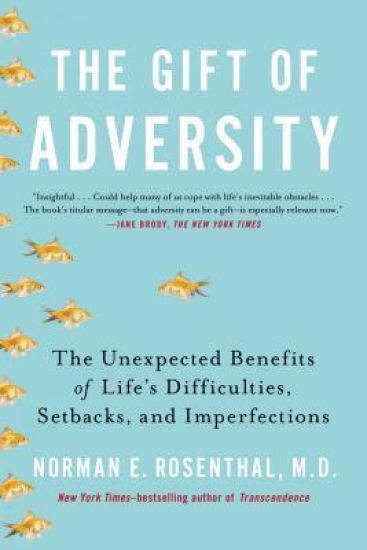
Now in paperback--this acclaimed book from Norman Rosenthal, the New York Times-bestselling author and research psychiatrist, shows how life's disappointments and difficulties provide us with the lessons we need to become happier and more resilient human beings. Winner of the 2014 Nautilus Award represents "Better Books for a Better World"--the Silver Award in the category of Heroic Journeys. Adversity is an irreducible fact of life. Although we can and should learn from all experiences, both positive and negative, bestselling author Dr. Norman E. Rosenthal, believes that adversity is by far the best teacher most of us will ever encounter. Whether the adversity one experiences is the result of poor decision-making, a desire to test one's mettle, or plain bad luck, Rosenthal believes life's most important lessons--from the value of family to the importance of occasionally cutting corners--can be best learned from it. Running counter to society's current prevailing message that "excellence" must always be aspired to, and failure or mistakes of any sort are to be avoided at all costs, Rosenthal shows that engaging with our own failures and defeats is one of the only ways we are able to live authentic and meaningful lives, and that each different type of adversity carries its own challenges and has the potential to yield its own form of wisdom. Using stories from his own life--including his childhood in apartheid-era South Africa, his years after suffering a violent attack from a stranger, and his career as a psychiatrist--as well as case studies and discussions with well-known figures like Viktor Frankl and David Lynch, Rosenthal shows that true innovation, emotional resilience, wisdom, and dignity can only come from confronting and understanding the adversity we have experienced. Even when life is hardest, there are meanings to be found, riches to be harvested, and gifts that can last a lifetime. Rosenthal illustrates his message through a series of compact, memorable chapters, each one drawn from episodes in the lives of his patients, colleagues, or himself, and concluded with a take-away maxim on the lesson learned.