Kirjojen hintavertailu. Mukana 12 390 323 kirjaa ja 12 kauppaa.

Kirjahaku

Etsi kirjoja tekijän nimen, kirjan nimen tai ISBN:n perusteella.

1000 tulosta hakusanalla Shanna Ferrigno

Childhood and NineteenthCentury American Theatre

Childhood and NineteenthCentury American Theatre

Shauna Vey

Southern Illinois University Press
2015
sidottu
Revealing the careers and backstage lives of child performers and their place in antebellum AmericaFrom 1855 until 1863, the Marsh Troupe of Juvenile Comedians, a professional acting company of approximately thirty children, entertained audiences with their nuanced performances of adult roles on stages around the globe. In Childhood and NineteenthCentury American Theatre: The Work of the Marsh Troupe of Juvenile Actors, author Shauna Vey provides an insightful account not only of this unique antebellum stage troupe but also of contemporary theatre practices and the larger American culture, including shifts in the definition of childhood itself.Both a microhistory of a professional theatre company and its juvenile players in the decade before the Civil War and a larger narrative of cultural change in the United States, Childhood and NineteenthCentury American Theatre sheds light on how childhood was idealized both on and off the stage, how the role of the child in society shifted in the nineteenth century, and the ways economic value and sentiment contributed to how children were viewed.

The Art of Memes in Feminist Digital Culture

The Art of Memes in Feminist Digital Culture

Shana MacDonald

OHIO STATE UNIVERSITY PRESS
2025
sidottu
In The Art of Memes in Feminist Digital Culture, Shana MacDonald argues that memes are a unique medium of communication that both respond to and reflect the current cultural moment. The book--the first to treat memes as a unique medium of communication distinct from other internet and digital media--examines feminist and queer activist uses of memes as a form of digital resistance, demonstrating through collage, reenactment, and montage that countercultural meme makers intervene in the status quo and offer cultural critiques with potentially broad circulation. In this way, MacDonald situates memes as part of a lineage of aesthetic resistance, exploring the operational logic of bricolage, intertextuality, and intermediality within contemporary internet meme cultures on the left. MacDonald examines memes from feminist, queer, antiracist, and anticapitalist accounts on Instagram, as well as how meme genres and themes shift when they travel across different platforms and subcultures. By considering memes as a medium, she sheds light on how they operate within contemporary digital culture as a beacon for online public discourse that pushes against dominant norms.
The Art of Memes in Feminist Digital Culture

The Art of Memes in Feminist Digital Culture

Shana MacDonald

OHIO STATE UNIVERSITY PRESS
2025
nidottu
In The Art of Memes in Feminist Digital Culture, Shana MacDonald argues that memes are a unique medium of communication that both respond to and reflect the current cultural moment. The book--the first to treat memes as a unique medium of communication distinct from other internet and digital media--examines feminist and queer activist uses of memes as a form of digital resistance, demonstrating through collage, reenactment, and montage that countercultural meme makers intervene in the status quo and offer cultural critiques with potentially broad circulation. In this way, MacDonald situates memes as part of a lineage of aesthetic resistance, exploring the operational logic of bricolage, intertextuality, and intermediality within contemporary internet meme cultures on the left. MacDonald examines memes from feminist, queer, antiracist, and anticapitalist accounts on Instagram, as well as how meme genres and themes shift when they travel across different platforms and subcultures. By considering memes as a medium, she sheds light on how they operate within contemporary digital culture as a beacon for online public discourse that pushes against dominant norms.
Naming New York

Naming New York

Sanna Feirstein

New York University Press
2001
sidottu
A comprehensive compilation and explanation of Manhattan's streets, alleys, avenues, plazas, parks and corners New York is the oldest continually occupied city in America, yet its rich history is largely obscured by development. New Yorkers are surrounded by hundreds of place names, from those that survive from Manhattan's earliest days as a Dutch trading post to those that reflect the city's rich colonial, African and immigrant heritage. They provide a veritable encyclopedia of the city's history. Buildings may come and go, but place names are surprisingly durable. Naming New York is a comprehensive compilation and explanation of the names of Manhattan's streets, alleys, avenues, plazas, parks and corners. It surveys names currently in use and includes the oldest and the newest honorific "add-on" names, from Astor Place to Yitzak Rabin Way. Whether you're a history or trivia buff, tourist, or just fascinated by place names, learning about the origins of these mostly unexamined sources enriches one's experience of the city, and transforms a simple neighborhood errand into a trip through time. For example: Bowery: In the 17th century, Dutch farms known as "bowerij" were laid out in this section of Manhattan along the path of an old Indian trail. Known since that time as the Bowery, the thoroughfare became the first section of the Post Road from New York City to Boston. Houston Street: For William Houstoun, 1757-1812, of a prominent Georgia family, who married a daughter of Manhattan landowner Nicholas Bayard III. The Georgia provenance of the name accounts for its pronunciation and spelling both of which distinguish it from the Texas city. Wall Street: Follows the line of the city wall that the Dutch erected in 1653 across the northern perimeter of New Amsterdam to protect against attack from the British in New England.
Naming New York

Naming New York

Sanna Feirstein

New York University Press
2001
pokkari
A comprehensive compilation and explanation of Manhattan's streets, alleys, avenues, plazas, parks and corners New York is the oldest continually occupied city in America, yet its rich history is largely obscured by development. New Yorkers are surrounded by hundreds of place names, from those that survive from Manhattan's earliest days as a Dutch trading post to those that reflect the city's rich colonial, African and immigrant heritage. They provide a veritable encyclopedia of the city's history. Buildings may come and go, but place names are surprisingly durable. Naming New York is a comprehensive compilation and explanation of the names of Manhattan's streets, alleys, avenues, plazas, parks and corners. It surveys names currently in use and includes the oldest and the newest honorific "add-on" names, from Astor Place to Yitzak Rabin Way. Whether you're a history or trivia buff, tourist, or just fascinated by place names, learning about the origins of these mostly unexamined sources enriches one's experience of the city, and transforms a simple neighborhood errand into a trip through time. For example: Bowery: In the 17th century, Dutch farms known as "bowerij" were laid out in this section of Manhattan along the path of an old Indian trail. Known since that time as the Bowery, the thoroughfare became the first section of the Post Road from New York City to Boston. Houston Street: For William Houstoun, 1757-1812, of a prominent Georgia family, who married a daughter of Manhattan landowner Nicholas Bayard III. The Georgia provenance of the name accounts for its pronunciation and spelling both of which distinguish it from the Texas city. Wall Street: Follows the line of the city wall that the Dutch erected in 1653 across the northern perimeter of New Amsterdam to protect against attack from the British in New England.
Anthem

Anthem

Shana L. Redmond

New York University Press
2013
pokkari
For people of African descent, music constitutes a unique domain of expression. From traditional West African drumming to South African kwaito, from spirituals to hip-hop, Black life and history has been dynamically displayed and contested through sound. Shana Redmond excavates the sonic histories of these communities through a genre emblematic of Black solidarity and citizenship: anthems. An interdisciplinary cultural history, Anthem reveals how this "sound franchise" contributed to the growth and mobilization of the modern, Black citizen. Providing new political frames and aesthetic articulations for protest organizations and activist-musicians, Redmond reveals the anthem as a crucial musical form following World War I. Beginning with the premise that an analysis of the composition, performance, and uses of Black anthems allows for a more complex reading of racial and political formations within the twentieth century, Redmond expands our understanding of how and why diaspora was a formative conceptual and political framework of modern Black identity. By tracing key compositions and performances around the world—from James Weldon Johnson's "Lift Ev'ry Voice and Sing" that mobilized the NAACP to Nina Simone's "To Be Young, Gifted & Black" which became the Black National Anthem of the Congress of Racial Equality (CORE)—Anthem develops a robust recording of Black social movements in the twentieth century that will forever alter the way you hear race and nation.
Anthem

Anthem

Shana L. Redmond

New York University Press
2013
sidottu
For people of African descent, music constitutes a unique domain of expression. From traditional West African drumming to South African kwaito, from spirituals to hip-hop, Black life and history has been dynamically displayed and contested through sound. Shana Redmond excavates the sonic histories of these communities through a genre emblematic of Black solidarity and citizenship: anthems. An interdisciplinary cultural history, Anthem reveals how this "sound franchise" contributed to the growth and mobilization of the modern, Black citizen. Providing new political frames and aesthetic articulations for protest organizations and activist-musicians, Redmond reveals the anthem as a crucial musical form following World War I. Beginning with the premise that an analysis of the composition, performance, and uses of Black anthems allows for a more complex reading of racial and political formations within the twentieth century, Redmond expands our understanding of how and why diaspora was a formative conceptual and political framework of modern Black identity. By tracing key compositions and performances around the world—from James Weldon Johnson's "Lift Ev'ry Voice and Sing" that mobilized the NAACP to Nina Simone's "To Be Young, Gifted & Black" which became the Black National Anthem of the Congress of Racial Equality (CORE)—Anthem develops a robust recording of Black social movements in the twentieth century that will forever alter the way you hear race and nation.
Television News and Human Rights in the US & UK
Does the CNN Effect exist? Political communications scholars have debated the influence of television news coverage on international affairs since television news began, especially in relation to the coverage of massive human rights violations. These debates have only intensified in the last 20 years, as new technologies have changed the nature of news and the news cycle. But despite frequent assertion, little research into the CNN Effect, or whether television coverage of human rights violations causes state action, exists. Bridging across the disciplines of human right studies, comparative politics, and communication studies in a way that has not been done, this book looks at television news coverage of human rights in the US and UK to answer the question of whether the CNN Effect actually exists.Examining the human rights content in television news in the US and UK yields insights to what television news producers and policy makers consider to be human rights, and what, if anything, audiences can learn about human rights from watching television news. After reviewing 20 years of footage using three different types of content analyses of American television news broadcasts and two different types of British news broadcasts, and comparing those results with human rights rankings and print news coverage of human rights, Shawns M. Brandle concludes that despite rhetoric from both countries in support of human rights, there is not enough coverage of human rights in either country to argue that television media can spur state action on human rights issues. More simply, the violations will not be televised.A welcome and timely book presenting an important examination of human rights coverage on television news.
Fraught Balance

Fraught Balance

Shayna M Silverstein

WESLEYAN UNIVERSITY PRESS
2024
nidottu
A vivid and intricate study of dance music traditions that reveals the many contradictions of Syrian identity in the 21st century Dabke, one of Syria's most beloved dance music traditions, is at the center of the country's war and the social tensions that preceded conflict. Drawing on almost two decades of ethnographic, archival, and digital research, Shayna M. Silverstein shows how dabke dance music embodies the fraught dynamics of gender, class, ethnicity, and nationhood in an authoritarian state. The book situates dabke politically, economically, and historically in a broader account of expressive culture in Syria's recent (and ongoing) turmoil. Silverstein shows how people imagine the Syrian nation through dabke, how the state has coopted it, how performances of masculinity reveal—and play with—the tensions and complexities of the broader social imaginary, how forces opposed to the state have used it resistively, and how migrants and refugees have reimagined it in their new homes in Europe and the United States. She offers deeply thoughtful reflections on the ethnographer's ethical and political dilemmas on fieldwork in an authoritarian state. Silverstein's study ultimately questions the limits of authoritarian power, considering the pleasure and play intrinsic to dabke circles as evidence for how performance cultures sustain social life and solidify group bonds while reproducing the societal divides endemic to Syrian authoritarianism.
The Feminine in German Song

The Feminine in German Song

Sanna Iitti

Peter Lang Publishing Inc
2006
sidottu
Nineteenth-century composers were drawn to subjects related to gender. Songs about women open a view into nineteenth-century understandings of gender and sexuality. The author argues about ways to hear sexual difference in Lied, analyzing musical compositions in the light of composer biographies and in terms of musical gestures. Her comparison of the Suleika and Lorelei songs by Romantic composers, including the Mendelssohns and the Schumanns, reveals cultural and sexual anxieties besides conflicting arguments about music and its perception. Both the songs and their critique illustrate the functioning of gender in nineteenth-century composition and aesthetic reasoning.
Searching for a Different Future

Searching for a Different Future

Shana Cohen

Duke University Press
2004
sidottu
By examining how neoliberal economic reform policies have affected educated young adults in contemporary Morocco, Searching for a Different Future posits a new socioeconomic formation: the global middle class. During Morocco’s postcolonial period, from the 1950s through the 1970s, development policy and nationalist ideology supported the formation of a middle class based on the pursuit of education, employment, and material security. Neoliberal reforms adopted by Morocco since the early 1980s have significantly eroded the capacity of the state to nurture the middle class, and unemployment and temporary employment among educated adults has grown. There is no longer an obvious correlation between the best interests of the state and those of the middle-class worker. As Shana Cohen demonstrates, educated young adults in Morocco do not look toward the state for economic security and fulfillment but toward the diffuse, amorphous global market. Cohen delves into the rupture that has occurred between the middle class, the individual, and the nation in Morocco and elsewhere around the world. Combining institutional economic analysis with cultural theory and ethnographic observation including interviews with seventy young adults in Casablanca and Rabat, she reveals how young, urban, educated Moroccans conceive of their material, social, and political conditions. She finds that, for the most part, they perceive improvement in their economic and social welfare apart from the types of civic participation commonly connected with nationalism and national identity. In answering classic sociological questions about how the evolution of capitalism influences identity, Cohen sheds new light on the measurable social and economic consequences of globalization and on its less tangible effects on individuals’ perception of their place in society and prospects in life.
Searching for a Different Future

Searching for a Different Future

Shana Cohen

Duke University Press
2004
pokkari
By examining how neoliberal economic reform policies have affected educated young adults in contemporary Morocco, Searching for a Different Future posits a new socioeconomic formation: the global middle class. During Morocco’s postcolonial period, from the 1950s through the 1970s, development policy and nationalist ideology supported the formation of a middle class based on the pursuit of education, employment, and material security. Neoliberal reforms adopted by Morocco since the early 1980s have significantly eroded the capacity of the state to nurture the middle class, and unemployment and temporary employment among educated adults has grown. There is no longer an obvious correlation between the best interests of the state and those of the middle-class worker. As Shana Cohen demonstrates, educated young adults in Morocco do not look toward the state for economic security and fulfillment but toward the diffuse, amorphous global market. Cohen delves into the rupture that has occurred between the middle class, the individual, and the nation in Morocco and elsewhere around the world. Combining institutional economic analysis with cultural theory and ethnographic observation including interviews with seventy young adults in Casablanca and Rabat, she reveals how young, urban, educated Moroccans conceive of their material, social, and political conditions. She finds that, for the most part, they perceive improvement in their economic and social welfare apart from the types of civic participation commonly connected with nationalism and national identity. In answering classic sociological questions about how the evolution of capitalism influences identity, Cohen sheds new light on the measurable social and economic consequences of globalization and on its less tangible effects on individuals’ perception of their place in society and prospects in life.
Cape Verdean Blues

Cape Verdean Blues

Shauna Barbosa

University of Pittsburgh Press
2018
nidottu
The speaker in Cape Verdean Blues is an oracle walking down the street. Shauna Barbosa interrogates encounters and the weight of their space. Grounded in bodily experience and the phenomenology of femininity, this collection provides a sense of Cape Verdean identity. It uniquely captures the essence of “Sodade,” as it refers to the Cape Verdean American experience, and also the nostalgia and self-reflection one navigates through relationships lived, lost, and imagined. And its layers of unusual imagery and sound hold the reader in their grip.
Pastimes

Pastimes

Shana J. Brown

University of Hawai'i Press
2011
sidottu
Pastimes is the first book in English on Chinese jinshi, or antiquarianism, the pinnacle of traditional connoisseurship of ancient artifacts and inscriptions. As a scholarly field, jinshi was inaugurated in the Northern Song (960-1127) and remained popular until the early twentieth century. Literally the study of inscriptions on bronze vessels and stone steles, jinshi combined calligraphy and painting, the collection of artifacts, and philological and historical research. For aficionados of Chinese art, the practices of jinshi offer a fascinating glimpse into the lives of traditional Chinese scholars and artists, who spent their days roaming the sometimes seamy world of the commercial art market before attending elegant antiquarian parties, where they composed poetic tributes to their ancient objects of obsession. And during times of political upheaval, such as the nineteenth century, the art and artifact studies of jinshi legitimatized reform and contributed to a dynamic and progressive field of learning.
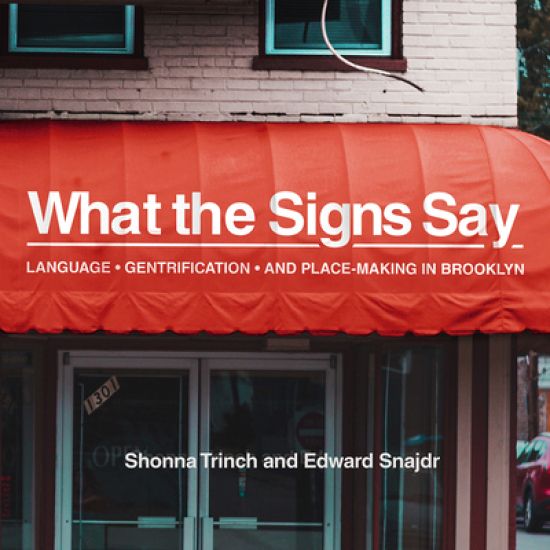
What the Signs Say

What the Signs Say

Shonna Trinch; Edward Snajdr

Vanderbilt University Press
2020
sidottu
Although we may not think we notice them, storefronts and their signage are meaningful, and the impact they have on people is significant. What the Signs Say argues that the public language of storefronts is a key component to the creation of the place known as Brooklyn, New York. Using a sample of more than two thousand storefronts and over a decade of ethnographic observation and interviews, the study charts two very different types of local Brooklyn retail signage. The unique and consistent features of many words, large lettering, and repetition that make up Old School signage both mark and produce an inclusive and open place. In contrast, the linguistic elements of New School signage, such as brevity and wordplay, signal not only the arrival of gentrification, but also the remaking of Brooklyn as distinctive and exclusive.Shonna Trinch and Edward Snajdr, a sociolinguist and an anthropologist respectively, show how the beliefs and ideas that people take as truths about language and its speakers are deployed in these different sign types. They also present in-depth ethnographic case studies that reveal how gentrification and corporate redevelopment in Brooklyn are intimately connected to public communication, literacy practices, the transformation of motherhood and gender roles, notions of historical preservation, urban planning, and systems of privilege. Far from peripheral or irrelevant, shop signs say loud and clear that language displayed in public always matters.
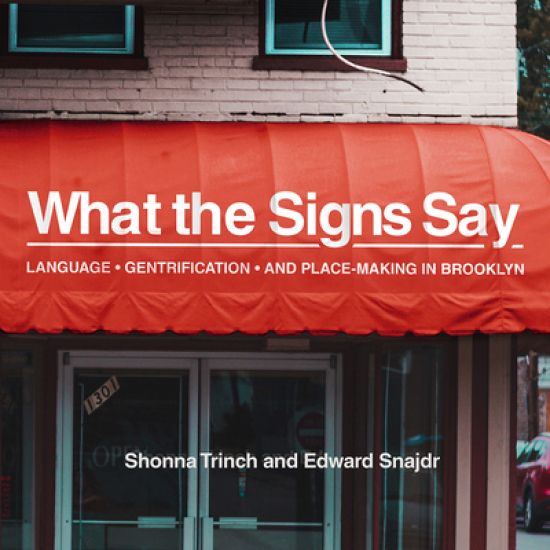
What the Signs Say

What the Signs Say

Shonna Trinch; Edward Snajdr

Vanderbilt University Press
2020
nidottu
Although we may not think we notice them, storefronts and their signage are meaningful, and the impact they have on people is significant. What the Signs Say argues that the public language of storefronts is a key component to the creation of the place known as Brooklyn, New York. Using a sample of more than two thousand storefronts and over a decade of ethnographic observation and interviews, the study charts two very different types of local Brooklyn retail signage. The unique and consistent features of many words, large lettering, and repetition that make up Old School signage both mark and produce an inclusive and open place. In contrast, the linguistic elements of New School signage, such as brevity and wordplay, signal not only the arrival of gentrification, but also the remaking of Brooklyn as distinctive and exclusive.Shonna Trinch and Edward Snajdr, a sociolinguist and an anthropologist respectively, show how the beliefs and ideas that people take as truths about language and its speakers are deployed in these different sign types. They also present in-depth ethnographic case studies that reveal how gentrification and corporate redevelopment in Brooklyn are intimately connected to public communication, literacy practices, the transformation of motherhood and gender roles, notions of historical preservation, urban planning, and systems of privilege. Far from peripheral or irrelevant, shop signs say loud and clear that language displayed in public always matters.
A Seat at the Table: A Generation Reimagining Its Place in the Church

A Seat at the Table: A Generation Reimagining Its Place in the Church

Shawna Songer Gaines

Beacon Hill Press of Kansas City
2012
nidottu
Why are so many 20- and 30-something Christians disappearing from the church?They are told how much the church wants young people, yet there is growing suspicion among young believers about who is in and who is out of the scope of Christian orthodoxy. Through this suspicion, a rift between the generations has emerged. In the face of frustration, of being cut out because they don't seem to fit, young believers often take their gifts and leave the church.This book helps those who feel displaced by this generational collision to find a sense of place and welcome with a church that is still becoming all that God wants it to be. If you are a young person who wonders if there is a place in the church for someone like you, or if you want to know if your own church can be the kind of body in which young people are welcome, A Seat at the Table will give you a new personal and kingdom perspective. Embrace the challenge to re-imagine your relationship with the church in light of this generational collision, not seeing it as an unredeemable rift, but as an opportunity to give and receive hospitality.
We Are Not in Pakistan

We Are Not in Pakistan

Shauna Singh Baldwin

Goose Lane Editions
2007
pokkari
A Quill & Quire Book of the YearTen years after her stunning debut, Shauna Singh Baldwin returns to Goose Lane with an outstanding new collection of ten stories. Migrating from Central America to the American South, from Metro Toronto to the Ukraine, this book features an unforgettable cast of characters. In the title story, 16-year-old Megan hates her Pakistani grandmother — until Grandma disappears. In the enchanting magical realism of "Naina," an Indo-Canadian woman is pregnant with a baby girl who refuses to be born. "The View from the Mountain" introduces Wilson Gonzales, who makes friends with his new American boss, the aptly named Ted Grand. But following 9/11, Ted's suspicions cloud his judgment and threaten his friendship with Wilson. Each containing an entire world, these stories are marked by indelible images and unforgettable turns of phrase — hallmarks of Baldwin's fictional world.
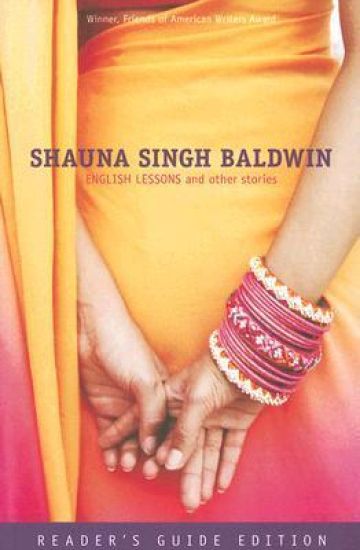
English Lessons and Other Stories

English Lessons and Other Stories

Shauna Singh Baldwin

Goose Lane Editions
2008
pokkari
Winner, CBC Canadian Literary Award and Friends of American Writers AwardThe new reader's guide edition of Shauna Singh Baldwin's literary debut features the fifteen stories from the original collection, an interview with the author, an original afterword, and her suggested reading list. When Shauna Singh Baldwin's debut collection was first published in 1996, it took readers by storm. Reviewers discovered a new voice; listeners tuned in to the stories on CBC Radio. Since then, Baldwin has written two award-winning novels and, in 2007, a second story collection, We Are Not in Pakistan. Dramatizing the lives of Indian women from 1919 to the present, from India to North America, Shauna Singh Baldwin travels from the intimate sphere of family to the wasteland of office and university.