Kirjojen hintavertailu. Mukana 11 241 044 kirjaa ja 12 kauppaa.

Kirjahaku

Etsi kirjoja tekijän nimen, kirjan nimen tai ISBN:n perusteella.

1000 tulosta hakusanalla Theodor Boder

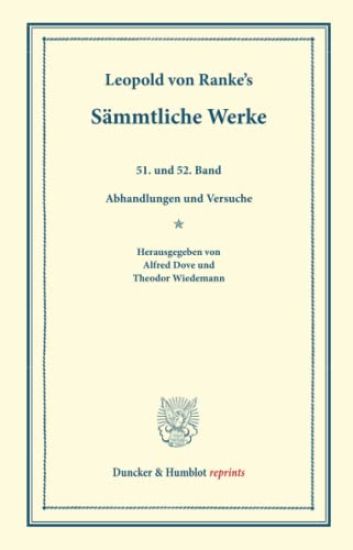
Sammtliche Werke: Einundfunfzigster Und Zweiundfunfzigster Band: Abhandlungen Und Versuche. Neue Sammlung. Hrsg. Von Alfred Dove / Theodor Wiedemann
This is a reproduction of a book published before 1923. This book may have occasional imperfections such as missing or blurred pages, poor pictures, errant marks, etc. that were either part of the original artifact, or were introduced by the scanning process. We believe this work is culturally important, and despite the imperfections, have elected to bring it back into print as part of our continuing commitment to the preservation of printed works worldwide. We appreciate your understanding of the imperfections in the preservation process, and hope you enjoy this valuable book. ++++ The below data was compiled from various identification fields in the bibliographic record of this title. This data is provided as an additional tool in helping to ensure edition identification: ++++ SAmmtliche Werke: FranzOsische Geschichte Vornehmlich Im Sechzehnten Und Siebzehnten Jahrhundert; 3; Volume 10 Of SAmmtliche Werke: FranzOsische Geschichte Vornehmlich Im Sechzehnten Und Siebzehnten Jahrhundert; 3; Leopold Von Ranke Leopold von Ranke Duncker und Humblot, 1869
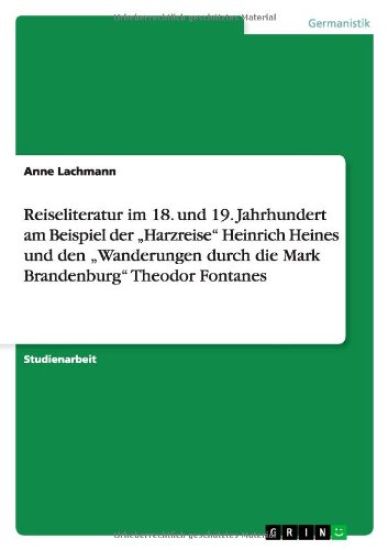
Reiseliteratur im 18. und 19. Jahrhundert am Beispiel der "Harzreise" Heinrich Heines und den "Wanderungen durch die Mark Brandenburg" Theodor Fontanes
Studienarbeit aus dem Jahr 2009 im Fachbereich Germanistik - Neuere Deutsche Literatur, Note: 2,0, Universit t Potsdam (Institut f r Germanistik), Veranstaltung: Literarische Ann herung an Geschichte und Landschaft: Theodor Fontane, Wanderungen durch die Mark Brandenburg, Sprache: Deutsch, Abstract: In dieser Hausarbeit m chte ich die Bedeutung der Gattung Reisebericht im 18. und 19. Jahrhundert n her erl utern. Dabei werde ich zun chst auf die Entwicklung dieser Gattung eingehen und den Begriff n her erl utern. Anhand ausgew hlter Literatur, der "Harzreise" Heinrich Heines sowie den "Wanderungen durch die Mark Brandenburg" Theodor Fontanes soll den LeserInnen ein berblick ber diese Gattung, die heute fast ganz an Bedeutung verloren hat, geschaffen werden. Weitestgehend m chte ich ber die Intentionen von Autoren zum Schreiben von Reiseberichten informieren und Texte in ihrem Aufbau und deren Gestaltung vergleichen.
Als Papst Pius X. im Jahre 1904 n. Chr. keine echte Antwort auf die Judenfrage des Zionistenführers Theodor Herzl wusste......
Da die Frage nach dem K nig der Juden bis heute ungekl rt scheint, jedoch die v lkerrechtswidrige Besatzung und der Landraub Pal stinas durch das angeblich von Gott auserw hlte Volk Israel seit ber 55 Jahren andauert und in einen V lkermord an der einheimischen, pal stinensischen Bev lkerung bergegangen ist, hat nun eine genaue berpr fung der Texte der Bibel eindeutig ergeben, dass Jesus der K nig der Juden und N chstenliebe g ttliches Gesetz ist. Diesen Beweis h tte jedoch sp testens Papst Pius X. gegen ber dem j dischen Zionistenf hrer Theodor Herzl im Jahre 1904 n. Chr. erbringen m ssen, als dieser ihn zu einer Audienz aufsuchte. Es ist nicht m glich, die Uhr zur ckzudrehen. Doch es ist m glich, die Zukunft in eine Richtung zu steuern, in der Wahrheit, Frieden und Gerechtigkeit regieren.
Fundamental Basis Of Irisdiagnosis

Fundamental Basis Of Irisdiagnosis

Theodor Kriege

C W Daniel Co Ltd
2009
nidottu
Irisdiagnosis is the Science of diagnosing illness from the marks and colour changes in the iris of the human eye, developed from the original observations and research of Ignaz von Peczley, a Hungarian, who published his findings in 1880. Much research has followed and this method of diagnosis is now applied by homeopathic and naturopathic practitioners in both Europe and America. In Fundamental Basics of Irisdiagnosis Theodor Kriege shows you how to practise this for yourself, guiding you though the essentials of the process and teaching you how to diagnose accurately.
Bloody Constraint

Bloody Constraint

Theodor Meron

Oxford University Press Inc
1999
sidottu
Chivalry, one of Shakespeare's central themes, retains its pertinence and topicality in our rules for international humanitarian law and the conduct of war. Against a background of Medieval and Renaissance sources as well as Shakespeare's historical and dramatic realms, Professor Meron considers the ways in which law, chivalry, morality, conscience, and state necessity are deployed in Shakespeare to promote a society in which soldiers behave humanely and leaders are held to high standards of civilized behavior. In doing so, he illustrates the literary genealogy of such contemporary international humanitarian concerns as the treatment of prisoners and of women and accountability for war crimes. An insightful consideration of modern humanitarian law as seen from the perspectives of both Shakespeare and history, Bloody Constraint will also interest students of Medieval and Renaissance studies.
Bloody Constraint

Bloody Constraint

Theodor Meron

Oxford University Press Inc
2000
nidottu
War is a major theme in Shakespeare's plays. Aside from its dramatic appeal, it provided him with a context in which his characters, steeped in the ideals of chivalry, could discuss such concepts as honor, courage, patriotism, and justice. Well aware of the decline of chivalry in his own era, Shakespeare gave his characters lines calling for civilized behavior, mercy, humanitarian principles, and moral responsibility. In this remarkable new book, eminent legal scholar Theodor Meron looks at contemporary international humanitarian law and rules for the conduct of war through the lens of Shakespeare's plays and discerns chivalry's influence there. The book comes as a response to the question of whether the world has lost anything by having a system of law based on the Hague and Geneva conventions. Meron contends that, despite the foolishness and vanity of its most extreme manifestations, chivalry served as a customary law that restrained and humanized the conflicts of the generally chaotic and brutal Middle Ages. It had the advantage of resting on the sense that rules arise naturally out of societies, their armed forces, and their rulers on the basis of experience. Against a background of Medieval and Renaissance sources as well as Shakespeare's historical and dramatic settings, Meron considers the ways in which law, morality, conscience, and state necessity are deployed in Shakespeare's plays to promote a society in which soldiers behave humanely and leaders are held to high standards of civilized behavior. Thus he illustrates the literary genealogy of such modern international humanitarian concerns as the treatment of prisoners and of noncombatants and accountability for war crimes, showing that the chivalric legacy has not been lost entirely. Fresh and insightful, Bloody Constraint will interest scholars of international law, lovers of Shakespeare, and anyone interested in the history of war.
Human Rights Law-Making in the United Nations

Human Rights Law-Making in the United Nations

Theodor Meron

Oxford University Press
1986
sidottu
This book is an examination and critique of the methods employed by the United Nations in adopting human rights instruments. Three of the major instruments - the International Convention on the Elimination of All Forms of Racial Discrimination, the Convention on the Elimination of All Forms of Discrimination Against Women, and the International Convention on Civil and Political Rights - are selected for detailed study. The author concludes that the present system of law-making is inadequate and points to many examples of unclear provisions and of overlap and conflict within a single instrument or between instruments. In order that this important function of the organized international community, that of protecting human rights, can work effectively, improvements in law-making techniques are necessary, and Professor Meron concludes with some suggestions for reforms both of the institutions and of the process itself.
Human Rights and Humanitarian Norms as Customary Law
Although the protection of human rights has seen a rapid growth in many areas, little attention has been paid in scholarly literature to the place of human rights in the discipline of international law. This book is an attempt to fill that gap. The inquiry is divided into two principal areas of discussion. Firstly, it looks at the relationship between human rights and humanitarian norms and customary law. Secondly, it concerns itself with the relationship between human rights and humanitarian norms on the one hand, and the law of state responsibility on the other. The author examines how contemporary human rights and humanitarian law meshes with the general principles of international law and particularly with the principles governing the international responsibility of States. The author clarifies the status of international human rights and humanitarian norms in public international law, and examines the sources, evidence, and process of the creation of such rights.
Henry's Wars and Shakespeare's Laws

Henry's Wars and Shakespeare's Laws

Theodor Meron

Clarendon Press
1993
sidottu
Shakespeare's Henry V has traditionally been acclaimed for its impressive depiction of the psychological and political impact of warfare, and it remains one of the most widely-discussed plays in the canon. In this highly original, scholarly, and thought-provoking study Professor Meron uses rare medieval ordinances and other medieval and Renaissance historical and legal sources to provide challenging new contexts for Shakespeare's famous play. The result is a gripping account of how Henry V and other `Histories' dramatically articulated complex medieval and Renaissance attitudes to warfare and the conduct of nations and individuals in time of war. The author uses the play and the campaign itself as a frame for the examination of the medieval laws of war, and examines stability and change in attitudes towards the laws of war.
War Crimes Law Comes of Age

War Crimes Law Comes of Age

Theodor Meron

Clarendon Press
1999
sidottu
In this edited collection, Theodor Meron, the world's most important author on issues of international humanitarian law, brings together a fascinating collection of his essays on war crimes and related areas, together with a new concluding chapter, from which the book takes its title, which brings together the themes explored in the essays. The rapid and fundamental developments in the last few years on the establishment of individual criminal responsibility for serious violations of international humanitarian law have been such that now more than ever is an appropriate time to assess their principal features. This book will be welcomed by all scholars in the field as a useful and significant contribution to our understanding of international humanitarian law.
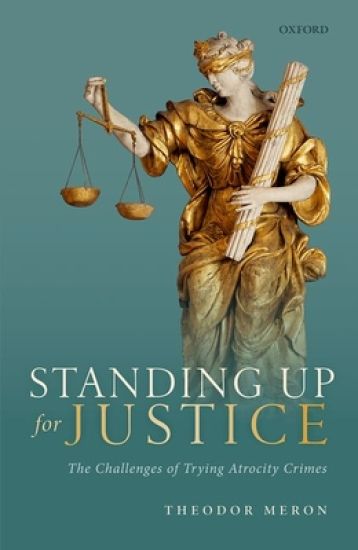
Standing Up for Justice

Standing Up for Justice

Theodor Meron

Oxford University Press
2021
sidottu
This is a book about international criminal justice written by one of its foremost practitioners and academic thinkers, Judge Theodor Meron. For two decades, Judge Meron has been at the heart of the international criminal justice system, serving as President of the International Criminal Tribunal for the former Yugoslavia (ICTY), President of the International Residual Mechanism for Criminal Tribunals, and a Judge of the Appeals Chambers of the ICTY and the International Criminal Tribunal for Rwanda. Drawing on this experience, and his life and career before serving as an international judge, Judge Meron reflects on some of the key questions facing the international criminal justice system. In the opening chapter, Judge Meron writes vividly about his childhood experiences in Poland during World War II, his education, career with the Israeli Foreign Ministry, and subsequent move into academia in the United States. The book continues with Meron's reflections on what it means to transform from a law professor into an international criminal judge, and shifts focus to the criminal courtroom, addressing topics such as the judicial function, the rule of law, and the principle of fairness in trying atrocity crimes: genocide, crimes against humanity, and war crimes. Judge Meron discusses judicial independence and impartiality in international criminal courts, shedding light on the mystery of judicial decision-making and deliberations. Notably, he addresses the controversial subjects of acquittals and the early release of prisoners. Although acquittals are often seen as a failure of international justice, Judge Meron argues that legal principle must come before any extraneous purpose, however desirable that purpose may be. Finally, the book looks ahead at the challenges facing the future of international justice and accountability, and discusses the all-important question: does international criminal justice work?
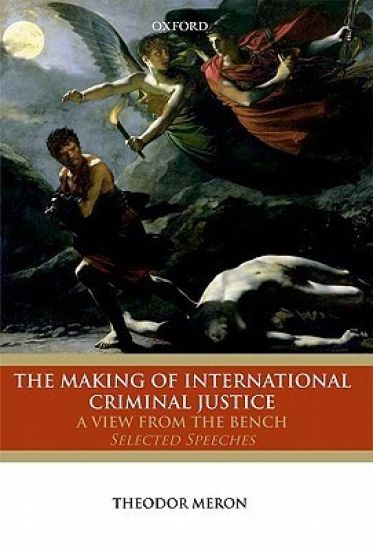
The Making of International Criminal Justice

The Making of International Criminal Justice

Theodor Meron

Oxford University Press
2011
sidottu
There has been a quiet revolution over the course of the past quarter century in the prosecution of individuals for war crimes before international courts. Until recently, and with a few notable exceptions in the wake of World War II, violations of the laws of war and international humanitarian law were addressed primarily as claims between states. However, this approach has changed radically in just the last twenty years, as the international community has increasingly accepted the idea of individual criminal responsibility for violations of international humanitarian law. The International Criminal Tribunals for the former Yugoslavia and Rwanda have played a key role in this transformation and, as the trailblazers for a growing number of new international or hybrid criminal courts, in establishing the field of international criminal justice and encouraging the national prosecution of war crimes. Understanding the Tribunals' origins, their ground-breaking jurisprudence, and how they have addressed critical legal and practical challenges is essential to understanding both the revolution that has occurred over the past twenty years and how international criminal law will change and grow in the years ahead. As a leading scholar on humanitarian law, past President of the International Criminal Tribunal for the former Yugoslavia, and Appeals Judge for both the Yugoslavia and Rwanda Tribunals, Theodor Meron has observed and influenced the development of international criminal law as it has evolved from a mostly academic exercise to a cornerstone of the new international legal order. In this collection of speeches delivered during his first decade on the bench, he offers an insightful overview of the foundations of international criminal law as well as a unique, insider's perspective on the challenges faced by international criminal tribunals, their creation of a corpus of substantive and procedural law regarding everything from sentencing and self-representation to the law of genocide and the protection of prisoners of war, the contributions of other international courts, and the responsibilities of international jurists. Judge Meron's personal reflections and unparalleled experience in international criminal justice make this volume as rewarding for experts as it is for the general public.
The Making of International Criminal Justice

The Making of International Criminal Justice

Theodor Meron

Oxford University Press
2012
nidottu
Until recently, and with a few notable exceptions in the wake of World War II, violations of the laws of war and international humanitarian law were addressed primarily as claims between states. However, this approach has changed radically in the last twenty years, as the international community has increasingly accepted the idea of individual criminal responsibility for violations of international humanitarian law. The International Criminal Tribunals for the former Yugoslavia and Rwanda have played a key role in this transformation and, as the trailblazers for a growing number of new international or hybrid criminal courts, in establishing the field of international criminal justice and encouraging the national prosecution of war crimes. Understanding the Tribunals' origins, their ground-breaking jurisprudence, and how they have addressed critical legal and practical challenges is essential to understanding both the revolution that has occurred over the past twenty years and how international criminal law will change and grow in the years ahead. As a leading scholar on humanitarian law, and President of the International Criminal Tribunal for the former Yugoslavia, Theodor Meron has observed and influenced the development of international criminal law as it has evolved from a mostly academic exercise to a cornerstone of the new international legal order. In this collection of speeches delivered during his first decade on the bench, he offers an insightful overview of the foundations of international criminal law as well as a unique insider's perspective on the challenges faced by international criminal tribunals, their creation of a corpus of substantive and procedural law, and the responsibilities of international jurists. Judge Meron's experience in international criminal justice makes this volume as rewarding for experts as it is for the general public.
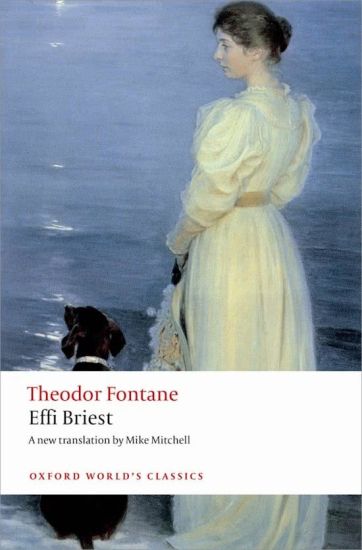
Effi Briest

Effi Briest

Theodor Fontane

Oxford University Press
2015
nidottu
'I loathe what I did, but what I loathe even more is your virtue.' Seventeen-year-old Effi Briest is steered by her parents into marriage with an ambitious bureaucrat, twenty years her senior. He takes her from her home to a remote provincial town on the Baltic coast of Prussia where she is isolated, bored, and prey to superstitious fears. She drifts into a half-hearted affair with a manipulative, womanizing officer, which ends when her husband is transferred to Berlin. Years later, events are triggered that will have profound consequences for Effi and her family. Effi Briest (1895) is recognized as one of the masterpieces by Theodor Fontane, Germany's premier realist novelist, and one of the great novels of marital relations together with Madame Bovary and Anna Karenina. It presents life among the conservative Prussian aristocracy with irony and gentle humour, and opposes the rigid and antiquated morality of the time by treating its heroine with sympathy and keen psychological insight. ABOUT THE SERIES: For over 100 years Oxford World's Classics has made available the widest range of literature from around the globe. Each affordable volume reflects Oxford's commitment to scholarship, providing the most accurate text plus a wealth of other valuable features, including expert introductions by leading authorities, helpful notes to clarify the text, up-to-date bibliographies for further study, and much more.
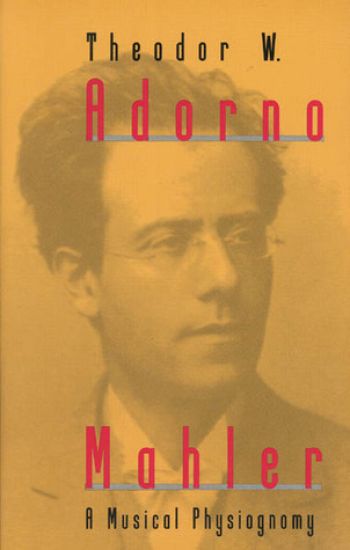
Mahler

Mahler

Theodor W. Adorno

University of Chicago Press
1996
nidottu
Theodor W. Adorno goes beyond conventional thematic analysis to gain a more complete understanding of Mahler's music through his character, his social and philosophical background, and his moment in musical history. Adorno examines the composer's works as a continuous and unified development that began with his childhood response to the marches and folk tunes of his native Bohemia.Since its appearance in 1960 in German, Mahler has established itself as a classic of musical interpretation. Now available in English, the work is presented here in a translation that captures the stylistic brilliance of the original.Theodor W. Adorno (1903-69), one of the foremost members of the Frankfurt school of critical theory, studied with Alban Berg in Vienna during the late twenties, and was later the director of the Institute of Social Research at the University of Frankfurt from 1956 until his death. His works include Aesthectic Theory, Introduction to the Sociology of Music, The Jargon of Authenticity, Prism, and Philosophy of Modern Music.