Kirjojen hintavertailu. Mukana 11 230 651 kirjaa ja 12 kauppaa.

Kirjahaku

Etsi kirjoja tekijän nimen, kirjan nimen tai ISBN:n perusteella.

1000 tulosta hakusanalla Thomas Witherow

The Papers of Thomas Jefferson, Volume 34

The Papers of Thomas Jefferson, Volume 34

Thomas Jefferson

PRINCETON UNIVERSITY PRESS
2008
sidottu
In Volume 34, covering May through July 1801, the story of Thomas Jefferson's first presidential administration continues to unfold. He quickly begins to implement his objectives of economy and efficiency in government. Requesting the chief clerk of the War Department to prepare a list of commissioned army officers, Jefferson has his secretary Meriwether Lewis label the names on the list with such descriptors as "Republican" or "Opposed to the administration, otherwise respectable officers." The president calls his moves toward a reduction in the army a "chaste reformation." Samuel Smith, interim head of the Navy Department, in accordance with the Peace Establishment Act, arranges for the sale of surplus warships. Secretary of the Treasury Albert Gallatin gathers figures on revenues and expenses and suggests improvements in methods of collecting taxes. Jefferson delivers an eloquent statement on his policy of removals from office to the merchants of New Haven, who objected to his dismissal of the collector of the port of New Haven. He makes clear that while his inaugural address declared tolerance and respect for the minority, it did not mean that no offices would change hands. On the twenty-fifth anniversary of the Fourth of July, Jefferson entertains around one hundred citizens, including a delegation of five Cherokee chiefs. And on 30 July, Jefferson leaves the Federal City for two months at Monticello.
The Papers of Thomas Jefferson, Retirement Series, Volume 4

The Papers of Thomas Jefferson, Retirement Series, Volume 4

Thomas Jefferson

Princeton University Press
2008
sidottu
Volume Four of this definitive edition of Thomas Jefferson's papers from the end of his presidency until his death includes 581 documents from 18 June 1811 to 30 April 1812. Between these two dates, Jefferson famously declares that, "tho' an old man, I am but a young gardener"; expresses hostility to dogs and joins in a petition for a tax to reduce their numbers; calculates lines for a horizontal sundial; surveys part of his Bedford County estate; and draws up work schedules for his Poplar Forest plantation and detailed slave lists for Poplar Forest and Monticello. Jefferson also takes readings of a solar eclipse; attempts to determine Monticello's longitude; measures Willis Mountain; and calls for a fixed international standard for measures, weights, and coins. Joseph Milligan publishes a revised edition of Jefferson's Manual of Parliamentary Practice in March 1812, and Jefferson sends William Wirt a detailed and colorful but largely negative portrait of Patrick Henry for use in his biography of the Virginia orator. Finally, and perhaps of greatest importance to posterity, in January 1812 correspondence resumes between Jefferson and his old friend John Adams, after a long hiatus resulting from their rivalry for the presidency in 1800.
The Papers of Thomas Jefferson, Retirement Series, Volume 5

The Papers of Thomas Jefferson, Retirement Series, Volume 5

Thomas Jefferson

Princeton University Press
2009
sidottu
Volume Five of the definitive edition of Thomas Jefferson's papers from the end of his presidency until his death includes 592 documents from 1 May 1812 to 10 March 1813. America declares war on Great Britain on 18 June 1812. Jefferson counsels domestic reconciliation while suggesting that America recruit British incendiaries to burn London if British ships attack American cities. He passes on to President James Madison a long and discouraging letter from Isaac A. Coles describing American military bungling in the Niagara Campaign. An unofficial proposal that Jefferson return to public life as secretary of state does not gain the retired statesman's support. Jefferson receives many requests for governmental patronage, responds insightfully to a colorful assortment of authors and inventors, is mildly diverted by a fraudulent perpetual-motion machine, and spends considerable time on legal troubles. A dispute with David Michie over land in Albemarle County nearly leads to a duel between Michie and Jefferson's agent. A conflict with Samuel Scott over property in Campbell County further vexes Jefferson, who prepares an extensively researched answer to Scott's complaint. Despite the conflict, Jefferson graciously writes a letter of introduction for Scott's son. Jefferson remains accessible to the public, receives anonymous letters urging him to convert to Christianity, and settles a wager for one correspondent who asks if Jefferson ever met the British king. Jefferson gloomily observes that "the hand of age is upon me" and complains that his faculties are failing. He still has thirteen years to live.
The Papers of Thomas Jefferson, Retirement Series, Volume 6

The Papers of Thomas Jefferson, Retirement Series, Volume 6

Thomas Jefferson

Princeton University Press
2010
sidottu
Volume Six of the definitive edition of Thomas Jefferson's papers from the end of his presidency until his death presents 516 documents from 11 March to 27 November 1813. Although free from the cares of government, Jefferson cannot disassociate himself from politics entirely. He recommends to President James Madison during the War of 1812 that gunboats be used to protect the Chesapeake Bay, and writes to his congressional son-in-law, John Wayles Eppes, urging the repayment of the national debt and the reining in of the American banking system. Jefferson remains active and healthy, making trips to his beloved Poplar Forest estate, entertaining visitors at Monticello, and happily supervising the education of his grandchildren and other relations. His correspondence shows no signs of abating--he writes to John Waldo and John Wilson to discuss the improvement of English orthography, addresses Isaac McPherson as part of a plea for limits on government-sanctioned intellectual-property rights, and provides a study of Meriwether Lewis for Nicholas Biddle's History of the Expedition under the command of Captains Lewis and Clark. Finally, this volume records the most intense period of correspondence between Jefferson and John Adams during their retirement. In an exchange of thirty-one letters, the two men reveal their hopes and fears for the nation.
The Papers of Thomas Jefferson, Volume 35

The Papers of Thomas Jefferson, Volume 35

Thomas Jefferson

Princeton University Press
2009
sidottu
For the first two months covered by this volume, Thomas Jefferson is residing at Monticello, avoiding the "rather sickly" season in the nation's capital. His mountaintop house finally has a roof and both daughters and their families come to stay with him. Using cowpox vaccine received from Benjamin Waterhouse, he undertakes what he calls "my experiment," the systematic inoculation of family members and slaves against the smallpox. In Washington, the construction of buildings for the nation's capital moves forward. The walls of the chamber of the House of Representatives now extend "up to the window heads," with only three feet more to go. Jefferson considers the erection of this chamber as well as completion of a "good gravel road" along Rock Creek as crucial for "ensuring the destinies of the city." The interior decoration of the President's House also progresses, with draperies, girandoles, and a chandelier furnishing the circular room. His carriage is ready to be shipped from Philadelphia. As the city takes shape, so too do the operating principles of Jefferson's administration. He dispatches a letter to his heads of department outlining "the mode & degrees of communication" for conducting their business. In mid-November, he enters a period of intense activity in the preparation of his first annual message to Congress, soliciting suggestions but personally drafting the document that he will submit in writing in early December.
The Papers of Thomas Jefferson, Volume 36

The Papers of Thomas Jefferson, Volume 36

Thomas Jefferson

PRINCETON UNIVERSITY PRESS
2010
sidottu
The period covered by this volume brings to a conclusion Thomas Jefferson's first year as president. On 8 December he communicates his first annual message to Congress: peace between France and England is restored; a rise in population will increase revenue and help abolish internal taxes; the standing army can be done away with; "peace & friendship" prevail with Indian neighbors. He recommends two particular matters to the attention of Congress: a revision of the laws on naturalization and a review of the Judiciary Act. Two delegations of Indian nations hold conferences with Jefferson and Secretary of War Henry Dearborn in Washington. Jefferson observes that it is good for them to "renew the chain of affection." The president receives a "Mammoth Cheese" as a token of esteem from the citizens of Cheshire, Massachusetts, and the letter from the Danbury Baptists arrives. In his famous reply to the Baptists, Jefferson states that "religion is a matter which lies solely between man & his god." Shortly after legislators arrive in town for the opening of Congress, he begins to entertain at the President's House. He uses such occasions to bridge the divide between the executive and legislative branches and foster political understanding between Republicans and Federalists. As he moves into his second year as president, he is optimistic about his legislative program and the Republican majority in Congress.
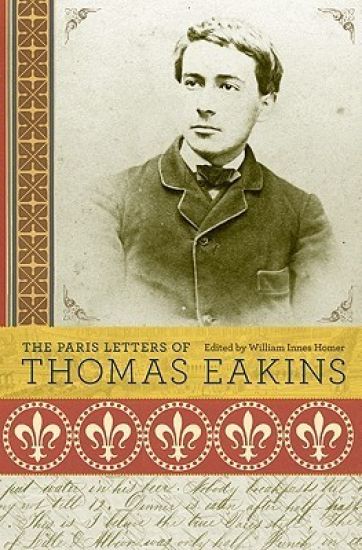
The Paris Letters of Thomas Eakins

The Paris Letters of Thomas Eakins

Thomas Eakins

PRINCETON UNIVERSITY PRESS
2009
sidottu
The most revealing and interesting writings of American artist Thomas Eakins are the letters he sent to family and friends while he was a student in Paris between 1866 and 1870. This book presents all these letters in their entirety for the first time; in fact, this is the first edition of Eakins's correspondence from the period. Edited and annotated by Eakins authority William Innes Homer, this book provides a treasure trove of new information, revealing previously hidden facets of Eakins's personality, providing a much richer picture of his artistic development, and casting fresh light on his debated psychosexual makeup. The book is illustrated with the small, gemlike drawings Eakins included in his correspondence, as well as photographs and paintings. In these letters, Eakins speaks openly and frankly about human relationships, male companionship, marriage, and women. In vivid, charming, and sometimes comic detail, he describes his impressions of Paris--from the training he received in the studio of Jean-Leon Gerome to the museums, concerts, and popular entertainments that captured his imagination. And he discusses with great insight contemporary aesthetic and scientific theories, as well as such unexpected subjects as language structure, musical composition, and ice-skating technique. Also published here for the first time are the letters and notebook Eakins wrote in Spain following his Paris sojourn. This long-overdue volume provides an indispensable portrait of a great American artist as a young man.
The Papers of Thomas Jefferson, Retirement Series, Volume 7

The Papers of Thomas Jefferson, Retirement Series, Volume 7

Thomas Jefferson

Princeton University Press
2011
sidottu
The 526 documents printed in this volume run from 28 November 1813 to 30 September 1814. During this period Jefferson reviews the extant sources on the 1765 Stamp Act crisis to aid William Wirt, a Patrick Henry scholar; records his largely positive impressions of George Washington; and updates a reading list for law students that he had initially drawn up forty years earlier. In the spring of 1814 Jefferson becomes a trustee of the Albemarle Academy, the earliest direct ancestor of the University of Virginia. He is soon actively involved in planning for its establishment, helping to draft rules for governance of the academy's trustees and propose funding options, and he lays out an expansive vision for its future as an institution of higher learning. Jefferson also exchanges ideas on collegiate education with such respected scholars as Thomas Cooper and Jose Correa da Serra. Jefferson's wide-ranging correspondence includes a temperate response to a lengthy letter from Miles King urging the retired president to reflect on his personal religion, and a diplomatic but noncommittal reply to a proposal by Edward Coles that the author of the Declaration of Independence employ his prestige to help abolish slavery. Having learned of the British destruction late in August 1814 of the public buildings in Washington, Jefferson offers his massive book collection as a replacement for the Library of Congress. The nucleus for one of the world's great public libraries is formed early in 1815 when the nation purchases Jefferson's 6,707 volumes.
The Papers of Thomas Jefferson, Volume 37

The Papers of Thomas Jefferson, Volume 37

Thomas Jefferson

PRINCETON UNIVERSITY PRESS
2011
sidottu
This volume opens on 4 March 1802, the first anniversary of Thomas Jefferson's inauguration as the nation's third president, and closes on 30 June. In March, a delegation of Seneca Indians comes to Washington to discuss their tribe's concerns, and Jefferson names a commissioner to handle a land sale by Oneida Indians to the state of New York. In April, the Senate ratifies a treaty with the Choctaw nation for a wagon road across their lands. Jefferson worries about an increasingly dictatorial France taking back control of New Orleans, prompting him to the intemperate remark that he would "marry" America's fortunes to the British fleet. Charles Willson Peale sends him sketches of the skull of a prehistoric bison found in Kentucky. During the closing, and very frustrating, weeks of Congress, he distracts himself with a cipher devised by Robert Patterson. He prepares lists of books to be purchased for the recently established Library of Congress and also obtains many titles for his own collection. Even while he is in Washington occupied with matters of state, Jefferson has been keeping close watch on the renovations at Monticello. In May, he has Antonio Giannini plant several varieties of grapes in the southwest vineyard, and he orders groceries, molasses, dry Lisbon wine, and cider to be shipped to Monticello in time for his arrival. He looks forward "with impatience" to the moment he can embrace his family once more.
The Papers of Thomas Jefferson, Retirement Series, Volume 8

The Papers of Thomas Jefferson, Retirement Series, Volume 8

Thomas Jefferson

Princeton University Press
2012
sidottu
Volume eight of the project documenting Thomas Jefferson's last years presents 591 documents dated from 1 October 1814 to 31 August 1815. Jefferson is overjoyed by American victories late in the War of 1812 and highly interested in the treaty negotiations that ultimately end the conflict. Following Congress' decision to purchase his library, he oversees the counting, packing, and transportation of his books to Washington. Jefferson uses most of the funds from the sale to pay old debts but spends some of the proceeds on new titles. He resigns from the presidency of the American Philosophical Society, revises draft chapters of Louis H. Girardin's history of Virginia, and advises William Wirt on revolutionary-era Stamp Act resolutions. Jefferson criticizes those who discuss politics from the pulpit, and he drafts a bill to transform the Albemarle Academy into Central College. Monticello visitors Francis W. Gilmer, Francis C. Gray, and George Ticknor describe the mountaintop and its inhabitants, and Gray's visit leads to an exchange with Jefferson about how many generations of white interbreeding it takes to clear Negro blood. Finally, although death takes his nephew Peter Carr and brother Randolph Jefferson, the marriage of his grandson Thomas Jefferson Randolph is a continuing source of great happiness.
The Papers of Thomas Jefferson, Volume 38

The Papers of Thomas Jefferson, Volume 38

Thomas Jefferson

Princeton University Press
2012
sidottu
Volume 38 opens on 1 July 1802, when Jefferson is in Washington, and closes on 12 November, when he is again there. For the last week of July and all of August and September, he resides at Monticello. Frequent correspondence with his heads of department and two visits with Secretary of State James Madison, however, keep the president abreast of matters of state. Upon learning in August of the declaration of war by Mawlay Sulayman, the sultan of Morocco, much of the president's and the cabinet's attention is focused on that issue, as they struggle to balance American diplomatic efforts with reliance on the country's naval power in the Mediterranean. Jefferson terms the sultan's actions "palpably against reason." In September, he addresses the concerns of the mayor of New York City and the governor of South Carolina that free blacks expelled from Guadeloupe by the French will be landed onto American shores. Although he believes the matter will be dealt with by the states, he also instructs Secretary of the Treasury Albert Gallatin to direct custom house officers to be watchful. In late August, Jefferson is alerted that he has been touched by the "breath of Slander," when James T. Callender's accusations appear in the Richmond Recorder and make public his relationship with Sally Hemings. The president offers no comment, and a month later returns to Washington, where he continues planning for an impending visit by his daughters.
The Papers of Thomas Jefferson, Retirement Series, Volume 9

The Papers of Thomas Jefferson, Retirement Series, Volume 9

Thomas Jefferson

Princeton University Press
2013
sidottu
Volume Nine of the project documenting Thomas Jefferson's last years presents 523 documents from 1 September 1815 to 30 April 1816. In this period, Jefferson makes three trips to Poplar Forest. During two visits to the Peaks of Otter, he measures their altitude and his calculations are reprinted in several newspapers. Jefferson welcomes the returning war hero Andrew Jackson in a visit to Poplar Forest and offers a toast at a public dinner in Lynchburg held in the general's honor. With the end of the War of 1812, Jefferson uses European contacts to begin restocking his wine cellar and refilling his bookshelves. In a draft letter to Horatio G. Spafford, Jefferson indulges in a "tirade" against a pamphlet by a New England clergyman. Jefferson decides to drop the section from the letter but sends it to Richmond Enquirer publisher Thomas Ritchie with permission to publish it without Jefferson's name. An anonymous letter in the Washington Daily National Intelligencer on the interpretation of the U.S. Constitution elicits a similarly anonymous response from Jefferson. His family circle grows with the birth of a great-granddaughter. Despite a report of his death, Jefferson continues to enjoy perfect health.
The Papers of Thomas Jefferson, Volume 39

The Papers of Thomas Jefferson, Volume 39

Thomas Jefferson

Princeton University Press
2013
sidottu
This volume opens on 13 November 1802, when Jefferson is in Washington, and closes on 3 March 1803, the final day of his second year as president. The central issue of these months is the closing of the right of deposit at New Orleans, an act that threatens the economic wellbeing of Westerners. Jefferson asks his old friend Pierre Samuel du Pont de Nemours to remind the French government of the strong friendship between the two nations. To disarm the political opposition, the president sends James Monroe, who is respected by the Federalists, to Europe as a special envoy to work with Robert Livingston in negotiating the dispute with France. Jefferson proposes a "bargain" that will result in the acquisition of the Louisiana Territory. In a confidential message to Congress, Jefferson seeks $2,500 to send a small party of men to explore the Missouri River. Congress concurs, and Jefferson's secretary Meriwether Lewis will lead the expedition. Settling the boundaries with Native American lands is a major theme of the volume. In reality, "settling" results in major cessions of Indian lands to the American government. During the months of this volume Jefferson never leaves the capital, even for a brief sojourn at Monticello. He does, however, enjoy a visit of six weeks from his daughters and two of his grandchildren. They participate in Washington society, capture the affection of Margaret Bayard Smith, and brighten Jefferson's days.
The Papers of Thomas Jefferson, Volume 40

The Papers of Thomas Jefferson, Volume 40

Thomas Jefferson

Princeton University Press
2014
sidottu
This volume opens on 4 March 1803, the first day of Jefferson's third year as president. Still shaken by the closing of the right of deposit at New Orleans, he confronts the potential political consequences of a cession of Louisiana to France that might result in a denial of American access to the Mississippi. But he resists pressures to seize New Orleans by force, urging patience instead. The cabinet determines in April that "all possible procrastinations" should be used in dealing with France, but that discussions with Great Britain move forward as well. In Paris, a treaty for the cession of the Louisiana Territory to the United States is signed, and in May the right of deposit is restored. On 3 July, word reaches Jefferson in Washington of the agreement that France has sold the entire Territory for $15 million. The glorious news, which may be the most momentous that Jefferson receives while president, appears in the National Intelligencer the following day. Having received congressional approval to send an expedition to locate a continental route to the Pacific, Jefferson drafts instructions and a cipher for Meriwether Lewis and arranges for the needed instruments. Following through on a promise to a friend to give his views of Christianity, Jefferson puts his religious creed on paper, a "Syllabus" of the morals of Jesus and the comparative merits of Christianity. He intends it only for a few trusted friends.
The Papers of Thomas Jefferson: Retirement Series, Volume 10

The Papers of Thomas Jefferson: Retirement Series, Volume 10

Thomas Jefferson

Princeton University Press
2014
sidottu
The 558 documents in this volume cover the period from 1 May 1816 to 18 January 1817. During this time, Jefferson expects political upheaval in Great Britain, welcomes the imminent presidential transition from James Madison to James Monroe, and privately suggests substantial amendments to Virginia's constitution. Jefferson occasionally gives legal advice, including an opinion on whether perjury can be committed before a grand jury. He turns down a request to sell Natural Bridge, calculates the latitude of Poplar Forest and Willis's Mountain, receives a large shipment of foreign books, exchanges the last of a series of letters with Pierre Samuel Du Pont de Nemours, and is appointed a visitor of Central College. As before, sojourners flock to Monticello. The Baron de Montlezun and Francis Hall provide informative accounts of Jefferson's home, way of life, and thoughts on many subjects. Jefferson attempts to bring Destutt de Tracy's Treatise on Political Economy into print, offers biographical information for Delaplaine's Repository, and recommends revisions to a forthcoming biography of Patrick Henry. Jefferson and Francis Adrian Van der Kemp trade letters about Jesus's life and teachings, and after the ailing Charles Thomson circulates the mistaken idea that Jefferson has converted to Christianity, correspondents question him about his spiritual beliefs.
The Papers of Thomas Jefferson: Retirement Series, Volume 11

The Papers of Thomas Jefferson: Retirement Series, Volume 11

Thomas Jefferson

Princeton University Press
2015
sidottu
The 584 documents in this volume cover the period from 19 January to 31 August 1817, during which Jefferson devotes much time and energy to founding Central College, the predecessor of the University of Virginia. In May 1817, at its first official meeting, the college's Board of Visitors authorizes land purchases and a subscription campaign that eventually raises more than $44,000. Jefferson also prepares a legal brief for his chancery suit against the directors of the Rivanna Company. After years of disagreements and failed negotiations, he composes and revises a legal statement of his claim to the property in dispute. Although the complaint is submitted to the court in May 1817, the case is not settled until December 1819. In March 1817 Jefferson's friend James Monroe begins his first term as president. During the summer Jefferson learns of the death of two friends, Madame de Stael Holstein and Pierre Samuel Du Pont de Nemours. Late in the summer he visits Natural Bridge with two of his granddaughters. Jefferson continues to purchase books from Europe with the assistance of George Ticknor, and Stephen Cathalan helps him restock his wine cellar and pantry. Even though Jefferson answers his voluminous correspondence selectively, he still chafes under the burden.
The Papers of Thomas Jefferson, Volume 41

The Papers of Thomas Jefferson, Volume 41

Thomas Jefferson

Princeton University Press
2015
sidottu
The Louisiana Purchase dominates the months covered in this volume. Jefferson departs for Monticello to enjoy a needed respite after the busy three and a half months he has just spent in the nation's capital. Shortly before leaving Washington, he has a last meeting with his cabinet, after which he issues a proclamation to reconvene Congress on 17 October, three weeks early. It is the "great and weighty" business of the French government's stunning offer to transfer all of the Louisiana Territory to the United States that necessitates this important gathering. The event brings Jefferson enthusiastic congratulations from his friends and fellow Republicans. With Jefferson's great success, however, comes the reality of getting the agreement with France approved and implemented. The boundaries of the territory ceded are not even clear. In private letters to his trusted advisers, Jefferson discusses the proper course of action. Should both houses of Congress be called to consider the French offer? Is it prudent to make the substance of a treaty public? And perhaps most vexing, does this executive action require an amendment to the Constitution? Some Federalists criticize the plan, but an expansion of the nation's territory, proponents argue, will raise America's stature in the eyes of the world. With the widening of the country's borders, Jefferson's project to send an exploratory party westward seems even timelier. William Clark accepts Meriwether Lewis's invitation to join the expedition, and on the last day of August Lewis begins his journey down the Ohio River, the building of his boat finally complete.
The Papers of Thomas Jefferson: Retirement Series, Volume 12

The Papers of Thomas Jefferson: Retirement Series, Volume 12

Thomas Jefferson

Princeton University Press
2016
sidottu
The 580 documents in this volume cover a wide range of fascinating topics. Jefferson receives impressions of a mammoth's tooth, altitude and meteorological observations, a call for a national pharmacopoeia, a discussion of primeval geology, and a letter that elicits Jefferson's opinion that cognition exists "in animal bodies certainly, in Vegetables probably, in Minerals not impossibly." Jefferson leases his Tufton and Lego plantations to his grandson Thomas Jefferson Randolph. The directors of the Rivanna Company rebut Jefferson's 1817 bill of complaint and he unwittingly ensures his eventual financial ruin by endorsing notes totaling $20,000 for Wilson Cary Nicholas. Jefferson adds to the collections of the American Philosophical Society and writes an extended introduction to the "Anas," a corpus of official papers and political anecdotes documenting his service as George Washington's secretary of state. Jefferson drafts legislation to establish a public education system in Virginia. He attends a Masonic cornerstone laying ceremony for the nascent Central College's first pavilion early in October 1817 and is greatly pleased by the passage on 21 February 1818 of a law establishing a commission to plan a new state university, raising his hopes that Central College might soon become the University of Virginia.
The Papers of Thomas Jefferson, Volume 42

The Papers of Thomas Jefferson, Volume 42

Thomas Jefferson

PRINCETON UNIVERSITY PRESS
2016
sidottu
Confessing that he may be acting "with more boldness than wisdom," Jefferson in November 1803 drafts a bill to create Orleans Territory, which he entrusts to John Breckinridge for introduction in the Senate. The administration sends stock certificates to France in payment for Louisiana. Relieved that affairs in the Mediterranean have improved with the evaporation of a threat of war with Morocco, the president does not know yet that Tripoli has captured the frigate Philadelphia with its officers and crew. He deals with never-ending issues of appointment to office and quarreling in his own party, while hearing that some Federalists are "as Bitter as wormwood." He shares seeds of the Venus flytrap with Elizabeth Leathes Merry, the British minister's wife. She and her husband, however, create a diplomatic storm over seating arrangements at dinner parties. Having reached St. Louis, Meriwether Lewis reports on the progress of the western expedition. Congress passes the Twelfth Amendment, which will provide for the separate election of president and vice president. In detailed notes made after Aaron Burr calls on him in January, Jefferson records his long-standing distrust of the New Yorker. Less than a month later, a congressional caucus nominates Jefferson for a second term, with George Clinton to replace Burr as vice president. Jefferson makes his first trials of the "double penned writing box" called the polygraph.
The Papers of Thomas Jefferson: Retirement Series, Volume 13

The Papers of Thomas Jefferson: Retirement Series, Volume 13

Thomas Jefferson

Princeton University Press
2017
sidottu
This volume's 598 documents span 22 April 1818 to 31 January 1819. Jefferson spends months preparing for a meeting to choose the site of the state university. He drafts the Rockfish Gap Report recommending the location of the University of Virginia at Charlottesville as well as legislation confirming this decision. Jefferson travels to Warm Springs to cure his rheumatism but instead contracts a painful infection on his buttocks. His enforced absence from Poplar Forest leads to detailed correspondence with plantation manager Joel Yancey. A work that Jefferson helped translate, Destutt de Tracy's Treatise on Political Economy, is finally published. Salma Hale visits Monticello and describes Jefferson's views on food, wine, and religion. In acknowledging an oration by Mordecai M. Noah, Jefferson remarks that the suffering of members of the Jewish faith "has furnished a remarkable proof of the universal spirit of religious intolerance." He receives long discussions of occult science and the nature of light by Robert Miller and Gabriel Crane. Abigail Adams dies, and Jefferson assures John Adams that their own demise will result in "an ecstatic meeting with the friends we have loved & lost and whom we shall still love and never lose again."