Kirjojen hintavertailu. Mukana 12 390 323 kirjaa ja 12 kauppaa.

Kirjahaku

Etsi kirjoja tekijän nimen, kirjan nimen tai ISBN:n perusteella.

1000 tulosta hakusanalla "Civilization"

The Lost Civilization of Suolucidir

The Lost Civilization of Suolucidir

Susan Daitch

City Lights Books
2016
pokkari
"With shades of Umberto Eco and Paul Auster, this brilliant, addictive adventure novel is about the search for a mythical lost city located somewhere in modern-day Iran. As a succession of explorers and shady characters dig deeper into the landscape, the ancient secret of Suolucidir is gradually revealed. This is brainy, escapist fiction at its best."--Publishers Weekly, Starred & Boxed Review "The author's prose is rich with winking allusions and sendups of modern tomb-raiding tropes, down to an explorer with 'a long stiff braid down her back.'"--The New Yorker " ...cerebral, satirical, and entertaining archaeological thriller ...this richly crafted and handsomely written novel rewards rereading."--David Cooper, New York Journal of Books "It's always a delight to discover a voice as original as Susan Daitch's."--Salman Rushdie "One of the most intelligent and attentive writers at work in the US today."--David Foster Wallace Indiana Jones meets Italo Calvino in a masterful, absurdist blend of biting social satire, rollicking adventure, invented history and mythology. A series of archeological expeditions unfolds through time, each one looking for the ruins of a fabled underground city-state that once flourished in a remote province near the border of present-day Iran, Pakistan, and Afghanistan. Sealed off for centuries by seismic activity, Suolucidir beckons with the promise of plunder and the glory of discovery, fantasies as varied as the imaginations of her aspiring modern-day conquerors. As the tumult of the twentieth century's great wars, imperial land grabs and anti-colonial revolutions swirl across its barren, deserted landscape, the ancient city remains entombed below the surface of the earth. A succession of adventurers, speculators and unsavory characters arrive in search of their prize, be it archeological treasure, oil, or evidence of crimes and punishments. Intrigue, conspiracies, and counter-plots abound, and contemporary events interfere with each expedition, whether in the form of the Axis advance, British Petroleum, or the Revolutionary Guards. People disappear, relics are stolen, and the city closes in upon itself once more. A satiric, post-colonial adventure story of mythic proportions, The Lost Civilization of Suolucidir takes place against a background of actual events, in a part of the world with a particular historical relationship to Russia and the West. But though we are treated to visual "evidence" of its actual existence, Suolucidir remains a mystery, perhaps an invention of those who seek it, a place where history and identity are subject to revision, and the boundaries between East and West are anything but solid, reliable, or predictable. Praise for The Lost Civilization of Suolucidir: "Susan Daitch has written a literary barnburner of epic proportions. The question buried at the core of The Lost Civilization of Suolucidir is one of empirical--or is the imperial?--knowledge itself. Her labyrinthine tale of archeological derring-do calls to mind both 1984 and 2666, and does so by looking backward in time as well as forward. It is also utterly original, the work of a visionary writer with an artistic sensibility all her own." --Andrew Ervin, author of Burning Down George Orwell's House "This is a novel of archeology and history, of mythology and empire, powered by an undeniable call to adventure and a deep yearning for understanding, written by a novelist who manages to surprise on nearly every page."--Matt Bell, author of Scrapper "Daitch's latest is a beguiling and virtuoso companion to our inevitable end: a novel that wrenches, sentence by fine sentence, some order from the chaos, while never shortchanging the chaos itself."--Mark Doten, author of The Infernal "Daitch's novel is Indiana Jones for the introspective crowd--a continual, thrilling, and harrowing search for historical treasures."--Michelle Anne Schingler, Foreword Reviews

The Philosophy of Civilization

The Philosophy of Civilization

Albert Schweitzer

Prometheus Books
1987
pokkari
Albert Schweitzer's social and ethical philosophy is best expressed in The Philosophy of Civilization. Not widely available in recent years, this edition will give contemporary readers the opportunity to discover his prophetic thought. In Book I, The Decay and Restoration of Civilization, Schweitzer argues that the essential feature of every culture is its world view, and that a culture can be healthy and stable only as its world view is optimistic and ethical. Without this outlook, it is impossible to avoid the world's destruction. In Book II, Civilization and Ethics, he reviews the world's major ethical systems in search of the essential principle of "the moral," after which the world and life-affirming ethic of "reverence for life" is set forth. Through Schweitzer's guidance, man will strive for spiritual and ethical self-fulfillment which in turn may be actualized in all the processes of the world, making us a truly civilized people. Schweitzer's ultimate goal is to help us recognize that the source of universal misery and catastrophe is the absence of a theory of the universe.
Destruction of Black Civilization

Destruction of Black Civilization

Chancellor Williams

Third World Press,U.S.
1992
nidottu
This is a widely read classic exposition of the history of Africans on the continent, the people of African descent in the United States and in the diaspora. This is well researched scholarly work detailing the development of civilisation in Africa and its destruction.
A History of Civilization in 50 Disasters

A History of Civilization in 50 Disasters

Gale Eaton

Tilbury House,U.S.
2019
sidottu
Civilization rearranges nature for human convenience. Clothes and houses keep us warm; agriculture feeds us; medicine fights our diseases. It all works—most of the time. But key resources lie in the most hazardous places, so we choose to live on river flood plains, on the slopes of volcanoes, at the edge of the sea, above seismic faults. We pack ourselves into cities, Petri dishes for germs. Civilization thrives on the edge of disaster. And what happens when natural forces meet molasses holding tanks, insecticides, deepwater oil rigs, nuclear power plants? We learn the hard way how to avoid the last disaster—and maybe how to create the next one. What we don’t know can, indeed, hurt us. This book’s white-knuckled journey from antiquity to the present leads us to wonder at times how humankind has survived. And yet, as Author Gale Eaton makes clear, civilization has advanced not just in spite of disasters but in part because of them. Hats off to human resilience, ingenuity, and perseverance! They’ve carried us this far; may they continue to do so into our ever-hazardous future. The History in 50 series explores history by telling thematically linked stories. Each book includes 50 illustrated narrative accounts of people and events—some well-known, others often overlooked—that, together, build a rich connect the-dots mosaic and challenge conventional assumptions about how history unfolds. Dedicated to the premise that history is the greatest story ever told.Includes a mix of “greatest hits” with quirky, surprising, provocative accounts.Challenges readers to think and engage.Includes a glossary of technical terms; sources by chapter; teaching resources as jumping-off points for student research; and endnotes.Fountas & Pinnell Level Z+
A History of Civilization in 50 Disasters

A History of Civilization in 50 Disasters

Gale Eaton

Tilbury House,U.S.
2019
nidottu
Civilization rearranges nature for human convenience. Clothes and houses keep us warm; agriculture feeds us; medicine fights our diseases. It all works—most of the time. But key resources lie in the most hazardous places, so we choose to live on river flood plains, on the slopes of volcanoes, at the edge of the sea, above seismic faults. We pack ourselves into cities, Petri dishes for germs. Civilization thrives on the edge of disaster. And what happens when natural forces meet molasses holding tanks, insecticides, deepwater oil rigs, nuclear power plants? We learn the hard way how to avoid the last disaster—and maybe how to create the next one. What we don’t know can, indeed, hurt us. This book’s white-knuckled journey from antiquity to the present leads us to wonder at times how humankind has survived. And yet, as Author Gale Eaton makes clear, civilization has advanced not just in spite of disasters but in part because of them. Hats off to human resilience, ingenuity, and perseverance! They’ve carried us this far; may they continue to do so into our ever-hazardous future. The History in 50 series explores history by telling thematically linked stories. Each book includes 50 illustrated narrative accounts of people and events—some well-known, others often overlooked—that, together, build a rich connect the-dots mosaic and challenge conventional assumptions about how history unfolds. Dedicated to the premise that history is the greatest story ever told.Includes a mix of “greatest hits” with quirky, surprising, provocative accounts.Challenges readers to think and engage.Includes a glossary of technical terms; sources by chapter; teaching resources as jumping-off points for student research; and endnotes.
A Story of Civilization in 50 Disasters

A Story of Civilization in 50 Disasters

Gale Eaton

Tilbury House,U.S.
2019
nidottu
Civilization rearranges nature for human convenience. Clothes and houses keep us warm; agriculture feeds us; medicine fights our diseases. It all works—most of the time. But key resources lie in the most hazardous places, so we choose to live on river flood plains, on the slopes of volcanoes, at the edge of the sea, above seismic faults. We pack ourselves into cities, Petri dishes for germs. Civilization thrives on the edge of disaster. And what happens when natural forces meet molasses holding tanks, insecticides, deepwater oil rigs, nuclear power plants? We learn the hard way how to avoid the last disaster—and maybe how to create the next one. What we don’t know can, indeed, hurt us. This book’s white-knuckled journey from antiquity to the present leads us to wonder at times how humankind has survived. And yet, as Author Gale Eaton makes clear, civilization has advanced not just in spite of disasters but in part because of them. Hats off to human resilience, ingenuity, and perseverance! They’ve carried us this far; may they continue to do so into our ever-hazardous future. The History in 50 series explores history by telling thematically linked stories. Each book includes 50 illustrated narrative accounts of people and events—some well-known, others often overlooked—that, together, build a rich connect the-dots mosaic and challenge conventional assumptions about how history unfolds. Dedicated to the premise that history is the greatest story ever told.Includes a mix of “greatest hits” with quirky, surprising, provocative accounts.Challenges readers to think and engage.Includes a glossary of technical terms; sources by chapter; teaching resources as jumping-off points for student research; and endnotes.Fountas & Pinnell Level Z+
The Unconscious Civilization

The Unconscious Civilization

John R Saul

House of Anansi Press Inc.
2024
pokkari
Governor General's Award WinnerTenth Anniverary Edition, with a new prefaceOur society, John Ralston Saul argues in his 1995 CBC Massey Lectures, is only superficially based on the individual and democracy. Increasingly it is conformist and corporatist, a society in which legitimacy lies with specialist or interest groups and decisions are made through constant negotiations between these groups.The paradox of our situation is that knowledge has not made us conscious. Instead, we have sought refuge in a world of illusion where language is cut off from reality. Reconnecting language to reality, clarifying what we mean by individualism and democracy, making these realities central to the citizen's life, identifying ideologies in order to control them, these are among the first elements of equilibrium which Saul proposes in these lectures.John Ralston Saul argues that our society is only superficially based on democracy, and that increasingly it is conformist and corporatist.
The Great Wave of Civilization

The Great Wave of Civilization

Herschel Hardin

Talonbooks
1976
pokkari
The Great Wave of Civilization is Herschel Hardin's play about the destruction of the people of the Blackfoot Confederacy by the liquor trade in Montana and Alberta in the 19th century. Little Dog of the Northern Blackfoot tribe vs. Snookum Jim, free trader, I.G. Baker, merchant-prince of Fort Benton and the rest of the "great wave of civilization." Cast of five women and 13 men.
Challenge to Civilization

Challenge to Civilization

Blair A Stonechild

University of Regina Press
2024
pokkari
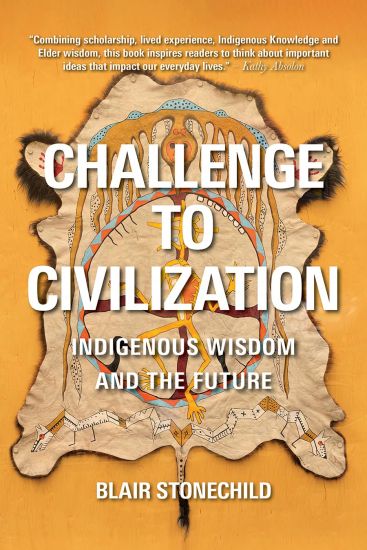
Rediscovering, valuing, and embracing Indigenous spirituality and wisdom is critical for humanity to survive in the future. Civilization is a western, Eurocentric construct borne from a distrust of nature, a desire to endlessly exploit it and profit from it. Despite being a relatively recent development, civilization's inherent logic has resulted in over-population, inequality, poverty, misery, war, and climate change and now threatens humanity's very survival. How can humanity expect to survive if it continues to look for solutions from the very structures and ideologies that have brought it to the brink of extinction? In this final book of his trilogy, Dr. Blair Stonechild deftly illustrates how Indigenous spirituality, wisdom, and land-based knowledge is critical to human survival in the face of environmental destruction and human-induced climate change. Reinterpreting world history from an Indigenous perspective, Stonechild's solution to this unfolding catastrophe is "ecolization," a state in which humans recognize they are not the central purpose of creation and a way of existing harmoniously with the natural and spiritual worlds. Beautifully written, urgent, and critical, Challenge to Civilization reminds us that it is not Earth that is in danger of extinction, but ourselves, and Indigenous spiritual wisdom can be the guiding light through what will otherwise be humanity's final, ever-darkening days.
Perspectives on Early Andean Civilization in Peru

Perspectives on Early Andean Civilization in Peru

Yale University Publications in Anthropology
2020
pokkari
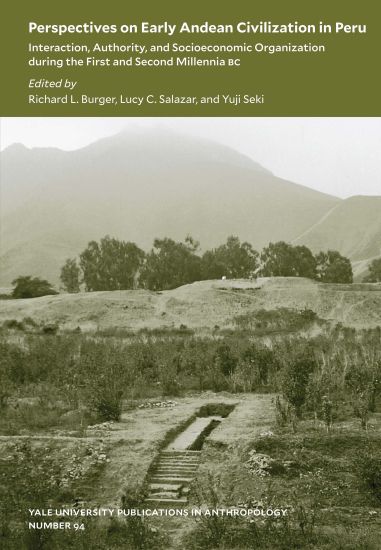
A new perspective on early Andean civilization focused on emergent social complexity during the first and second millennia B.C. This Yale University Publications in Anthropology volume presents investigations of Peruvian archaeological sites, focusing on early developments in coastal, highland, and cloud forest environments. The contributors provide new perspectives on early Andean civilization by exploring patterns of interaction, authority, and socioeconomic organization during the first and second millennia B.C. in the Central Andes of Peru. Large-scale subjects such as architecture, organization, technology, and ideology are examined, in addition to fine-grained topics including animal bones, pottery style and technology, site orientation, and religious iconography. Distributed for the Yale Peabody Museum
Essays in Ancient Civilization Presented to Helene J. Kantor

Essays in Ancient Civilization Presented to Helene J. Kantor

Albert Leonard; Bruce B Williams

Oriental Institute of the University of Chicago
1989
nidottu
As a number of Professor Kantor's publications stand as models of their kind, elegant, precise, erudite and stimulating, it is a challenge to contribute to a volume in her honor. There are many who, though never formally taught by her, have been encouraged by the "limitless patience and an unswerving devotion to humane learning," noted in Janet H. Johnson's foreword, and inspired by the standards she sets. The twenty-five contributors to this volume are but a fraction of those indebted to her; but between them they pay appropriate tribute in a handsomely produced book, which includes a "bibliography of the publications and communications of Helene J. Kantor (through June 15th 1988)" compiled by Charles E. Jones. [From a review by P. R. S. Moorey in Journal of Near Eastern Studies 52 (1993) 49-51].
Logos and Civilization

Logos and Civilization

Nader Saiedi

Association for Baha'i Studies
2023
pokkari
As the Bah ' community becomes an ever more familiar figure on the international landscape, attention has been increasingly attracted to the teachings of its founder, Bah 'u'll h. In this groundbreaking study, Nader Saiedi addresses key controversies and problems in the current academic literature about Bah 'u'll h's writings. Saiedi approaches the subject from sociological, historical, philosophical, spiritual, and theological perspectives and draws on the vast body of previously untranslated original Persian and Arabic texts. Analyzing selected works that represent the three stages of Bah 'u'll h's revelation, he argues for the conceptual continuity of Bah 'u'll h's teaching throughout His life, from the inception of His mission in Tehran's Siyah-Chal dungeon to the last books He wrote in exile in Ottoman Palestine.Logos and Civilization is an original and probing investigation of the writings of Bah 'u'll h, whose visionary insights into the spiritual, social, economic, and political dimensions of humanity in the context of globalization have only begun to attract the attention they merit.
The Last Bastion of Civilization: Japan 2041, a Scenario Analysis
Trump, Brexit, Putin: Where Are We Heading?If you're a contrarian, or simply wish to imagine a radically different future, The Last Bastion of Civilization will challenge your current world-view.Written as a series of letters and short essays, each of the 18 chapters attacks a present-day assumption with a counter-punch argument of its own.Sometimes controversial, always challenging, it's a future to consider given today's world affairs.Andrew Blencowe is the CEO of an international software company and writes alternative fiction thrillers. He lives in Japan.
The Islamic Civilization

The Islamic Civilization

Mustafa Siba'i

Claritas Books
2007
nidottu
This book covers the glorious Islamic past when Islam reached its peak in terms of justice, peace, and prosperity. Learn about Islam's contribution to science, medicine, mathematics, human rights, animal rights, race relations and astronomy.
The Five Stages of Civilization

The Five Stages of Civilization

Roland Y Kim

Roland Yongchul Kim
2021
pokkari
Our prominent personality features are shaped in early childhood beyond our awareness and control. However, we can change them through our conscious effort throughout our life. The challenge is that emotional growth will stay arrested if the stress from the original environmental stimuli is not processed and resolved. Trauma is an emotional response to a shocking event like an accident, natural disaster, or witnessing or experiencing violence at any age. Still, in childhood, it can be subtle when an unintentional withdrawal of attention, rejection, separation, or abandonment is experienced, even for a short period, from the original attachment figures. This volume covers how the further development of personality is related to enhancing the awareness and skills in answering the following critical questions: What factors contribute to the arrestment of our personality structure? What is the developmental road map to follow on our journey for character building?How does the ability to set or flex boundaries in our important relationships affect our personality?What are the differences among various types of compassion as parts of our personality, such as Identification, apathy, sympathy, indifference, and empathy?How do we develop skills in communication and emotional expression?How do we cultivate emotional intelligence?How can we resolve personality conflicts in a deadlocked marriage?What are typical styles of divorce, custody, adoption, and childcare arrangement according to various stages?Why would conventional parenting practices - authoritarian, permissive, and authoritative not work with the emotionally and behaviorally challenged?What are the good and the bad in Tiger, French, and American mom parenting?How does trauma escalate into hostility according to the "Trauma-Hostility Model"?How are untreated traumas reenacted in our relationship with others or the next generation through an unconscious process?What are the stage-appropriate psychotherapy approaches and typical stress-coping and help-seeking behaviors?What are the five stages in negotiation and conflict management at home or work? What are the five stages in morality and locus of control: "Hierarchy of Human Morality?" What are the ideal leadership styles at each stage of emotional development?How are the themes and characters portrayed in movies and songs of a particular stage of emotional development? While searching for the answers, the readers will find wisdom through truth-finding, grief, acceptance, and renewed hope to embark on a challenging journey toward further growth of personality and the ultimate emotional freedom.