

Kirjahaku
Etsi kirjoja tekijän nimen, kirjan nimen tai ISBN:n perusteella.
1000 tulosta hakusanalla Al Leone
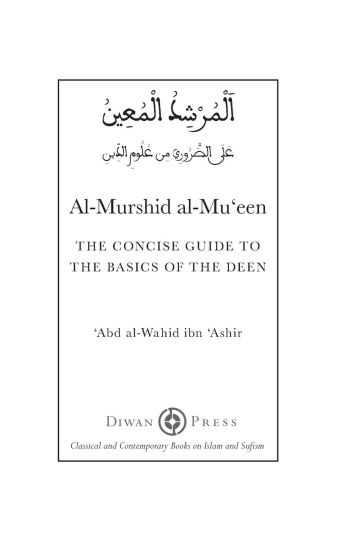

"It is the most comprehensive and useful abridgement to be found in Mālikī fiqh." (Farīd al-Anṣārī Mafhūm al-'Ālimiyyah)The works of Ibn Juzayy partake of a particular miraculous quality of the last of the Messengers of Allah, may Allah bless him and them and grant them peace: they unite concision and comprehensiveness.Comprehensively, the author presents both the range of judgments within the school of the People of Madīnah as well as the range of judgments among the madhhabs at large, but with concision in a single modest Arabic volume. He covers not only 'aqīdah and 'ibādāt but also mu'āmalāt, other matters of taṣawwuf, and yet others pertaining to history, i.e. the sīrah of the Messenger ﷺ, the khulafā' and Andalus.His main concern is to say with clarity what the dīn IS, and then to note the legitimate differences, and sometimes the illegitimate ones in order to dismiss them. To show the spectrum of valid differences is vitally important in the age of literalism that says "tell me the ṣaḥīḥ hadith so that I can act on it" or in its Mālikī version, "tell me the well-known judgment (mashhūr)." The author carefully lets the reader know the well-known judgments (mashhūr) but sets them within the spectrum of valid judgments from the luminaries among Mālik's students, such as Ibn al-Qāsim, Ashhab, Aṣbagh, Ibn Wahb and Ibn al-Mājishūn et al, who, it is well to remember, may simply be acting on what they learnt from Mālik himself.Following Ibn Juzayy's own division of his work into two parts, we here publish Volume 1 containing the chapters on 'aqīdah and 'ibādāt, reserving mu'āmalāt for Volume 2.Ibn Juzayy was Abu-l-Qāsim Muḥammad ibn Aḥmad ibn Muḥammad ibn 'Abdullāh ibn Yaḥyā ibn 'Abd ar-Raḥmān ibn Yūsuf ibn Sa'īd ibn Juzayy al-Kalbī. He was born on the 19th Rabī' al-Awwal in 693 AH/1294 CE. He mastered the essential sciences of the dīn, and wrote significant works on tafsīr, hadith, 'aqīdah, taṣawwuf, qirā'āt (recitations and rescensions of the Qur'ān) and uṣūl al-fiqh. He died as a shahīd in the Battle of Tareef on Monday 7th Jumāda-l-Ūlā 741 AH/30th October 1340 CE.Dr. Asadullah Yate (Cantab.) has translated works from Arabic, Persian, German and French, and, in collaboration with others, from Turkish. He teaches Arabic and Fiqh at the Weimar Institute, and is Imam al-Khateeb at the mosque of Stralsund, Germany.

"It is the most comprehensive and useful abridgement to be found in Mālikī fiqh." (Farīd al-Anṣārī Mafhūm al-'Ālimiyyah)The works of Ibn Juzayy partake of a particular miraculous quality of the last of the Messengers of Allah, may Allah bless him and them and grant them peace: they unite concision and comprehensiveness.Comprehensively, the author presents both the range of judgments within the school of the People of Madīnah as well as the range of judgments among the madhhabs at large, but with concision in a single modest Arabic volume. He covers not only 'aqīdah and 'ibādāt but also mu'āmalāt, other matters of taṣawwuf, and yet others pertaining to history, i.e. the sīrah of the Messenger ﷺ, the khulafā' and Andalus.His main concern is to say with clarity what the dīn IS, and then to note the legitimate differences, and sometimes the illegitimate ones in order to dismiss them. To show the spectrum of valid differences is vitally important in the age of literalism that says "tell me the ṣaḥīḥ hadith so that I can act on it" or in its Mālikī version, "tell me the well-known judgment (mashhūr)." The author carefully lets the reader know the well-known judgments (mashhūr) but sets them within the spectrum of valid judgments from the luminaries among Mālik's students, such as Ibn al-Qāsim, Ashhab, Aṣbagh, Ibn Wahb and Ibn al-Mājishūn et al, who, it is well to remember, may simply be acting on what they learnt from Mālik himself.Following Ibn Juzayy's own division of his work into two parts, we here publish Volume 1 containing the chapters on 'aqīdah and 'ibādāt, reserving mu'āmalāt for Volume 2.Ibn Juzayy was Abu-l-Qāsim Muḥammad ibn Aḥmad ibn Muḥammad ibn 'Abdullāh ibn Yaḥyā ibn 'Abd ar-Raḥmān ibn Yūsuf ibn Sa'īd ibn Juzayy al-Kalbī. He was born on the 19th Rabī' al-Awwal in 693 AH/1294 CE. He mastered the essential sciences of the dīn, and wrote significant works on tafsīr, hadith, 'aqīdah, taṣawwuf, qirā'āt (recitations and rescensions of the Qur'ān) and uṣūl al-fiqh. He died as a shahīd in the Battle of Tareef on Monday 7th Jumāda-l-Ūlā 741 AH/30th October 1340 CE.Dr. Asadullah Yate (Cantab.) has translated works from Arabic, Persian, German and French, and, in collaboration with others, from Turkish. He teaches Arabic and Fiqh at the Weimar Institute, and is Imam al-Khateeb at the mosque of Stralsund, Germany.




Al-Khor Island
Moonrise Press Ltd
2014
nidottu

La emocionante novela historica de Howard Headworth nos lleva a los anos de 1480 en Espana. Para los espanoles es el amanecer de la epoca dorada del pais. Para los moros de Al-Andalus en el sur, es el principio de una cosecha amarga. Y lejos al oeste, un Nuevo Mundo hace senas.....Descripciones gloriosas de batalles y conflictos, los horrores de la Inquisicion Espanol, el trazo de acontecimientos historicos llevando a la entrada de los Reyes Catolicos en Granada en 1492, una panoplia de caracteres, perfiles de las tradiciones y habilidades de los campesinos musulmanes en Al-Andalus, y finalmente el primer viaje de Cristobal Colon a las Indias, hacen de este libro un singular tesoro.Howard Headworth vive en Almeria, Espana, durante veinte anos. Nacio en Gales y estudio geologia en la universidad alli y en Londres. Usa su gran experiencia como director cientifico asi como su pasion para la historia de su pais adoptivo en esta novela historica.
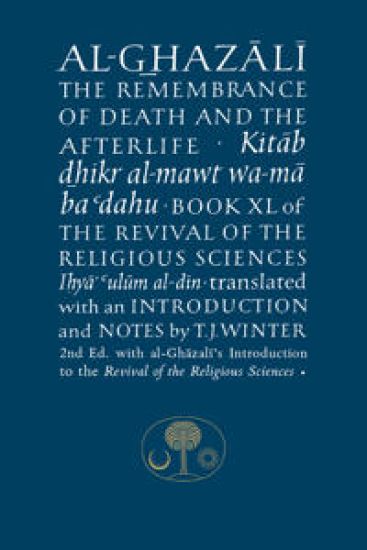
Al-Ghazali on the Remembrance of Death and the Afterlife
Abu Hamid al-Ghazali
The Islamic Texts Society
2015
sidottu
This is the first English translation of a key section of al-Ghazali's Revival of the Religious Sciences, (Ihya' 'Ulum al-Din), widely regarded as the greatest work of Muslim spirituality. Its theme is of universal interest: death, and the life to come. After expounding his Sufi philosophy of death, and showing the importance of the contemplation of human morality to the mystical way of self-purification, al-Ghazali's takes his readers through the stages of the future life: the vision of the Angels of the Grave, the Resurrection, the Intercession of the Prophets, and finally, the torments of Hell, the delights of Paradise, and-for the elect-the beatific vision of God's Countenance. In this new edition, the Islamic Texts Society has included a translation of Imam Ghazali's own Introduction to the Revival of the Religious Sciences which gives the reasons that caused him to write the work, the structure of the whole of the Revival and places each of the chapters in the context of the others.

Al-Ghazali on the Remembrance of Death and the Afterlife
Abu Hamid al-Ghazali
The Islamic Texts Society
2015
nidottu
This is the first English translation of a key section of al-Ghazali's Revival of the Religious Sciences, (Ihya' 'Ulum al-Din), widely regarded as the greatest work of Muslim spirituality. Its theme is of universal interest: death, and the life to come. After expounding his Sufi philosophy of death, and showing the importance of the contemplation of human morality to the mystical way of self-purification, al-Ghazali's takes his readers through the stages of the future life: the vision of the Angels of the Grave, the Resurrection, the Intercession of the Prophets, and finally, the torments of Hell, the delights of Paradise, and-for the elect-the beatific vision of God's Countenance. In this new edition, the Islamic Texts Society has included a translation of Imam Ghazali's own Introduction to the Revival of the Religious Sciences which gives the reasons that caused him to write the work, the structure of the whole of the Revival and places each of the chapters in the context of the others.

Al-Ghazali on the Manners Relating to Eating
Abu Hamid al-Ghazali
The Islamic Texts Society
2015
sidottu
Al-Ghazali on the Manners Relating to Eating is the eleventh chapter of The Revival of the Religious Sciences which is widely regarded as the greatest work of Muslim spirituality. This volume begins the section dealing with man and society, and the norms of daily life. While concentrating on a daily activity, eating, al-Ghazali presents the importance of aligning every aspect of one's life with religion and spirituality. Referring extensively to the example of the Prophet and to that of the early Sufis, al-Ghazali illustrates how the simple activity of eating can encourage numerous virtues which are themselves necessary for the remainder of the spiritual life. The sections of Al-Ghazali on the Manners Relating to Eating are divided into what a person must uphold when eating alone, how a person must conduct himself when eating in company and the manners of hospitality. Through these sections, al-Ghazali also discusses lawful and unlawful foods and practices, cleanliness, fasting, general health issues, and the blessings of contentment with little and generosity.In this new edition, the Islamic Texts Society has included a translation of Imam Ghazali's own Introduction to the Revival of the Religious Sciences which gives the reasons that caused him to write the work, the structure of the whole of the Revival and places each of the chapters in the context of the others.

Al-Ghazali on the Manners Relating to Eating
Abu Hamid al-Ghazali
The Islamic Texts Society
2015
nidottu
"Al-Ghazali on the Manners Relating to Eating" is the eleventh chapter of the "Revival of the Religious Sciences" (Ihya Ulum al-Din), which is widely regarded as the greatest work of Muslim spirituality. In "Al-Ghazali on the Manners Relating to Eating", Abu Hamid al-Ghazali helps to bring to light the religious and spiritual dimensions of one of the most basic of human needs: eating and the conduct connected with it.---First, Ghazali discusses what a person must uphold when eating by himself: that the food is lawful, that both the person and the surroundings should be clean, that one must be content with what is available, and how the person should conduct himself while eating and after eating. Ghazali then proceeds to discuss eating in company and says that to all the above should be added the necessity of courtesy, conversation and the proper presentation of food. Finally, Ghazali expounds the virtues of hospitality and generosity and the conduct of the host as well as that of the guest. Other topics that are discussed are: abstention from food, fasting and general health. Whilst the focus of this chapter of the "Revival" is upon the question of eating, Ghazali also presents the importance of aligning every aspect of one's life with religion and spirituality. Referring extensively to the example of the Prophet and to that of the early Sufis, Ghazali illustrates how the simple activity of eating can encourage numerous virtues that are themselves necessary for the remainder of the spiritual life.---In this new edition, the Islamic Texts Society has included the translation of Abu Hamid al-Ghazali's own Introduction to the "Revival of the Religious Sciences" which gives the reasons that caused him to write the work, the structure of the whole of the "Revival" and places each of the chapters in the context of the others.
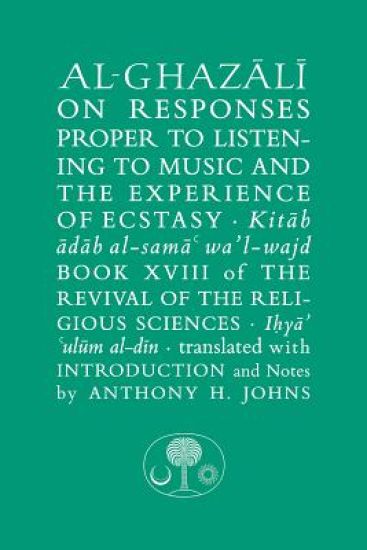
Al-Ghazali on Responses Proper to Listening to Music and the Experience of Ecstasy
Abu Hamid al-Ghazali
The Islamic Texts Society
2025
pokkari

Al-Ghazali on the Condemnation of Pride and Self-Admiration
Abu Hamid al-Ghazali
The Islamic Texts Society
2018
sidottu
The Condemnation of Pride and Self-Admiration is the twenty-ninth chapter of The Revival of the Religious Sciences, a monumental work of classical Islam written by the theologian-mystic Abu Hamid Muhammad al-Ghazali. Perhaps the most important chapter in the whole of Revival, The Condemnation of Pride and Self-Admiration delves into the fundamental spiritual ailments and major impediments of the soul, namely pride and self-admiration. In Part One, Ghazali focuses on pride, firstly by showing how the Qur'an condemns it, then by demonstrating what pride is and what its symptoms are, how pride manifests outwardly, as well as the seven causes of pride, the root cause being self-admiration. In seeking ways to cure the soul of pride, Ghazali presents the virtue of humility as the spiritual virtue par excellence; he offers examples of true humility, of false humility, and the manner by which the seven causes of pride can be uprooted. In Part Two, Ghazali hones in on the root cause of pride: self-admiration. As with pride, Ghazali defines self-admiration, shows the various ways it manifests inwardly, how it causes negligence, delusion and complacency, how each of these can be remedied.Just as humility is recognised as the virtue par excellence, pride is recognised as the vice par excellence; and this by all religions. The Condemnation of Pride and Self-Admiration is therefore a genuine contribution to the field of virtue ethics and will be of interest to all those engaged in the religious and spiritual life.

Al-Ghazali on the Condemnation of Pride and Self-Admiration
Abu Hamid Al-Ghazali
The Islamic Texts Society
2018
nidottu
The Condemnation of Pride and Self-Admiration is the twenty-ninth chapter of The Revival of the Religious Sciences, a monumental work of classical Islam written by the theologian-mystic Abu Hamid Muhammad al-Ghazali. Perhaps the most important chapter in the whole of Revival, The Condemnation of Pride and Self-Admiration delves into the fundamental spiritual ailments and major impediments of the soul, namely pride and self-admiration. In Part One, Ghazali focuses on pride, firstly by showing how the Qur'an condemns it, then by demonstrating what pride is and what its symptoms are, how pride manifests outwardly, as well as the seven causes of pride, the root cause being self-admiration. In seeking ways to cure the soul of pride, Ghazali presents the virtue of humility as the spiritual virtue par excellence; he offers examples of true humility, of false humility, and the manner by which the seven causes of pride can be uprooted. In Part Two, Ghazali hones in on the root cause of pride: self-admiration. As with pride, Ghazali defines self-admiration, shows the various ways it manifests inwardly, how it causes negligence, delusion and complacency, how each of these can be remedied.Just as humility is recognised as the virtue par excellence, pride is recognised as the vice par excellence; and this by all religions. The Condemnation of Pride and Self-Admiration is therefore a genuine contribution to the field of virtue ethics and will be of interest to all those engaged in the religious and spiritual life.

An important part of The Revival of the Religious Sciences, the Book of PatienceThankfulness is a detailed discussion of the two qualities central to all faiths. Ghazali defines patience and thankfulness, their different forms, degrees and applications. And, he discusses the meaning of tribulation and blessings in connection with the virtues.

Al-Ghazali on Love, Longing, Intimacy & Contentment
Abu Hamid al-Ghazali
The Islamic Texts Society
2016
nidottu
"Al-Ghazali on Love, Longing, Intimacy and Contentment" is the thirty-sixth chapter of Abu Hamid al-Ghazali's "Revival of the Religious Sciences" (Ihya Ulum al-Din), which is widely regarded as the greatest work of Muslim spirituality. "Al-Ghazali on Love, Longing, Intimacy and Contentment" is of fundamental importance in the history of Islamic thought and in the development of Sufism, being the first treatise to establish not merely the possibility but the necessity for the love of God.---In "Al-Ghazali on Love, Longing, Intimacy and Contentment", Ghazali argues that all the virtues and spiritual stages that precede love, like repentance, patience and thankfulness, lead to love; and all the spiritual stages that follow on from love are a result of it. Using proof texts from the Qur'an, the Traditions of the Prophet Muhammad and Sufi precepts, Ghazali succeeds in marshalling forceful arguments to make his case. Out of Ghazali's pioneering treatment would emerge not only new trends in Sufi theory and practice, but an entire body of mystical poetry including that of the great Persian poets Rumi and Hafiz.---Professor Eric Ormsby's fully annotated translation brings out all the beauty and lyricism of the text. The translation is preceded by an extensive introduction which sets the work in its historical and spiritual context.---In this new edition, the Islamic Texts Society has included the translation of Abu Hamid al-Ghazali's own Introduction to the "Revival of the Religious Sciences" which gives the reasons that caused him to write the work, the structure of the whole of the "Revival" and places each of the chapters in the context of the others.
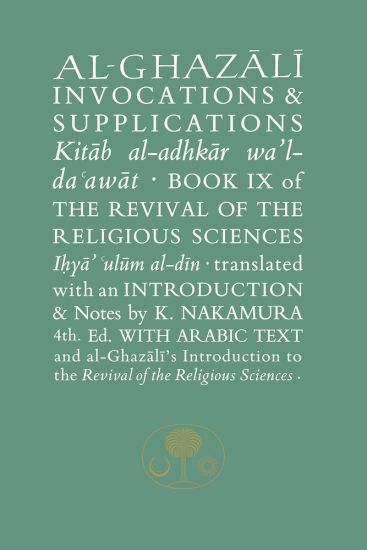
Al-Ghazali on Invocations and Supplications
Abu Hamid al-Ghazali
The Islamic Texts Society
2016
nidottu
The 4th edition of Nakamura's acclaimed translation of Book IX of the "Revival of the Religious Sciences" now including Ghazali's Introduction. Probably the most widely read compendium of prayers in the Muslim world. Popular for its comprehensiveness and for its exploration of the psychological and spiritual effects of prayer. With Arabic text.
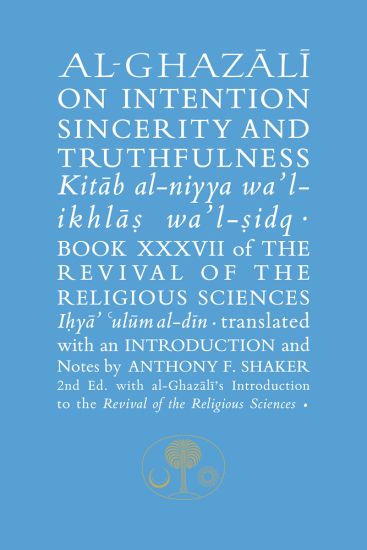
Al-Ghazali on Intention, Sincerity and Truthfulness
Abu Hamid al-Ghazali
The Islamic Texts Society
2016
nidottu
Al-Ghazali on Intention, Sincerity & Truthfulness is the thirty-seventh chapter of the Revival of the Religious Sciences. It falls in the section dealing with the virtues. Here Ghazali deals with the very important subject of intention which is of crucial importance in Islam. He asks: 'How can someone ignorant of the meaning of intention verify his own intention; or how can someone ignorant of the meaning of sincerity verify his own sincerity; or how can someone sincerely claim truthfulness if he has not verified its meaning?' In the Book of Intention, Sincerity & Truthfulness, Ghazali gives a response to each of these questions by expounding the reality and levels of intention, sincerity and truthfulness, those acts which affirm them and those acts which mar them. As in all his writings, Ghazali bases his arguments on the Qur'an, the example of the Prophet and the sayings of numerous scholars and Sufis.