Kirjojen hintavertailu. Mukana 11 518 949 kirjaa ja 12 kauppaa.

Kirjahaku

Etsi kirjoja tekijän nimen, kirjan nimen tai ISBN:n perusteella.

1000 tulosta hakusanalla Andrew Power

Andrew Warde and His Descendants: 1597-1910 (1910)

Andrew Warde and His Descendants: 1597-1910 (1910)

George Kemp Ward

Literary Licensing, LLC
2014
sidottu
Andrew Warde And His Descendants: 1597-1910 is a genealogical book written by George Kemp Ward in 1910. The book traces the lineage of Andrew Warde, an English immigrant who settled in Connecticut in the 17th century, and his descendants up until the early 20th century. The book begins with a brief history of Andrew Warde's life and his journey to America, including his involvement in the founding of the town of Fairfield, Connecticut. From there, the book delves into the genealogy of Andrew Warde's descendants, providing detailed information on each generation and their respective families.The book is divided into several sections, each focusing on a different branch of the Warde family. These sections include information on the Warde, Ward, and Warden families, as well as related families such as the Burr, Beers, and Sherwood families.Throughout the book, Ward provides extensive genealogical information, including birth and death dates, marriage records, and other historical details. He also includes photographs and illustrations of family members and important locations, such as the Warde homestead in Fairfield.Overall, Andrew Warde And His Descendants: 1597-1910 is a comprehensive genealogical resource for anyone interested in tracing their lineage back to this prominent early American family.This Is A New Release Of The Original 1910 Edition.This scarce antiquarian book is a facsimile reprint of the old original and may contain some imperfections such as library marks and notations. Because we believe this work is culturally important, we have made it available as part of our commitment for protecting, preserving, and promoting the world's literature in affordable, high quality, modern editions, that are true to their original work.
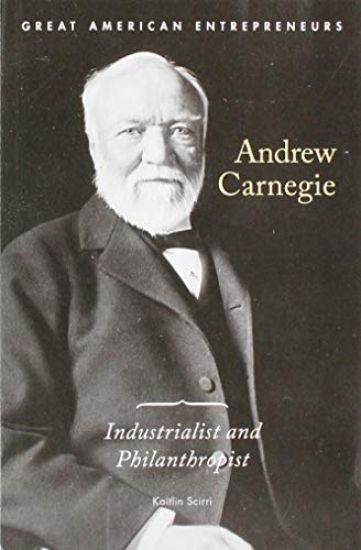
Andrew Carnegie: Industrialist and Philanthropist

Andrew Carnegie: Industrialist and Philanthropist

Kaitlin Scirri

Cavendish Square Publishing
2019
nidottu
Industrialist Andrew Carnegie achieved great financial success in the steel industry in nineteenth-century America. An immigrant from Scotland, Carnegie came to America as a boy and worked hard to become one of the wealthiest men in the world. After retiring from the steel industry, he gave his fortune away, believing the wealthy had an obligation to those less fortunate. Students will follow Carnegie's rags-to-riches story, learning about the industrialization of America and Carnegie's most influential works and achievements. They will also learn of Carnegie's business strategies, how he overcame obstacles and criticism, and his philanthropic work that continues through many institutes and organizations today.
Narrative and Writings of Andrew Jackson, of Kentucky

Narrative and Writings of Andrew Jackson, of Kentucky

Andrew Jackson

Createspace Independent Publishing Platform
2014
nidottu
The United States of America has had many presidents that Americans agree were either great or awful, while some fall into a mediocre category of irrelevance. In many cases a national consensus has been reached on men like Abraham Lincoln and James Buchanan. But the president with the most controversial legacy might be "Old Hickory", Andrew Jackson. In his lifetime, Jackson came to represent what middle class Americans viewed as the quintessential American. Jackson had a modest upbringing, served as a teenager during the American Revolution, became a war hero during the War of 1812, and championed populism and the common American during his presidency. He also embodied courage and manliness, famously carrying a bullet from a duel in his body for decades until his death. On the other hand, critics continue to charge that Jackson's legacy is irreversibly stained by his stances on slavery and Native Americans. Jackson opposed the idea of secession but helped keep the antebellum slave system in place, but he is most notorious for his forcible removal of thousands of Native Americans, the best known being the Cherokees' "Trail of Tears". When the Supreme Court ruled that the state of Georgia could not impose laws upon the Cherokees, Jackson is popularly quoted (though apocryphally) as dismissing the decision, "John Marshall has made his decision; now let him enforce it." With Jackson as controversial today as ever before, the dueling narratives over his legacy often overshadow the man.
Andrew's Abominable Christmas: A Color-With-Me Adventure

Andrew's Abominable Christmas: A Color-With-Me Adventure

Keith White

Createspace Independent Publishing Platform
2014
nidottu
It's an abominable Christmas Andrew thought it was just going to be another ordinary Christmas when he and his family went to pick out a tree. Little did he know, a new friend would follow him home and together they would go on a brand new "Color-With-Me" adventure Grab your crayons and get ready for some fun
Andrew Jackson: A Brief History of Old Hickory

Andrew Jackson: A Brief History of Old Hickory

Nicholas L. Vulich

Createspace Independent Publishing Platform
2015
nidottu
Andrew Jackson has the dubious honor of being the first President to have an assassination attempt made upon his life. Picture this: Sixty-three year old Andrew Jackson is walking across the Capitol Rotunda. Richard Lawrence, an unemployed house painter moves to the front of the crowd. He fires two pistol shots into the President. By luck, both pistols misfire. The aging Jackson charges the attempted assassin, beating him to the ground with his cane. Jackson was no stranger to death or weapons. In his lifetime he fought three duels, faced down the Creek Indians, and ultimately fought the final battle of the War of 1812 at New Orleans. Thomas Jefferson wrote: "I feel very much alarmed at the prospect of seeing General Jackson President. He is one of the most unfit men I know of for the place. He has had very little respect for laws or constitutions, and is, in fact, an able military chief. His passions are terrible. He has been much tried since I knew him, but he is a dangerous man." During the 1828 Presidential campaign Jackson's opponents took to calling him "jackass." Being the bad-ass he was Jackson liked the idea, and used it as his own for a while. Years later the donkey was adopted as the symbol of the Democratic Party. This short - 40 - page illustrated guide will tell you all you need to know to understand the Jacksonian Era in America... even if you know absolutely nothing about the South Carolina Nullifiers, the National Bank Crisis, or Indian Removal. In less than an hour, you'll learn all you need to know to impress your friends about Andrew Jackson, the Battle of New Orleans, the Creek and Seminole Indian Wars, and more...