Kirjojen hintavertailu. Mukana 11 342 296 kirjaa ja 12 kauppaa.

Kirjahaku

Etsi kirjoja tekijän nimen, kirjan nimen tai ISBN:n perusteella.

1000 tulosta hakusanalla Content Team Audiolearn

Oxford Picture Dictionary Content Areas for Kids: Reproducibles Collection
Accelerate your students' Academic Language Development with the second edition of the Oxford Picture Dictionary for the Content Areas for Kids program. This research-based program: * Is flexible enough to be used in any teaching situation * Provides explicit instruction through research-based routines by Kate Kinsella * Makes vocabulary with the academic language learners need to be successful * Is standards based and aligned to the Common Core State Standards and other leading research on what works most effectively
Oxford Picture Dictionary Content Area for Kids Classroom Set Pack [With CDROM and CD (Audio)]
Accelerate your students' Academic Language Development with the second edition of the Oxford Picture Dictionary for the Content Areas for Kids program. This research-based program: Is flexible enough to be used in any teaching situation. Provides explicit instruction through research-based routines by Kate Kinsella. Makes vocabulary with the academic language learners need to be successful. Is standards based and aligned to the Common Core State Standards and other leading research on what works most effectively.
Nonideal Theory and Content Externalism

Nonideal Theory and Content Externalism

Jeff Engelhardt

OXFORD UNIVERSITY PRESS INC
2024
sidottu
This book charges that just about every philosophical theory of mind or language developed over the past 50 years in the West is systematically inaccurate. Systemic oppression has influenced the processes that theories of mind or language purport to identify; however, that same systemic oppression has also made it so that most middle-to-upper class White men (including most philosophers of mind or language) are ignorant of systemic oppression. Consequently, most theories of mind or language are systematically inaccurate because they fail to account for the influences of systemic oppression. Philosopher Jeff Engelhardt argues for the de-idealization of two influential theories in the philosophy of mind and language--social externalism and objective type externalism--and considers some consequences of the de-idealization project. Following the work of Charles Mills, Engelhardt argues that ideal theories adopt oppression-obscuring assumptions while nonideal theories avoid them (or at least try to). Ideal theories assume that language users are basically equal, and that social institutions and structures are basically just, but scholarship on Western social relations, institutions, and structures shows that in fact each of these is systematically influenced by oppression. Consequently, ideal theories tend to be systematically inaccurate. Moreover, since oppression systematically produces ignorance of systemic oppression, such systematically inaccurate theories are likely the norm rather than the exception. Engelhardt shows that once we've shown that oppression systematically influences the processes that determine linguistic meanings (according to content externalism), then we have reason to expand our notion of hermeneutical injustice, we have evidence that hermeneutical injustice occurs systematically, and we have grounds for expanding discussions of conceptual engineering to include questions about engineering the processes that determine concepts, not just concepts themselves.
Nonideal Theory and Content Externalism

Nonideal Theory and Content Externalism

Jeff Engelhardt

OXFORD UNIVERSITY PRESS INC
2024
nidottu
This book charges that just about every philosophical theory of mind or language developed over the past 50 years in the West is systematically inaccurate. Systemic oppression has influenced the processes that theories of mind or language purport to identify; however, that same systemic oppression has also made it so that most middle-to-upper class White men (including most philosophers of mind or language) are ignorant of systemic oppression. Consequently, most theories of mind or language are systematically inaccurate because they fail to account for the influences of systemic oppression. Philosopher Jeff Engelhardt argues for the de-idealization of two influential theories in the philosophy of mind and language--social externalism and objective type externalism--and considers some consequences of the de-idealization project. Following the work of Charles Mills, Engelhardt argues that ideal theories adopt oppression-obscuring assumptions while nonideal theories avoid them (or at least try to). Ideal theories assume that language users are basically equal, and that social institutions and structures are basically just, but scholarship on Western social relations, institutions, and structures shows that in fact each of these is systematically influenced by oppression. Consequently, ideal theories tend to be systematically inaccurate. Moreover, since oppression systematically produces ignorance of systemic oppression, such systematically inaccurate theories are likely the norm rather than the exception. Engelhardt shows that once we've shown that oppression systematically influences the processes that determine linguistic meanings (according to content externalism), then we have reason to expand our notion of hermeneutical injustice, we have evidence that hermeneutical injustice occurs systematically, and we have grounds for expanding discussions of conceptual engineering to include questions about engineering the processes that determine concepts, not just concepts themselves.
The Land of Lost Content

The Land of Lost Content

Rosemary Lloyd

Clarendon Press
1992
sidottu
The Land of Lost Content explores the ways in which nineteenth-century French writers represented childhood and children in their work. Rosemary Lloyd considers poetry, fiction, autobiographies, and letters to trace the ways in which a range of writers gradually responded to changing concepts of the self. After a study of central problems and recurrent motifs encountered in autobiography, a chronological survey of fictional texts shows the development of a series of myths of childhood successively debunked by later writers, who in turn create their own myths. Further chapters explore such central themes as reading, nature, and school, and examine the evolution of a literature in which the child becomes the main protagonist, as well as addressing the question of whether the child figure is merely used as a reductive stereotype. This is the first study of childhood in nineteenth-century France to range from autobiography through major fiction to works for children, and to use as its primary focus the narratological difficulties of recreating childhood.
Context and Content

Context and Content

Robert C. Stalnaker

Clarendon Press
1999
nidottu
In Context and Content Robert Stalnaker develops a philosophical picture of the nature of speech and thought and the relations between them. Two themes in particular run through these collected essays: the role that the context in which speech takes place plays in accounting for the way language is used to express thought, and the role of the external environment in determining the contents of our thoughts. Stalnaker argues against the widespread assumption of the priority of linguistic over mental representation, which he suggests has had a distorting influence on our understanding. The first part of the book develops a framework for representing contexts and the way they interact with the interpretation of what is said in them. This framework is used to help to explain a range of linguistic phenomena concerning presupposition and assertion, conditional statements, the attribution of beliefs, and the use of names, descriptions, and pronouns to refer. Stalnaker then draws out the conception of thought and its content that is implicit in this framework. He defends externalism about thought--the assumption that our thoughts have the contents they have in virtue of the way we are situated in the world--and explores the role of linguistic action and linguistic structure in determining the contents of our thoughts. Context and Content offers philosophers and cognitive scientists a summation of Stalnaker's important and influential work in this area. His new introduction to the volume gives an overview of this work and offers a convenient way in for those who are new to it. The Oxford Cognitive Science series is a new forum for the best contemporary work in this flourishing field, where various disciplines--cognitive psychology, philosophy, linguistics, cognitive neuroscience, and computational theory--join forces in the investigation of thought, awareness, understanding, and associated workings of the mind. Each book constitutes an original contribution to its subject, but will be accessible beyond the ranks of specialists, so as to reach a broad interdisciplinary readership. The series will be carefully shaped and steered with the aim of representing the most important developments in the field and bringing together its constituent disciplines.
Context and Content

Context and Content

Robert C. Stalnaker

Clarendon Press
1999
sidottu
In Context and Content Robert Stalnaker develops a philosophical picture of the nature of speech and thought and the relations between them. Two themes in particular run through these collected essays: the role that the context in which speech takes place plays in accounting for the way language is used to express thought, and the role of the external environment in determining the contents of our thoughts. Stalnaker argues against the widespread assumption of the priority of linguistic over mental representation, which he suggests has had a distorting influence on our understanding. The first part of the book develops a framework for representing contexts and the way they interact with the interpretation of what is said in them. This framework is used to help to explain a range of linguistic phenomena concerning presupposition and assertion, conditional statements, the attribution of beliefs, and the use of names, descriptions, and pronouns to refer. Stalnaker then draws out the conception of thought and its content that is implicit in this framework. He defends externalism about thought--the assumption that our thoughts have the contents they have in virtue of the way we are situated in the world--and explores the role of linguistic action and linguistic structure in determining the contents of our thoughts. Context and Content offers philosophers and cognitive scientists a summation of Stalnaker's important and influential work in this area. His new introduction to the volume gives an overview of this work and offers a convenient way in for those who are new to it. The Oxford Cognitive Science series is a new forum for the best contemporary work in this flourishing field, where various disciplines--cognitive psychology, philosophy, linguistics, cognitive neuroscience, and computational theory--join forces in the investigation of thought, awareness, understanding, and associated workings of the mind. Each book constitutes an original contribution to its subject, but will be accessible beyond the ranks of specialists, so as to reach a broad interdisciplinary readership. The series will be carefully shaped and steered with the aim of representing the most important developments in the field and bringing together its constituent disciplines.
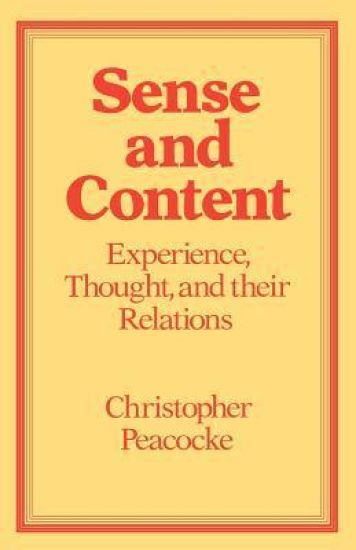
Sense and Content

Sense and Content

Christopher Peacocke

Oxford University Press
1983
nidottu
Peacocke argues that the propositional content of mental states can only be understood in relation to perceptual experience and shows that not all experience is representational.
Sense and Content

Sense and Content

Christopher Peacocke

Oxford University Press
1983
sidottu
The topics of this book lie in the intersection of three areas: the philosophy of mind, the theory of meaning and content, and the philosophy of psychology. The book grew out of a desire to treat the nature of the content of psychological states in much greater detail than was attempted in Holistic Explanation. The present work is based on material presented in classes at Oxford University in the years 1979 to 1982.
Quality and Content

Quality and Content

Joseph Levine

Oxford University Press
2018
sidottu
Joseph Levine draws together a series of essays in which he has developed his distinctive approach to philosophy of mind. He explores such topics as the "phenomenal concept strategy" to defend materialism from anti-materialist intuitions, the doctrine of representationalism about phenomenal character, the modal argument against materialism, the nature of demonstrative thought, and cognitive phenomenology. Levine argues that the phenomenal concept strategy cannot work and that representationalism has certain fatal flaws, at least if it is to be joined to a materialist metaphysics. On the other hand, he defends materialism from the modal argument, contending that it relies on a questionable conflation of semantic and metaphysical issues. Levine also provides a naturalistic theory of demonstrative thought, criticizing certain philosophical arguments involving that notion in the process. All of the essays in some way respond to various materialist attempts to close the "explanatory gap" as well as outline a different conception of conscious experience that would accommodate the gap. Levine connects his work with related themes in contemporary psychology and with such hot philosophical topics as cognitive phenomenology.
Does Perception Have Content?

Does Perception Have Content?

Oxford University Press Inc
2014
sidottu
Within the contemporary philosophical debates over the nature of perception, the question of whether perception has content in the first place recently has become a focus of discussion. The most common view is that it does, but a number of philosophers have questioned this claim. The issue immediately raises a number of related questions. What does it mean to say that perception has content? Does perception have more than one kind of content? Does perceptual content derive from the content of beliefs or judgments? Should perceptual content be understood in terms of accuracy conditions? Is naive realism compatible with holding that perception has content? This volume brings together philosophers representing many different perspectives to address these and other central questions in the philosophy of perception.
Expanding a Digital Content Management System
Building large integrated content management systems is a daunting task and there is little guidance for the implementation process for the mid-level manager. There are thousands of home grown or old standalone systems in need of upgrading and expanding to keep up with the growing challenge of digital media. This book allows the non-technical executive to understand the key concepts and issues. It covers the technical process and business aspects of expanding a system.
A Theory of Content and Other Essays

A Theory of Content and Other Essays

Jerry A. Fodor

Bradford Books
1992
pokkari
This collection of new and previously published essays reflects the major research and thought of one of today's preeminent philosophers of mind.This collection of new and previously published essays reflects the major research and thought of one of today's preeminent philosophers of mind. The first seven essays are philosophical pieces that focus on mental representation and the foundations of intentionality; these are followed by four psychological essays on cognitive architecture. In his eloquent introduction Fodor shows how the two areas are thematically united and epistemologically related, highlighting his concern in finding alternatives to holistic accounts of mental content. Fodor's philosophical essays develop an informational view of semantics that offers the possibility of atomism about meaning; his psychological essays present a modular view of cognitive architecture that offers the possibility of atomism about perception. These ideas, he points out, are joined in epistemology in way that the books last essay begins to explore. Taken together, the essays represent Fodor's lively attempt to knock the underpinnings from the currently popular relativism to show that the arguments for semantic and psychological holism are insubstantial and that important alternatives exist to be explored.
Managing Enterprise Content

Managing Enterprise Content

Ann Rockley; Charles Cooper

New Riders Publishing
2012
nidottu
Smartphones, eBook readers, and tablet computers like the Apple iPad have forever changed the way people access and interact with content. Your customers expect the content you provide them to be adaptive --responding to the device, their location, their situation, and their personalized needs. Authors Ann Rockley and Charles Cooper provide insights and guidelines that will help you develop a unified content strategy—a repeatable, systematic plan that can help you reach your customers, anytime, anywhere, on any device. This up-to-date new edition of Managing Enterprise Content helps you: Determine business requirements Build your vision Design content that adapts to any device Develop content models, metadata, and workflow Put content governance in place Adapt to new and changed roles Identify tools requirements With this book you’ll learn to design adaptable content that frees you from the tyranny of an ever increasing array of devices.
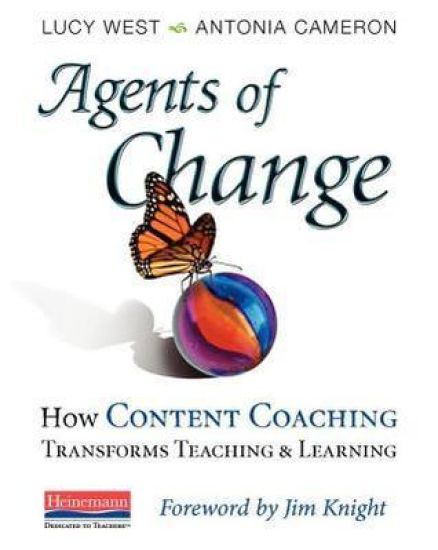
Agents of Change: How Content Coaching Transforms Teaching and Learning

Agents of Change: How Content Coaching Transforms Teaching and Learning

Antonia Cameron; Lucy West

HEINEMANN EDUCATIONAL BOOKS
2013
nidottu
"If education is to be the learning profession, then we must walk the walk of learners. The bottom line is not perfection, constant success, and high test scores. The bottom line is creating a culture in which learning, innovation, and collaboration are the norms--a learning culture. When adults in schools create such environments, children will thrive." --Lucy West and Antonia Cameron How can teacher leaders cultivate an adult learning environment that will upgrade teaching capacity system-wide, and ultimately improve student learning in every classroom? Lucy West and Toni Cameron turn decades of experience designing and implementing coaching initiatives into a practical resource for transforming school culture and inspiring true learning at every level. Agents of Change provides coaches, administrators, and teacher leaders with specific techniques, tools, and strategies for working with individual classroom teachers to plan and co-teach lessons, reflect on them afterwards, and find evidence of student learning. Lucy and Toni argue that when we infuse rich learning conversations into the professional discourse via coaching, study lessons, and regular meeting times for professionals to work collaboratively, we're able to examine what it takes on a day to day basis to reach every student in our classrooms. The transformative potential of content coaching to improve both teacher and student learning on a school-wide level has never been more clear. Purchase includes free access to an online video case study. Read a sample chapter
Texts and Lessons for Content-Area Reading: With More Than 75 Articles from the New York Times, Rolling Stone, the Washingto N Post, Car and Driv
"To have any hope of kids investing fully in the subject matter, we have to start by evoking their curiosity and get them interested in the topic. Engaging the students can't wait. If we wait for the fun stuff that might pop up later, the kids will have already jumped ship." --Harvey "Smokey" Daniels and Nancy Steineke Today we're all expected to be "teachers of reading"--no matter what our subject area. With Texts and Lessons for Content-Area Reading, Harvey "Smokey" Daniels and Nancy Steineke support content-area and language-arts teachers alike by pairing more than 75 short, kid-tested reproducible nonfiction texts with 33 simple, ready-to-go lessons that deepen comprehension and support effective collaboration. In the same teacher-friendly, classroom-wise voices that made Subjects Matter and Content-Area Writing bestsellers, Daniels and Steineke prove that with the right materials and the right lessons, you can turn your kids into much better readers in your subject field by showing: how proficient readers think how skillful collaborators act how to use quick and engaging activities that add to, not steal from subject-matter learning. Each real-world text was chosen for its subject-area relevance, its interest to teens, and for its "wow factor"--the texts most likely to engage kids in discussion and debate. Step-by-step lessons accompany each text, including: 23 Strategy Lessons that focus closely on at least one key comprehension strategy or collaboration skill that proficient learners use, and address the Common Core Standards for ELA 10 Text Set Lessons that directly align to commonly taught curricular topics and offer a deeper, longer engagement in the subjects and strategies at hand. Watch what happens when you give your kids a combination of interesting texts, instruction in smart-reader strategies, and an explicit understanding of good discussion skills. Meeting the standards has never been so much fun. Better Together Used together, Texts and Lessons for Teaching Literature and Texts and Lessons for Content-Area Reading give you all the lesson ideas you need for all text types. Save 15% when you buy them together in a Texts and Lessons Bundle.
Rethinking the Normative Content of Critical Theory
Marxism's chief failing is its substitution of a labour theory of value for the struggles of the labour movement. Consequently, Marxism rests on transhistorical categories that are vulnerable to his own critique of political economy. Jurgen Habermas and Axel Honneth seek to correct this by placing critical theory on a normative foundation. Unfortunately, they restrict this to the cultural sphere. By extending their notion of intersubjectivity to the economic system it can be viewed as an inactive form of morality which social movements influence in the course of their struggles.
Developing Creative Content for Games
This book provides readers with a solid understanding of game development, design, narrative, charaterization, plot, back story and world creation elements that are crucial for game writers and designers as they create a detailed world setting, adventure, characters, narrative and plot suitable for possible publication. Game design and development issues such as writing for games, emergent complexity, risk reward systems, competitive and cooperative game play will be investigated, analyzed and critiqued. Examples will be used to highlight and explain the various concepts involved and how the game development process works.Key FeaturesProvides the critical skills any good game designer should have, such as narrative, characterization, progression, challenges, world building, plot, and rewardsUsing a hands-on, learn-by-doing approach, this book teaches prospective game designers how to excel in creating their own worlds and adventures without having to learn any programming or technical computer skillsIncludes clear and concise chapter objectives, chapter overviews, examples, case studies, key terms and multiple in-depth analysesMultiple case studies are provided and thoroughly analyzed so that readers will be familiar with the concepts and methodologies involved in each taskOver the course of the book, readers will develop a professional level asset for inclusion in a portfolio of work suitable for submitting to job applications
Incorporating Foreign Language Content in Humanities Courses
Incorporating Foreign Language Content in Humanities Courses introduces innovative ways to integrate aspects of foreign language study into courses containing humanities concepts. The edited collection offers case studies from various universities and across multiple languages. It serves as a useful guide to all foreign language faculty with any language expertise (as well as others interested in promoting foreign languages) for the adaptation and development of their own curricula. Infusing foreign language content into English-taught humanities courses helps promote languages as practical and relevant to students. It will be of interest to language educators, including teachers, teachers-in-training, teacher educators, and administrators.
Incorporating Foreign Language Content in Humanities Courses
Incorporating Foreign Language Content in Humanities Courses introduces innovative ways to integrate aspects of foreign language study into courses containing humanities concepts. The edited collection offers case studies from various universities and across multiple languages. It serves as a useful guide to all foreign language faculty with any language expertise (as well as others interested in promoting foreign languages) for the adaptation and development of their own curricula. Infusing foreign language content into English-taught humanities courses helps promote languages as practical and relevant to students. It will be of interest to language educators, including teachers, teachers-in-training, teacher educators, and administrators.