Kirjojen hintavertailu. Mukana 12 016 292 kirjaa ja 12 kauppaa.

Kirjahaku

Etsi kirjoja tekijän nimen, kirjan nimen tai ISBN:n perusteella.

1000 tulosta hakusanalla Cotten Seiler

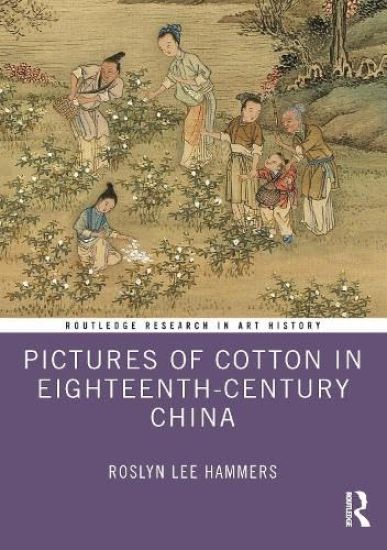
Pictures of Cotton in Eighteenth-Century China

Pictures of Cotton in Eighteenth-Century China

Roslyn Lee Hammers

TAYLOR FRANCIS LTD
2025
sidottu
Pictures of Cotton in Eighteenth-Century China narrates cotton’s journey from a little understand material to a cherished commodity ennobled by associations with the classical heritage of China. In the 12th century, cotton, an imported crop, was plucked from the fields and entered the margins of agricultural treatises. The material was eventually “acknowledged” as cotton, an object distinct from silk, worthy of representation. By the late 16th century, representations of the plant and of the labor used to process it were incorporated into agricultural publications. During the 18th century, cotton imagery and discussions were situated in imperial encyclopaedias, further consolidating its classical legacy. The Governor-general Fang Guancheng (1696/8-1768) deemed cotton a worthy subject for ambitious painting. In 1765, he designed the Pictures of Cotton, a series of sixteen paintings complete with commentary that delineated the processes of growing cotton and manufacturing fabric. He presented the Pictures of Cotton to the Qianlong emperor (r. 1735-96) who inscribed his imperial verse on each scene. Knowledge about the fiber became a means to collaborate at the highest level of the court and bureaucracy. Fang replicated the series, complete with imperial verses into carved stone to enable replication. The Jiaqing emperor (r.1796-1821) likewise published the series as woodblock prints. Upon domestication, cotton advanced political legitimacy, a commodity that attained canonical status. Cotton was represented in a scopic regime formulated by the Qing imperium, and in the process, the Imperially Inscribed Pictures of Cotton became the authoritative vision of cotton. This study is ideal for those studying Chinese art, Chinese history, Asian Studies, and history of science and technology.’

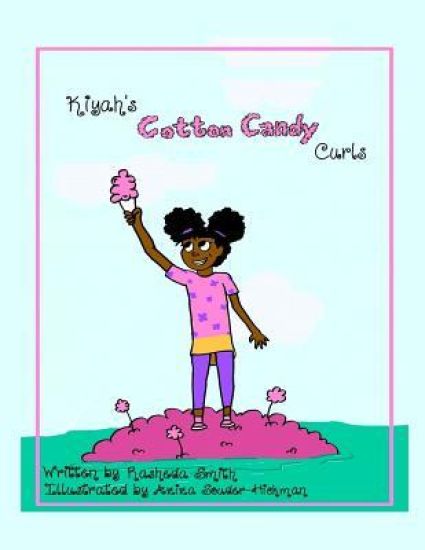
Kiyah's Cotton Candy Curls

Kiyah's Cotton Candy Curls

Rasheda Smith

Independently Published
2019
nidottu
"Television may show faces that are not always like ours, but that takes away nothing from you; for you shine so bright. TV is nothing more than a box of images that breathe no light. Unlike the television, you are able to go out and experience the beauty of life; you can use your senses to intake the positive energy around you. Now tell me, have you seen a TV do that? My guess is that you will say, "no"; an answer as simple as that."
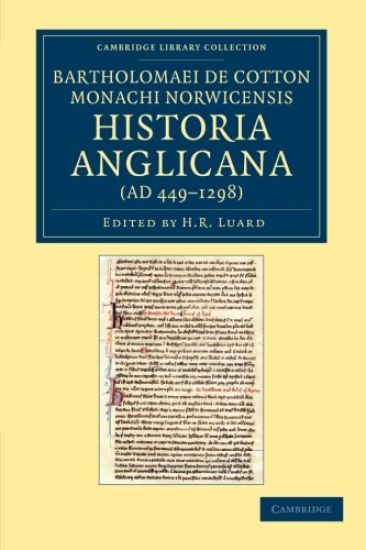
Bartholomaei de Cotton, Monachi Norwicensis, Historia Anglicana (AD 449–1298)
Bartholomaeus de Cotton, the Cellarer of Norwich Cathedral Priory, died in 1321/2. His most important work is the Historia Anglicana, written in 1292, with a few later additions. Book I, the history of Britain, taken from Geoffrey of Monmouth, was omitted by H. R. Luard from this 1859 edition. Book II, the history of England, is divided into two sections, from 455 to 1066, and from 1066 to the end of the thirteenth century. The work is most valuable for the period after 1264, as one of Cotton's sources, an anonymous Norwich chronicle, contains material not found elsewhere, and he also quotes from ecclesiastical and royal documents. Book III gives the history of the bishops and archbishops of England, mostly taken from other sources but with some useful material relating to the Diocese of Norwich. A glossary is provided.
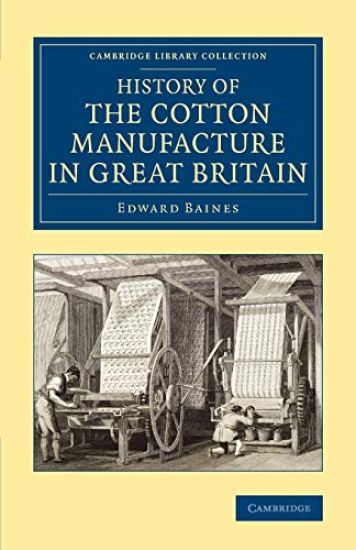
History of the Cotton Manufacture in Great Britain

History of the Cotton Manufacture in Great Britain

Edward Baines

Cambridge University Press
2015
pokkari
The journalist and politician Edward Baines (1800–90) succeeded his father as editor of the Leeds Mercury and as MP for Leeds. From a dissenting family, he was a social reformer but passionately believed that the state should not interfere in matters such as working hours and education. In this 1835 work, he sees the cotton industry as an exemplar of the unity of 'the manufactory, the laboratory, and the study of the natural philosopher', in making practical use of creative ideas and scientific discoveries. He surveys cotton manufacture from its origins to its 'second birth' in England, and focuses on the current state of machinery, trade and working conditions in all aspects of the business, and its outputs, including cloth, lace, stockings and cotton wool. This comprehensive work was important for its detailed analysis of a vital commercial activity, and remains so today for the historical information it contains.