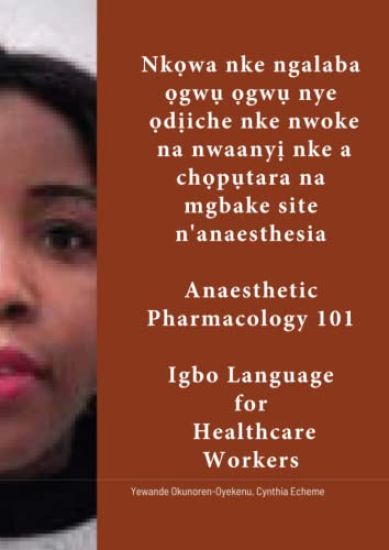
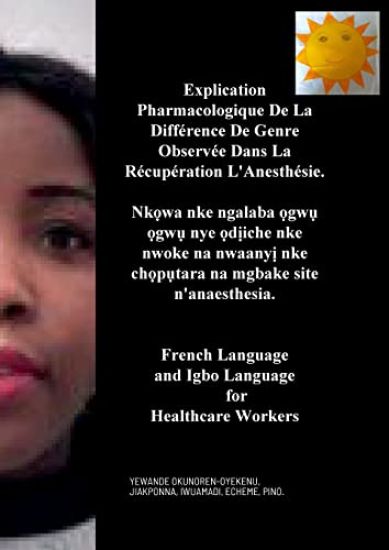
This book is for healthcare professionals and the public interested in how anaesthetic agents work. It provides essential information on general anaesthetic pharmacology. The review will aid in a patient-centric approach to anaesthesia practice and considerations for dosage regimens in a gender-wise and ethnic fashion for best results in recovery from general anaesthetics. This book is also useful as a language learning tool for healthcare professionals and trainees to enhance the physician-patient experience in regions where English is a second language. Akwụkwọ a bụ maka ndị ọkachamara ahụike yana ọhaneze ndị nwere mmasị na ka ndị ọrụ anestetiiki si enweta mmetụta ha. Ọ na-enye ozi dị mkpa na mmetụta nke okike na agbụrụ na metabolism nke ndị na-ahụ maka anestetiiki izugbe. A na-atụlekwa mmetụta nke ụdị ịwa ahụ, na-elekwasị anya na mgbake site na anesthesia mgbe rhinoplasty gasịrị. N'ihi na ọtụtụ ndị mmadụ chọrọ ka m bipụta nchọpụta m, edeela m akwụkwọ a a kpọrọ Anaesthetic Pharmacology 101 dịka ntụziaka nye amụmamụ a nke bụ nke dabeekarịsịrị n'usoro amụmamụ ihe anestetiiki dabeere n'ihe nchọpụta nke e jiri ndị nrịanrịa mee, tinyere nleba anya na ka e si enye ha ọgwụ ahụ site n'itule ma onye ahụ ọ bụ nwoke ka ọ bụ nwa nyị, tinyere ntule nke ebe onye ahụ si pụta, iji nweta ezigbo akụkọ n'ikpeazụ maka ezigbo mgbake zuru oke site n'Anestetiiki nke izugbe. Anaesthetic Pharmacology 102, ihe ọmụmụ ngalaba ọgwụọgwụ dị elu, bụ nke a ga-enweta n'ihe ngosi Power-Point maka ebumnuche mmụta, ma ọ bụrụ ma ị chọọ ya. Enwere m olileanya na ịgụ akwụkwọ a ga-amasị gị. Daalụ. Dr. Yewande Okunoren-Oyekenu
William Dean Howells ( March 1, 1837 - May 11, 1920) was an American realist novelist, literary critic, and playwright, nicknamed "The Dean of American Letters". He was particularly known for his tenure as editor of The Atlantic Monthly, as well as for his own prolific writings, including the Christmas story "Christmas Every Day" and the novels The Rise of Silas Lapham and A Traveler from Altruria. Early life and family: William Dean Howells was born on March 1, 1837 in Martinsville, Ohio (now known as Martins Ferry, Ohio) to William Cooper Howells and Mary Dean Howells, the second of eight children. His father was a newspaper editor and printer who moved frequently around Ohio. In 1840, the family settled in Hamilton, Ohio, where his father oversaw a Whig newspaper and followed Swedenborgianism.Their nine years there were the longest period that they stayed in one place. The family had to live frugally, although the young Howells was encouraged by his parents in his literary interests. He began at an early age to help his father with typesetting and printing work, a job known at the time as a printer's devil. In 1852, his father arranged to have one of his poems published in the Ohio State Journal without telling him. Early career: In 1856, Howells was elected as a clerk in the State House of Representatives. In 1858, he began to work at the Ohio State Journal where he wrote poetry and short stories, and also translated pieces from French, Spanish, and German. He avidly studied German and other languages and was greatly interested in Heinrich Heine. In 1860, he visited Boston and met with writers James Thomas Fields, James Russell Lowell, Oliver Wendell Holmes, Sr., Nathaniel Hawthorne, Henry David Thoreau, and Ralph Waldo Emerson. He became a personal friend to many of them, including Henry Adams, William James, Henry James, and Oliver Wendell Holmes, Jr. In 1860 Howells wrote Abraham Lincoln's campaign biography Life Of Abraham Lincoln and subsequently gained a consulship in Venice. He married Elinor Mead on Christmas Eve 1862 at the American embassy in Paris. She was a sister of sculptor Larkin Goldsmith Mead and architect William Rutherford Mead of the firm McKim, Mead, and White. Among their children was architect John Mead Howells. Editorship and other literary pursuits: The Howells returned to America in 1865 and settled in Cambridge, Massachusetts. He wrote for various magazines, including the Atlantic Monthly and Harper's Magazine. In January 1866, James Fields offered him a position as assistant editor at the Atlantic Monthly; he accepted after successfully negotiating for a higher salary, though he was frustrated by Fields' close supervision. Howells was made editor in 1871, after five years as assistant editor, and he remained in this position until 1881. In 1869, he met Mark Twain with whom he formed a longtime friendship. But his relationship with journalist Jonathan Baxter Harrison was more important for the development of his literary style and his advocacy of Realism. Harrison wrote a series of articles for the Atlantic Monthly during the 1870s on the lives of ordinary Americans.Howells gave a series of twelve lectures on "Italian Poets of Our Century" for the Lowell Institute during its 1870-71 season. He published his first novel Their Wedding Journey in 1872, but his literary reputation soared with the realist novel A Modern Instance (1882), which described the decay of a marriage. His 1885 novel The Rise of Silas Lapham became his best known work, describing the rise and fall of an American entrepreneur of the paint business. His social views were also strongly represented in the novels Annie Kilburn (1888), A Hazard of New Fortunes (1890), and An Imperative Duty (1891).............
Keine ausf hrliche Beschreibung f r "Qana'a (Gen gsamkeit) in der arabischen Literatur anhand des Kitab al-Qana'a wa-t-ta'affuf von Ibn Abi d-Dunya" verf gbar.
Ce livre est destin aux professionnels de la sant et au public int ress par le fonctionnement des agents anesth siques. Il fournit des informations essentielles sur la pharmacologie de l'anesth sie g n rale. La recherche a montr que les patients de sexe f minin subissent une aggravation des effets secondaires des agents anesth siques par rapport aux patients de sexe masculin de tous les groupes ethniques. Ce livre fournit l'explication pharmacologique soutenant la diff rence observ e dans le sexe et l'origine ethnique en ce qui concerne la r cup ration de l'anesth sie avec un accent particulier sur la r cup ration apr s rhinoplastie. En raison de la demande g n rale d'expliquer les r sultats de mes recherches, j'ai crit ce livre comme un guide. Les r sultats faciliteront une approche centr e sur le patient de la pratique de l'anesth sie et des consid rations pour les sch mas posologiques par sexe et origine ethnique pour de meilleurs r sultats dans la r cup ration des anesth sies g n rales.
This book is for healthcare professionals and the public interested in how anaesthetic agents work. It provides essential information on general anaesthetic pharmacology. The review will aid in a patient-centric approach to anaesthesia practice and considerations for dosage regimen in a gender-wise and ethnic fashion for best results in recovery from general anaesthetics
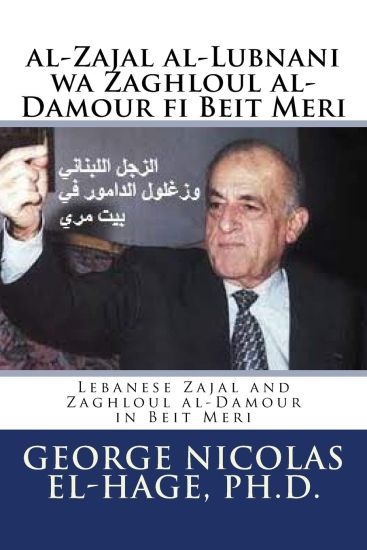
Zajal is the public register of the collective memory of its people and the chronicle that preserves their traditions, conventions, and popular heritage. It is mainly an oral poetic tradition that is meant to be presented (sung or recited) in a public forum before an audience, preferably on stage, between two poets or more. The origins of Zajal date back to pre-Islamic Arabia; some also argue that Zajal originated in Andalusia during the Arab's occupation of Spain. The first wave of Zajal that reached us dates back to the 12th century where this form of poetry in dialect became popular in Lebanon and later flourished in monasteries and among educated scholars, linguists, and even prominent politicians including the ruler of Lebanon, Emir Bashir, The Second. The second wave of Zajal started in the late 1930s with the poet Asaad el-Khoury al-Fighali, better known as Shahrour al-Wadi, who established the first group of poets and set the early rules of Zajal on stage. He was followed by a number of (Zajjaaline): Zajal poets, who carried on the tradition. However, one name stands out as the founder of modern Zajal poetry in Lebanon: Joseph al-Hashime, better known as Zaghloul al-Damour (1925- 2018). Zaghloul actively accompanied this art for over seventy years. He is considered the patron-poet of Zajal and its representative par excellence. It is agreed among critics that he is the teacher, educator, and the one-man- academy that graduated tens of modern poets who studied under his supervision, learned from him, emulated him, and owe their reputation and career to his tutelage and sponsorship. Poets who wanted to be recognized and accredited either joined his group or sought to challenge him on stage just to say that they sang along with Zaghloul. Zaghloul founded the modern school/academy of Zajal poetry, established the definitive rules of debate/challenge between poets, set up the protocol of "an evening of Zajal poetry" on stage, was the first to appear with his group on television in a weekly Zajal show, and is hailed as the ambassador of Lebanese Zajal to the world of Diaspora to bring a taste of home to Lebanese and Arab immigrants around the globe. He became the preferred voice of poetry chosen to celebrate Lebanon's weddings, funerals, national commemorations, and social events. He also established the first journal to publish Zajal poetry, debates, and duals between poets on regular basis. His journal, al-Masrah, continued its mission for over twenty years. He also published a number of his own poetry books. All said, Zaghloul remains a unique poet in the history of Zajal. His name has become synonymous with this art beloved to all Lebanese and Arab people. Zaghloul was endowed with three gifts that distinguished him and put him in a class by himself: 1) a unique talent for romantic poetry, especially spontaneous poetry inspired by the occasion or situation at hand, that touches the hearts and the minds of the listeners, 2) an exceptional and matchless voice that is in itself an orchestra of hummingbirds and multiple musical instruments simultaneously playing, 3) but above all, he was gifted with a gentle and temperate character and a kind and loving personality that endeared him to his contemporaries, his audiences, and his challengers and rivals alike. Zaghloul will be remembered not only for his poetic genius and his pioneering role but also for his humility, humanity, and for having been supportive and loyal to his friends and always gracious, civil, and forgiving towards his opponents on stage. Those who challenged him were always taught a lesson but without being degraded or embarrassed by him on stage. His passing at the age of 93 dealt a great blow to the most cherished art of Zajal, and he was mourned across Lebanon, the entire Arab world, and in Diaspora.
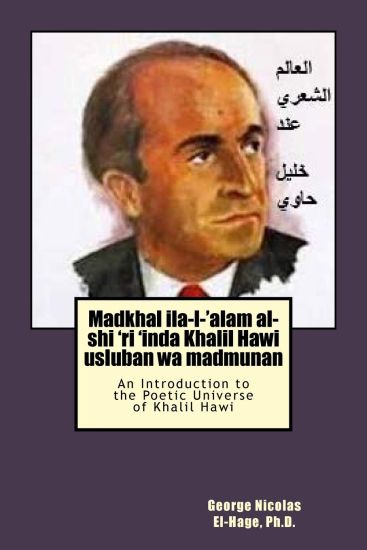
This book is a study in Arabic of Khalil Hawi's "poetic universe" with all its richness and implications. It focuses on Hawi's poetic style and content. Khalil Hawi is the leading existential poet in the Arab world as well as one of the most important and well known avant-garde poets of modern Arabic literature who shaped the fate of contemporary Arabic poetry in the twentieth century. His poetry is deeply punctuated with symbols and metaphors and is permeated with political and social connotations. He draws heavily on figures and heroes selectively lifted from history, mythology, religion, literature, and philosophy. His life and sad death are the embodiment of the destiny of the tragic hero who offered himself as a true sacrificial lamb for his nation and its people. His life journey was an epic quest for the ultimate hero who would rise from the ashes of a defeated nation that once was the giver of civilization and culture to the world. Alone, Hawi fought the "nocturnal owl" of a tragic history of defeat and humiliation which he desperately wanted to transform into a present day of glorious victories for his nation and its young generation of "demi-gods" whom he expected to rebel and destroy the old traditions and ancient relics of a shameful catastrophic past that continued to persist over the horizon of the Arab nation, leading it from one defeat to another. When Hawi realized that his vision would not come to pass in a nation that had grown accustomed to tragedy and defeat, he offered to give his life in order to speed up the victory, and he willingly died to erase the shame and transgressions of his people and their rulers. Khalil Hawi committed suicide on the morning of June 6, 1982 on the eve of the Israeli invasion of his beloved city, Beirut.
Set 150 years ago on the vast American plains, this thrilling adventure follows three young boys-Bud, Wayra, and Talko Shokoba-as they embark on a life-changing journey. During their travels, they encounter a mystical figure: The Great White Buffalo, accompanied by the Spirit Woman, a powerful and ethereal being who rides the legendary beast.The Spirit Woman, emerging from The Other Side of the Gates of Beyond, delivers a profound message of hope, crisis, and the future of their peoples. As the boys listen to her words, they are confronted with both a warning and a vision for a new world.Their encounter with the Spirit Woman sparks a transformative adventure that challenges them to grow, learn, and ultimately change the course of their lives. With the fate of their people at stake, Bud, Wayra, and Talko Shokoba must come to terms with the spiritual forces at work in their world and embrace their roles in shaping the future.