Edward W. Said once urged the legendary Eqbal Ahmad not to leave your words scattered to the winds, or even recorded on tape, but collected and published in several volumes for everyone to read. Then those who don t have the privilege of knowing you will know what a truly remarkable, gifted man you are. In these intimate and wide-ranging conversations, Ahmad discusses nationalism, ethnic conflict, the politics of memory, and liberation struggles around the world.
Welcome To Cottonwood Creek houses sixteen tales of terror from seven different authors A collection of short stories that range from accounts of zombies and monsters to the darkest evil of deranged human souls.Featuring stories that will take you on a journey you won't soon forget. Now buckle up tight for a trip down to Cottonwood Creek, if you dare...Tales told by: Thomas Baker David Owain Hughes Jonathan Edward Ondrashek Maxine Grey Robert Wagner Aaron Thorton Caitlin Gee
This is the 19th book from author and popular music historian Harvey Kubernik. His comprehensive compilation of interviews and conversations with rock, blues, folk, soul, reggae musicians, singers, songwriters, and recording engineers, photographers, cinematographers, documentary movie makers and distributors whose creative works matter, and who share their insider stories, techniques and inspiration with readers and viewers. This is the definitive volume for fans, collectors, music and film students to cherish and share anyone who follows rock 'n' roll facts and stax of wax from the fifties into our current century. For the ever-growing audience of people who love to see and hear their favorite stars performing live in arenas, concert halls, outdoor concert venues, and now on screen in theaters, on TV and in productions and formats designed for home entertainment, here is the real-to-reel backstory behind many of the music DVD's and movies you have on your shelves and in rotation on your home library. This book includes dialogues with acclaimed Oscar winners D. A. Pennebaker, Murray Lerner, Albert Maysles, Morgan Neville, John Ridley, and Curtis Hanson alongside commentary about noted directors Michael Lindsay-Hogg, Allan Arkush, Colin Hanks, Quentin Tarentino and Martin Scorsese. You'll also learn about filmmakers and screenwriters David Leaf, Leslie Ann Coles, and Travis Edward Pike, plus the often-overlooked rock 'n' roll contributions of native Americans. You'll be reminded again of the pioneering television efforts of Ed Sullivan and Dick Clark with photography displayed in the pages by Henry Diltz and Heather Harris. This 508 page book, illustrated with a total of 220 photos, documents and artifacts, is mandatory for anyone who loves music and available screen productions with the Rolling Stones, the Beatles, the Doors, Otis Redding, Bob Marley, the music of Motown, Bob Dylan, Elvis Presley, Johnny Cash, Brian Wilson, James Brown, the Bee Gees, John Lennon, the Supremes, Ike and Tina Turner, the Jimi Hendrix Experience, The Band, Paul Butterfield, and the sounds of Laurel Canyon, including the Mamas and the Papas, the Byrds, Crosby, Stills and Nash, and the famed studio recording musicians, the Wrecking Crew. Harvey examines seminal music television shows and the ongoing influence and impact of "American Bandstand," " Shindig " " Shebang " and "Upbeat." There's even a whole chapter on the sacred music George Harrison and Ravi Shankar presented in their Concert for Bangladesh charity event that will celebrate a 50th anniversary in 2021.This is the one you've been waiting for Harvey Kubernik is your tour guide on this journey through the past that you can still see, hear and own in 2020.
Merlin or the early history of king Arthur: - A prose romance - Vol. 2 is an unchanged, high-quality reprint of the original edition of 1899. Hansebooks is editor of the literature on different topic areas such as research and science, travel and expeditions, cooking and nutrition, medicine, and other genres. As a publisher we focus on the preservation of historical literature. Many works of historical writers and scientists are available today as antiques only. Hansebooks newly publishes these books and contributes to the preservation of literature which has become rare and historical knowledge for the future.
Merlin or the early history of king Arthur: - A prose romance - Vol. 1 is an unchanged, high-quality reprint of the original edition of 1899. Hansebooks is editor of the literature on different topic areas such as research and science, travel and expeditions, cooking and nutrition, medicine, and other genres. As a publisher we focus on the preservation of historical literature. Many works of historical writers and scientists are available today as antiques only. Hansebooks newly publishes these books and contributes to the preservation of literature which has become rare and historical knowledge for the future.
Understanding the Course of the War for American independence through Geographical Regions Identifying discrete geographical areas in order to better understand a conflict that moves across hundreds of thousands of square miles of land and water, such as the American Civil War and World War II, has been a valuable historical method. During this time of greater study of the war that made America, the authors of Theaters of the American Revolution take this approach for the first time. The result is a stimulating volume that will allow readers to see how the war flowed from region to region from 1775 to 1781, beginning in the Northern colonies and Canada, through the dark months in the Middle colonies, to a shift to the South and culmination at Yorktown. Simultaneously, the war raged up and down the western frontier, with the Patriots working to keep the British and their Indian allies from disrupting the main battle armies to the east. Equally important was the war at sea, where American privateers and a fledgling navy attempted to harass the British; but with the entrance of France to the conflict, the control of the sea took a much more balanced--and important-- aspect. With specially commissioned maps and colorful descriptions of eighteenth century American terrain, settlements, and cities, as well as key battles, Theaters of the American Revolution provides an ideal introduction to understanding one of the most important wars in world history in its totality. Contents Introduction - James Kirby Martin and David L. Preston The Northern Theater - James Kirby Martin The Middle Theater - Edward G. Lengel and Mark Edward Lender The Southern Theater - Jim Piecuch The Western Theater - Mark Edward Lender The Naval Theater - Charles Neimeyer
Improving Schools with Blended Learning is specifically designed to address the important issues needed to successfully modernise education within the context of technological change. It does this by first providing a clear roadmap for designing Blended Learning environments able to respond to the technological imperatives challenging schools at present, and then illustrating this roadmap via specific, original research that details the 'how to' aspects of a successful technology-based design process. School leaders, teachers, teacher education students and researchers will all find highly relevant information about how to manage for disruption in the new and informative approach to Blended Learning (BL) they will discover in this book. This book arose from two different research projects the authors have been pursuing over the last 3–5 years, including school improvement research and Blended Learning research designed to investigate the role of technology in effective teaching and learning. By combining the insights gained from these two different research areas, this book is able to present a novel understanding of BL that is both insightful and clearly evidence-based. Improving Schools with Blended Learning also provides several original contributions to specific knowledge in the areas of BL and school improvement that most educators will find highly useful, including the use of BL schemas, a clear and extended BL continuum, how to measure and evaluate the success of BL, how to scaffold teacher ICT knowledge and skills, and a specific process for contextualising applied BL in relation to the ‘disruption’ imperatives of the Knowledge Economy.
Improving Schools with Blended Learning is specifically designed to address the important issues needed to successfully modernise education within the context of technological change. It does this by first providing a clear roadmap for designing Blended Learning environments able to respond to the technological imperatives challenging schools at present, and then illustrating this roadmap via specific, original research that details the 'how to' aspects of a successful technology-based design process. School leaders, teachers, teacher education students and researchers will all find highly relevant information about how to manage for disruption in the new and informative approach to Blended Learning (BL) they will discover in this book. This book arose from two different research projects the authors have been pursuing over the last 3–5 years, including school improvement research and Blended Learning research designed to investigate the role of technology in effective teaching and learning. By combining the insights gained from these two different research areas, this book is able to present a novel understanding of BL that is both insightful and clearly evidence-based. Improving Schools with Blended Learning also provides several original contributions to specific knowledge in the areas of BL and school improvement that most educators will find highly useful, including the use of BL schemas, a clear and extended BL continuum, how to measure and evaluate the success of BL, how to scaffold teacher ICT knowledge and skills, and a specific process for contextualising applied BL in relation to the ‘disruption’ imperatives of the Knowledge Economy.
Interest in the his tory of statistics has grown substantially in recent years and the subject is now covered by a number of excellent books. S. M. Stigler's The History of Statistics (19S6) gives an overview up to 1900 while Anders Hald's two encyclopedic volumes A History of Probability and Statistics before 1750 and A History of Mathematical Statistics f'T'Om 1750 to 1930, published in 1990 and 1995, provide detailed mathematical discussion of the major contributions up to 1930. Hald's books have re moved Isaac Todhunter's A History of Probability from the pedestal which it occupied for a century and a quarter and rendered Karl Pearson's Lec ture Notes of mainly historical interest themselves. Journal papers have appeared on specific topics, especially in the series "Studies in the History of Probability and Statistics" in Biometrika and in the long sequence of papers in Archive for the History of the Exact Sciences by O. Sheynin. The two volumes of reprinted papers, mostly from Biometrika, issued in 1970 and 1977 have proved particularly valuable. More recently, many important papers published since 1900 have been reprinted with commentaries in the three-volume Breakth'T'Oughs in Statistics (1992-1997). Stigler's Statistics on the Table (1999) provides illuminating vignettes. In addition, specialized books have appeared on particular topics, such as A. I. Dale's A History of Inverse P'T'Obability (1991, 1999) and R. W. Fare brother's Fitting Linear Relationships (199S). The pioneering book on the early period, F. N.
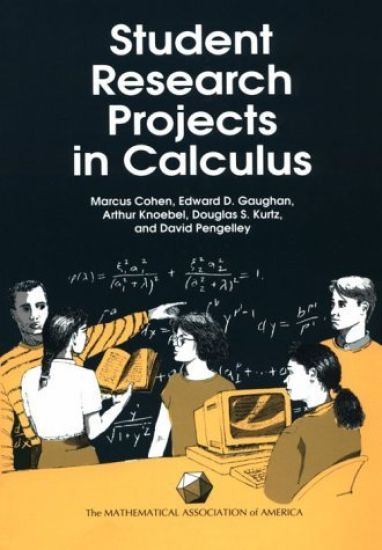
Changing the way students learn calculus at New Mexico State University. In the Spring of 1988, Marcus Cohen, Edward D. Gaughan, Arthur Knoebel, Douglas S. Kurtz, and David Penegelley began work on a student project approach to calculus. For the next two years, most of their waking hours (and some of their dreams) would be devoted to writing projects for their students and discovering how to make the use of projects in calculus classes not only successful, but practical as well. A grant from the National Science Foundation made it possible for this experiment to go forward on a large scale. The enthusiasm of the original group of five faculty was contagious, and soon other members of the department were also writing and using projects in their calculus classes. At the present time, about 80% of the calculus students at New Mexico State University are doing projects in their Calculus courses. Teachers can use their methods in teaching their own calculus courses.Student Research Projects in Calculus provides teachers with over 100 projects ready to assign to students in single and multivariable calculus. The authors have designed these projects with one goal in mind: to get students to think for themselves. Each project is a multistep, take-home problem, allowing students to work both individually and in groups. The projects resemble mini-research problems. Most of them require creative thought, and all of them engage the student's analytic and intuitive faculties. the projects often build from a specific example to the general case, and weave together ideas from many parts of the calculus. Project statements are clearly stated and contain a minimum of mathematical symbols. Students must draw their own diagrams, decide for themselves what the problem is about, and what toolsfrom the calculus they will use to solve it. This approach elicits from students an amazing level of sincere questioning, energetic research, dogged persistence, and conscientious communication. Each project has accompanying notes to the instructor, reporting students' experiences. The notes contain helpful information on prerequisites, list the main topics the project explores, and suggests helpful hints. The authors have also provided several introductory chapters to help instructors use projects successfully in their classes and begin to create their own.
Robert Clark; David Cox; Howard C. Jr. Curtiss; John W. Edwards; Kenneth C. Hall; David A. Peters; Robert Scanlan; Emil Simiu; Fernando Sisto; Thomas W. Strganac
In this new edition, the fundamental material on classical linear aeroelasticity has been revised. Also new material has been added describing recent results on the research frontiers dealing with nonlinear aeroelasticity as well as major advances in the modelling of unsteady aerodynamic flows using the methods of computational fluid dynamics and reduced order modeling techniques. New chapters on aeroelasticity in turbomachinery and aeroelasticity and the latter chapters for a more advanced course, a graduate seminar or as a reference source for an entrée to the research literature.
Interest in the his tory of statistics has grown substantially in recent years and the subject is now covered by a number of excellent books. S. M. Stigler's The History of Statistics (19S6) gives an overview up to 1900 while Anders Hald's two encyclopedic volumes A History of Probability and Statistics before 1750 and A History of Mathematical Statistics f'T'Om 1750 to 1930, published in 1990 and 1995, provide detailed mathematical discussion of the major contributions up to 1930. Hald's books have re moved Isaac Todhunter's A History of Probability from the pedestal which it occupied for a century and a quarter and rendered Karl Pearson's Lec ture Notes of mainly historical interest themselves. Journal papers have appeared on specific topics, especially in the series "Studies in the History of Probability and Statistics" in Biometrika and in the long sequence of papers in Archive for the History of the Exact Sciences by O. Sheynin. The two volumes of reprinted papers, mostly from Biometrika, issued in 1970 and 1977 have proved particularly valuable. More recently, many important papers published since 1900 have been reprinted with commentaries in the three-volume Breakth'T'Oughs in Statistics (1992-1997). Stigler's Statistics on the Table (1999) provides illuminating vignettes. In addition, specialized books have appeared on particular topics, such as A. I. Dale's A History of Inverse P'T'Obability (1991, 1999) and R. W. Fare brother's Fitting Linear Relationships (199S). The pioneering book on the early period, F. N.
Web applications are used every day by millions of users, which is why they are one of the most popular vectors for attackers. Obfuscation of code has allowed hackers to take one attack and create hundreds-if not millions-of variants that can evade your security measures. Web Application Obfuscation takes a look at common Web infrastructure and security controls from an attacker's perspective, allowing the reader to understand the shortcomings of their security systems. Find out how an attacker would bypass different types of security controls, how these very security controls introduce new types of vulnerabilities, and how to avoid common pitfalls in order to strengthen your defenses.