Kirjojen hintavertailu. Mukana 11 627 463 kirjaa ja 12 kauppaa.

Kirjahaku

Etsi kirjoja tekijän nimen, kirjan nimen tai ISBN:n perusteella.

1000 tulosta hakusanalla David Peter

Accounting for Business

Accounting for Business

David Harvey; Edward McLaney; Peter Atrill

Butterworth-Heinemann Ltd
2000
nidottu
'Accounting for Business' is ideal for undergraduate students on business and accounting courses who need to understand the nuts and bolts of financial accounting. This popular textbook has always enjoyed a deserved reputation for accessibility and thoroughness. Now in its third edition, its contents have been fully updated and restructured to make them even easier to use. Readers will benefit from the coverage of current accounting practices and legislation, in addition to the range of worked examples and self-test activities throughout the book. 'Accounting for Business' clearly explains accounting information's role in making sound business decisions and focuses upon the aspects of accounting practice which are most relevant to the non-specialist manager. It is ideal for first year undergraduates of business studies, higher students and those pursuing professional accountancy qualifications. This third edition has been restructured, to further enhance its 'student centred' approach. The content has now been broken down into 25 roughly equivalent 'bite-sized' individual study topics. Each of these requires 6 hours of study time, enabling this book to support a full scale semester course with two topics a week, or a full year course at one topic a week. Includes a wide selection of topical case studies, with a broad spread of international examples.

Digital Health Information for the Consumer

Digital Health Information for the Consumer

David Nicholas; Paul Huntington; Peter Williams

Ashgate Publishing Limited
2007
sidottu
This unique book draws on research that constituted the first major nationwide evaluation of the use and impact of key digital health information platforms which were provided to thousands of health consumers in the UK. The authors offer the first comprehensive and detailed comparison of usage and impact of the three major ICT platforms delivering health information - the internet, touch-screen kiosks and digital interactive television. It provides an extensive reference source on how health consumers behave when online, whether this differs according to digital platform or type of user, how users perceive digital health services and what health benefits these services deliver. The book will be invaluable reading for all those interested in digital health information - students, academics, health policy-makers and information managers.
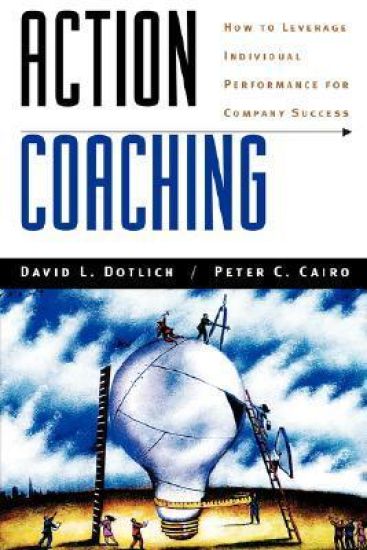
Action Coaching

Action Coaching

David L. Dotlich; Peter C. Cairo

Jossey-Bass Inc.,U.S.
1999
nidottu
Chances are, if you're a manager in most any organization today, coaching has become an integral part of your responsibilities. And there's no more effective approach to coaching than Action Coaching. Developed by the authors through their work with Levi Strauss, Colgate, Bank of America, Arthur Andersen and other leading companies, Action Coaching is the only coaching process that dramatically increases an individual's personal performance in direct correlation with established organizational goals. Here, Dotlich and Cairo share the same advice, techniques, and tools they've used to transform hundreds of managers and executives into first-rate coaches. Moreover, they clearly demonstrate how Action Coaching can be used as a strategy for achieving organizational goals by aligning personal improvement with a company's vision for the future.
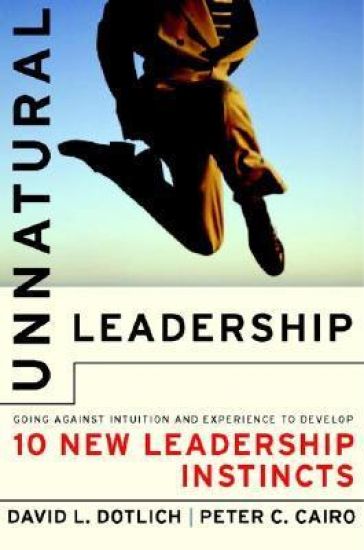
Unnatural Leadership

Unnatural Leadership

David L. Dotlich; Peter C. Cairo

Jossey-Bass Inc.,U.S.
2002
sidottu
Written by David Dotlich and Peter Cairo— two of the country's top executive coaches and educators— Unnatural Leadership debunks the common notion of the natural leader as a flawless figure. The book describes the truth about being a real leader in a business environment turned upside down by e-commerce, diversity, security concerns, globalization, and matrix structures. Drawing on personal experience working with successful leaders in top-tier companies throughout the world, Dotlich and Cairo identify a style of leadership used by those who succeed in complicated business and people situations, a style that maximizes a leader's strengths and acknowledges weaknesses.
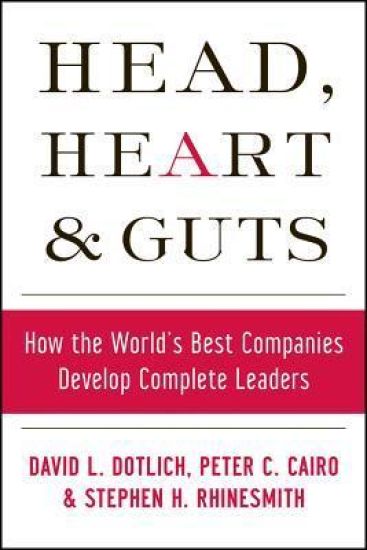
Head, Heart and Guts

Head, Heart and Guts

David L. Dotlich; Peter C. Cairo; Stephen H. Rhinesmith

Jossey-Bass Inc.,U.S.
2006
sidottu
This book reveals the three most important capabilities leaders must demonstrate today: the ability to set strategy, empathize with others, and take risks—all at the same time. In Head, Heart, and Guts, leadership experts David Dotlich, Peter Cairo, and Stephen Rhinesmith—who teach and coach CEOs and executive teams throughout the world—argue that to be successful in a complex, matrixed, fast-moving world, “whole” leaders must set strategy, develop trusting relationships with others, and consistently do the right thing based on personal values. “Partial” leaders, often the product of traditional executive programs, may be successful in the shortrun, but their companies lose over time. Filled with case studies of companies such as Bank of America, Johnson & Johnson, Novartis, and UBS, Head, Heart, and Guts, lays out specific steps and actions for leaders who want to grow beyond their “leadership comfort zone” and an action plan for companies that want to move beyond tried-and-true leadership development in order to develop “whole” leaders throughout their leadership pipeline.
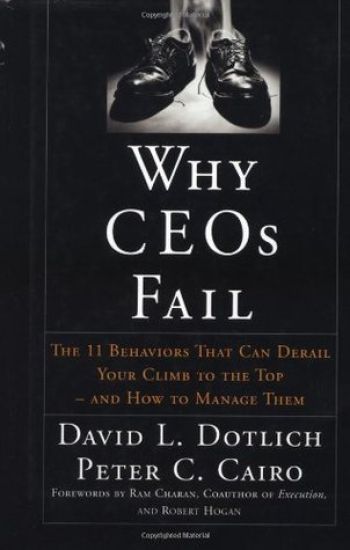
Why CEOs Fail

Why CEOs Fail

David L. Dotlich; Peter C. Cairo

Jossey-Bass Inc.,U.S.
2003
sidottu
If any of the following behaviors sound like you or someone you work with, beware! In Why CEOs Fail, David L. Dotlich and Peter C. Cairo describe the most common characteristics of derailed top executives and how you can avoid them: Arrogance—you think that you're right, and everyone else is wrong.Melodrama—you need to be the center of attention.Volatility—you're subject to mood swings.Excessive Caution—you're afraid to make decisions.Habitual Distrust—you focus on the negatives.Aloofness —you're disengaged and disconnected.Mischievousness—you believe that rules are made to be broken.Eccentricity—you try to be different just for the sake of it.Passive Resistance—what you say is not what you really believe.Perfectionism—you get the little things right and the big things wrong.Eagerness to Please—you try to win the popularity contest.
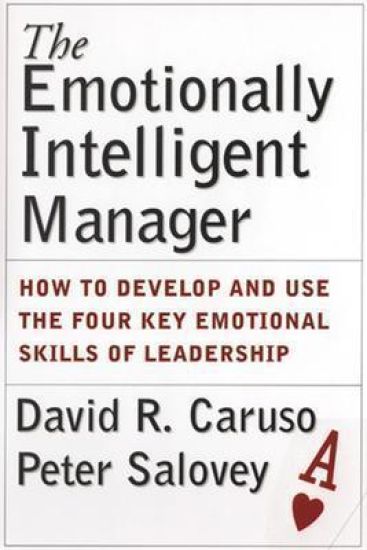
The Emotionally Intelligent Manager

The Emotionally Intelligent Manager

David R. Caruso; Peter Salovey

Jossey-Bass Inc.,U.S.
2004
sidottu
We have long been taught that emotions should be felt and expressed in carefully controlled ways, and then only in certain environments and at certain times. This is especially true when at work, particularly when managing others. It is considered terribly unprofessional to express emotion while on the job, and many of us believe that our biggest mistakes and regrets are due to our reactions at those times when our emotions get the better of us. David R. Caruso and Peter Salovey believe that this view of emotion is not correct. The emotion centers of the brain, they argue, are not relegated to a secondary place in our thinking and reasoning, but instead are an integral part of what it means to think, reason, and to be intelligent. In The Emotionally Intelligent Manager , they show that emotion is not just important, but absolutely necessary for us to make good decisions, take action to solve problems, cope with change, and succeed. The authors detail a practical four-part hierarchy of emotional skills: identifying emotions, using emotions to facilitate thinking, understanding emotions, and managing emotions—and show how we can measure, learn, and develop each skill and employ them in an integrated way to solve our most difficult work-related problems.
Hermeneutics as Apprenticeship – How the Bible Shapes Our Interpretive Habits and Practices

Hermeneutics as Apprenticeship – How the Bible Shapes Our Interpretive Habits and Practices

David I. Starling; Peter O`brien

Baker Academic, Div of Baker Publishing Group
2016
nidottu
A Fresh Approach to the Art of Biblical InterpretationThis book offers a fresh approach to the art of biblical interpretation, focusing on the ways Scripture itself forms its readers as wise and faithful interpreters. David Starling shows that apprenticing ourselves to the interpretive practices of the biblical writers and engaging closely with texts from all parts of the Bible help us to develop the habits and practices required to be good readers of Scripture. After introducing the principles, Starling works through the canon, providing inductive case studies in interpretive method and drawing out implications for contemporary readers. Offering a fresh contribution to hermeneutical discussions, this book will be an ideal supplement to traditional hermeneutics textbooks for seminarians. It includes a foreword by Peter O'Brien.
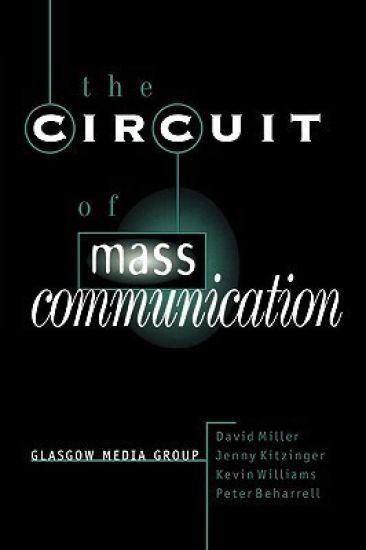
The Circuit of Mass Communication

The Circuit of Mass Communication

David Miller; Jenny Kitzinger; Peter Beharrell

SAGE Publications Ltd
1998
sidottu
This book moves beyond the narrow focus of much of the work on media and cultural studies to examine the whole process of interaction between the media and the social world. Rejecting approaches which focus only on ownership or discourse or audience reception, this new book from the Glasgow Media Group, examines: promotional strategies; media production; representation and audience responses; as well as broader impacts on policy, culture and society. Using a detailed analysis of the struggle over representation during the AIDS crisis as point of departure, The Circuit of Mass Communication reveals the power of the media to influence public opinion, and the complex interaction between media coverage, audience response and contemporary power relations. Based on extensive empirical research, this book offers a range of challenging insights on media power, active audiences and moral panics.
The Circuit of Mass Communication

The Circuit of Mass Communication

David Miller; Jenny Kitzinger; Peter Beharrell

SAGE Publications Ltd
1998
nidottu
This book moves beyond the narrow focus of much of the work on media and cultural studies to examine the whole process of interaction between the media and the social world. Rejecting approaches which focus only on ownership or discourse or audience reception, this new book from the Glasgow Media Group, examines: promotional strategies; media production; representation and audience responses; as well as broader impacts on policy, culture and society. Using a detailed analysis of the struggle over representation during the AIDS crisis as point of departure, The Circuit of Mass Communication reveals the power of the media to influence public opinion, and the complex interaction between media coverage, audience response and contemporary power relations. Based on extensive empirical research, this book offers a range of challenging insights on media power, active audiences and moral panics.
National Rights, International Obligations

National Rights, International Obligations

David George; Prof. Peter Jones; Simon Caney

Westview Press Inc
1996
pokkari
Nationalism is once again rising and spreading. Nationlist movements are active throughout the world, demanding political recognition of their nations' identity. Yet the current revival of nationalism has taken place alongside claims that nation-states are becoming obsolete in an increasingly globalized world. In addition, now perhaps more than ever, people are conscious of humanity as a whole and are ready to take seriously the international dimensions of morality.In this collection of timely essays, distinguished moral and political philosophers examine issues raised by the competing claims of nationhood and internationalism from a variety of perspectives, and defend a variety of answers. Questions discussed include: Is humanity really divided into nations or are nations invented by nationalists? Does a nation have the right to be self-determining? If so, must each nation form a separate and sovereign state? Do our obligations stop at national boundaries? Do we not have obligations to human beings as such? Why then should we be less concerned about foreigners" than about our compatriots? Can we be concerned for social justice within societies yet not across the world as a whole? If we embrace ideas of human rights and global obligations, how do we establish what those rights and obligations actually are? Is it proper, plausible, or practical to aspire to such universal moral principles in a world characterized by national diversity and cultural difference?
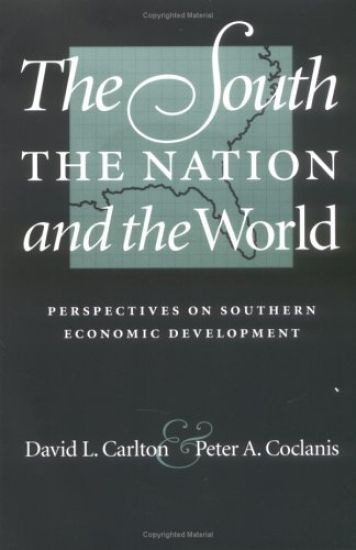
The South, the Nation and the World

The South, the Nation and the World

David L. Carlton; Peter A. Coclanis

University of Virginia Press
2003
nidottu
Like the rest of British North America, the American South was ""born capitalist."" The slave plantation, then, was essentially a form of business enterprise like any other - indeed, one quite modern and sophisticated for its time. There were initially very few significant differences in business culture between the northern and southern parts of what became the United States Yet the plantation placed its peculiar stamp on the South, and vice versa, and its path of development diverged increasingly from that of the growing manufacturing belt of the North. In their essays collected in The South, the Nation, and the World, David Carlton and Peter Coclanis effectively argue that the chronic economic difficulties of the American South cannot simply be explained away as resulting from a distinctive ""premodern"" business climate, because there was actually very little variation between one region's business climate and another's during the Antebellum period. Instead, it was the collapse of the slave regime in the 1860s that left the South in dire need of economic restructuring, and by Reconstruction the emergent American economy had foreclosed options formerly available to southern enterprise. Forced to play catch-up, southerners have had at best mixed success in the continuing struggle to create an economic life affording stable growth and broad opportunity to all the region's people - and Carlton and Coclanis offer a fascinating illumination of the twists and turns in that economic history.
Narrative Theory

Narrative Theory

David Herman; James Phelan; Peter J Rabinowitz; Brian Richardson; Robyn R Warhol

OHIO STATE UNIVERSITY PRESS
2012
pokkari
Narrative Theory: Core Concepts and Critical Debates addresses two frequently asked questions about narrative studies: "what is narrative theory?" and "how do different approaches to narrative relate to each other?" In engaging with these questions, the book demonstrates the diversity and vitality of the field and promotes a broader dialogue about its assumptions, methods, and purposes. In Part One, the co-authors explore the scope and aims of narrative from four distinct perspectives: rhetorical (Phelan and Rabinowitz), feminist (Warhol), mind-oriented (Herman), and unnatural (Richardson). Using case studies (Huckleberry Finn, Persuasion, On Chesil Beach, and Midnight's Children, respectively), the co-authors explain their different takes on the same core concepts: authors, narrators, narration; plot, time, and progression; space, setting, and perspective; character; reception and the reader; and narrative values. In Part Two, the co-authors respond to one another's views. As they discuss the relation of the approaches to each other, they highlight significant current debates and map out key developments in the field. Accessibly written, Narrative Theory can serve as the basis for a wide range of courses, even as its incisive presentation of four major approaches and its lively give-and-take about the powers and limitations of each make the book an indispensable resource for specialists.
Digital Health Information for the Consumer

Digital Health Information for the Consumer

David Nicholas; Paul Huntington; Peter Williams

CRC Press Inc
2017
nidottu
This unique book draws on research that constituted the first major nationwide evaluation of the use and impact of key digital health information platforms which were provided to thousands of health consumers in the UK. The authors offer the first comprehensive and detailed comparison of usage and impact of the three major ICT platforms delivering health information - the internet, touch-screen kiosks and digital interactive television. It provides an extensive reference source on how health consumers behave when online, whether this differs according to digital platform or type of user, how users perceive digital health services and what health benefits these services deliver. The book will be invaluable reading for all those interested in digital health information - students, academics, health policy-makers and information managers.
The Diversity Myth

The Diversity Myth

David O. Sacks; Peter A. Thiel; Elizabeth Fox-Genovese

Independent Institute,U.S.
1999
pokkari
This is a powerful exploration of the debilitating impact that politically-correct “multiculturalism” has had upon higher education and academic freedom in the United States. In the name of diversity, many leading academic and cultural institutions are working to silence dissent and stifle intellectual life. This book exposes the real impact of multiculturalism on the institution most closely identified with the politically correct decline of higher education—Stanford University. Authored by two Stanford graduates, this book is a compelling insider’s tour of a world of speech codes, “dumbed-down” admissions standards and curricula, campus witch hunts, and anti-Western zealotry that masquerades as legitimate scholarly inquiry. Sacks and Thiel use numerous primary sources—the Stanford Daily, class readings, official university publications—to reveal a pattern of politicized classes, housing, budget priorities, and more. They trace the connections between such disparate trends as political correctness, the gender wars, Generation X nihilism, and culture wars, showing how these have played a role in shaping multiculturalism at institutions like Stanford. The authors convincingly show that multiculturalism is not about learning more; it is actually about learning less. They end their comprehensive study by detailing the changes necessary to reverse the tragic disintegration of American universities and restore true academic excellence.
The Ethics of Special Ops

The Ethics of Special Ops

Deane-Peter Baker; Roger Herbert; David Whetham

Cambridge University Press
2023
sidottu
The field of military ethics has generally been attentive to emerging trends in modern warfare. Cyber, robotics and AI, for example, have inspired an abundant and flourishing literature. One trend, however, has been largely overlooked: the emergence of special operations as a prominent instrument of statecraft. Drawing extensively on historical cases and first-hand experience, the authors of this book call attention to qualities inherent in special operations – and special operators – that challenge the moral framework which has long informed conventional military operations. Moral theorists will find this analysis provocative, while practitioners – those who conduct or oversee special operations and have an interest in the moral wellbeing of special operators – can put the authors' insights to practical use. Those who simply view with fascination the opaque world of special operations will find this book illuminating.
The Ethics of Special Ops

The Ethics of Special Ops

Deane-Peter Baker; Roger Herbert; David Whetham

Cambridge University Press
2025
pokkari
The field of military ethics has generally been attentive to emerging trends in modern warfare. Cyber, robotics and AI, for example, have inspired an abundant and flourishing literature. One trend, however, has been largely overlooked: the emergence of special operations as a prominent instrument of statecraft. Drawing extensively on historical cases and first-hand experience, the authors of this book call attention to qualities inherent in special operations – and special operators – that challenge the moral framework which has long informed conventional military operations. Moral theorists will find this analysis provocative, while practitioners – those who conduct or oversee special operations and have an interest in the moral wellbeing of special operators – can put the authors' insights to practical use. Those who simply view with fascination the opaque world of special operations will find this book illuminating.
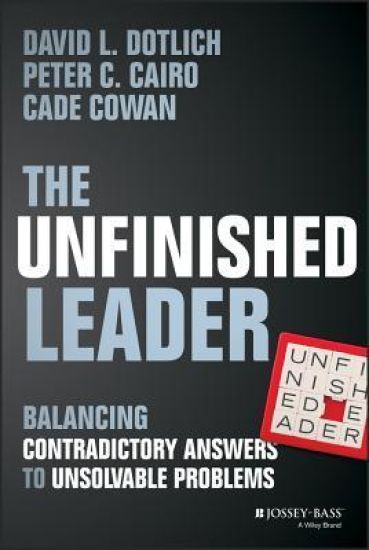
The Unfinished Leader

The Unfinished Leader

David L. Dotlich; Peter C. Cairo; Cade Cowan

John Wiley Sons Inc
2014
sidottu
With the demands of technology, transparency, and constant connectedness, and calls for higher performance, leaders from the front line to the C-suite face complex dilemmas that cannot be easily denied or postponed. These perplexing, recurring issues are familiar to anyone in a leadership role today, including: How do I balance my functional or business unit goals with the needs of my peers and the whole company?How do I support and promote others while still advancing my own career?How do I emphasize teamwork and still reward the “stars”?Can I really devote enough time and energy to both family and work? These are not “problems” but paradoxes—situations in which there will never be a single correct solution—and while they make many leaders feel overwhelmed and challenged, this remarkable book provides help. The Unfinished Leader is a modern handbook for recognizing, facing, and inspiring others to expose the real issues that underlie paradoxes in modern organizations. Leaders must first recognize situations they will never be able to “solve” and understand how to confront the barriers—in their own heads and their organizations—that push them towards seeking ultimate solutions that don’t exist. Leading through complexity requires giving up the illusion of control, consistency, and closure, while embracing the reality of being permanently “unfinished.” Drawing from interviews with 100 CEOs and top leaders from a wide range of companies—such as Avon, Nike, Colgate, DeutschePost DHL, Johnson & Johnson, PepsiCo, and many more— The Unfinished Leader provides the mindsets and tools to recognize contradictory requirements, understand competing demands, and still be able to take action. No one can find or even should look for perfect solutions to impossible situations. The Unfinished Leader will help leaders at all levels understand and excel at their true task: guiding themselves and their teams through ongoing paradoxes, reconciling competing outcomes, continually changing and adapting, and thereby building lasting success.
Wisdom and Management in the Knowledge Economy

Wisdom and Management in the Knowledge Economy

David Rooney; Bernard McKenna; Peter Liesch

Routledge
2014
nidottu
Today there are more technology, technologists, knowledge and experts than at any time in human history; but from a global perspective, it is difficult to argue that this accumulation of knowledge and technology has put the world in an unambiguously better position than it was in the past. Business is not getting any easier to do and major corporate collapses based on poor decisions, poor conduct, and poor judgement continue to occur. In public administration too, basic institutions and services (education, health, transport) seem to be continually undergoing “crises” of inadequate delivery and excessive pressure. Wisdom and Management in the Knowledge Economy explains why unwise managerial practice can happen in a world characterized by an excess of information and knowledge. Drawing on Aristotle’s idea of practical wisdom, the book develops a theory of social practice wisdom that addresses important social psychological and sociological dynamics that underpin wise management and organizations. As well as providing a detailed theory of social practice wisdom, this book considers practical issues in organizational communication, behavior, culture, change and knowledge as well as in HRM, leadership, ethics, strategy, international business, business education, and wisdom research. By introducing the notion of social practice wisdom, aspects of social structure, organizational culture, and organizational communication needed for wisdom to flourish are for the first time rendered visible in a way that opens new possibilities for wiser management, wiser organizations, and wisdom research.