

Kirjahaku
Etsi kirjoja tekijän nimen, kirjan nimen tai ISBN:n perusteella.
1000 tulosta hakusanalla Dominic


Interpretación Hermenéutica de los Tratados Fronterizos entre República Dominicana y Haití
Santiago Edmundo Morales Gómez
Eliva Press
2025
pokkari

![Photography Indoors; Featuring the Work of Dominic Chiesa [and Others]](/covers/9781014087683.jpg)
Photography Indoors; Featuring the Work of Dominic Chiesa [and Others]
Anonymous
Hassell Street Press
2021
sidottu
![Photography Indoors; Featuring the Work of Dominic Chiesa [and Others]](/covers/9781014797377.jpg)
Photography Indoors; Featuring the Work of Dominic Chiesa [and Others]
Anonymous
Hassell Street Press
2021
nidottu

A New Life of St. Dominic: Founder of the Dominican Order
Jordan of Saxony
Literary Licensing, LLC
2012
sidottu
""A New Life of St. Dominic: Founder of the Dominican Order"" is a biographical account of the life of St. Dominic, written by Jordan of Saxony. St. Dominic is known for founding the Dominican Order, a Catholic religious order focused on preaching and teaching. The book covers St. Dominic's early life, his education, his travels, and his work as a preacher and teacher. It also delves into his spiritual life, including his devotion to the Virgin Mary and his belief in the importance of prayer and contemplation. The author, Jordan of Saxony, was a fellow Dominican and a close associate of St. Dominic, which lends an intimate and personal perspective to the account. The book is a detailed and comprehensive look at the life of one of the most important figures in Catholic history and provides insight into the founding and development of the Dominican Order.This scarce antiquarian book is a facsimile reprint of the old original and may contain some imperfections such as library marks and notations. Because we believe this work is culturally important, we have made it available as part of our commitment for protecting, preserving, and promoting the world's literature in affordable, high quality, modern editions, that are true to their original work.

A New Life of St. Dominic: Founder of the Dominican Order
Literary Licensing, LLC
2012
nidottu

The Hound of God: A Story of St. Dominic
Brother Ernest; Nancy Langenbahn
Literary Licensing, LLC
2012
nidottu
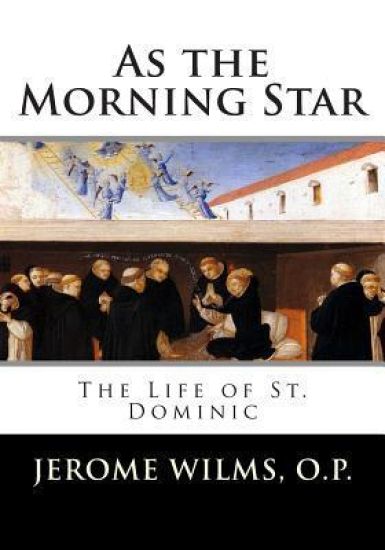
As the Morning Star: The Life of St. Dominic
Jerome Wilms O. P.
Createspace Independent Publishing Platform
1956
nidottu
That after seven hundred years his life is still the subject of historians' endeavors is a clear proof of the deep significance of St. Dominic's personality for his Order, for the clergy, and the entire Church. He lived in the late Middle Ages, when the Chair of Peter was occupied by popes like Innocent III, whose prudence and firmness were active factors in shaping Europe's history. The spirit of faith still had at least a little influence in political matters, and enthusiasm for the reclaiming of the Holy Land swayed men's hearts. However, there were also ominous signs that a religious retrogression had begun.Heretics were stirring up trouble in different localities. Monastic discipline had become relaxed. Spiritual ministrations were being neglected, because the clergy were either entangled in worldly matters or had succumbed to the easy life made available to them by their rich revenues. The ancient landed property of the Church excited the greed of the pious donors' less devout offspring. Revolutionary ideas, hostile to the faith, were being propagated and put into practice, and well-disposed individuals were too ignorant of religious principles to steer themselves out of this dangerous current. By means of General Councils and Diocesan Synods, the Church had issued strict moral decrees for priests and religious concerning their pastoral duties and especially the preaching of the Gospel; but the end was not attained by merely issuing these decrees. Dominic was a man of action. He realized the need of the age and chose as his particular lifework the preaching of the Gospel. He established an Order, dedicated entirely to the salvation of souls by means of teaching and preaching the Word of God. With this foundation Dominic introduced an entirely new element into the history of religious orders. He retained the community life and solemn choral prayer of the Augustinian canons and adopted many austerities from the old monastic orders, but added to all this the stipulation that the particular task of his followers would be the salvation of their fellow men. For that purpose he obliged his disciples to devote themselves, rain or shine, to study and preaching. Dominic became the patriarch of apostolic orders. To all with whom he came in contact, to his brethren and to outsiders, he was in truth an openhanded and largehearted Father, wonderfully indulgent, but at the same time not yielding an inch in those things which mature deliberation had convinced him were necessary, and ready to attempt squaring a circle in order to carry out a worthy undertaking. Such a man has much to tell our own generation, perhaps everything needed for a genuine renewal.Mediatrix Press specializes in reprints of old books and Latin titles that need to get back in print. Many more titles will be forthcoming.

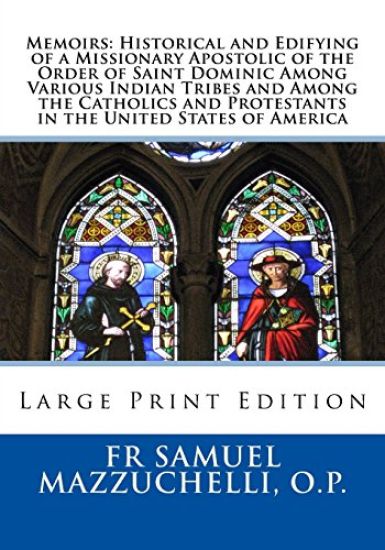
Memoirs: Historical and Edifying of a Missionary Apostolic of the Order of Saint Dominic Among Various Indian Tribes and Among
Samuel Mazzuchelli O. P.
Createspace Independent Publishing Platform
2018
nidottu
TO THE READER Among the motives that persuaded the compiler of these memoirs to consent to their publication, there are two leading ones: First, to comply with the earnest solicitations of many pious persons in Italy, both of the laity and religious of the illustrious Order of Preachers to which the missionary glories in belonging, who have expressed the most eager desire to obtain a more thorough knowledge of his labors in a region little known in Europe, and where, thanks to Divine Assistance, he was able to establish Catholic worship; the second motive he considers as of grave importance, also, as it is with the design of contributing to the Ecclesiastical history of the United States of America, those documents which will one day assist to make clear the beginning of the dioceses of Detroit, of Milwaukee and of Dubuque, recently erected by the Sovereign Pontiff, happily reigning, and make known the obstacles which the servants of the Lord have to encounter in the propagating of the truth of the Gospel. It is to be hoped that this little work which may tend to the edification of some, and may powerfully move the zeal of others for the propagation of the Faith, will redound also to the greater glory of God, which is the only aim proposed by him who writes. It has been thought useful to preface the book with a few thoughts concerning the vocation to the holy missions, and a simple account of the circumstances which attended the same vocation of the person in question, for the benefit of those who feeling called thereto, delay in responding either through misplaced apprehension or for any other reasons. For the better understanding of the subject, and in order not to deviate from the form of a well-conducted narration, although facts and places varied in many respects are treated of, it has been thought best to describe them chronologically, and thus relieve the monotony of the account. Honorable mention has not been omitted of the missions of other priests which were near those of the missionary, not only to render them their just meed of homage, but also that there might be no break in the history of those countries. The compiler would be more diffuse in his description of the missions which in some places preceded those of the missionary, if the accounts given by the old inhabitants of certain places had shown a higher degree of probability. Actuated solely by the thought of helping others, he has intermingled with his own narrations certain moral reflections that sprang from a heart accustomed to derive from all happenings that which makes the blessings of Divine Providence and the sublimity of the Christian virtues shine forth the more resplendently. The name of the missionary and the circumstances of his life not connected with the history of his labors, are withheld as is fitting, since they are considered of no importance to the object of these memoirs, who looks upon himself as but a simple instrument of the Will of the Lord. If any should wonder that the Annals of the Propagation of the Faith have not published at least a portion of these memoirs he must bear in mind, in the first place that not everything which is effected by the missionaries in foreign countries can be known by that wonderful Association which is beyond praise; and moreover, that there are priests who by reason of their great distance from Italy, or the precarious conditions surrounding them, or lastly, perhaps, willing to put into practice the Evangelical Counsel, to let not the left hand know what the right hand doeth, fail to set forth their deeds in public. We are to consider, however, that our Lord counseled us to make known our good works and glorify our Father Who is in Heaven (St. Matthew, V. 16); He Who graciously disposes all things, has appointed in His inscrutable ways, the time, when, with Christian prudence, not through vainglory, or through any other human motive, it will be fitting to reveal His works.
Memoirs: Historical and Edifying of a Missionary Apostolic of the Order of Saint Dominic Among Various Indian Tribes and Among
Samuel Mazzuchelli O. P.
Createspace Independent Publishing Platform
2018
nidottu
Among the motives that persuaded the compiler of these memoirs to consent to their publication, there are two leading ones: First, to comply with the earnest solicitations of many pious persons in Italy, both of the laity and religious of the illustrious Order of Preachers to which the missionary glories in belonging, who have expressed the most eager desire to obtain a more thorough knowledge of his labors in a region little known in Europe, and where, thanks to Divine Assistance, he was able to establish Catholic worship; the second motive he considers as of grave importance, also, as it is with the design of contributing to the Ecclesiastical history of the United States of America, those documents which will one day assist to make clear the beginning of the dioceses of Detroit, of Milwaukee and of Dubuque, recently erected by the Sovereign Pontiff, happily reigning, and make known the obstacles which the servants of the Lord have to encounter in the propagating of the truth of the Gospel. It is to be hoped that this little work which may tend to the edification of some, and may powerfully move the zeal of others for the propagation of the Faith, will redound also to the greater glory of God, which is the only aim proposed by him who writes. It has been thought useful to preface the book with a few thoughts concerning the vocation to the holy missions, and a simple account of the circumstances which attended the same vocation of the person in question, for the benefit of those who feeling called thereto, delay in responding either through misplaced apprehension or for any other reasons. For the better understanding of the subject, and in order not to deviate from the form of a well-conducted narration, although facts and places varied in many respects are treated of, it has been thought best to describe them chronologically, and thus relieve the monotony of the account. Honorable mention has not been omitted of the missions of other priests which were near those of the missionary, not only to render them their just meed of homage, but also that there might be no break in the history of those countries. The compiler would be more diffuse in his description of the missions which in some places preceded those of the missionary, if the accounts given by the old inhabitants of certain places had shown a higher degree of probability. Actuated solely by the thought of helping others, he has intermingled with his own narrations certain moral reflections that sprang from a heart accustomed to derive from all happenings that which makes the blessings of Divine Providence and the sublimity of the Christian virtues shine forth the more resplendently. The name of the missionary and the circumstances of his life not connected with the history of his labors, are withheld as is fitting, since they are considered of no importance to the object of these memoirs, who looks upon himself as but a simple instrument of the Will of the Lord. If any should wonder that the Annals of the Propagation of the Faith have not published at least a portion of these memoirs he must bear in mind, in the first place that not everything which is effected by the missionaries in foreign countries can be known by that wonderful Association which is beyond praise; and moreover, that there are priests who by reason of their great distance from Italy, or the precarious conditions surrounding them, or lastly, perhaps, willing to put into practice the Evangelical Counsel, to let not the left hand know what the right hand doeth, fail to set forth their deeds in public. We are to consider, however, that our Lord counseled us to make known our good works and glorify our Father Who is in Heaven (St. Matthew, V. 16); He Who graciously disposes all things, has appointed in His inscrutable ways, the time, when, with Christian prudence, not through vainglory, or through any other human motive, it will be fitting to reveal His works.
Sambumbia; a Discovery of the Dominican Republic, the Modern Hispañola
Page Cooper
Hassell Street Press
2021
sidottu
This work has been selected by scholars as being culturally important and is part of the knowledge base of civilization as we know it.This work is in the public domain in the United States of America, and possibly other nations. Within the United States, you may freely copy and distribute this work, as no entity (individual or corporate) has a copyright on the body of the work.Scholars believe, and we concur, that this work is important enough to be preserved, reproduced, and made generally available to the public. To ensure a quality reading experience, this work has been proofread and republished using a format that seamlessly blends the original graphical elements with text in an easy-to-read typeface.We appreciate your support of the preservation process, and thank you for being an important part of keeping this knowledge alive and relevant.
Sambumbia; a Discovery of the Dominican Republic, the Modern Hispañola
Page Cooper
Hassell Street Press
2021
nidottu
Sacrorum Conciliorum Nova Et Amplissima Collectio, Cujus Johannes Dominicus Mansi Et Post Ipsius Mortem Florentius Et Venetianus Editores Ab Anno 1758 Ad Annum 1798 Priores Triginta Unum Tomos Ediderunt, Nunc Autem Continuatat Et Absoluta, Volume 29...
Giovan Domenico Mansi; Philippe Labbe
Hutson Street Press
2025
sidottu
Sacrorum Conciliorum Nova Et Amplissima Collectio, Cujus Johannes Dominicus Mansi Et Post Ipsius Mortem Florentius Et Venetianus Editores Ab Anno 1758 Ad Annum 1798 Priores Triginta Unum Tomos Ediderunt, Nunc Autem Continuatat Et Absoluta, Volume 26...
Giovan Domenico Mansi; Philippe Labbe
Hutson Street Press
2025
sidottu

Sacrorum Conciliorum Nova Et Amplissima Collectio, Cujus Johannes Dominicus Mansi Et Post Ipsius Mortem Florentius Et Venetianus Editores Ab Anno 1758 Ad Annum 1798 Priores Triginta Unum Tomos Ediderunt, Nunc Autem Continuatat Et Absoluta, Volume 4...
Giovan Domenico Mansi; Philippe Labbe
Hutson Street Press
2025
sidottu