Title: Introductory remarks to a narrative of the irruption of the Kafir hordes, into the Eastern Province of the Cape of Good Hope, A.D. 1834-35. By the editor of the "Graham's Town Journal" i.e. Robert Godlonton]. Part I (Parts II & III).Publisher: British Library, Historical Print EditionsThe British Library is the national library of the United Kingdom. It is one of the world's largest research libraries holding over 150 million items in all known languages and formats: books, journals, newspapers, sound recordings, patents, maps, stamps, prints and much more. Its collections include around 14 million books, along with substantial additional collections of manuscripts and historical items dating back as far as 300 BC.The GENERAL HISTORICAL collection includes books from the British Library digitised by Microsoft. This varied collection includes material that gives readers a 19th century view of the world. Topics include health, education, economics, agriculture, environment, technology, culture, politics, labour and industry, mining, penal policy, and social order. ++++The below data was compiled from various identification fields in the bibliographic record of this title. This data is provided as an additional tool in helping to insure edition identification: ++++ British Library Godlonton, Robert; 1835, 36. 2 pt., 270 p., plate: map; 8 . 8154.bb.57.
The 18th century was a wealth of knowledge, exploration and rapidly growing technology and expanding record-keeping made possible by advances in the printing press. In its determination to preserve the century of revolution, Gale initiated a revolution of its own: digitization of epic proportions to preserve these invaluable works in the largest archive of its kind. Now for the first time these high-quality digital copies of original 18th century manuscripts are available in print, making them highly accessible to libraries, undergraduate students, and independent scholars.The Age of Enlightenment profoundly enriched religious and philosophical understanding and continues to influence present-day thinking. Works collected here include masterpieces by David Hume, Immanuel Kant, and Jean-Jacques Rousseau, as well as religious sermons and moral debates on the issues of the day, such as the slave trade. The Age of Reason saw conflict between Protestantism and Catholicism transformed into one between faith and logic -- a debate that continues in the twenty-first century.++++The below data was compiled from various identification fields in the bibliographic record of this title. This data is provided as an additional tool in helping to insure edition identification: ++++British LibraryT105453With a half-title.London: printed for C. Dilly, 1790. 4], xv, 1],507, 1]p.; 8
The 18th century was a wealth of knowledge, exploration and rapidly growing technology and expanding record-keeping made possible by advances in the printing press. In its determination to preserve the century of revolution, Gale initiated a revolution of its own: digitization of epic proportions to preserve these invaluable works in the largest archive of its kind. Now for the first time these high-quality digital copies of original 18th century manuscripts are available in print, making them highly accessible to libraries, undergraduate students, and independent scholars.Delve into what it was like to live during the eighteenth century by reading the first-hand accounts of everyday people, including city dwellers and farmers, businessmen and bankers, artisans and merchants, artists and their patrons, politicians and their constituents. Original texts make the American, French, and Industrial revolutions vividly contemporary.++++The below data was compiled from various identification fields in the bibliographic record of this title. This data is provided as an additional tool in helping to insure edition identification: ++++British LibraryT106146With a half-title.Dublin: printed for H. Chamberlaineand Rice, L. White, W. Mc. Kenzie, J. Moore, Grueber and Mc. Allister, and 2 others in Dublin], 1790. xx,315, 1]p.; 12
Fulton J. Sheen, Norman Vincent Peale, and Billy Graham were America’s most popular religious leaders during the mid-twentieth century period known as the golden years of the Age of Extremes. It was part of an era that encompassed polemic contrasts of good and evil on the world stage in political philosophies and international relations. The 1950s and early 1960s, in particular, were years of high anxiety, competing ideologies, and hero/villain mania in America. Sheen was the voice of reason who spoke against those conflicting ideologies which were hostile to religious faith and democracy; Peale preached the gospel of reassurance, self-assurance, and success despite ominous global threats; and Graham was the heroic model of faith whose message of conversion provided Americans an identity and direction opposite to atheistic communism. This study looks at how and why their rhetorical leadership, both separately and together, contributed to the climate of an extreme era and influenced a national religious revival.
In this engaging fictional conversation, Peter Kreeft gives credible voices to C. S. Lewis, J. R. R. Tolkien, and Billy Graham as they discuss one of the most contentious questions in the history of Christianity: Is Jesus symbolically or substantially present in the Eucharist?These widely respected modern Christian witnesses represent three important Western theological traditions. Graham, an ordained Southern Baptist minister who traversed the world and the airwaves to spread the good news of salvation, represents evangelical Protestantism. Lewis, an Oxford professor, a prolific Christian apologist, and the author of The Chronicles of Narnia, was a member of the Church of England. Also an Oxford don, Tolkien was a friend of Lewis, the author of The Lord of the Rings, and a Roman Catholic.While Lewis and Tolkien likely discussed the Eucharist during their long friendship, the conversation in this book never took place--but it could have, says Kreeft, who faithfully presents the views of these three impressive men.
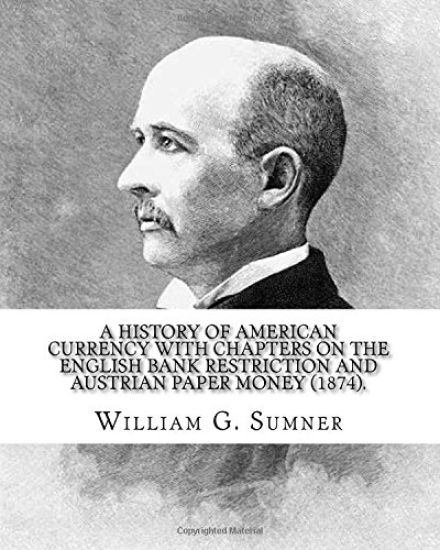
William Graham Sumner (October 30, 1840 - April 12, 1910) was a classical liberal (now a branch of "libertarianism" in American political philosophy) American social scientist. He taught social sciences at Yale, where he held the nation's first professorship in sociology. He was one of the most influential teachers at Yale or any major schools. Sumner was a polymath with numerous books and essays on American history, economic history, political theory, sociology, and anthropology. He supported laissez-faire economics, free markets, and the gold standard. He adopted the term "ethnocentrism" to identify the roots of imperialism, which he strongly opposed. He was a spokesman against imperialism and in favor of the "forgotten man" of the middle class, a term he coined. He had a long-term influence on conservatism in the United States.Sumner wrote an autobiographical sketch for the fourth of the histories of the Class of 1863 Yale College. In 1925, Rev. Harris E. Starr, class of 1910 Yale Department of Theology, published the first full length biography of Sumner. A second full length biography by Bruce Curtis was published in 1981. Other authors have included biographical information about Sumner as shown by citations in this "Biography" section.Sumner was born in Paterson, New Jersey, on October 30, 1840. His father, Thomas Sumner, was born in England and immigrated to the United States in 1836. His mother, Sarah Graham, was also born in England. She was brought to the United States in 1825 by her parents. Sumner's mother died when he was eight.In 1841, Sumner's father went prospecting as far west as Ohio, but came back east to New England and settled in Hartford, Connecticut, in about 1845. Sumner wrote about his high regard for his father: "His principles and habits of life were the best possible." Earlier in his life, Sumner said, that he accepted from others "views and opinions" different from his father's. However, "at the present time," Sumner wrote, "in regard to those matters, I hold with him and not with the others." Sumner did not name the "matters". Sumner was educated in the Hartford public schools. After graduation, he worked for two years as a clerk in a store before going to Yale College from which he graduated in 1863. Sumner achieved an impressive record at Yale as a scholar and orator. He was elected to the Phi Beta Kappa Society in his junior year and in his senior year to the secretive Skull and Bones society. Sumner avoided being drafted to fight in the American Civil War by paying a "substitute" $250, given to him by a friend, to enlist for three years. This and money given to him by his father and friends allowed Sumner to go to Europe for further studies. He spent his first year in the University of Geneva studying Latin and Hebrew and the following two years in the University of G ttingen studying ancient languages, history and Biblical science.All told, in his formal education, Sumner learned Hebrew, Greek, Latin, French, and German. In addition, after middle age he taught himself Dutch, Spanish, Portuguese, Italian, Russian, Polish, Danish, and Swedish. In May 1866, he went to Oxford University to study theology. At Oxford, Henry Thomas Buckle planted the sociology seed in Sumner's mind. However, Herbert Spencer was to have the "dominating influence upon Sumner's thought"....
The Life and Times of the Right Honourable Sir James R. G. Graham - Vol. 2 is an unchanged, high-quality reprint of the original edition of 1863. Hansebooks is editor of the literature on different topic areas such as research and science, travel and expeditions, cooking and nutrition, medicine, and other genres. As a publisher we focus on the preservation of historical literature. Many works of historical writers and scientists are available today as antiques only. Hansebooks newly publishes these books and contributes to the preservation of literature which has become rare and historical knowledge for the future.

![A Narrative of the Irruption of the Kafir Hordes Into the Eastern Province of the Cape of Good Hope, 1834-35. Compiled from Official Documents by the Editor of the "Graham's Town Journal" [I.E. Robert Godlonton].](/covers/9781241434014.jpg)
![Introductory Remarks to a Narrative of the Irruption of the Kafir Hordes, Into the Eastern Province of the Cape of Good Hope, A.D. 1834-35. by the Editor of the "Graham's Town Journal" [I.E. Robert Godlonton]. Part I (Parts II and III).](/covers/9781241438944.jpg)