Kirjojen hintavertailu. Mukana 11 242 230 kirjaa ja 12 kauppaa.

Kirjahaku

Etsi kirjoja tekijän nimen, kirjan nimen tai ISBN:n perusteella.

1000 tulosta hakusanalla Kenneth C Springirth

Texas vs. California

Texas vs. California

Kenneth P. Miller

Oxford University Press Inc
2020
nidottu
Texas and California are the leaders of Red and Blue America. As the nation has polarized, its most populous and economically powerful states have taken charge of the opposing camps. These states now advance sharply contrasting political and policy agendas and view themselves as competitors for control of the nation's future. Kenneth P. Miller provides a detailed account of the rivalry's emergence, present state, and possible future. First, he explores why, despite their many similarities, the two states have become so deeply divided. As he shows, they experienced critical differences in their origins and in their later demographic, economic, cultural, and political development. Second, he describes how Texas and California have constructed opposing, comprehensive policy models--one conservative, the other progressive. Miller highlights the states' contrasting policies in five areas--tax, labor, energy and environment, poverty, and social issues--and also shows how Texas and California have led the red and blue state blocs in seeking to influence federal policy in these areas. The book concludes by assessing two models' strengths, vulnerabilities, and future prospects. The rivalry between the two states will likely continue for the foreseeable future, because California will surely stay blue and Texas will likely remain red. The challenge for the two states, and for the nation as a whole, is to view the competition in a positive light and turn it to productive ends. Exploring one of the primary rifts in American politics, Texas vs. California sheds light on virtually every aspect of the country's political system.
The Psychology of Strategy: Exploring Rationality in the Vietnam War
How do strategists decide what they wish to achieve through war, and how they might accomplish it? And why does their understanding of violence regularly turn out to be wrong? In seeking answers to these questions Kenneth Payne draws on the study of psychology to examine strategic behaviour during the Vietnam War. He explores the ways in which cognitive biases distort our sense of our own agency and our decision-making, arguing that much of the latter is emotional, shaped by unconscious processing and driven by a prickly concern for social esteem. The Nixon and Johnson administrations both proved susceptible to the processes that are familiar to students of modern neuroscience and psychology, but perhaps less appreciated within strategic studies. US strategists in the Vietnam era miscalculated in ways that would surprise rational theorists, but not evolutionary psychologists: they exaggerated the stakes, embraced risky and overly optimistic solutions, and failed to appreciate the limits of force to shatter the enemy's resolve. Their concern for reputation led to escalation, based on a flawed conception of what such escalation could achieve. The Vietnam conflict provides an excellent illustration that war is an inherently psychological phenomenon. This challenges abstract notions of rationality in strategic affairs, suggesting that the strategists -- much like the rest of us -- are strangers to themselves.
The Spanish Atlantic World, 1492–1825

The Spanish Atlantic World, 1492–1825

Kenneth J. Andrien

OXFORD UNIVERSITY PRESS INC
2025
sidottu
The overseas enterprises of Spain expanded dramatically following the first voyage of Christopher Columbus in 1492. The Spanish had already conquered the Canary Islands, which served as a base for the later conquest of lands in the Americas (known as the Indies) that served as the foundation of the Spanish Atlantic world. After 1492 Spanish colonists fanned out from a few Caribbean outposts to Mexico, as armies overthrew the Aztec Empire and annexed the Maya domains in southern Mexico and Central America. In just over a decade the Spaniards brought down the Inca Empire, giving the Castilians control over the vast human and mineral resources in South America. Over the course of the sixteenth century, the Castilian invaders, followed by crown bureaucrats and Catholic clergymen, consolidated control over the central regions of Mexico and Peru. Spain eventually claimed control over the vast region from the current southwest of the United States to the southern tip of South America, creating a massive domain that brought unimaginable wealth to the Kingdoms of Spain. This wide-ranging study examines the evolution of the Spanish Atlantic World from its inception with the voyages of Christopher Columbus through the period of conquest and expansion in the sixteenth century, the era of consolidation in the seventeenth century, to the reform and renovation of the eighteenth century, culminating in its slow-motion collapse by 1825. Drawing on traditions from the long Reconquest of the Iberian Peninsula from the Muslims, the first conquistadors and settlers attempted to establish a stratified patriarchal society, based on Roman Catholic values and firmly tied to metropolitan Spain and the wider Atlantic world. As Spain became mired in a series of disastrous wars with European rivals and the colonial economy expanded, diversified, and became more self-sufficient in the seventeenth century, colonial elites gained greater political and social power. Under the new French Bourbon dynasty after 1700, crown ministers framed Enlightenment-inspired policies to reform the Spanish Atlantic world, creating a more centralized state apparatus with the ability to raise taxes, curtail contraband commerce, and establish a military capable of defending the interests of the crown against its European foes. These Bourbon Reforms enjoyed successes, despite provoking opposition among conservative groups in Spain and unrest and revolts in the Indies. Finally, Spain became embroiled in the wars of the French Revolution and the rise of Napoleon Bonaparte, which led a French invasion of Iberia, political tumult in Spain and the Indies, and the collapse of the Spanish Atlantic World and independence for the Americas. Drawing on his extensive research and the most recent literature, eminent historian Kenneth J. Andrien lucidly narrates the three hundred years during which the Spanish Indies evolved from kingdoms of the crown to dependent colonies to independent nations, leading to the fracturing of the Spanish Atlantic world.
The Spanish Atlantic World, 1492–1825

The Spanish Atlantic World, 1492–1825

Kenneth J. Andrien

OXFORD UNIVERSITY PRESS INC
2025
nidottu
The overseas enterprises of Spain expanded dramatically following the first voyage of Christopher Columbus in 1492. The Spanish had already conquered the Canary Islands, which served as a base for the later conquest of lands in the Americas (known as the Indies) that served as the foundation of the Spanish Atlantic world. After 1492 Spanish colonists fanned out from a few Caribbean outposts to Mexico, as armies overthrew the Aztec Empire and annexed the Maya domains in southern Mexico and Central America. In just over a decade the Spaniards brought down the Inca Empire, giving the Castilians control over the vast human and mineral resources in South America. Over the course of the sixteenth century, the Castilian invaders, followed by crown bureaucrats and Catholic clergymen, consolidated control over the central regions of Mexico and Peru. Spain eventually claimed control over the vast region from the current southwest of the United States to the southern tip of South America, creating a massive domain that brought unimaginable wealth to the Kingdoms of Spain. This wide-ranging study examines the evolution of the Spanish Atlantic World from its inception with the voyages of Christopher Columbus through the period of conquest and expansion in the sixteenth century, the era of consolidation in the seventeenth century, to the reform and renovation of the eighteenth century, culminating in its slow-motion collapse by 1825. Drawing on traditions from the long Reconquest of the Iberian Peninsula from the Muslims, the first conquistadors and settlers attempted to establish a stratified patriarchal society, based on Roman Catholic values and firmly tied to metropolitan Spain and the wider Atlantic world. As Spain became mired in a series of disastrous wars with European rivals and the colonial economy expanded, diversified, and became more self-sufficient in the seventeenth century, colonial elites gained greater political and social power. Under the new French Bourbon dynasty after 1700, crown ministers framed Enlightenment-inspired policies to reform the Spanish Atlantic world, creating a more centralized state apparatus with the ability to raise taxes, curtail contraband commerce, and establish a military capable of defending the interests of the crown against its European foes. These Bourbon Reforms enjoyed successes, despite provoking opposition among conservative groups in Spain and unrest and revolts in the Indies. Finally, Spain became embroiled in the wars of the French Revolution and the rise of Napoleon Bonaparte, which led a French invasion of Iberia, political tumult in Spain and the Indies, and the collapse of the Spanish Atlantic World and independence for the Americas. Drawing on his extensive research and the most recent literature, eminent historian Kenneth J. Andrien lucidly narrates the three hundred years during which the Spanish Indies evolved from kingdoms of the crown to dependent colonies to independent nations, leading to the fracturing of the Spanish Atlantic world.
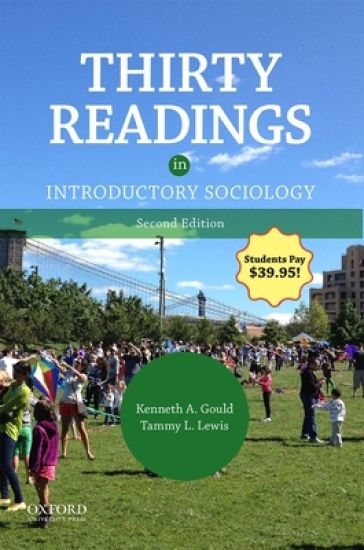
Thirty Readings in Introductory Sociology

Thirty Readings in Introductory Sociology

Kenneth A. Gould; Tammy L. Lewis

Oxford University Press
2016
nidottu
Thirty Readings in Introductory Sociology, Second Edition, introduces students to the field of sociology in an engaging, accessible manner. Designed to be used alone or with its companion, Ten Lessons in Introductory Sociology, the book is organized around four themes commonly examined in introductory courses: Why sociology? What unites society? What divides society? and How do societies change? Rather than provide encyclopedic responses to such questions, Thirty Readings in Introductory Sociology engages students in critical thinking while presenting key concepts and methods in sociology. Edited by Kenneth A. Gould and Tammy L. Lewis, the text raises sociological questions, applies a sociological lens, illustrates how data are used, and presents core topics in a way that is easy for students to grasp. Each section begins with an introduction by Gould and Lewis, followed by three readings: one classical, one that uses qualitative data, and a third that uses quantitative data.
Fighting at the Legal Boundaries

Fighting at the Legal Boundaries

Kenneth Watkin

Oxford University Press Inc
2016
sidottu
The international law governing armed conflict is at a crossroads, as the formal framework of laws designed to control the exercise of self-defense and conduct of inter-state conflict finds itself confronted with violent 21st Century disputes of a very different character. Military practitioners who seek to stay within the bounds of international law often find themselves applying bodies of law-IHRL, IHL, ICL-in an exclusionary fashion, and adherence to those boundaries can lead to a formal and often rigid application of the law that does not adequately address contemporary security challenges. Fighting at the Legal Boundaries offers a holistic approach towards the application of the various constitutive parts of international law. The author focuses on the interaction between the applicable bodies of law by exploring whether their boundaries are improperly drawn, or are being interpreted in too rigid a fashion. Emphasis is placed on the disconnect that can occur between theory and practice regarding how these legal regimes are applied and interact with one another. Through a number of case studies, Fighting at the Legal Boundaries explores how the threat posed by insurgents, terrorists, and transnational criminal gangs often occurs not only at the point where these bodies of law interact, but also in situations where there is significant overlap. In this regard, the exercise of the longstanding right of States to defend nationals, including the conduct of operations such as hostage rescue, can involve the application of human rights based law enforcement norms to counter threats transcending the conflict spectrum. This book has five parts: Part I sets out the security, legal, and operational challenges of contemporary conflict. Part II focuses on the interaction between the jus ad bellum, humanitarian law and human rights, including an analysis of the historical influences that shaped their application as separate bodies of law. Emphasis is placed on the influence the proper authority principle has had in the human rights based approach being favored when dealing with "criminal" non-State actors during both international and non-international armed conflict. Part III analyzes the threats of insurgency and terrorism, and the state response. This includes exploring their link to criminal activity and the phenomenon of transnational criminal organizations. Part IV addresses the conduct of operations against non-State actors that span the conflict spectrum from inter-state warfare to international law enforcement. Lastly, Part V looks at the way ahead and discusses the approaches that can be applied to address the evolving, diverse and unique security threats facing the international community.
Bits and Pieces

Bits and Pieces

Kenneth B. McAlpine

Oxford University Press Inc
2018
sidottu
Bits and Pieces tells the story of chiptune, a style of lo-fi electronic music that emerged from the first generation of video game consoles and home computers in the late 1970s and early 1980s. Through ingenuity and invention, musicians and programmers developed code that enabled the limited hardware of those early 8-bit machines to perform musical feats that they were never designed to achieve. In time, that combination of hardware and creative code came to define a unique 8-bit sound that imprinted itself on a generation of gamers. For a new generation of musicians, this music has currency through the chipscene, a vibrant musical subculture that repurposes obsolete gaming hardware. It's performative: raw and edgy, loaded with authenticity and driven by a strong DIY ethic. It's more punk than Pac-Man, and yet, it's part of that same story of ingenuity and invention; 8-bit hardware is no longer a retired gaming console, but a quirky and characterful musical instrument. Taking these consoles to the stage, musicians fuse 8-bit sounds with other musical styles - drum'n'bass, jungle, techno and house - to create a unique contemporary sound. Analyzing musical structures and technological methods used with chiptune, Bits and Pieces traces the simple beeps of the earliest arcade games, through the murky shadows of the digital underground, to global festivals and movie soundtracks.
Bits and Pieces

Bits and Pieces

Kenneth B. McAlpine

Oxford University Press Inc
2018
nidottu
Bits and Pieces tells the story of chiptune, a style of lo-fi electronic music that emerged from the first generation of video game consoles and home computers in the late 1970s and early 1980s. Through ingenuity and invention, musicians and programmers developed code that enabled the limited hardware of those early 8-bit machines to perform musical feats that they were never designed to achieve. In time, that combination of hardware and creative code came to define a unique 8-bit sound that imprinted itself on a generation of gamers. For a new generation of musicians, this music has currency through the chipscene, a vibrant musical subculture that repurposes obsolete gaming hardware. It's performative: raw and edgy, loaded with authenticity and driven by a strong DIY ethic. It's more punk than Pac-Man, and yet, it's part of that same story of ingenuity and invention; 8-bit hardware is no longer a retired gaming console, but a quirky and characterful musical instrument. Taking these consoles to the stage, musicians fuse 8-bit sounds with other musical styles - drum'n'bass, jungle, techno and house - to create a unique contemporary sound. Analyzing musical structures and technological methods used with chiptune, Bits and Pieces traces the simple beeps of the earliest arcade games, through the murky shadows of the digital underground, to global festivals and movie soundtracks.
No Small Hope

No Small Hope

Kenneth A. Reinert

Oxford University Press Inc
2018
sidottu
With headlines focused on human suffering-civil wars, refugee flows, the spread of disease due to hunger and poor sanitation, population growth, climate change-it is easy to dive into despair. What is needed, instead, is a radical rethinking of global policy to realize the potential for improving the human condition. This book help provides hope by examining the basic needs for a fundamental shift in thinking about development and human security for both practical and ethical reasons. Kenneth A. Reinert calls for a basic goods approach that focuses on the provision of nutritious food, clean water, sanitation, health services, education services, housing, electricity, and human security services. This approach bridges two perspectives: that of standard growth, which emphasizes increasing GDP per capita, and that of capabilities/human development, which puts priority on the realization of human potential. Reinert argues that only when growth leads to an increase in the broad-based provision of basic goods and services will the hoped-for expansion of human capabilities and development be achieved. In short, basic goods and services are a critical link between growth and human development. No Small Hope: Towards the Universal Provision of Basic Goods places the basic goods approach on the firm foundation of objective human needs and subsistence rights. It offers a practical agenda for making real progress towards human development by focusing on the real determinants of human well-being in an ethical system of moral minimalism. In a world of climate change, increased risk of natural disasters and increased refugee flows, the basic goods approach promises to help alleviate ongoing suffering and address vast deprivations in basic needs fulfillment.
Aristophanes' Wasps

Aristophanes' Wasps

Kenneth Rothwell

OXFORD UNIVERSITY PRESS INC
2019
nidottu
Aristophanes' Wasps (422 B.C.) is an entertaining comedy that plunges us into the life of a family in classical Athens, while treating themes that readers of any time and place can appreciate. A father and son argue about politics, household servants try to please their master, a disruptive gang of the father's friends decide to intervene, a dog becomes a lightning-rod for his antics in the kitchen, attempts are made at reform and reconciliation, and it all ends with a drinking party that goes disastrously wrong. The father, Philocleon, and his friends, the chorus of wasp-like old men for whom the play is named, are some of the great creations of comic drama. The characters of the Wasps make constant references to the everyday world they are living in: its political demagogues, court system, religious rituals, social niceties, class distinctions, diseases, clothes, food, toilets, paychecks, geography, weather, household items, literary and mythological allusions, military experiences, and much more. These references give the play its immediacy, but their unfamiliarity to modern students can pose a challenge. This edition provides a full introduction devoted to the political, social, and literary background of the play, as well as notes to the text explaining historical details.
The Gerontological Imagination

The Gerontological Imagination

Kenneth F. Ferraro

Oxford University Press Inc
2018
nidottu
The scientific study of aging is a relatively nascent field of inquiry. Although philosophic and literary reflections on what it means to grow older appear in the earliest historical records, the systematic study of aging began in earnest about a century ago. Scholarly interest in the topic has accelerated in recent decades, due in part to rapid population aging in developed nations. As a result, the study of aging has been incorporated into many disciplines, emphasizing concepts, theories, and methods to elucidate the antecedents and consequences of growing older. Although each discipline has key concepts and empirical generalizations about aging, there is little agreement across disciplines about the intellectual core of gerontology. Each discipline brings its own intellectual heritage and perspective to the study of aging, but the question posed by author Ken Ferraro is whether there is an emergent perspective or way of thinking about aging that transcends the disciplines. Biologists, psychologists, and sociologists may claim an interest in gerontology, but do they have a common image of aging or a set of principles to guide their research? Do they share a paradigm-a fundamental image of aging-that incorporates concepts and empirical generalizations from multiple disciplines? And when disciplinary approaches to gerontology clash, which approach or conceptualization of aging is likely to emerge as part of the paradigm? Although biologists, psychologists, and social scientists share an interest in the study of aging, they are distinctive in how they conduct their research. The Gerontological Imagination provides an integrative paradigm of aging that makes it the first book to identify intellectual common ground among scholars studying aging. Ferraro identifies an underlying set of principles that constitute a paradigm for the study of aging: causality, life course analysis, multifaceted change, heterogeneity, accumulation processes, and ageism. The proposed paradigm provides an efficient way to identify and interpret essential ideas, findings, models, and theories across multiple disciplines that study aging.
The First Bilateral Investment Treaties

The First Bilateral Investment Treaties

Kenneth J. Vandevelde

Oxford University Press Inc
2017
sidottu
The First Bilateral Investment Treaties is the first and only history of the U.S. postwar Friendship, Commerce, and Navigation (FCN) treaty program, and focuses on the investment-related provisions of those treaties. The 22 U.S. postwar FCN treaties were the first bilateral investment treaties ever concluded, and nearly all of the core provisions in the modern network of more than 3000 international investment agreements worldwide trace their origin to these FCN treaties. This book explains the original understanding of the language of this vast network of agreements which have been and continue to be the subject of hundreds of international arbitrations and billions of dollars in claims. It is based on a review of some 32,000 pages of negotiating history housed in the National Archives. This book demonstrates that the investment provisions were founded on the New Deal liberalism of the Roosevelt-Truman administrations and were intended to acquire for U.S. companies investing abroad the same protections that foreign investors already received in the United States under the U.S. Constitution. It chronicles the failed U.S. attempt to obtain protection for investment through the proposed International Trade Organization (ITO), providing the first and only history of the investment-related provisions in the ITO Charter. It then shows how the FCN treaties, which dated back to 1776 and originally concerned with establishing trade and maritime relations, were re-conceptualized as investment treaties to provide investment protection bilaterally. This book is also a work of diplomatic history, offering an account of the negotiating history of each of the 22 treaties and describing U.S. negotiating policy and strategy.
Labor Economics: Principles in Practice

Labor Economics: Principles in Practice

Kenneth McLaughlin

Oxford University Press
2018
sidottu
Labor markets affect us all in important ways, but most books for this course take a very scholarly and theoretical approach to the subject. Connecting the theory to real life is essential. McLaughlin's text--the first in this market to apply a more pedagogical approach to the study of labor economics--makes that leap for students.
Beyond the Tyranny of Testing

Beyond the Tyranny of Testing

Kenneth J. Gergen; Scherto R. Gill

Oxford University Press Inc
2020
sidottu
Measurement-based assessment has dominated our educational systems at the expense of the learning and the well-being of students and teachers. In this book, Gergen and Gill propose a radical alternative to this broken system, which is based instead on an inspirational conception of schools as sites of collective meaning-making and a relational orientation to evaluation. The authors acknowledge that it is within the process of relating that the world comes to be meaningful for us, and equally, learning and well-being are embedded in relational process, which testing and grades undermine. Providing detailed illustrations using cases from pioneering schools around the globe at both the primary and secondary level, this book demonstrates how a relational orientation to evaluation in education can enhance learning processes, foster students' engagement, vitalize relationships, and elevate the evaluation of teaching and the school as a whole. Featuring collaborative learning, dialogic pedagogy, and flexible curricula, relational evaluation truly speaks to the demands of a rapidly changing world.
Chasing Pain: The Search for a Neurobiological Mechanism

Chasing Pain: The Search for a Neurobiological Mechanism

Kenneth L. Casey

Oxford University Press Inc
2019
nidottu
Conceptual models of how pain is created influence medical practice, neuroscientific research, and philosophical ideas about pain and other neurological functions. Given the broad scope of pain experiences, realistic models of pain neurobiology must consider the correlation between pain and tissue damage and how it is strongly affected by neurological disease, emotionally compelling circumstances, and by complex cognitive processes. Recent discoveries have made it clear that both sensory and affective systems are strongly modulated by activity in other sensory pathways and by affective and cognitive processes originating in the brain. As a result, pain should then be conceived as emerging from the conjoint activity of both sensory and affective neural systems, each becoming a target for pain treatment. Historically, pain has been conceived as emerging either from an undefined pattern of neural activity or from anatomically and physiologically unique structures in the nervous system. Observations made during the early and mid- 20th century showed that pain and pain-like behaviors normally require not only sensory detectors of noxious events (called nociceptors) but also brain affective (hedonic) mechanisms that generate emotional experience and expression. In Chasing Pain, pain specialists and neuroscientists will find a thoughtful discussion of the neuroscientific and clinical evidence that has led to contemporary concepts of pain neurobiology and how pain might emerge from neuronal activity. Written in a concise and annotated format, Doctor Kenneth Casey reveals that while contemporary research has greatly enriched our model of pain neurobiology, several important and therapeutically challenging clinical conditions remain poorly understood.
Armies of Sand

Armies of Sand

Kenneth Pollack

Oxford University Press Inc
2019
sidottu
Since World War II, Arab armed forces have consistently punched below their weight--they have lost many wars that by all rights they should have won, and in their best performances only ever achieved quite modest accomplishments. Over time, soldiers, scholars, and military experts have offered various explanations for this pattern. Reliance on Soviet military methods, the poor civil-military relations of the Arab world, the underdevelopment of the Arab states, and patterns of behavior derived from the wider Arab culture, have all been suggested as the ultimate source of Arab military difficulties. Armies of Sand, powerful and riveting history of Arab armies from the end of World War Two to the present, assesses these differing explanations and isolates the most important causes. Over the course of the book, he examines the combat performance of fifteen Arab armies and air forces in virtually every Middle Eastern war, from the Jordanians and Syrians in 1948 to Hizballah in 2006 and the Iraqis and ISIS in 2014-2017. He then compares these experiences to the performance of the Argentine, Chadian, Chinese, Cuban, North Korean, and South Vietnamese armed forces in their own combat operations during the twentieth century. The book ultimately concludes that reliance on Soviet doctrine was more of a help than a hindrance to the Arabs. In contrast, politicization and underdevelopment were both important factors limiting Arab military effectiveness, but patterns of behavior derived from the dominant Arab culture was the most important factor of all. Pollack closes with a discussion of the rapid changes occurring across the Arab world-political, economic, and cultural-as well as the rapid evolution in war making as a result of the information revolution. He suggests that because both Arab society and warfare are changing, the problems that have bedeviled Arab armed forces in the past could dissipate or even vanish in the future, with potentially dramatic consequences for the Middle East military balance. Sweeping in its historical coverage and highly accessible, this will be the go-to reference for anyone interested in the history of warfare in the Middle East since 1945.
Aristophanes' Wasps

Aristophanes' Wasps

Kenneth Rothwell

Oxford University Press Inc
2019
sidottu
Aristophanes' Wasps (422 B.C.) is an entertaining comedy that plunges us into the life of a family in classical Athens, while treating themes that readers of any time and place can appreciate. A father and son argue about politics, household servants try to please their master, a disruptive gang of the father's friends decide to intervene, a dog becomes a lightning-rod for his antics in the kitchen, attempts are made at reform and reconciliation, and it all ends with a drinking party that goes disastrously wrong. The father, Philocleon, and his friends, the chorus of wasp-like old men for whom the play is named, are some of the great creations of comic drama. The characters of the Wasps make constant references to the everyday world they are living in: its political demagogues, court system, religious rituals, social niceties, class distinctions, diseases, clothes, food, toilets, paychecks, geography, weather, household items, literary and mythological allusions, military experiences, and much more. These references give the play its immediacy, but their unfamiliarity to modern students can pose a challenge. This edition provides a full introduction devoted to the political, social, and literary background of the play, as well as notes to the text explaining historical details.
Desire in Chromatic Harmony

Desire in Chromatic Harmony

Kenneth M. Smith

Oxford University Press Inc
2020
sidottu
How does musical harmony engage listeners in relations of desire? Where does this desire come from? Author Kenneth Smith seeks to answer these questions by analyzing works from the turn of the twentieth- century that are both harmonically enriched and psychologically complex. Desire in Chromatic Harmony yields a new theory of how chromatic chord progressions direct the listener on intricate journeys through harmonic space, mirroring the tensions of thepsyche found in Schopenhauer, Freud, Lacan, Lyotard, and Deleuze. Smith extends this mode of enquiry into sophisticated music theory, while exploring philosophically engaged European and American composers such as Richard Strauss, Alexander Skryabin, Josef Suk, Charles Ives, and Aaron Copland. Focusing on harmonyand chord progression, the book drills down into the diatonic undercurrent beneath densely chromatic and dissonant surfaces. From the obsession with death and mourning in Suk's asrael Symphony to an exploration of "perversion" in Strauss's elektra; from the Sufi mysticism of Szymanowski's Song of the Night to the failed fantasy of the American dream in Copland's The Tender Land, Desire in Chromatic Harmony cuts a path through the dense forests ofchromatic complexity, revealing the psychological make-up of post-Wagnerian psychodynamic music.
Fighting at the Legal Boundaries

Fighting at the Legal Boundaries

Kenneth Watkin

Oxford University Press Inc
2019
nidottu
The international law governing armed conflict is at a crossroads, as the formal framework of laws designed to control the exercise of self-defense and conduct of inter-state conflict finds itself confronted with violent 21st Century disputes of a very different character. Military practitioners who seek to stay within the bounds of international law often find themselves applying bodies of law-IHRL, IHL, ICL-in an exclusionary fashion, and adherence to those boundaries can lead to a formal and often rigid application of the law that does not adequately address contemporary security challenges. Fighting at the Legal Boundaries offers a holistic approach towards the application of the various constitutive parts of international law. The author focuses on the interaction between the applicable bodies of law by exploring whether their boundaries are improperly drawn, or are being interpreted in too rigid a fashion. Emphasis is placed on the disconnect that can occur between theory and practice regarding how these legal regimes are applied and interact with one another. Through a number of case studies, Fighting at the Legal Boundaries explores how the threat posed by insurgents, terrorists, and transnational criminal gangs often occurs not only at the point where these bodies of law interact, but also in situations where there is significant overlap. In this regard, the exercise of the longstanding right of States to defend nationals, including the conduct of operations such as hostage rescue, can involve the application of human rights based law enforcement norms to counter threats transcending the conflict spectrum. This book has five parts: Part I sets out the security, legal, and operational challenges of contemporary conflict. Part II focuses on the interaction between the jus ad bellum, humanitarian law and human rights, including an analysis of the historical influences that shaped their application as separate bodies of law. Emphasis is placed on the influence the proper authority principle has had in the human rights based approach being favored when dealing with "criminal" non-State actors during both international and non-international armed conflict. Part III analyzes the threats of insurgency and terrorism, and the state response. This includes exploring their link to criminal activity and the phenomenon of transnational criminal organizations. Part IV addresses the conduct of operations against non-State actors that span the conflict spectrum from inter-state warfare to international law enforcement. Lastly, Part V looks at the way ahead and discusses the approaches that can be applied to address the evolving, diverse and unique security threats facing the international community.
Bioprinting

Bioprinting

Kenneth Douglas

Oxford University Press Inc
2021
sidottu
Of the 121,000 people on donor lists in the U.S., over 100,000 need kidney transplants and thousands die each year while waiting. Bioprinting aspires to build healthy kidney tissue from a patient's own cells and transplant this to boost failing kidneys without fear of rejection... As the 21st century dawned, a handful of inspired scientists tried to use 3D printing to create living human tissue. Their vision was to restore the health of people with intractable injuries, such as worn out cartilage, severed nerves, ailing kidneys, failing hearts—the gamut of human frailties. Their modest success energized others to join the quest. Now, after two decades of ingenious effort and hard work, they have carved out a vibrant new discipline: bioprinting. In Bioprinting: To Make Ourselves Anew, physicist Kenneth Douglas casts an eye over the achievements and future of bioprinting. He explains the science with rigor but with a minimum of technical baggage. This is the first book on the subject written expressly for the lay audience: accessible and even entertaining. Douglas interviewed two dozen bioprinting researchers from around the world, and he enriches the narrative by sharing stories from the scientists behind the science. These contemporary vignettes are complemented by historical accounts of the women and men whose prescient contributions were foundational to the development of bioprinting. The book describes the challenges and accomplishments in the bioprinting of blood vessels, cartilage, skin, bone, skeletal muscle, neuromuscular junctions, liver, heart, lung, kidney, and so-called organs-on-a-chip, as well as the challenges of providing a blood supply and nerves to bioprinted tissues. This is a compelling tale of a work in progress: to imitate nature and help heal people with debilitating afflictions.