Kirjojen hintavertailu. Mukana 11 342 296 kirjaa ja 12 kauppaa.

Kirjahaku

Etsi kirjoja tekijän nimen, kirjan nimen tai ISBN:n perusteella.

1000 tulosta hakusanalla Kevin Cook

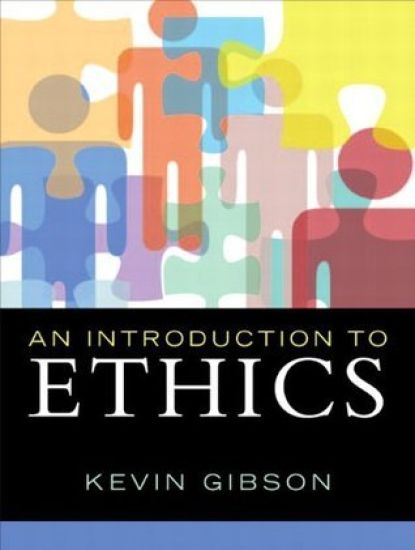
Introduction to Ethics, An

Introduction to Ethics, An

Kevin Gibson

Pearson
2013
nidottu
Provides a lively and accessible introduction to ethical theory An Introduction to Ethics provides readers with the guiding critical questions needed to be considered in our decision making. Students learn about the principles we apply to direct our behavior. The text enhances readers’ abilities to form arguments and conclusions, developing a systematic and coherent ethical view of their own.
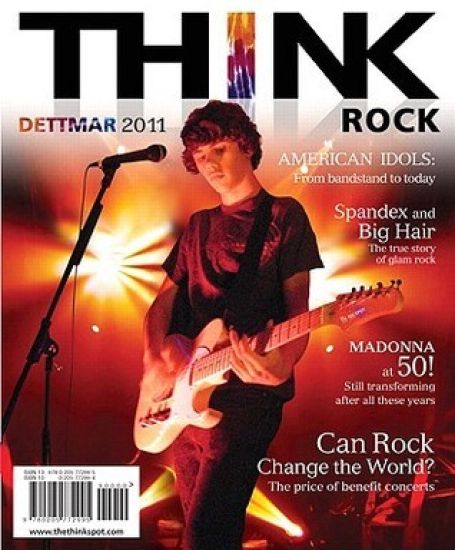
Think Rock

Think Rock

Kevin Dettmar

Pearson
2010
nidottu
THINK ROCK is the first Music title in the THINK series. It is designed for an introduction to rock music course for the non-music major at an economical price. Taking a chronological approach, it offers a basic introduction to the key eras, performers, and songs that shaped rock music. THINK ROCK is a full history, beginning with pre-rock styles and covering all styles right up to today’s latest sounds. In addition to the music itself, THINK ROCK addresses the rich cultural history of the rock era, and how social/cultural events shaped rock and were shaped by it. The book is richly illustrated with period photographs and reproductions of album covers and concert posters. An open access companion website is available with THINK ROCK at www.thethinkspot.com.
War, Baby

War, Baby

Kevin Mitchell

Vintage
2003
pokkari
25th February 1995 The Dark Destroyer vs the G-ManNigel Benn and Gerald McClennan Two men with a reputation to defend - a reputation for brutal, unforgiving combat both in the ring and outside it.
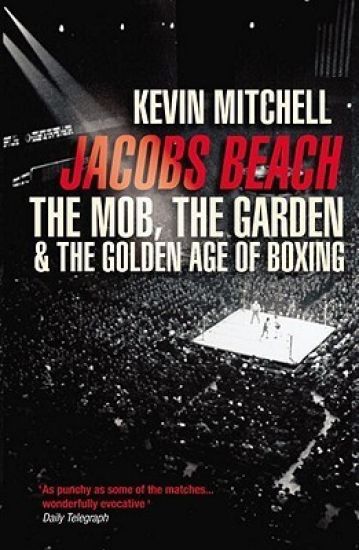
Jacobs Beach

Jacobs Beach

Kevin Mitchell

Vintage Publishing
2011
pokkari
They mingled with underworld heavies along a strip of New York pavement near the Garden known only as Jacobs Beach. Kevin Mitchell's gripping book is the unsanitised story of those times and that place, of Rat Pack cool and the fading of the Mob's peculiar glamour, brilliantly told through the eyes of the men who were there.
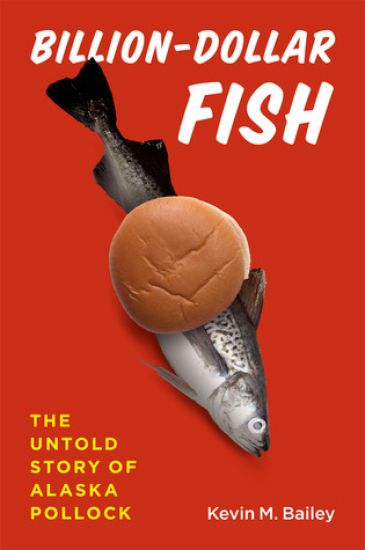
Billion-Dollar Fish

Billion-Dollar Fish

Kevin M. Bailey

University of Chicago Press
2013
sidottu
Alaska pollock is everywhere. If you're eating fish but you don't know what kind it is, it's almost certainly pollock. Prized for its generic fish taste, pollock masquerades as crab meat in California rolls and seafood salads, and it feeds millions as fish sticks in school cafeterias and Filet-O-Fish sandwiches at McDonald's. That ubiquity has made pollock the most lucrative fish harvest in America-the fishery in the United States alone has an annual value of over one billion dollars. But even as the money rolls in, pollock is in trouble: in the last few years, the pollock population has declined by more than half, and some scientists are predicting the fishery's eventual collapse. In "Billion-Dollar Fish", Kevin M. Bailey combines his years of first-hand pollock research with a remarkable talent for storytelling to offer the first natural history of Alaska pollock. Crucial to understanding the pollock fishery, he shows, is recognizing what aspects of its natural history make pollock so very desirable to fish, while at the same time making it resilient, yet highly vulnerable to overfishing. Bailey delves into the science, politics, and economics surrounding Alaska pollock in the Bering Sea, detailing the development of the fishery, the various political machinations that have led to its current management, and, perhaps most important, its impending demise. He approaches his subject from multiple angles, bringing in the perspectives of fishermen, politicians, environmentalists, and biologists, and drawing on revealing interviews with players who range from Greenpeace activists to fishing industry lawyers. Seamlessly weaving the biology and ecology of pollock with the history and politics of the fishery, as well as Bailey's own often raucous tales about life at sea, "Billion-Dollar Fish" is a book for every person interested in the troubled relationship between fish and humans, from the depths of the sea to the dinner plate.
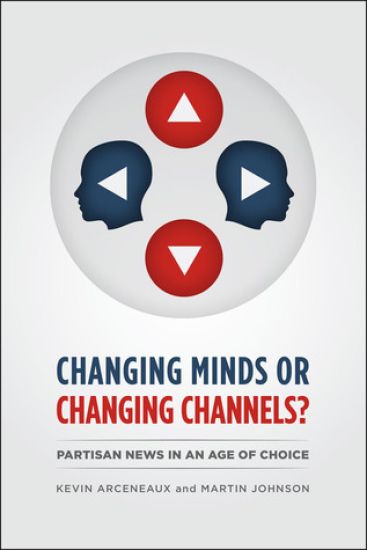
CHANGING MINDS OR CHANGING CHANNELS? - PARTISANNEWS IN AN AGE OF CHOICE

CHANGING MINDS OR CHANGING CHANNELS? - PARTISANNEWS IN AN AGE OF CHOICE

Kevin Arceneaux; Martin Johnson

University of Chicago Press
2013
nidottu
We live in an age of media saturation, where with a few clicks of the remote - or mouse - we can tune in to programming where the facts fit our ideological predispositions. But what are the political consequences of this vast landscape of media choice? Partisan news has been roundly castigated for reinforcing prior beliefs and contributing to the highly polarized political environment we have today, but there is little evidence to support this claim, and much of what we know about the impact of news media come from studies that were conducted at a time when viewers chose from among six channels rather than scores. Through a series of innovative experiments, Kevin Arceneaux and Martin Johnson show that such criticism is unfounded. Americans who watch cable news are already polarized, and their exposure to partisan programming of their choice does not significantly change their initial position. In fact, the opposite is true: viewers become more polarized when forced to watch programming that opposes their beliefs. A much more troubling consequence of the ever-expanding media environment, the authors show, is that it has allowed people to tune out the news: the four top-rated partisan news programs draw a mere three percent of the total number of people watching television. Overturning much of the conventional wisdom, Changing Minds or Changing Channels? demonstrates that the strong effects of media exposure found in past research are simply not applicable in today's more saturated media landscape.
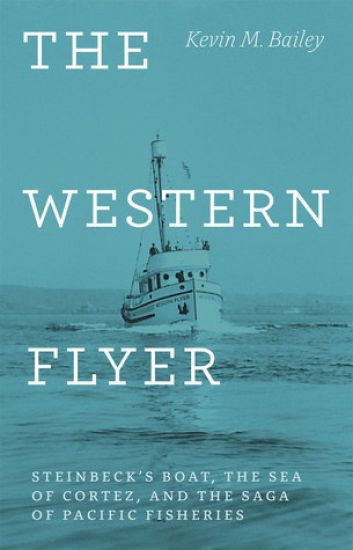
The Western Flyer

The Western Flyer

Kevin M. Bailey

University of Chicago Press
2015
sidottu
In January, 2010, the Gemini was moored in the Swinomish Slough on a Native American reservation near Anacortes, Washington. Unbeknownst to almost everyone, the rusted and dilapidated boat was in fact the most famous fishing vessel ever to have sailed: the original Western Flyer, immortalized in John Steinbeck's nonfiction classic The Log from the Sea of Cortez. In this book, Kevin M. Bailey resurrects this forgotten witness to the changing tides of Pacific fisheries. He draws on the Steinbeck archives, interviews with family members of crew, and more than three decades working in Pacific Northwest fisheries to trace the depletion of marine life through the voyages of a single ship. After Steinbeck and his friend Ed Ricketts - a pioneer in the study of the West Coast's diverse sea life and the inspiration behind "Doc" in Cannery Row-chartered the boat for their now - famous 1940 expedition, the Western Flyer returned to its life as a sardine seiner in California. But when the sardine fishery in Monterey collapsed, the boat moved on: fishing for Pacific Ocean perch off Washington, king crab in the Bering Sea off Alaska, and finally wild Pacific salmon - all industries that would also face collapse. As the Western Flyer herself faces an uncertain future - a businessman has bought her, intending to bring the boat to Salinas, California, and turn it into a restaurant feature just blocks from Steinbeck's grave - debates about the status of the California sardine, and of West Coast fisheries generally, have resurfaced. With a compelling and timely tale of a boat and the people it carried, of fisheries exploited, and of fortunes won and lost, The Western Flyer is environmental history at its best: a journey through time and across the sea, charting the ebb and flow of the cobalt waters of the Pacific coast.
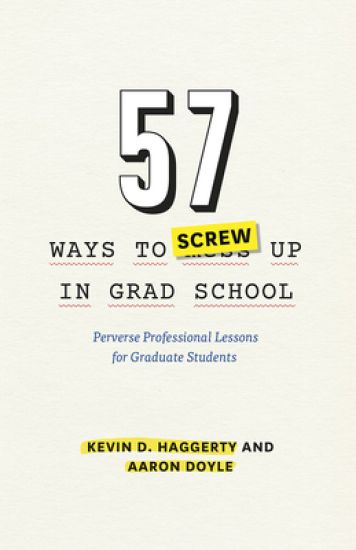
57 Ways to Screw Up in Grad School

57 Ways to Screw Up in Grad School

Kevin D. Haggerty; Aaron Doyle

University of Chicago Press
2015
sidottu
Don't think about why you're applying. Select a topic for entirely strategic reasons. Choose the coolest supervisor. Write only to deadlines. Expect people to hold your hand. Become "that" student. When it comes to a masters or PhD program, most graduate students don't deliberately set out to fail. Yet, of the nearly 500,000 people who start a graduate program each year, up to half will never complete their degree. Books abound on acing the admissions process, but there is little on what to do once the acceptance letter arrives. Veteran graduate directors Kevin D. Haggerty and Aaron Doyle have set out to demystify the world of advanced education. Taking a wry, frank approach, they explain the common mistakes that can trip up a new graduate student and lay out practical advice about how to avoid the pitfalls. Along the way they relate stories from their decades of mentorship and even share some slip-ups from their own grad experiences. The litany of foul-ups is organized by theme and covers the grad school experience from beginning to end: selecting the university and program, interacting with advisors and fellow students, balancing personal and scholarly lives, navigating a thesis, and creating a life after academia. Although the tone is engagingly tongue-in-cheek, the lessons are crucial to anyone attending or contemplating grad school. 57 Ways to Screw Up in Grad School allows you to learn from others' mistakes rather than making them yourself.
57 Ways to Screw Up in Grad School

57 Ways to Screw Up in Grad School

Kevin D. Haggerty; Aaron Doyle

University of Chicago Press
2015
nidottu
Don't think about why you're applying. Select a topic for entirely strategic reasons. Choose the coolest supervisor. Write only to deadlines. Expect people to hold your hand. Become "that" student. When it comes to a masters or PhD program, most graduate students don't deliberately set out to fail. Yet, of the nearly 500,000 people who start a graduate program each year, up to half will never complete their degree. Books abound on acing the admissions process, but there is little on what to do once the acceptance letter arrives. Veteran graduate directors Kevin D. Haggerty and Aaron Doyle have set out to demystify the world of advanced education. Taking a wry, frank approach, they explain the common mistakes that can trip up a new graduate student and lay out practical advice about how to avoid the pitfalls. Along the way they relate stories from their decades of mentorship and even share some slip-ups from their own grad experiences. The litany of foul-ups is organized by theme and covers the grad school experience from beginning to end: selecting the university and program, interacting with advisors and fellow students, balancing personal and scholarly lives, navigating a thesis, and creating a life after academia. Although the tone is engagingly tongue-in-cheek, the lessons are crucial to anyone attending or contemplating grad school. 57 Ways to Screw Up in Grad School allows you to learn from others' mistakes rather than making them yourself.
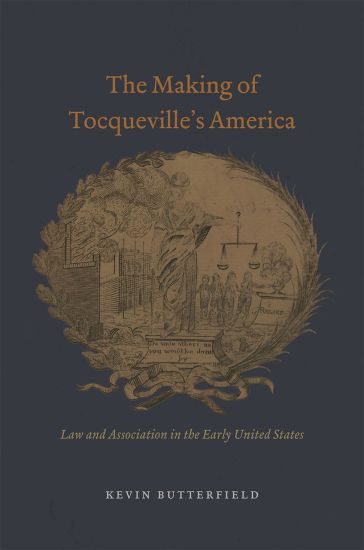
The Making of Tocqueville's America

The Making of Tocqueville's America

Kevin Butterfield

University of Chicago Press
2015
sidottu
Alexis de Tocqueville was among the first to draw attention to Americans' propensity to form voluntary associations-and to join them with a fervor and frequency unmatched anywhere in the world. For nearly two centuries, we have sought to understand how and why early nineteenth-century Americans were, in Tocqueville's words, "forever forming associations." In The Making of Tocqueville's America, Kevin Butterfield argues that to understand this, we need to first ask: what did membership really mean to the growing number of affiliated Americans? Butterfield explains that the first generations of American citizens found in the concept of membership-in churches, fraternities, reform societies, labor unions, and private business corporations-a mechanism to balance the tension between collective action and personal autonomy, something they accomplished by emphasizing law and procedural fairness. As this post-Revolutionary procedural culture developed, so too did the legal substructure of American civil society. Tocqueville, then, was wrong to see associations as the training ground for democracy, where people learned to honor one another's voices and perspectives. Rather, they were the training ground for something no less valuable to the success of the American democratic experiment: increasingly formal and legalistic relations among people.
Fishing Lessons

Fishing Lessons

Kevin M. Bailey

University of Chicago Press
2018
sidottu
Fish bones in the caves of East Timor reveal that humans have systematically fished the seas for at least 42,000 years. But in recent centuries, our ancient, vital relationship with the oceans has changed faster than the tides. As boats and fishing technology have evolved, traditional fishermen have been challenged both at sea and in the marketplace by large-scale fishing companies whose lower overhead and greater efficiency guarantee lower prices. In Fishing Lessons, Kevin M. Bailey captains a voyage through the deep history and present course of this sea-change--a change that has seen species depleted, ecosystems devastated, and artisanal fisheries transformed into a global industry afloat with hundreds of billions of dollars per year. Bailey knows these waters, the artisanal fisheries, and their relationship with larger ocean ecology intimately. In a series of place-based portraits, he shares stories of decline and success as told by those at the ends of the long lines and hand lines, channeling us through the changing dynamics of small-scale fisheries and the sustainability issues they face--both fiscal and ecological. We encounter Paolo Vespoli and his tiny boat, the Giovanni Padre,in the Gulf of Naples; Wenche, a sea Sami, one of the indigenous fisherwomen of Norway; and many more. From salmon to abalone, the Bay of Fundy to Monterey and the Amazon, Bailey's catch is no fish tale. It is a global story, casting a net across waters as vast and distinct as Puget Sound and the Chilean coast. Sailing across the world, Bailey explores the fast-shifting current of how we gather food from the sea, what we gain and what we lose with these shifts, and potential solutions for the murky passage ahead.
The Dark Gaze

The Dark Gaze

Kevin Hart

University of Chicago Press
2004
sidottu
A profound reconsideration of how Blanchot work figures theologically in some of the major currents of twentieth-century thought. Hart reveals Blanchot to be a thinker devoted to the possibilities of a spiritual life with the possibilities of leading an ethical life in the absence of God.
The Dark Gaze

The Dark Gaze

Kevin Hart

University of Chicago Press
2004
nidottu
A profound reconsideration of how Blanchot work figures theologically in some of the major currents of twentieth-century thought. Hart reveals Blanchot to be a thinker devoted to the possibilities of a spiritual life with the possibilities of leading an ethical life in the absence of God.
Marx at the Margins

Marx at the Margins

Kevin B. Anderson

University of Chicago Press
2016
nidottu
In Marx at the Margins, Kevin Anderson uncovers a variety of extensive but neglected texts by Marx that cast what we thought we knew about his work in a startlingly different light. Analyzing a variety of Marx’s writings, including journalistic work written for the New York Tribune, Anderson presents us with a Marx quite at odds with conventional interpretations. Rather than providing us with an account of Marx as an exclusively class-based thinker, Anderson here offers a portrait of Marx for the twenty-first century: a global theorist whose social critique was sensitive to the varieties of human social and historical development, including not just class, but nationalism, race, and ethnicity, as well. Through highly informed readings of work ranging from Marx’s unpublished 1879–82 notebooks to his passionate writings about the antislavery cause in the United States, this volume delivers a groundbreaking and canon-changing vision of Karl Marx that is sure to provoke lively debate in Marxist scholarship and beyond. For this expanded edition, Anderson has written a new preface that discusses the additional 1879–82 notebook material, as well as the influence of the Russian-American philosopher Raya Dunayevskaya on his thinking.
Reconsidering Roosevelt on Race

Reconsidering Roosevelt on Race

Kevin J. McMahon

University of Chicago Press
2003
nidottu
Many have questioned FDR's record on race, suggesting that he had the opportunity but not the will to advance the civil rights of African Americans. Kevin J. McMahon challenges this view, arguing instead that Roosevelt's administration played a crucial role in the Supreme Court's increasing commitment to racial equality—which culminated in its landmark decision in Brown v. Board of Education.McMahon shows how FDR's attempt to strengthen the presidency and undermine the power of conservative Southern Democrats dovetailed with his efforts to seek racial equality through the federal courts. By appointing a majority of rights-based liberals deferential to presidential power, Roosevelt ensured that the Supreme Court would be receptive to civil rights claims, especially when those claims had the support of the executive branch.
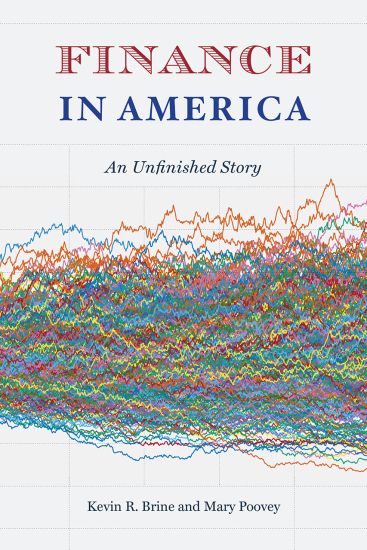
Finance in America

Finance in America

Kevin R. Brine; Mary Poovey

University of Chicago Press
2017
nidottu
The economic crisis of 2008 led to an unprecedented focus on the world of high finance and revealed it to be far more arcane and influential than most people could ever have imagined. Any hope of avoiding future crises, it's clear, rest on understanding finance itself. To understand finance, however, we have to learn its history, and this book fills that need. Kevin R. Brine, an industry veteran, and Mary Poovey, an acclaimed historian, show that finance as we know it today emerged gradually in the late nineteenth century and only coalesced after World War II, becoming ever more complicated and ever more central to the American economy. The authors explain the models, regulations, and institutions at the heart of modern finance and uncover the complex and sometimes surprising origins of its critical features, such as corporate accounting standards, the Federal Reserve System, risk management practices, and American Keynesian and New Classic monetary economics. This book sees finance through its highs and lows, from pre-Depression to post-Recession, exploring the myriad ways in which the practices of finance and the realities of the economy influenced one another through the years. A masterwork of collaboration, Finance in America lays bare the theories and practices that constitute finance, opening up the discussion of its role and risks to a broad range of scholars and citizens.
Nixon's Court

Nixon's Court

Kevin J. McMahon

University of Chicago Press
2011
sidottu
Most analysts have deemed Richard Nixon's challenge to the judicial liberalism of the Warren Supreme Court a failure, "a counterrevolution that wasn't". "Nixon's Court" offers an alternative assessment. Kevin J. McMahon reveals a Nixon whose public rhetoric was more conservative than his administration's actions and whose policy toward the Court was more subtle than previously recognized. Viewing Nixon's judicial strategy as part political and part legal, McMahon argues that Nixon succeeded substantially on both counts. Many of the issues dear to social conservatives, such as abortion and school prayer, were not nearly as important to Nixon. Consequently, his nominations for the Supreme Court were chosen primarily to advance his "law and order" and school desegregation agendas - agendas the Court eventually endorsed. But there were also political motivations to Nixon's approach: he wanted his judicial policy to be conservative enough to attract white southerners and northern white ethnics disgruntled with the Democratic Party but not so conservative as to drive away moderates in his own party. In essence, then, he used his criticisms of the Court to speak to members of his "Silent Majority" in hopes of disrupting the long-dominant New Deal Democratic coalition. For McMahon, Nixon's judicial strategy succeeded not only in shaping the course of constitutional law in the areas he most desired but also in laying the foundation of an electoral alliance that would dominate presidential politics for a generation.
Hunted

Hunted

Kevin Lewis O'Neill

University of Chicago Press
2019
sidottu
“It’s not a process,” one pastor insisted, “rehabilitation is a miracle.” In the face of addiction and few state resources, Pentecostal pastors in Guatemala City are fighting what they understand to be a major crisis. Yet the treatment centers they operate produce this miracle of rehabilitation through extraordinary means: captivity. These men of faith snatch drug users off the streets, often at the request of family members, and then lock them up inside their centers for months, sometimes years.Hunted is based on more than ten years of fieldwork among these centers and the drug users that populate them. Over time, as Kevin Lewis O’Neill engaged both those in treatment and those who surveilled them, he grew increasingly concerned that he, too, had become a hunter, albeit one snatching up information. This thoughtful, intense book will reframe the arc of redemption we so often associate with drug rehabilitation, painting instead a seemingly endless cycle of hunt, capture, and release.
Hunted

Hunted

Kevin Lewis O'Neill

University of Chicago Press
2019
nidottu
“It’s not a process,” one pastor insisted, “rehabilitation is a miracle.” In the face of addiction and few state resources, Pentecostal pastors in Guatemala City are fighting what they understand to be a major crisis. Yet the treatment centers they operate produce this miracle of rehabilitation through extraordinary means: captivity. These men of faith snatch drug users off the streets, often at the request of family members, and then lock them up inside their centers for months, sometimes years.Hunted is based on more than ten years of fieldwork among these centers and the drug users that populate them. Over time, as Kevin Lewis O’Neill engaged both those in treatment and those who surveilled them, he grew increasingly concerned that he, too, had become a hunter, albeit one snatching up information. This thoughtful, intense book will reframe the arc of redemption we so often associate with drug rehabilitation, painting instead a seemingly endless cycle of hunt, capture, and release.
Billion-Dollar Fish

Billion-Dollar Fish

Kevin M. Bailey

University of Chicago Press
2021
nidottu
Alaska pollock is everywhere. If you’re eating fish but you don’t know what kind it is, it’s almost certainly pollock. Prized for its generic fish taste, pollock masquerades as crab meat in california rolls and seafood salads, and it feeds millions as fish sticks in school cafeterias and Filet-O-Fish sandwiches at McDonald’s. That ubiquity has made pollock the most lucrative fish harvest in America—the fishery in the United States alone has an annual value of over one billion dollars. But even as the money rolls in, pollock is in trouble: in the last few years, the pollock population has declined by more than half, and some scientists are predicting the fishery’s eventual collapse. In Billion-Dollar Fish, Kevin M. Bailey combines his years of firsthand pollock research with a remarkable talent for storytelling to offer the first natural history of Alaska pollock. Crucial to understanding the pollock fishery, he shows, is recognizing what aspects of its natural history make pollock so very desirable to fish, while at the same time making it resilient, yet highly vulnerable to overfishing. Bailey delves into the science, politics, and economics surrounding Alaska pollock in the Bering Sea, detailing the development of the fishery, the various political machinations that have led to its current management, and, perhaps most important, its impending demise. He approaches his subject from multiple angles, bringing in the perspectives of fishermen, politicians, environmentalists, and biologists, and drawing on revealing interviews with players who range from Greenpeace activists to fishing industry lawyers. Seamlessly weaving the biology and ecology of pollock with the history and politics of the fishery, as well as Bailey’s own often raucous tales about life at sea, Billion-Dollar Fish is a book for every person interested in the troubled relationship between fish and humans, from the depths of the sea to the dinner plate.