Kirjojen hintavertailu. Mukana 11 244 527 kirjaa ja 12 kauppaa.

Kirjahaku

Etsi kirjoja tekijän nimen, kirjan nimen tai ISBN:n perusteella.

1000 tulosta hakusanalla Laurence Stapleton

The Second 100 Chinese Characters: Traditional Character Edition

The Second 100 Chinese Characters: Traditional Character Edition

Laurence Matthews; Alison Matthews

Tuttle Publishing
2016
nidottu
This book is a quick and easy way to learn the second 100 basic Chinese traditional characters. The major struggle facing all beginning Chinese language students is to learn to recognize, read and write hundreds of Chinese characters. A working knowledge of characters is essential for any student wishing to learn Chinese. The Second 100 Chinese Characters adopts a structural approach that helps students to overcome this initial difficulty and quickly master the basic Chinese characters that are fundamental to this language. This book contains characters that have been carefully selected and sequenced for rapid and effective learning. For effective learning, memorization and practice, each Chinese character is shown separately on a single page, together with its English definitions, hanyu pinyin romanization, alternate form (if any), a stroke order guide and ample space for writing practice. The stroke order guides introduce the student to the standard stroke sequence used in writing the characters, by tracing over them. After learning the correct stroke order, the student can then practice writing the character on their own, thus reinforcing recognition and memorization. Large boxes with grid lines for correct proportions are provided. Related compounds and phrases containing each character are also included to assist in vocabulary building. Three indexes (alphabetically by the English meanings and the pinyin romanization, and by radicals) are provided at the back of the book for quick and easy reference, along with extra sheets of blank boxes for writing practice. This book features The second 100 most frequently-used Chinese characters. Foundation characters for the HSK A level language proficiency test. Standard hanyu pinyin romanizations. Step-by-step stroke order guides and ample space for writing practice. Over 500 words and phrases containing the basic characters. Concise English definitions.
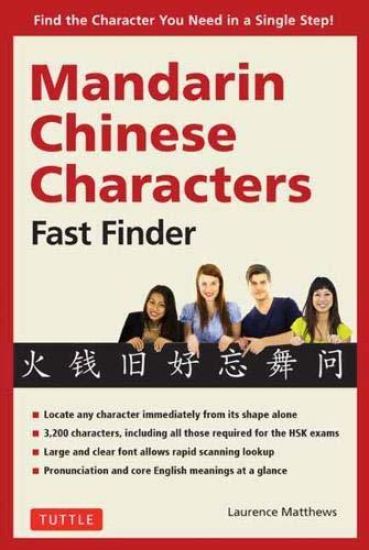
Mandarin Chinese Characters Fast Finder

Mandarin Chinese Characters Fast Finder

Laurence Matthews

Tuttle Publishing
2018
nidottu
Ever wished for a resource to look up Chinese characters from their shape alone?Mandarin Chinese Characters Fast Finder is a study aid that lets you look up Chinese characters quickly and intuitively from their appearance alone, without knowing their pronunciation, radical or stroke count. This reference book has been designed for dedicated learners of Chinese, as well as general readers with interest in the written Chinese language. Mandarin Chinese Characters Fast Finder features: A thumb-index allowing rapid access to all of the characters by shape rather than etymological radical Clear and easy-to-read layout to facilitate speedy scanning Covers 3,200 characters, including those prescribed for all levels of the HSK Proficiency test Comprehensive information for each character, including: traditional forms, pronunciation, core English meaning, radical, stroke count, HSK grade
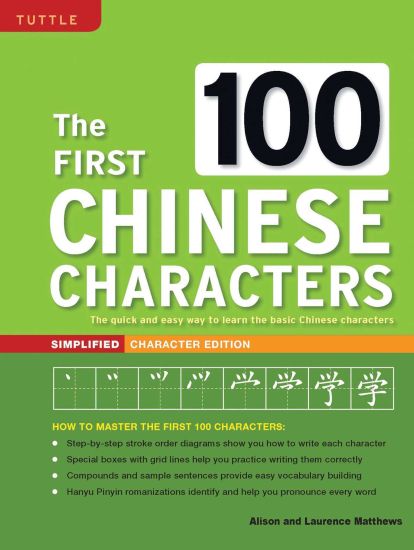
The First 100 Chinese Characters: Simplified Character Edition

The First 100 Chinese Characters: Simplified Character Edition

Laurence Matthews; Alison Matthews

Tuttle Publishing
2017
nidottu
This book is a quick and easy way to learn basic Chinese Characters.All beginning Chinese language learners struggle to memorize and learn to write Chinese characters. The First 100 Chinese Characters adopts a structural approach which helps students to quickly master the basic characters that are fundamental to this language. This character book is intended for beginning Chinese students. It presents characters that have been carefully selected for rapid and effective learning. The English meanings, pronunciations in hanyu pinyin and alternate forms (if any) for each Chinese character are presented along with a stroke order guide and spaces for writing practice. Printed with gray guidelines, the stroke order guides are designed to be traced over to teach students the standard sequence of strokes used to write the character. Related compounds and phrases are given to assist in vocabulary building. Three indexes at the back allow the characters to be looked up by their English meanings, hanyu pinyin pronunciations, or radicals. Extra practice sheets are also provided. This Chinese character book contains: Step-by-step stroke order diagrams show you how to write each character. Special boxes with grid lines help you practice writing them correctly. Compounds and sample sentences provide easy vocabulary building.Hanyu pinyin romanizations identify and help you pronounce every word.
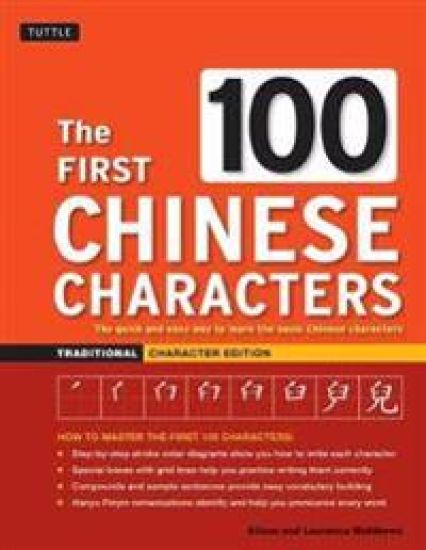
The Second 100 Chinese Characters: Traditional Character Edition

The Second 100 Chinese Characters: Traditional Character Edition

Laurence Matthews; Alison Matthews

TUTTLE PUBLISHING
2025
nidottu
Master Chinese characters the quick & easy way!Learn the Second 100 Basic Chinese Traditional CharactersCracking the code of Chinese characters can be tough, but with this book, it becomes much easier. Perfect for beginners, this guide helps you quickly recognize, read, and write essential characters.Why This Book Works:Easy-to-follow Structure: Characters are carefully selected and sequenced for rapid learning.Comprehensive Pages: Each character gets its own page with: English definitionsHanyu pinyin romanizationAlternate forms (if any)Stroke order guidePlenty of space for practiceHighlights:Stroke Order Guides: Trace characters to learn the correct stroke sequence, then practice on your own.Grid Lines: Keep your characters proportionate and neat.Vocabulary Building: Related compounds and phrases for each character.Quick References: Three indexes for English meanings, pinyin, and radicals.Extra Practice: Additional sheets with blank boxes for more writing practice.What's Inside:The second 100 most frequently used Chinese characters.Foundation characters for the HSK A level language proficiency test.Standard hanyu pinyin romanizations.Step-by-step stroke order guides.Over 500 words and phrases.Concise English definitions.
Japanese Kanji Fast Finder

Japanese Kanji Fast Finder

Laurence Matthews

TUTTLE PUBLISHING
2025
nidottu
Anyone studying Kanji has wished for a reference that would enable them to look up a character by its shape alone.Now, Japanese Kanji Fast Finder delivers precisely that: a study aid that lets users look up Japanese Kanji quickly and intuitively, without having to know their reading, radical or stroke count, and without having to learn yet another system. This easy-to-use reference book has been designed for dedicated learners of Japanese who know some Kanji, as well as general readers with interest in the written Japanese language. Japanese Kanji Fast Finder features: A thumb-index that allows for rapid access to any of the Kanji characters by their shapes Large fonts and an easy-to-read layout to facilitate rapid scanning Pronunciations and core English meanings at a glance All 1,945 General Use Kanji as prescribed by the Japanese Ministry of Education Comprehensive information for each Kanji, with the following: the core English meaning, ON (Chinese-derived) and KUN (native Japanese) readings, stroke count, and radicalWhether you're formally studying Japanese, or are a traveler, manga enthusiast, or Japanophile, this is the perfect reference for anyone looking to become more familiar with the Japanese characters.
The Pequots in Southern New England

The Pequots in Southern New England

Laurence M. Hauptman; James D. Wherry; William T. Hagan

University of Oklahoma Press
1993
nidottu
Before their massacre by Massachusetts Puritans in 1637, the Pequots were preeminent in southern New England. Their location on the eastern Connecticut shore made them important producers of the wampum required to trade for furs from the Iroquois. They were also the only Connecticut Indians to oppose the land-hungry English. For those reasons, they became the first victims of white genocide in colonial America.Despite the Pequot War of 1637, and the greed and neglect of their white neighbors and ""overseers,"" the Pequots endured in their ancestral homeland. In 1983 they achieved federal recognition. In 1987 they commemorated the 350th anniversary of the Pequot War by organizing the Mashantucket Pequot Historical Conference, at which distinguished scholars presented the articles assembled here.
Chief Daniel Bread and the Oneida Nation of Indians of Wisconsin

Chief Daniel Bread and the Oneida Nation of Indians of Wisconsin

Laurence M. Hauptman; L. Gordon McLester

University of Oklahoma Press
2002
sidottu
Chief Daniel Bread (1800-1873) played a key role in establishing the Oneida Indians' presence in Wisconsin after their removal from New York, yet no monument commemorates his deeds as the community's founder. Laurence M. Hauptman and L. Gordon McLester, III, redress that historical oversight, connecting Bread's life story with the nineteenth-century history of the Oneida Nation.Bread was often criticized for his support of acculturation and missionary schools as well as for his working relationship with Indian agents; however, when the Federal-Menominee treaties slashed Oneida lands, he fought back, taking his people's cause to Washington and confronting President Andrew Jackson. The authors challenge the long-held views about Eleazer Williams's leadership of the Oneidas and persuasively show that Bread's was the voice vigorously defending tribal interests.
Coming Full Circle

Coming Full Circle

Laurence M. Hauptman

University of Oklahoma Press
2019
sidottu
The disastrous Buffalo Creek Treaty of 1838 called for the Senecas' removal to Kansas (then part of the Indian Territory). From this low point, the Seneca Nation of Indians, which today occupies three reservations in western New York, sought to rebound. Beginning with events leading to the Seneca Revolution in 1848, which transformed the nation's government from a council of chiefs to an elected system, Laurence M. Hauptman traces Seneca history through the New Deal. Based on the author's nearly fifty years of archival research, interviews, and applied work, Coming Full Circle shows that Seneca leaders in these years learned valuable lessons and adapted to change, thereby preparing the nation to meet the challenges it would face in the post-World War II era, including major land loss and threats of termination. Instead of emphasizing American Indian decline, Hauptman stresses that the Senecas were actors in their own history and demonstrated cultural and political resilience. Both Native belief, in the form of the Good Message of Handsome Lake, and Christianity were major forces in Seneca life; women continued to play important social and economic roles despite the demise of clan matrons' right to nominate the chiefs; and Senecas became involved in national and international competition in long-distance running and in lacrosse. The Seneca Nation also achieved noteworthy political successes in this period. The Senecas resisted allotment, and thus saved their reservations from breakup and sale. They recruited powerful allies, including attorneys, congressmen, journalists, and religious leaders. They saved their Oil Spring Reservation, winning a U.S. Supreme Court case against New York State on the issue of taxation and won remuneration in their Kansas Claims case. These efforts laid the groundwork for the Senecas' postwar endeavor to seek compensation before the Indian Claims Commission and pursuit of a series of land claims and tax lawsuits against New York State.
Coming Full Circle

Coming Full Circle

Laurence M. Hauptman

University of Oklahoma Press
2020
nidottu
The disastrous Buffalo Creek Treaty of 1838 called for the Senecas' removal to Kansas (then part of the Indian Territory). From this low point, the Seneca Nation of Indians, which today occupies three reservations in western New York, sought to rebound. Beginning with events leading to the Seneca Revolution in 1848, which transformed the nation's government from a council of chiefs to an elected system, Laurence M. Hauptman traces Seneca history through the New Deal. Based on the author's nearly fifty years of archival research, interviews, and applied work, Coming Full Circle shows that Seneca leaders in these years learned valuable lessons and adapted to change, thereby preparing the nation to meet the challenges it would face in the post-World War II era, including major land loss and threats of termination. Instead of emphasizing American Indian decline, Hauptman stresses that the Senecas were actors in their own history and demonstrated cultural and political resilience. Both Native belief, in the form of the Good Message of Handsome Lake, and Christianity were major forces in Seneca life; women continued to play important social and economic roles despite the demise of clan matrons' right to nominate the chiefs; and Senecas became involved in national and international competition in long-distance running and in lacrosse. The Seneca Nation also achieved noteworthy political successes in this period. The Senecas resisted allotment, and thus saved their reservations from breakup and sale. They recruited powerful allies, including attorneys, congressmen, journalists, and religious leaders. They saved their Oil Spring Reservation, winning a U.S. Supreme Court case against New York State on the issue of taxation and won remuneration in their Kansas Claims case. These efforts laid the groundwork for the Senecas' postwar endeavor to seek compensation before the Indian Claims Commission and pursuit of a series of land claims and tax lawsuits against New York State.
Chief Daniel Bread and the Oneida Nation of Indians of Wisconsin Volume 241

Chief Daniel Bread and the Oneida Nation of Indians of Wisconsin Volume 241

Laurence M. Hauptman; L. Gordon McLester

UNIVERSITY OF OKLAHOMA PRESS
2025
nidottu
Chief Daniel Bread (1800-1873) played a key role in establishing the Oneida Indians' presence in Wisconsin after their removal from New York, yet no monument commemorates his deeds as the community's founder. Laurence M. Hauptman and L. Gordon McLester, III, redress that historical oversight, connecting Bread's life story with the nineteenth-century history of the Oneida Nation.Bread was often criticized for his support of acculturation and missionary schools as well as for his working relationship with Indian agents; however, when the Federal-Menominee treaties slashed Oneida lands, he fought back, taking his people's cause to Washington and confronting President Andrew Jackson. The authors challenge the long-held views about Eleazer Williams's leadership of the Oneidas and persuasively show that Bread's was the voice vigorously defending tribal interests.
Moliere

Moliere

Laurence Romero

The University of North Carolina Press
1971
nidottu
An attempt to trace the development of Moliere criticism organized around three categories: biographical, academic (both historical and formalistic), and commentaries by ""theater professionals.
Heidegger and Marx

Heidegger and Marx

Laurence Hemming

Northwestern University Press
2013
nidottu
Martin Heidegger and Karl Marx remain two of the most influential thinkers in philosophy, in political science and other social sciences, and in the humanities. Yet there has never been a full-length study in English of the relationship between their ideas, and there has only been one study in German (from 1966). A Productive Dialogue fills this gap and contradicts the widely held assumption that Heidegger had no significant engagement with Marx. Hemming focuses on four related areas of inquiry—Heidegger’s reading of Marx; Marx’s relation to G. W. F. Hegel; Heidegger’s disastrous political involvement with National Socialism; and the significance of Hegel, Marx, Heidegger, and Friedrich Nietzsche for the politics of the twentieth and twenty-first centuries. A Productive Dialogue explores the understanding of political processes, systems, and behaviour that animates both thinkers.
A Room in California

A Room in California

Laurence Goldstein

Northwestern University Press
2005
nidottu
Southern California is one of two significant places in Laurence Goldstein's fourth collection of poems. A native of Los Angeles, the author re-encounters the vivid ghosts of an exotic personal landscape: Criswell the TV prophet, Madame Nhu at the Beverly Wilshire Hotel, Mickey Cohen in a downtown deli, Bob Hope in a photo shoot with the poet's family. From the Pacific boardwalk to Death Valley, these poems enliven their borderlands with pungent language and dramatic incident. Goldstein then takes the reader to Ethiopia, the setting of a long dramatic monologue narrated by a young American woman seeking the reincarnation of the medieval Christian potentate Prester John, for help in the apocalyptic wars of the twenty-first century. His most ambitious book to date, the subjects in this collection range from the aging pear tree and the domestic living room, to Nordic witches and Nazi demons. Some poems are in fixed forms including the villanelle ""Rock Star,"" the sonnet translation from Verlaine, ""Langueur,"" and the rhymed quatrains of a narrative poem adapted from a short story by Arthur Miller. Other poems employ organic style to explore the poet's situation, or predicament, in the culture he has outlived and the culture he has inherited.
A Room in California

A Room in California

Laurence Goldstein

Northwestern University Press
2005
sidottu
Southern California is one of two significant places in Laurence Goldstein's fourth collection of poems. A native of Los Angeles, the author re-encounters the vivid ghosts of an exotic personal landscape: Criswell the TV prophet, Madame Nhu at the Beverly Wilshire Hotel, Mickey Cohen in a downtown deli, Bob Hope in a photo shoot with the poet's family. From the Pacific boardwalk to Death Valley, these poems enliven their borderlands with pungent language and dramatic incident. Goldstein then takes the reader to Ethiopia, the setting of a long dramatic monologue narrated by a young American woman seeking the reincarnation of the medieval Christian potentate Prester John, for help in the apocalyptic wars of the twenty-first century. His most ambitious book to date, the subjects in this collection range from the aging pear tree and the domestic living room, to Nordic witches and Nazi demons. Some poems are in fixed forms including the villanelle ""Rock Star,"" the sonnet translation from Verlaine, ""Langueur,"" and the rhymed quatrains of a narrative poem adapted from a short story by Arthur Miller. Other poems employ organic style to explore the poet's situation, or predicament, in the culture he has outlived and the culture he has inherited.
The Meaning of Pentecost in Early Methodism

The Meaning of Pentecost in Early Methodism

Laurence W. Wood

Scarecrow Press
2002
nidottu
John Fletcher's theology of Pentecost is generally unknown today, and this book is the first comprehensive treatise on this subject. His writings were in large part responsible for shaping the theology of early American Methodism, especially his treatise on Christian Perfection, which highlighted a theology of Pentecostal sanctification. Wood recounts the decisive influence Fletcher had on early Methodism, and shows that his writings were able to "control the opinions of the largest and most effective body of evangelical clergymen of the earth." Fletcher's views on the Holy Spirit were also relevant in the ecumenical movement, specifically with reference to the World Council of Churches Commission on Faith and Order held in Lima, Peru, in 1982. This group recommended the introduction of a liturgy of the Spirit in Christian baptism. For students and scholars or general readers interested in Methodist history and theology. Also a resource for pastors-helpful in developing a theology of Pentecost that will preach in a relevant way in the contemporary world.
Designing for the Movies

Designing for the Movies

Laurence Irving

Scarecrow Press
2005
nidottu
Laurence Irving came from a prominent British theatrical family. He was the grandson of the legendary Sir Henry Irving and the son of actors H.B. Irving and Dorothea Baird. Unlike his forebears, however, Laurence chose not to enter the acting profession, but gained an international reputation as an artist, set designer and art director. In this memoir, Irving recounts his World War I flying career, his art studies and painting in the early 1920s - up to the moment in 1927 when Douglas Fairbanks asked him to design The Iron Mask in Hollywood. In Designing for the Movies, Irving vividly recounts working in Hollywood for such distinguished figures as Mary Pickford, Charlie Chaplin, and William Cameron Menzies. Upon his return to the United Kingdom, he worked on other notable films including Moonlight Sonata and George Bernard Shaw's Pygmalion. Irving's time in Hollywood marked the end of the silent film years and this memoir depicts the effect on all those concerned, with astute and penetrating portraits of the professionals who felt this change so dramatically. Anyone with even the slightest interest in the history of filmmaking and the early characters involved with it will not want to miss this insightful account.