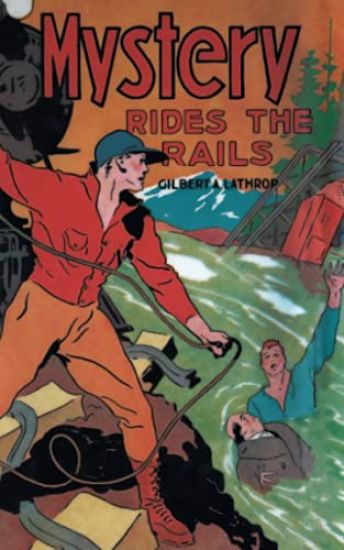
"Mystery" is about the "Silver Town Northern Railroad"- "...55 miles of track including sidings and loading spurs. Three narrow gauge engines, four combination coaches and thirty-five assorted freight cars..." It takes place in and around the Silverton area and some of the place and mine names are easliy recognizable actual onesand it is loosely based on at least one of the Otto Mear's roads.
A Masque of Poets (1878) is a poetry collection edited by George Parsons Lathrop. Part of Boston-based publisher Roberts Brothers’ “No Name” series, A Masque of Poets presents the works of little-known writers—including Emily Dickinson—alongside such recognized masters as Christina Rossetti and James Russell Lowell, leaving each poem anonymous to allow the reader to experience the work without thought of reputation. “Sing! Sing of what? The world is full of song; / And all the singing seems but echoed notes / Of the great masters…” Beginning with this playful introductory poem, A Masque of Poets attempts to demystify poetry by removing poets from the equation altogether. Understanding the pressures inherent to making art, especially the kind of art with such a long and storied history as poetry, this collection foregoes reputation and tradition by allowing the poems to speak for themselves, to appear anonymously so that the reader might make a clear judgment regarding each poem’s meaning and quality. Far from mere publishing gimmick, A Masque of Poets is a highly original, challenging, and rewarding collection of poems that happens to include works from some of the nineteenth century’s finest poets. By forcing the reader to trust their interpretive abilities, A Masque of Poets reinvigorates a craft whose worth was never the names of its practitioners, but the words they could produce. “Success,” the final poem before the concluding “novelette in verse” Guy Vernon, just so happens to be one of the only poems published by Emily Dickinson in her lifetime. For its importance to Dickinson scholars, as well as for its genuine originality, A Masque of Poets remains an essential contribution to the history of American literature. With a beautifully designed cover and professionally typeset manuscript, this edition of A Masque of Poets is a classic work of American literature reimagined for modern readers.
A Masque of Poets (1878) is a poetry collection edited by George Parsons Lathrop. Part of Boston-based publisher Roberts Brothers’ “No Name” series, A Masque of Poets presents the works of little-known writers—including Emily Dickinson—alongside such recognized masters as Christina Rossetti and James Russell Lowell, leaving each poem anonymous to allow the reader to experience the work without thought of reputation. “Sing! Sing of what? The world is full of song; / And all the singing seems but echoed notes / Of the great masters…” Beginning with this playful introductory poem, A Masque of Poets attempts to demystify poetry by removing poets from the equation altogether. Understanding the pressures inherent to making art, especially the kind of art with such a long and storied history as poetry, this collection foregoes reputation and tradition by allowing the poems to speak for themselves, to appear anonymously so that the reader might make a clear judgment regarding each poem’s meaning and quality. Far from mere publishing gimmick, A Masque of Poets is a highly original, challenging, and rewarding collection of poems that happens to include works from some of the nineteenth century’s finest poets. By forcing the reader to trust their interpretive abilities, A Masque of Poets reinvigorates a craft whose worth was never the names of its practitioners, but the words they could produce. “Success,” the final poem before the concluding “novelette in verse” Guy Vernon, just so happens to be one of the only poems published by Emily Dickinson in her lifetime. For its importance to Dickinson scholars, as well as for its genuine originality, A Masque of Poets remains an essential contribution to the history of American literature. With a beautifully designed cover and professionally typeset manuscript, this edition of A Masque of Poets is a classic work of American literature reimagined for modern readers.
George Parsons Lathrop (1851-1898) was an American poet and novelist. Nathaniel Hawthorne ( born Nathaniel Hathorne; July 4, 1804 - May 19, 1864) was an American novelist, Dark Romantic, and short story writer. He was born in 1804 in Salem, Massachusetts, to Nathaniel Hathorne and the former Elizabeth Clarke Manning. His ancestors include John Hathorne, the only judge involved in the Salem witch trials who never repented of his actions. Nathaniel later added a "w" to make his name "Hawthorne" in order to hide this relation. He entered Bowdoin College in 1821, was elected to Phi Beta Kappa in 1824, and graduated in 1825. Hawthorne published his first work, a novel titled Fanshawe, in 1828; he later tried to suppress it, feeling it was not equal to the standard of his later work. He published several short stories in periodicals, which he collected in 1837 as Twice-Told Tales. The next year, he became engaged to Sophia Peabody. He worked at the Boston Custom House and joined Brook Farm, a transcendentalist community, before marrying Peabody in 1842. The couple moved to The Old Manse in Concord, Massachusetts, later moving to Salem, the Berkshires, then to The Wayside in Concord. The Scarlet Letter was published in 1850, followed by a succession of other novels. A political appointment as consul took Hawthorne and family to Europe before their return to Concord in 1860. Hawthorne died on May 19, 1864, and was survived by his wife and their three children. Much of Hawthorne's writing centers on New England, many works featuring moral allegories with a Puritan inspiration. His fiction works are considered part of the Romantic movement and, more specifically, Dark romanticism. His themes often center on the inherent evil and sin of humanity, and his works often have moral messages and deep psychological complexity. His published works include novels, short stories, and a biography of his college friend Franklin Pierce
This book was not designed as a biography, but is rather a portrait. And, to speak more carefully still, it is not so much this, as my conception of what a portrait of Hawthorne should be. For I cannot write with the authority of one who had known him and had been formally intrusted with the task of describing his life. On the other hand, I do not enter upon this attempt as a mere literary performance, but have been assisted in it by an inward impulse, a consciousness of sympathy with the subject, which I may perhaps consider a sort of inspiration. My guide has been intuition, confirmed and seldom confuted by research. Perhaps it is even a favoring fact that I should never have seen Mr. Hawthorne; a personality so elusive as his may possibly yield its traits more readily to one who can never obtrude actual intercourse between himself and the mind he is meditating upon. An honest report upon personal contact always has a value denied to the reviews of after-comers, yet the best criticism and biography is not always that of contemporaries.
We know not when Death or disaster comes, Mightier than battle-drums To summon us away. Death bids us say farewell To all we love, nor stay For tears;-and who can tell How soon misfortune's hand May smite us where we stand, Dragging us down, aloof, Under the swift world's hoof? Strike hands for faith, and power To gladden the passing hour; To wield the sword, or raise a song;- To press the grape; or crush out wrong. And strengthen right. Give me the man of sturdy palm And vigorous brain; Hearty, companionable, sane, 'Mid all commotions calm, Yet filled with quick, enthusiastic fire;- Give me the man Whose impulses aspire, And all his features seem to say, "I can "





![The Dolliver Romance; Fanshawe; [and], Septimius Felton, by Nathaniel Hawthorne: With an Appendix Containing the Ancestral Footstep, Complete works of](/covers/9781534660212.jpg)