Learn the US Constitution by reading the Federalist Papers. It is the best thing you can do to understand our great form of government.This book contains an unabridged version of the series of 85 articles and essays, written by founders Alexander Hamilton, James Madison, and John Jay, with a crisp two-part introduction by Brian W. Kelly. The purpose of the Federalist authors was to convince the people that the best course of action was to ratify the US ConstitutionToday more than ever with our top officials ignoring the Constitution and executing the office in lawless fashion, Americans need to know their rights and protections built into the basic framework of our government.Just because one or two powerful persons choose to ignore our rights and freedoms does not mean we must endure the tyranny. The first step of course is to understand the most basic written precepts. Reading the Federalist Papers is a must for every US citizen.
This work has been selected by scholars as being culturally important and is part of the knowledge base of civilization as we know it.This work is in the public domain in the United States of America, and possibly other nations. Within the United States, you may freely copy and distribute this work, as no entity (individual or corporate) has a copyright on the body of the work.Scholars believe, and we concur, that this work is important enough to be preserved, reproduced, and made generally available to the public. To ensure a quality reading experience, this work has been proofread and republished using a format that seamlessly blends the original graphical elements with text in an easy-to-read typeface.We appreciate your support of the preservation process, and thank you for being an important part of keeping this knowledge alive and relevant.
This work has been selected by scholars as being culturally important and is part of the knowledge base of civilization as we know it.This work is in the public domain in the United States of America, and possibly other nations. Within the United States, you may freely copy and distribute this work, as no entity (individual or corporate) has a copyright on the body of the work.Scholars believe, and we concur, that this work is important enough to be preserved, reproduced, and made generally available to the public. To ensure a quality reading experience, this work has been proofread and republished using a format that seamlessly blends the original graphical elements with text in an easy-to-read typeface.We appreciate your support of the preservation process, and thank you for being an important part of keeping this knowledge alive and relevant.
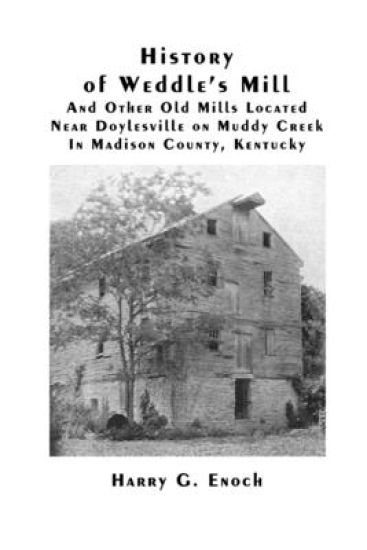
George Weddle operated a gristmill on Muddy Creek from the early to mid-1800s. The mill stood about two miles from the Kentucky River, near the road from Richmond to Jackson's Ferry. The establishment played a prominent role in the local community for nearly a century. The gristmill produced flour and cornmeal for nearby farmers, as well as for a distillery, and a stagecoach stop brought travelers by the tavern to sample the house whiskey. The mill was a county landmark until it was destroyed by a fire in 1971. Several concerns operated at the site at various times, including Douglas' Mill, Weddle's Mill, Walden's Distillery, Ogg's Mill and Griggs' Mill. Cassius Marcellus Clay, that most colorful member of Kentucky's most illustrious family, owned the mill for sixteen years. 54 pp.
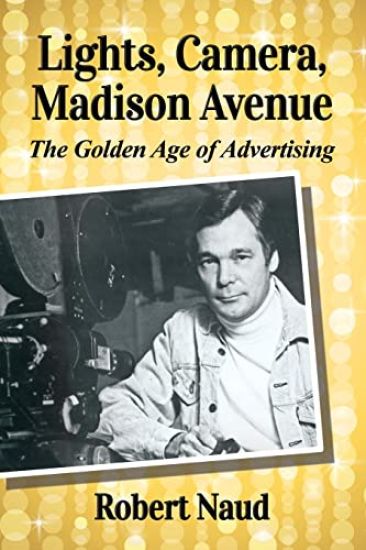
This inside look at the production of 20th century television commercials begins with a review of advertising's beginnings going through the 1960s and early 1970s. The author, a career "Mad man," recounts lightheartedly his experiences on commercial productions--both live and film--in theaters and studios in New York City, at LBJ's ranch, on the White House lawn, along Rome's Appian Way, in Lady Astor's dining room and on the Tryall Golf Course in Jamaica, among other places. The technical (and people) challenges involved in producing high-end commercials for major corporations are given in often funny detail.
*Includes pictures of the First Ladies and important people, places, and events in their lives. *Includes Bibliographies for further reading. American presidents have shaped the course of global affairs for generations, but as the saying goes, behind every great man there's a great woman. While the First Ladies often remain overshadowed by their husbands, some have carved unique niches in their time and left their own lasting legacy. Abigail Adams served as a political advisor that earned her the moniker "Mrs. President", while Dolley Madison helped establish the role of the First Lady in the early 1800s, Eleanor Roosevelt gave voice to policy issues in a way that made her a forerunner of First Ladies like Hillary Clinton, and Jackie Kennedy created glamorous trends that made her more popular than her husband. Eleanor Roosevelt and Hillary Clinton may have been the most politically active First Ladies in American history, but Abigail Adams was the first to act as political advisor for her husband and the first to be dubbed "Mrs. President". Indeed, Abigail was politically inclined to degree highly unusual among women of the 18th and 19th century, and she had originally impressed her future husband John because she was so well versed in poetry, philosophy and politics. After the Constitution was ratified, George Washington went about setting all the precedents for the role of the presidency, establishing traditions like the Cabinet. But the role of being the First Lady of the United States was defined by the wife of the 4th president. James Madison may have been the Father of the Constitution, but his wife Dolley all but defined the responsibilities and customs of being the president's wife. It's possible that the world would have remembered Mary Todd Lincoln (1818-1882) if only because she was the wife of one of America's greatest presidents and present for his shocking assassination, but Mary was one of the most unique women to ever be First Lady, and she was in the White House during the country's most trying time. If Dolley Madison was instrumental in molding the role of First Lady in the 19th century, credit can be given to Eleanor Roosevelt for revolutionizing the political nature of the role in the 20th and 21st centuries and making it possible for presidents like Bill Clinton to enlist their wives to handle political duties. In 1961, President John F. Kennedy made it seem like anything was possible, and Americans were eager to believe him. The next three years would be fondly and famously labeled "Camelot," suggesting an almost mythical quality about the young President and his family. The famous label came from John's fashionable and beautiful wife, Jackie, whose elegance and grace made her the most popular woman in the world. Her popularity threatened to eclipse even her husband's, who famously quipped on one presidential trip to France that he was "the man who accompanied Jacqueline Kennedy to Paris." During the presidential campaign in 1992, Democratic challenger Bill Clinton announced that by voting for him, Americans would get two presidents "for the price of one." The reference to his wife Hillary signified that she would be no ordinary First Lady, and indeed she was employed frequently by her husband in the White House to try to push legislation through Congress. Of course, describing Hillary Clinton as just a First Lady belittles all of her accomplishments. Today she is the most powerful woman in the world and one of the most recognizable. America's Greatest First Ladies looks at the lives and legacies of all 6 of these influential and important First Ladies, while also examining the relationships each had with their husband. With pictures of important people, places, and events, you will learn about America's Greatest First Ladies like you never have before.
*Includes dozens of pictures of the presidents and important people, places, and events in their lives. The 19th century was the pivotal era in American history, determining how a new nation would overcome its most divisive issues and become a superpower in the 20th century. To get there, the nation needed the leadership of American legends of different stripes and ideologies to guide the United States toward its destiny. The first of the 19th century presidents was one of its most celebrated Founding Fathers. Thomas Jefferson was instrumental in all of the aforementioned debates, authoring the Declaration of Independence, laying out the ideological groundwork of the notion of states' rights, leading one of the first political parties, and overseeing the expansion of the United States during his presidency. Jefferson was followed by his protege, James Madison. A lifelong statesman, Madison was the youngest delegate at the Continental Congress from 1780-83, and at 36 he was one of the youngest men who headed to Philadelphia for the Constitutional Convention in 1787. Despite his age, he was the Convention's most influential thinker, and the man most responsible for the final draft of the U.S. Constitution. Along with Alexander Hamilton and John Jay, Madison was one of the most persuasive advocates for ratifying the Constitution, authoring some of the most famous Federalist Papers, and he drafted the Bill of Rights that was later added to the Constitution.During his own presidency, he oversaw the War of 1812. the president with the most controversial legacy might be "Old Hickory", Andrew Jackson. In his lifetime, Jackson came to represent what middle class Americans viewed as the quintessential American. Jackson had a modest upbringing, served as a teenager during the American Revolution, became a war hero during the War of 1812, and championed populism and the common American during his presidency. He also embodied courage and manliness, famously carrying a bullet from a duel in his body for decades until his death. On the other hand, critics continue to charge that Jackson's legacy is irreversibly stained by his stances on slavery and Native Americans. Abraham Lincoln (1809-1865) is one of the most famous Americans in history and one of the country's most revered presidents. Schoolchildren can recite the life story of Lincoln, the "Westerner" who educated himself and became a self made man, rising from lawyer to leader of the new Republican Party before becoming the 16th President of the United States. Lincoln successfully navigated the Union through the Civil War but didn't live to witness his crowning achievement, becoming the first president assassinated when he was shot at Ford's Theater by John Wilkes Booth on April 14, 1865. In the 19th century, one of the surest ways to rise to prominence in American society was to be a war hero, like Andrew Jackson and William Henry Harrison. But few would have predicted such a destiny for Hiram Ulysses Grant, who had been a career soldier with little experience in combat and a failed businessman when the Civil War broke out in 1861. Together, these men shaped and secured America's destiny and positioned it for its arrival on a global stage near the end of the 19th century. Along with pictures of the presidents and important people, places, and events in their lives, you will learn about Thomas Jefferson, James Madison, Andrew Jackson, Abraham Lincoln, and Ulysses S. Grant like you never have before.