Kirjojen hintavertailu. Mukana 12 459 402 kirjaa ja 12 kauppaa.

Kirjahaku

Etsi kirjoja tekijän nimen, kirjan nimen tai ISBN:n perusteella.

1000 tulosta hakusanalla Maya Fang

The Carnegie Maya

The Carnegie Maya

Carnegie Institution of Washington

University Press of Colorado
2006
sidottu
Book and CD-ROM. This complete set of reports from the Carnegie Institution's Maya program collects in one thematically and regionally organised volume hundreds of documents from a foundational New World archaeological project. The Carnegie Institution of Washington sponsored archaeological, ethnographic, linguistic, and historical investigations in the Maya region of southern Mexico and northern Central America between 1914 and 1957. Dispersed and out-of-print for fifty years, more than 350 reports from the Maya program are now available in this single volume and accompanying fully searchable CD-ROM. Reports from the institution's annual Year Books and other materials collected here tell the history of Maya research through firsthand accounts by participating scholars and reveal the progression of Mesoamerican archaeology from a vocational interest to scholarly pursuit. Thematic and regional organisation of the reports permits readers to monitor development of research concepts. Appendixes list all Carnegie Maya publications.
The Carnegie Maya II

The Carnegie Maya II

Carnegie Institution of Washington

University Press of Colorado
2009
sidottu
In 2006, the University Press of Colorado published The Carnegie Maya: The Carnegie Institution of Washington Maya Research Program, 1913-1957. This volume made available once again to scholars the extensive data published in the CIW Year Book series. The Carnegie Maya II: Carnegie Institution of Washington Current Reports, 1952-1957 continues this project by republishing the CIW Current Reports series. The final CIW field project took place in July of 1950, in the Maya region of Mayapan, where extensive and detailed investigations were conducted for five years. To ensure the rapid dissemination of the results of the Mayapan Project, two series of papers described the work being undertaken and reported the preliminary findings. These were volumes 50 through 57 of the Year Books and numbers 1 through 41 of the Current Reports. A total of forty one Current Reports were published by the Carnegie Institution of Washington from 1952 to 1957. All forty one of these are reproduced in The Carnegie Maya II, accompanied by an introduction by John Weeks, a forward by Marilyn Masson, and a summary table of data compiled by Marilyn Masson regarding artifacts unearthed at Mayapan. Purchase of the print book comes with free individual access to the Adobe Digital Editions Carnegie Maya Series Ebook, which contains the complete set of The Carnegie Maya, The Carnegie Maya II, The Carnegie Maya III and The Carnegie Maya IV, thus making hundreds of documents from the Carnegie Institution's Maya program available in one source.
Prehistoric Lowland Maya Environment and Subsistence Economy

Prehistoric Lowland Maya Environment and Subsistence Economy

Peabody Museum of Archaeology Ethnology,U.S.
1987
nidottu
With contributions by Paul Bloom, Helen Sorayya Carr, Edward S. Deevey, Jr., Nancy L. Hamblin, S. E. Garrett-Jones, Hattula Moholy-Nagy, Mary Pohl, Amadeo M. Rea, Don S. Rice, Prudence M. Rice, Julie Stein, B. L. Turner II, Hague H. Vaughan, Richard R. Wilk, Frederick Matthew Wiseman This volume provides data from interdisciplinary projects produced over the past fifteen years, including palynology, limnology, geography, soil science, faunal analysis, ethnology, and ethnohistory. Centering on differences of opinion rather than on a synthesis of data, this analysis of the methods and theoretical principles by which specialists work yields a unique view of archaeological procedures.
Corpus of Maya Hieroglyphic Inscriptions, Volume 1: Introduction

Corpus of Maya Hieroglyphic Inscriptions, Volume 1: Introduction

Ian Graham

Peabody Museum of Archaeology Ethnology,U.S.
1985
nidottu
For more than 25 years the Peabody Museum has been publishing "The Corpus of Maya Hieroglyphic Inscriptions" under the editorial and artistic direction of Mayanist Ian Graham. The goal of this unique series of folio volumes is to document in photographs and detailed line drawings all known Maya inscriptions and their associated figurative art. When complete, the "Corpus" will have published the inscriptions from over 200 sites and 2,000 monuments. The series has been instrumental in the remarkable success of the ongoing process of deciphering Maya writing, making available hundreds of texts to epigraphers working around the world. Each volume in the series consists of three fascicles, which examine an individual site or group of neighboring sites and include maps of site location and plans indicating the placement monuments within each site. Each inscription is reproduced in its entirety in both photographs and line drawings. The text of each volume presents descriptive information about the sites and monuments and their associated artifacts. Volume I includes a Spanish translation of the Introduction text and six appendices: sources of sculpture and their codes; list of abbreviations and symbols used in the "Corpus" series; table of "tun"-endings between 8.1.15.0.0 and 10.9.3.0.0; a complete Calendar Round in tabular form, giving the position of "tun"-endings between 8.1.15.0.0 and 10.9.3.0.0; a method for the quick computation of Calendar Round position, by John S. Justeson; and Moon Age tables, by Lawrence Roys.
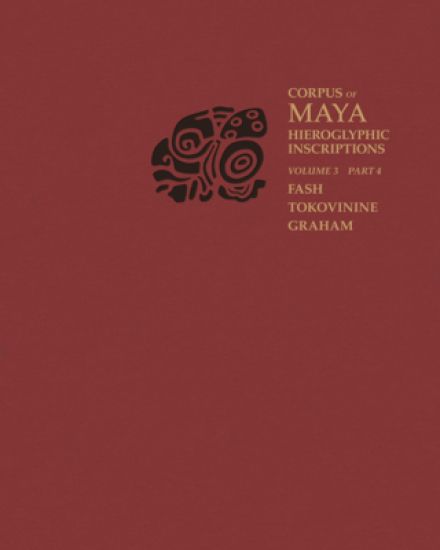
Corpus of Maya Hieroglyphic Inscriptions, Volume 3: Part 4: Yaxchilan

Corpus of Maya Hieroglyphic Inscriptions, Volume 3: Part 4: Yaxchilan

Barbara W. Fash; Alexandre Tokovinine; Ian Graham

PEABODY MUSEUM OF ARCHAEOLOGY ETHNOLOGY,U.S.
2022
nidottu
The goal of the Corpus of Maya Hieroglyphic Inscriptions is to document in photographs and detailed line drawings all known Maya inscriptions and their associated figurative art. As monuments continue to be discovered, the CMHI series is ongoing and far from complete. It has been instrumental in the remarkable success of the ongoing process of deciphering Maya writing, making available hundreds of texts to epigraphers working around the world, in addition to assisting studies among Maya communities and scholars. This folio-sized volume documents thirty stelae at Yaxchilan, a Classic Maya city located on the Usumacinta River in the state of Chiapas, Mexico. Precisely rendered line drawings and three-dimensional scans bring out details of the monuments that would otherwise be invisible to the naked eye. These illustrations are accompanied by descriptions of the stelae in English and Spanish.
Dictionary of the Maya Language

Dictionary of the Maya Language

Victoria Bricker

University of Utah Press,U.S.
1998
nidottu
The Maya language of Yucatan is known as Yucate by linguists, but its speakers refer to it as May. Dialiectical differences are minimal across the peninsula, and the more than 750,000 speakers of Maya can be understood wherever they go. Moreover, it is not only a living language but is of great use to epigraphers working on ancient Maya glyphs.This dictionary is the culmination of fourteen years’ labor centering on the town and dialect of Hocaba. Whereas other dictionaries of may use Latin paradigms, this is the first to provide a comprehensive, systematic listing of the stems that can be derived from each root and that give Maya its distinctive character. The entries cover the full range of Maya speech, from simple expressions and idioms to compound stems. Maya sample sentences provide a window into the richness of everyday communication, with its mixture of wit, epithets, insults, riddles, aphorisms, and exchanges of information, including a wonderful assortment of metaphorical expressions like "peccary’s eyelashes" for a type of bean, "the end of the road" for marriage, and a verb meaning "to draw breath with puckered mouth after eating chili." Among the cultural domains encompassed by the dictionary are agriculture, architecture, astronomy, culinary practices and recipes, education, folklore, games, humor, medical prescriptions, ritual, toys, and weaving, many of which have roots in the Precolumbian past. In addition to the dictionary entries, this work also contains a short grammar, a botanical index, and bibliography.
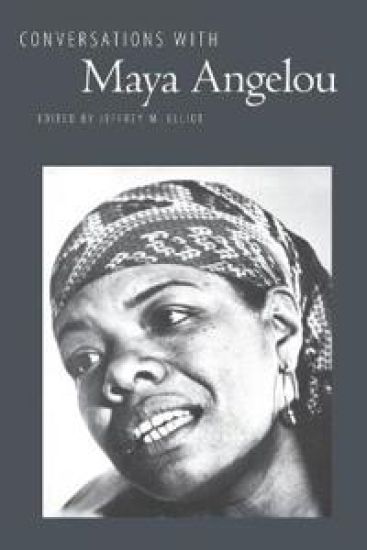
Conversations with Maya Angelou

Conversations with Maya Angelou

UNIVERSITY PRESS OF MISSISSIPPI
2014
nidottu
One of so many talents could only be expected to talk superbly, too. Here in over two dozen interviews is the voice of Maya Angelou (1928-2014) telling with strength, warmth, honesty, and dignified pride of her impact upon a difficult world and ultimately of her triumph. She has written poetry and a stream of dynamic autobiographies that include I Know Why the Caged Bird Sings; Gather Together in My Name; Singin' and Swingin' and Gettin' Merry Like Christmas; and Oh Pray My Wings Are Gonna Fit Me Well. In Conversations with Maya Angelou she spreads out the facts of her remarkable history for our examination and in sharing these conveys a salubrious philosophy and a zest for life. Jeffrey M. Elliot was a professor of political science at North Carolina Central University. His books include The State and Local Government Political Dictionary, Urban Society, and many others. He conducted over 350 interviews, including interviews with Jimmy Carter, Fidel Castro, and Contra leader Adolfo Calero.