Plenty of activities to keep your kids occupied during the October half term break, autumn/fall holiday.Would your children like to: Colour in picturesJoin the dots and colour in the resultsTrace spooky picturesWrite their own stories using story promptsFind hidden words in word searchesSolve Halloween mazesLearn how to do Sudoku puzzlesAnd find all the answers at the back of the book?Keep your children busy over half term, fall break on rainy days, road trips, or when you're simply too rushed to entertain them. Hours of fun with lots of different puzzles, pictures to color and story prompts to develop their imaginations, creating their own exciting ghost stories.Makes a great gift for for the half-term school holidays. Halloween themed mazes and lovely pictures to color in add to the magic of this activity book.Buy now to delight your youngsters for Halloween
I almost drowned. Then, I thought I was dreaming or maybe had a concussion... But she's real. Ayli, the last Starsurfer, is real and she is amazing I want her to stay, but she can't. The question is, how do you return a fallen Starsurfer to the stars? More to the point, how can I, the kid whose only skills are surfing and tripping over his own two feet, possibly help get Ayli home before it's too late?
..."And so thinking, I accidentally released a fart. Everyone held their nose and ran because it was a piece of art.Suddenly my tooth popped out onto the bench. Even my tooth couldn't stand this stench."Oliver's Tips for Kids Series 2Oliver realized he had a loose tooth. But as much as he and his family have been trying to get it out, everything just remains on the idea. A crying father, a sleeping grandfather and a scared aunt are just the beginning of this fun adventure...Every child reacts differently when they start to lose their baby teeth. Some kids get excited and can't wait for their visit from the Tooth Fairy. They constantly wiggle the tooth, hoping it will pop out soon. Many kids have the opposite reaction. They avoid touching the loose tooth completely and just hope the problem will go away. The decline any help to pull it out because they are so afraid of the pain. If your child is afraid to have a tooth extracted, this is the perfect book for you. Here are 10 funniest ways to get a tooth out that will make you and your kid laugh. Funny suggestions and even more hilarious outcomes will turn your child's fear into excitement. This is an energetic story suitable for the youngest readers. You will enjoy the colorful illustrations as well as the rhymes written in simple and fun language.It has a great message: *Great way to easing the fear about losing first tooth*Helps to prepare your child for losing baby teeth*It can also be fun for the kids who already have that enthusiasm*Cute illustrations with nice rhyming story*Not too long, grabs kid's attention*Suitable for the youngest readers If you love jokes, humor and crazy ideas, buy this book and enjoy it.
Oliver and Eleanor: Only One Season for Love is a novel whose idea came to the author's mind when he was going to work one grey rainy day. On his way, he was listening to classical instrumental music. There was a moment when one melody finished and another one started. In the beginning, it seemed very simple and boring, just like the weather and his surroundings that day. But then, he clearly saw a picture of a lonely, homeless man on the verge of death, who was playing his unheard-of music for the last time in his life, expressing all the pain that he's carried through his life, all within just a few seconds. At one point, when the pianist seemed to be finishing and that his life would end with the last note, the author wanted to change the track to something lighter, something that would cause depression and feeling how tragic life was like. But then all of a sudden, at the very end, a violin gently and harmoniously flows into the melody, changing not only the melody itself but everything around. The pianist, who had been sitting alone at the piano in a grey closed room where no sunlight could creep in, suddenly started to see the sun coming up, shining on him and wrapping him in its warm embrace. It was the violin that quietly and carefully broke into his nearly finished melody. It came and changed everything from the melody to the feelings the pianist was experiencing. The two melodies fused into one, as if it was one complete piece of music, although it hadn't seemed so from the start. The grand piano had sounded so complete, yet the violin was able to join in harmoniously in the middle of the piece. That's how the idea for Oliver was born. A story about a homeless man who decided to end his life through suicide, unable to bear his life on the streets any longer. After his failed suicide attempt, he went to get out from the rain, escaping unnoticed into an airport. There, he found the grand piano right in the middle of a large hall. He was playing it for the last time, when he met a wonderful, beautiful girl named Eleanor - who turned out to be blind. After hearing the melody about his life, she literally decided to help him and took him to Milan where she was to have a concert. As it turned out later, Eleanor was a talented and world-famous violin player touring the world. Oliver got a chance for a new life. However, he had a secret that he couldn't reveal to Eleanor, who had just started to trust him. The secret would later come to the surface, telling a story that would explain how such a talented man ended up on the streets, leading such a wretched life.
Oliver Twist is Charles Dickens's second novel, and was first published as a serial from 1837 to 1839. The story centres on orphan Oliver Twist, born in a workhouse and sold into apprenticeship with an undertaker. After escaping, Oliver travels to London, where he meets the "Artful Dodger", a member of a gang of juvenile pickpockets led by the elderly criminal Fagin. Oliver Twist is notable for its unromantic portrayal of criminals and their sordid lives, as well as for exposing the cruel treatment of the many orphans in London in the mid-19th century. In this early example of the social novel, Dickens satirises the hypocrisies of his time, including child labour, the recruitment of children as criminals, and the presence of street children.
Cromwell lived in an age when it was not possible to realize a government based upon those large principles of social, political, and religious liberty in which-at any rate, during his earlier years-he sincerely believed; but the movement of which he was the head was the first of the great movements which, marching along essentially the same lines, have produced the English-speaking world as we at present know it. So far from this great movement, of which Puritanism was merely one manifestation, being the last of a succession of similar heroisms, it had practically very much less connection with what went before than with all that has guided us in our history since. The men who figured in it and the principles for which they contended, are strictly akin to the men and the principles that have appeared in all similar great movements since. We must keep ever in mind the essentially modern character of the movement if we are to appreciate its true inwardness, its true significance. Fundamentally, it was the first struggle for religious, political, and social freedom, as we now understand the terms.
Oliver Twist, or The Parish Boy's Progress was Charles Dickens' second novel, following The Pickwick Papers, and was published as a serial in the magazine Bentley's Miscellany between 1837 and 1839. It details the misadventures of its eponymous character, Oliver Twist, born in a Victorian-era workhouse, his mother dying within minutes of his birth. He is raised in miserable conditions, half-starved, and then sent out as an apprentice to an undertaker. Running away from this situation, he walks to London and falls under the influence of a criminal gang run by an old man called Fagin, who wants to employ the child as a pickpocket. The novel graphically depicts the wretched living conditions of much of the poor people of Victorian times and the disgusting slums in which they were forced to live. It has been accused of perpetrating anti-Semitic stereotypes in the character of Fagin, almost always referred to as "the Jew" in the book's early chapters. Interestingly, while the serial was still running in the magazine, Dickens was eventually persuaded that he was wrong in this and removed many such usages in later episodes. He also introduced more kindly Jewish characters in such later novels as Our Mutual Friend. Oliver Twist was immediately popular in serial form, with its often gripping story and lurid details. It has remained one of Dicken's best-loved novels, and the story has often been made into films and television series, as well as into a very popular musical, Oliver .
At the heart of Dickens's second novel is a story as much about crime and poverty as it is about justice and charity. Orphaned at birth, Oliver Twist grows up under the loveless, relentless watch of a workhouse. He runs away with hopes for a better life in London, only to become-at the hands of the unforgettable Artful Dodger-a guileless pawn in a gang of pickpockets and robbers working for Fagin, one of Dickens's most controversial villains. Full of ingenious plot twists, at turns thrilling, tragic, tender, and sharp-eyed, Oliver Twist is among Dickens's most enduring classics; the story of a young orphan who dares to say, "Please, sir, I want some more." We are delighted to publish this classic book as part of our extensive Classic Library collection. Many of the books in our collection have been out of print for decades, and therefore have not been accessible to the general public. The aim of our publishing program is to facilitate rapid access to this vast reservoir of literature, and our view is that this is a significant literary work, which deserves to be brought back into print after many decades. The contents of the vast majority of titles in the Classic Library have been scanned from the original works. To ensure a high quality product, each title has been meticulously hand curated by our staff. Our philosophy has been guided by a desire to provide the reader with a book that is as close as possible to ownership of the original work. We hope that you will enjoy this wonderful classic work, and that for you it becomes an enriching experience
Washington Irving (April 3, 1783 - November 28, 1859) was an American short story writer, essayist, biographer, historian, and diplomat of the early 19th century. He is best known for his short stories "Rip Van Winkle" (1819) and "The Legend of Sleepy Hollow" (1820), both of which appear in his collection, The Sketch Book of Geoffrey Crayon, Gent. His historical works include biographies of Oliver Goldsmith, Muhammad, and George Washington, as well as several histories of 15th-century Spain dealing with subjects such as Alhambra, Christopher Columbus, and the Moors. Irving served as the U.S. ambassador to Spain from 1842 to 1846.
Oliver Twist is born an orphan and grows up handed from bad position to worse. Eventually he ends up in the London street gang run by Fagin, who attempts to blacken the boy's pure soul in his service. Through chance and coincidence Oliver is restored to his mother's middle-class family, where he is shown love and comfort for the first time in his life. The villains' attempts to kidnap him back are foiled and all are transported or hanged.
She Stoops to Conquer is a comedy by the Anglo-Irish 1] author Oliver Goldsmith, first performed in London in 1773. The play is a favourite for study by English literature and theatre classes in the English-speaking world. It is one of the few plays from the 18th century to have retained its appeal and is regularly performed. The play has been adapted into a film several times, including in 1914 and 1923. Initially the play was titled Mistakes of a Night and the events within the play take place in one long night. In 1778 John O'Keeffe wrote a loose sequel, Tony Lumpkin in Town. Plot Wealthy countryman Mr. Hardcastle arranges for his daughter Kate to meet Charles Marlow, the son of a rich Londoner, hoping the pair will marry. Unfortunately, Marlow prefers lower-class women, finding them less intimidating than women of high society. On his first acquaintance with Kate, the latter realises she will have to pretend to be 'common' to get Marlow to woo her. Thus Kate 'stoops to conquer', by posing as a maid, hoping to put Marlow at his ease so he falls for her. Marlow sets out for Mr. Hardcastle's manor with a friend, George Hastings, an admirer of Miss Constance Neville, another young lady who lives with the Hardcastles. During the journey the two men get lost and stop at an alehouse, The Three Jolly Pigeons, for directions. Tony Lumpkin, Kate's step-brother and Constance's cousin, comes across the two strangers at the alehouse and realising their identity, plays a practical joke by telling them that they are a long way from their destination and will have to stay overnight at an inn. The "inn" he directs them to is in fact the home of the Hardcastles. When they arrive, the Hardcastles, who have been expecting them, go out of their way to make them welcome. Marlow and Hastings, believing themselves in an inn, behave extremely disdainfully towards their hosts. Hardcastle bears their unwitting insults with forbearance, because of his friendship with Marlow's father. Kate learns of her suitor's shyness from Constance and a servant tells her about Tony's trick. She decides to masquerade as a serving-maid (changing her accent and garb) to get to know him. Marlow falls in love with her and plans to elope but because she appears of a lower class, acts in a somewhat bawdy manner around her. All misunderstandings are resolved by the end, thanks to an appearance by Sir Charles Marlow. The main sub-plot concerns the secret romance between Constance and Hastings. Constance needs her jewels, an inheritance, guarded by Tony's mother, Mrs. Hardcastle, who wants Constance to marry her son, to keep the jewels in the family. Tony despises the thought of marrying Constance - he prefers a barmaid at the alehouse - and so agrees to steal the jewels from his mother's safekeeping for Constance, so she can elope to France with Hastings. The play concludes with Kate's plan succeeding, she and Marlow become engaged. Tony discovers his mother has lied about his being "of age" and thus entitled to his inheritance. He refuses to marry Constance, who is then eligible to receive her jewels and become engaged to Hastings, which she does.... Oliver Goldsmith (10 November 1728 - 4 April 1774) was an Irish novelist, playwright and poet, who is best known for his novel The Vicar of Wakefield (1766), his pastoral poem The Deserted Village (1770), and his plays The Good-Natur'd Man (1768) and She Stoops to Conquer (1771, first performed in 1773). He is thought to have written the classic children's tale The History of Little Goody Two-Shoes (1765).....
Rare edition with unique illustrations and elegant classic cream paper. One of the most widely read novels of all time, Les Miserables was the crowning literary achievement of Victor Hugo's stunning career. Includes unique vintage illustrations.
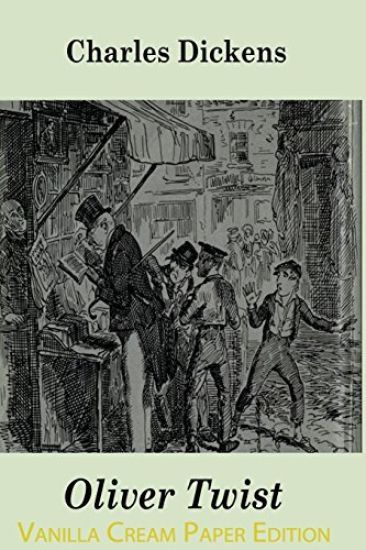
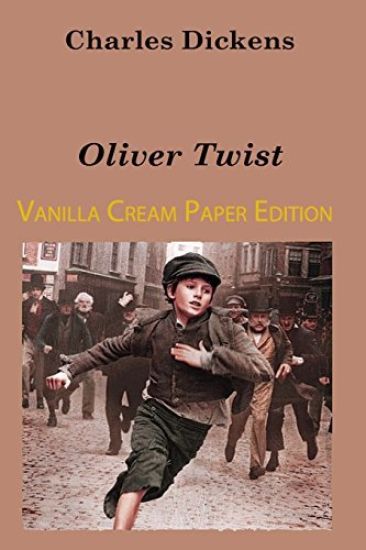
Rare edition with unique illustrations and elegant classic cream paper. At the heart of Dickens's second novel is a story as much about crime and poverty as it is about justice and charity. Orphaned at birth, Oliver Twist grows up under the loveless, relentless watch of a workhouse. He runs away with hopes for a better life in London, only to become-at the hands of the unforgettable Artful Dodger-a guileless pawn in a gang of pickpockets and robbers working for agin, one of Dickens's most controversial villains. Full of ingenious plot twists, at turns thrilling, tragic, tender, and sharp-eyed, Oliver Twist is among Dickens's most enduring classics; the story of a young orphan who dares to say, "Please, sir, I want some more." Includes unique illustrations.
Rare edition with unique illustrations and elegant classic cream paper. At the heart of Dickens's second novel is a story as much about crime and poverty as it is about justice and charity. Orphaned at birth, Oliver Twist grows up under the loveless, relentless watch of a workhouse. He runs away with hopes for a better life in London, only to become-at the hands of the unforgettable Artful Dodger-a guileless pawn in a gang of pickpockets and robbers working for agin, one of Dickens's most controversial villains. Full of ingenious plot twists, at turns thrilling, tragic, tender, and sharp-eyed, Oliver Twist is among Dickens's most enduring classics; the story of a young orphan who dares to say, "Please, sir, I want some more." Includes unique illustrations.
Oliver Twist ist ein Gesellschaftsroman von Charles Dickens, der unter dem vollst ndigen Titel "Oliver Twist; or, The Parish Boy's Progress" ("Oliver Twist oder der Weg des F rsorgez glings") von Februar 1837 bis April 1839 in Fortsetzungen in der Zeitschrift "Bentley's Miscellany" erschien. Oliver Twist ist Dickens' zweiter Roman. Er wurde mehrfach f r Theater, Kino, Fernsehen und Comic adaptiert. Der Roman erz hlt die Geschichte des Findelkindes und Waisenjungen Oliver Twist, der im Armenhaus einer englischen Kleinstadt aufw chst, ohne etwas ber seine Herkunft zu wissen. Durch die katastrophalen Zust nde im Armenhaus gezwungen, bittet er um mehr Nahrung, worauf er eine Woche lang in den Kohlenkeller gesperrt wird. Au erdem wird ausgeschrieben, dass die Gemeinde denjenigen entlohne, der sich seiner annehmen w rde. Dies f hrt ihn zum ans ssigen Sarg-Tischler namens Mr. Sowerberry, der einer ehrlichen Arbeit nachgeht und den Jungen allm hlich auf seine Art liebgewinnt. Der Nebenlehrling Noah Claypole beleidigt Olivers tote Mutter, weshalb Oliver sich mit ihm pr gelt und er daf r mit Schl gen bestraft wird. Er flieht anschlie end zu Fu nach London. Oliver braucht sieben Tage, bis er dort ganz ersch pft ankommt. In London ger t er in die F nge des j dischen Hehlers Fagin (Boss der Diebe), der ihn vor dem sicheren Tod auf der Stra e bewahrt, indem er ihn verk stigt. Seine Sch tzlinge bilden eine Diebesbande, die haupts chlich aus Stra enjungen besteht. Fagin macht auch Oliver mit dem Diebeshandwerk vertraut. Der u erst brutale Eigenbr tler Bill Sikes und die ihm nahestehende Diebesgesellin Nancy, die auf eine eigenartige Weise mit Sikes verbunden ist, treten ebenfalls zu dieser Zeit in Olivers Leben. In solcher Gesellschaft lebend und lernend, wird Oliver eines Tages auf eine Diebestour mitgenommen, die fatale Folgen f r ihn hat. Nachdem das Opfer Mr. Brownlow bemerkt, dass er bestohlen wurde, wird Oliver f lschlicherweise f r den Dieb gehalten. W hrend des Verh rs auf der Polizeiwache wird Oliver in einem fiebrigen Anfall ohnm chtig und wird schlie lich durch einen Zeugen entlastet, ganz zum Wohlgefallen des mitleidigen Mr. Brownlow, welcher den Jungen unter seine Fittiche nimmt und ihn gesundpflegen l sst.
Oliver Twist; or, the Parish Boy's Progress is author Charles Dickens's second novel, and was first published as a serial 1837-39. The story centres on orphan Oliver Twist, born in a workhouse and sold into apprenticeship with an undertaker. After escaping, Twist travels to London, where he meets "The Artful Dodger", a member of a gang of juvenile pickpockets led by the elderly criminal, Fagin. Oliver Twist is notable for its unromantic portrayal by Dickens of criminals and their sordid lives, as well as for exposing the cruel treatment of the many orphans in London in the mid-19th century. The alternative title, The Parish Boy's Progress, alludes to Bunyan's The Pilgrim's Progress, as well as the 18th-century caricature series by William Hogarth, A Rake's Progress and A Harlot's Progress. In this early example of the social novel, Dickens satirises the hypocrisies of his time, including child labour, the recruitment of children as criminals, and the presence of street children. The novel may have been inspired by the story of Robert Blincoe, an orphan whose account of working as a child labourer in a cotton mill was widely read in the 1830s. It is likely that Dickens's own youthful experiences contributed as well. Oliver Twist has been the subject of numerous adaptations for various media, including a highly successful musical play, Oliver , and the multiple Academy Award-winning 1968 motion picture. Disney also put its spin on the novel with the animated film called Oliver & Company in 1988.
"...It is a true tale of grief and trial, and sorrow...such tales usually are; if it were one of unmixed joy and happiness, it would be very brief. Olver Twist is Charles Dickens' classic tale of an orphan in search of a true home. Facing the harsh reality and cruelty of poverty he is forced to live in a dark and dismal London workhouse run by Mr. Bumble, a cruel man who cheats the boys out of their meager rations. One of the most often quoted lines from the book is "Please, sir, I want some more". Said by young Oliver to a church workhouse employee, Oliver is not only not given more food, but he is also treated like a dreadful sinner and criminal. Hungry and desperate, Oliver makes his escape, but being penniless and alone, he is easily lured into a world of crime by Fagin, the mastermind of a gang of young pickpockets. Luckily, when Oliver is sent on a mission by Fagin, he is rescued by a kindly gentleman. This benefactor takes him in but Oliver finds himself involved in a battle with an evil person and must use his wits to protect himself and others until he ultimately find his place in the world. The sordid lives of street criminals and the cruel treatment of orphans living in London in the mid-19th century is exposed in Dicken's story. He satirizes child labor and domestic violence in what is considered to be an early social novel. Dickens himself, spent two years in the workhouse at the age of 12 and missed several years of education. Dickens created some of literature's best-known fictional characters, and is regarded by many as the greatest novelist of the Victorian era.
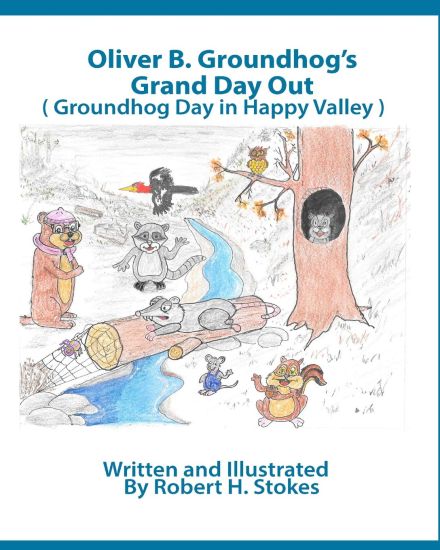
Take a trip with Oliver the Groundhog in search for that special treat and follow the trail through Happy Valley. You will meet his friends as he walks to his favorite destination and dances into your heart Children become quickly more intelligent through books Help children read and grow in their appreciation of books and the magical world of imagination. Age group 5-10. Younger ones will enjoy your reading to them. While older ones can build their vocabulary and learn about the world around them... Robert H. Stokes