Kirjojen hintavertailu. Mukana 11 244 527 kirjaa ja 12 kauppaa.

Kirjahaku

Etsi kirjoja tekijän nimen, kirjan nimen tai ISBN:n perusteella.

1000 tulosta hakusanalla Philo

Philosophical Perspectives on Infinity

Philosophical Perspectives on Infinity

Graham Oppy

Cambridge University Press
2009
pokkari
This book is an exploration of philosophical questions about infinity. Graham Oppy examines how the infinite lurks everywhere, both in science and in our ordinary thoughts about the world. He also analyses the many puzzles and paradoxes that follow in the train of the infinite. Even simple notions, such as counting, adding and maximising present serious difficulties. Other topics examined include the nature of space and time, infinities in physical science, infinities in theories of probability and decision, the nature of part/whole relations, mathematical theories of the infinite, and infinite regression and principles of sufficient reason.
Philosophy and Biblical Interpretation

Philosophy and Biblical Interpretation

Peter Addinall

Cambridge University Press
2009
pokkari
This study explores the nature of the conflict between science and religion. It shows through a detailed examination of this conflict as it was manifested in nineteenth-century Britain that religion and science, properly understood, cannot co-exist in mutual harmony. The legacy of their conflict in the last century has been passed on to the twentieth century, greatly to the detriment of religious belief. It is the author's contention that a return to the essentials of Kant's critical philosophy would lay bare the profound differences between religious and scientific approaches to the world, and the nature of the choice to be made between them. In its effort to demarcate the outlines of a genuine biblical theology (and to articulate the proper procedures for producing one) the book casts light on important questions of biblical interpretation, and demands a radical reassessment of the meaning of science for society.
Philosophical Foundations for the Practices of Ecology

Philosophical Foundations for the Practices of Ecology

William A. Reiners; Jeffrey A. Lockwood

Cambridge University Press
2009
sidottu
Ecologists use a remarkable range of methods and techniques to understand complex, inherently variable, and functionally diverse entities and processes across a staggering range of spatial, temporal and interactive scales. These multiple perspectives make ecology very different to the exemplar of science often presented by philosophers. In Philosophical Foundations for the Practices of Ecology, designed for graduate students and researchers, ecology is put into a new philosophical framework that engages with this inherent pluralism while still placing constraints on the ways that we can investigate and understand nature. The authors begin by exploring the sources of variety in the practice of ecology and how these have led to the current conceptual confusion. They argue that the solution is to adopt the approach of constrained perspectivism and go on to explore the ontological, metaphysical, and epistemological aspects of this position and how it can be used in ecological research and teaching.
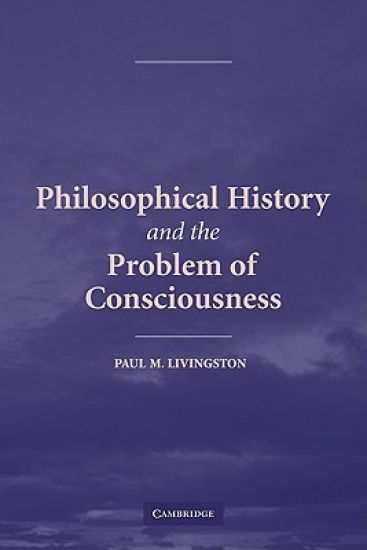
Philosophical History and the Problem of Consciousness

Philosophical History and the Problem of Consciousness

Paul M. Livingston

Cambridge University Press
2009
pokkari
The problem of explaining consciousness remains a problem about the meaning of language: the ordinary language of consciousness in which we define and express our sensations, thoughts, dreams and memories. This book argues that the problem arises from a quest that has taken shape over the twentieth century, and that the analysis of history provides new resources for understanding and resolving it. Paul Livingston traces the development of the characteristic practices of analytic philosophy to problems about the relationship of experience to linguistic meaning, focusing on the theories of such philosophers as Carnap, Schlick, Neurath, Husserl, Ryle, Putnam, Fodor and Wittgenstein. Clearly written and avoiding technicalities, this book will be eagerly sought out by professionals and graduate students in philosophy and cognitive science.
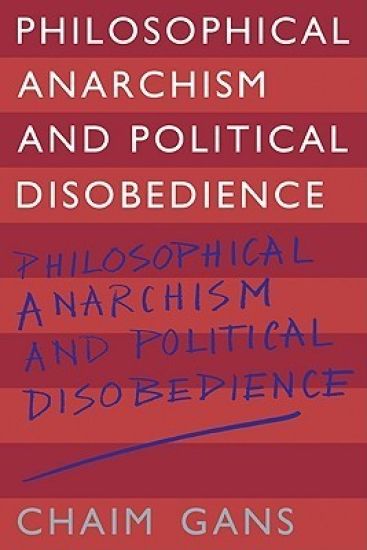
Philosophical Anarchism and Political Disobedience

Philosophical Anarchism and Political Disobedience

Chaim Gans

Cambridge University Press
2009
pokkari
This book examines the central questions concerning the duty to obey the law: the meaning of this duty; whether and where it should be acknowledged; and whether and when it should be disregarded. Many contemporary philosophers deny the very existence of this duty, but take a cautious stance towards political disobedience. This 'toothless anarchism', Professor Gans argues, should be discarded in favour of a converse position confirming the existence of a duty to obey the law which can be outweighed by values and principles of political morality. Informed by the Israeli experience of political disobedience motivated by radically differing moral outlooks, the author sets out the principles which should guide our attitude to law and political authority even amidst clashing ideologies and irreconcilable moralities. This book will be of interest to students and scholars of law, philosophy and politics, and anyone concerned with the individual's responsibilities toward his or her political community.
Philosophical Foundations for the Practices of Ecology

Philosophical Foundations for the Practices of Ecology

Reiners William A.; Lockwood Jeffrey A.

Cambridge University Press
2009
pokkari
Ecologists use a remarkable range of methods and techniques to understand complex, inherently variable, and functionally diverse entities and processes across a staggering range of spatial, temporal and interactive scales. These multiple perspectives make ecology very different to the exemplar of science often presented by philosophers. In Philosophical Foundations for the Practices of Ecology, designed for graduate students and researchers, ecology is put into a new philosophical framework that engages with this inherent pluralism while still placing constraints on the ways that we can investigate and understand nature. The authors begin by exploring the sources of variety in the practice of ecology and how these have led to the current conceptual confusion. They argue that the solution is to adopt the approach of constrained perspectivism and go on to explore the ontological, metaphysical, and epistemological aspects of this position and how it can be used in ecological research and teaching.
Philosophy of Experimental Biology

Philosophy of Experimental Biology

Marcel Weber

Cambridge University Press
2010
pokkari
Philosophy of Experimental Biology explores some central philosophical issues concerning scientific research in experimental biology, including genetics, biochemistry, molecular biology, developmental biology, neurobiology, and microbiology. It seeks to make sense of the explanatory strategies, concepts, ways of reasoning, approaches to discovery and problem solving, tools, models and experimental systems deployed by scientific life science researchers and also integrates developments in historical scholarship, in particular the New Experimentalism. It concludes that historical explanations of scientific change that are based on local laboratory practice need to be supplemented with an account of the epistemic norms and standards that are operative in science. This book should be of interest to philosophers and historians of science as well as to scientists.
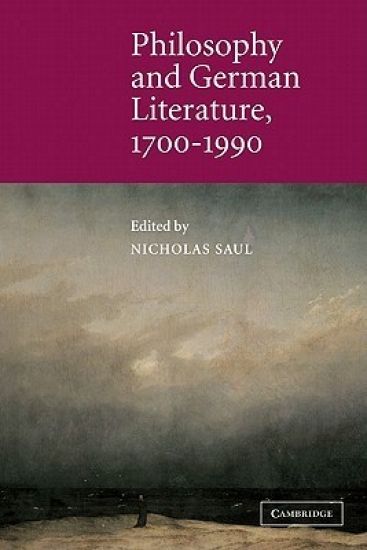
Philosophy and German Literature, 1700–1990
Although the importance of the interplay of literature and philosophy in Germany has often been examined within individual works or groups of works by particular authors, little research has been undertaken into the broader dialogue of German literature and philosophy as a whole. Philosophy and German Literature 1700–1990 offers six chapters by leading specialists on the dialogue between the work of German literary writers and philosophers through their works. The volume shows that German literature, far from being the mouthpiece of a dour philosophical culture dominated by the great names of Leibniz, Kant, Hegel, Marx, Heidegger and Habermas, has much more to offer: while possessing a high affinity with philosophy it explores regions of human insight and experience beyond philosophy's ken.
Philosophy as Therapeia

Philosophy as Therapeia

Cambridge University Press
2010
pokkari
'Empty are the words of that philosopher who offers therapy for no human suffering. For just as there is no use in medical expertise if it does not give therapy for bodily diseases, so too there is no use in philosophy if it does not expel the suffering of the soul.' The philosopher Epicurus gave famous voice to a conception of philosophy as a cure or remedy for the maladies of the human soul. What has not until now received attention is just how prominent an idea this has been across a whole spectrum of philosophical tradition. Philosophy as Therapeia presents a collection of papers by leading scholars, providing a new reading of the history of philosophy, one which perhaps contradicts those who have wanted to maintain that philosophy is a peculiarly European cultural product, and instead affirms its identity as a global intellectual practice.
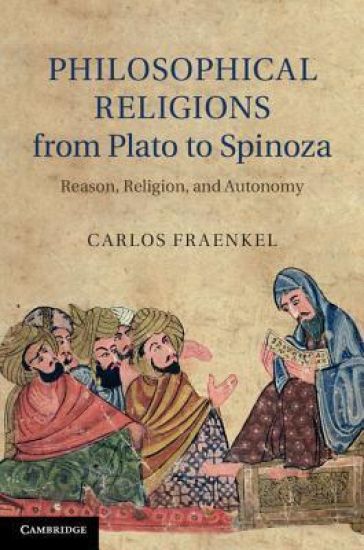
Philosophical Religions from Plato to Spinoza

Philosophical Religions from Plato to Spinoza

Carlos Fraenkel

Cambridge University Press
2012
sidottu
Many pagan, Jewish, Christian and Muslim philosophers from Antiquity to the Enlightenment made no meaningful distinction between philosophy and religion. Instead they advocated a philosophical religion, arguing that God is Reason and that the historical forms of a religious tradition serve as philosophy's handmaid to promote the life of reason among non-philosophers. Carlos Fraenkel provides the first account of this concept and traces its history back to Plato. He shows how Jews and Christians appropriated it in Antiquity, follows it through the Middle Ages in both Islamic and Jewish forms and argues that it underlies Spinoza's interpretation of Christianity. The main challenge to a philosophical religion comes from the modern view that all human beings are equally able to order their lives rationally and hence need no guidance from religion. Fraenkel's wide-ranging book will appeal to anyone interested in how philosophy has interacted with Jewish, Christian, and Muslim religious traditions.
Philosophy in History

Philosophy in History

Cambridge University Press
1984
pokkari
The sixteen essays in this volume confront the current debate about the relationship between philosophy and its history. On the one hand intellectual historians commonly accuse philosophers of writing bad - anachronistic - history of philosophy, and on the other, philosophers have accused intellectual historians of writing bad - antiquarian - history of philosophy. The essays here address this controversy and ask what purpose the history of philosophy should serve. Part I contains more purely theoretical and methodological discussion, of such questions as whether there are ‘timeless’ philosophical problems, whether the issues of one epoch are commensurable with those of another, and what style is appropriate to the historiography of the subject. The essays in Part II consider a number of case-histories. They present important revisionist scholarship and original contributions on topics drawn from ancient, early modern and more recent philosophy. All the essays have been specially commissioned, and the contributors include many of the leading figures in the field. The volume as a whole will be of vital interest to everyone concerned with the study of philosophy and of its history.
Philosophical Dimensions of Privacy

Philosophical Dimensions of Privacy

Cambridge University Press
1984
pokkari
The aim of compiling the various essays presented here is to make readily accessible many of the most significant and influential discussions of privacy to be found in the literature. In addition to being representative of the diversity of attitudes toward privacy, this collection has a coherence that results from the authors' focus on the same issues and theories. The main issue addressed in this book is the moral significance of privacy. Some social science and legal treatments are included because of their direct bearing on the moral issues that privacy raises. In addition to the classics on privacy, the author has included an interpretative essay on the privacy literature, which provides a philosophical guideline as to what the issues are and how various thinkers have contributed to their resolution.
Philosophical Essays on Freud

Philosophical Essays on Freud

Cambridge University Press
1982
pokkari
Philosophers are increasingly coming to recognize the importance of Freudian theory for the understanding of the mind. The picture Freud presents of the mind's growth and organization holds implications not just for such perennial questions as the relation of mind and body, the nature of memory and personal identity, the interplay of cognitive and affective processes in reasoning and acting, but also for the very way in which these questions are conceived and an interpretation of the mind is sought. This volume of essays, by some of today's leading philosophers, explores all these topics, as well as the methods, results and status of the theory itself, while two 'classical' discussions by Wittgenstein and Sartre are also included. A number of the contributions – those by Donald Davidson, W. D. Hart, Jim Hopkins, Adam Morton, David Pears and Richard Wollheim – have not been published before, and a very useful bibliography is provided. It is an anthology that will be vital to anyone interested in Freudian theory and, more generally, in philosophical psychology.