

Kirjahaku
Etsi kirjoja tekijän nimen, kirjan nimen tai ISBN:n perusteella.
1000 tulosta hakusanalla Primmer Jacob
Over half of the English language is derived from Latin. amateur amo, I love Montana mons, mountain patriot patria, native land spectacular specto, I look at mural murus, wall These and thousands of other words we use every day keep this "dead" language a language of kings and poets, of scrolls and secrets alive. And this means that when we study Latin, we're not just learning about Rome we're learning about ourselves. Rediscover this time-honored language, which led classical education pioneer Dorothy Sayers to declare that "Latin should be begun as early as possible ... when the chanting of Amo, amas, amat is as ritually agreeable to the feelings as the chanting of eeny, meeny, miney, moe." In Latin Primer 1 Martha Wilson equips elementary school students (grades 3 and up) with a solid foundation in classical Latin. Newly revised and expanded, this text covers the very basics: vocabulary for everyday concepts like farming, sailing, the human body, constellations, and family; verb and noun endings; and other beginning grammar concepts. This updated teacher's edition includes new teacher's notes, weekly quizzes, and a full glossary."

Over half of the English language is derived from Latin aquarium aqua, water fable fabula, story clamor clamo, I shout dolphin delphinus, dolphin narrator narro, I tell These and thousands of other words we use every day keep this "dead" language a language of kings and poets, of scrolls and secrets alive. And this means that when we study Latin, we're not just learning about Rome we're learning about ourselves. Rediscover this time-honored language, which led classical education pioneer Dorothy Sayers to declare that "Latin should be begun as early as possible ... when the chanting of "Amo, amas, amat" is as ritually agreeable to the feelings as the chanting of "eeny, meeny, miney, moe." In Latin Primer 2, Martha Wilson strengthens elementary school students (grades 4 and up) in the basics they discovered in Latin Primer 1, and leads them steadily into new territory. Revised and expanded, this text spotlights the fundamentals of classical Latin: vocabulary for everyday experiences like names of animals; verb and noun endings; adjective and adverb use; questions and commands; and other early grammar essentials. What's new in the Fourth Edition: First, the Primer 2 now features weekly Word Lists. Just like in Primer 1, students will receive a new Word List every week, rather than once every few weeks. This transition from Primer 1 to Primer 2 has never been more simple or familiar. Second, Canon Press has completely redesigned the layout. While older editions were arranged by category a word list section, exercise section, and test section the new edition has been arranged in a simple lesson-by-lesson format. For example, all of Lesson 1 s components are grouped together, back-to-back. When you finish one lesson, you re on to the next. No more flipping back and forth between sections everything you need for each lesson is right at your fingertips, whether you re the teacher or the student Third, they ve added new exercises to every lesson, giving students greater opportunity to practice and review their Latin skills, as well as providing teachers with more material to gauge their students level of understanding. Fourth, the teacher s edition has been significantly expanded. Mirroring the student book, it includes not only the answers, but also weekly quizzes and new weekly teacher s lesson notes. The lesson notes have been redesigned to explain the standard flow of every lesson and offer tips on preparation and focus for everything from weekly derivatives to unit goals. Whether you re a homeschooling parent or a classical school teacher, these convenient notes will save time, provide a clear direction for the course, and better help your students grasp the language. And last, but not least: you ve heard that you can t judge a book by its cover, but who doesn t like to use a good-looking book? Latin Primer 2 will debut in its new perfect bound form with perforated exercise pages for easy grading."
Over half of the English language is derived from Latin aquarium aqua, water fable fabula, story clamor clamo, I shout dolphin delphinus, dolphin narrator narro, I tell These and thousands of other words we use every day keep this "dead" language a language of kings and poets, of scrolls and secrets alive. And this means that when we study Latin, we're not just learning about Rome we're learning about ourselves. Rediscover this time-honored language, which led classical education pioneer Dorothy Sayers to declare that "Latin should be begun as early as possible ... when the chanting of "Amo, amas, amat" is as ritually agreeable to the feelings as the chanting of "eeny, meeny, miney, moe." In Latin Primer 2, Martha Wilson strengthens elementary school students (grades 4 and up) in the basics they discovered in Latin Primer 1, and leads them steadily into new territory. Revised and expanded, this text spotlights the fundamentals of classical Latin: vocabulary for everyday experiences like names of animals; verb and noun endings; adjective and adverb use; questions and commands; and other early grammar essentials. This updated Teacher's Edition includes new teacher's notes, weekly quizzes, and a full glossary."
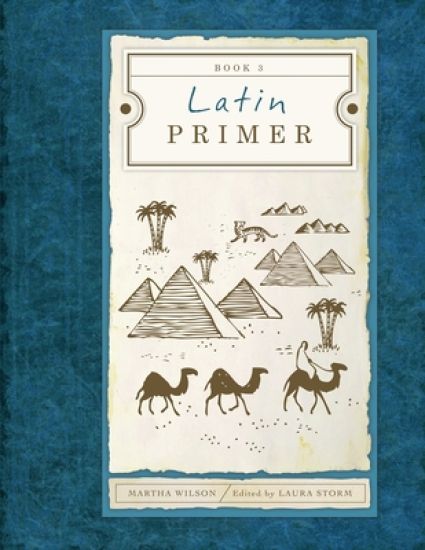
Over half of the English language is derived from Latin. unicorn-cornū, horn humble-humus, earth gregarious-grex, flock pantry-pānis, bread flamingo-flamma, flame These and thousands of other words we use every day keep this "dead" language-a language of kings and poets, of scrolls and secrets-alive. And this means that when we study Latin, we're not just learning about Rome-we're learning about ourselves. Rediscover this time-honored language, which led classical education innovator Dorothy Sayers to declare that "Latin should be begun as early as possible . . . when the chanting of 'amō, amās, amat' is as ritually agreeable to the feelings as the chanting of 'eeny, meeny, miney, moe.'" In Latin Primer 3, the language basics explored in Primers 1 and 2 continue, with an increasing emphasis on translation. Revised and expanded, this text introduces students (grades 5 and up) to Latin's final noun declensions and verb conjugations, as well as to perfect tense, indirect objects, simple prepositions, and more, opening up broad frontiers for their understanding and enjoyment of this early language. This updated Teacher's Edition includes new teacher's notes, new weekly quizzes, an English-Latin glossary, and a Latin-English glossary.
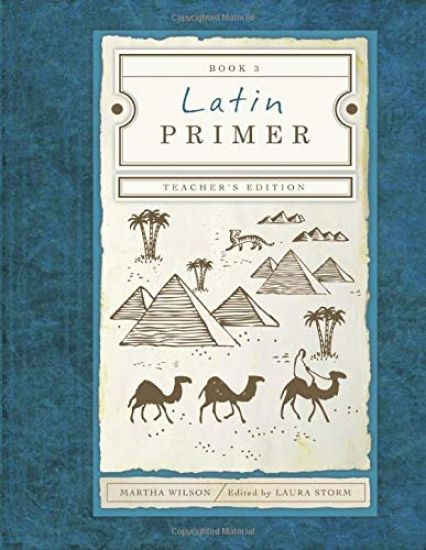
Over half of the English language is derived from Latin. unicorn-cornū, horn humble-humus, earth gregarious-grex, flock pantry-pānis, bread flamingo-flamma, flame These and thousands of other words we use every day keep this "dead" language-a language of kings and poets, of scrolls and secrets-alive. And this means that when we study Latin, we're not just learning about Rome-we're learning about ourselves. Rediscover this time-honored language, which led classical education innovator Dorothy Sayers to declare that "Latin should be begun as early as possible . . . when the chanting of 'amō, amās, amat' is as ritually agreeable to the feelings as the chanting of 'eeny, meeny, miney, moe.'" In Latin Primer 3, the language basics explored in Primers 1 and 2 continue, with an increasing emphasis on translation. Revised and expanded, this text introduces students (grades 5 and up) to Latin's final noun declensions and verb conjugations, as well as to perfect tense, indirect objects, simple prepositions, and more, opening up broad frontiers for their understanding and enjoyment of this early language. This updated Teacher's Edition includes new teacher's notes, new weekly quizzes, an English-Latin glossary, and a Latin-English glossary.


MATLAB Primer for Speech Language Pathology and Audiology
Frank R. Boutsen; Justin D. Dvorak
Plural Publishing Inc
2015
nidottu
MATLAB(R) Primer for Speech Language Pathology and Audiology provides training and access to MATLAB(R), the computational language developed by MathWorks. While there are MATLAB(R) textbooks and manuals written for the field of engineering, there are no textbooks targeting allied heath disciplines and speech-language pathology and audiology in particular. Research and practice in this field can greatly benefit from quantification and automation in data management, a domain that is increasingly labor intensive. The text anticipates and promotes increased reliance on quantification and automation in the field of speech-language pathology and audiology.This book is intended for students, practitioners and researchers in speech-language pathology and audiology who wish to increase their productivity by incorporating and automating common research procedures and data-analysis calculations, or to develop new tools and methods for their own paradigms and data processing. It assumes no prior knowledge of programming, but requires the reader have a grasp of basic computer skills such as managing folders, moving files, and navigating file paths and folder structures.Content and style are chosen so as to lower the threshold to an audience that as of yet has limited training in computer science. Concepts are presented in a personalized writing style (almost a dialogue with the reader), along with a didactic format that comes close to programmed instruction, using applications and work assignments that are concrete and manageable.Key Features:*Provides a comprehensive introduction to the user in an effort to limit background needed to follow the content*Includes several mathematical review appendices*Exercises for the student to apply skills learned in laboratory and clinical applications*Supplies many examples of MATLAB code and makes use of several datasets

A Primer on Modern Themes in Free Market Economics and Policy
John M Cobin
Universal Publishers
2009
pokkari
A Primer for the Exercise and Nutrition Sciences
Christopher B. Scott
Humana Press Inc.
2008
sidottu
What a journey writing this text has been. The lengthy voyage started well before the idea hatched of authoring a text that contained the word “thermodynamics”! I was informed by my good friend and sometimes colleague Dr. Jose Antonio that by including that word in the title, nutritionists and exercise physiologists might avoid the subject. But almost every step of my expedition was taken on a rather solid foundation of thermodynamics and as such the topic could not possibly be omitted from the title or the text of a book about bioenergetics and energy expenditure. I am not a physicist. In fact I ?rst went to college to become a football coach. That vocational choice began to deteriorate when taking the mandatory anatomy and physiology courses required of all physical education majors. This information was exciting; my interest in physical education began to wane. During sophomore year, I answered an advertisement in the school newspaper requesting research subjects.
In wildlife, fisheries, forestry, and range management departments around the country, natural resource scientists and their students advance understanding of the natural world largely through the collection and analysis of data. These students learn how to acquire data in the field and analyze them using modeling and other statistical methods.What they do not learn, contends author Fred S. Guthery, is what science means as an intellectual pursuit and where natural resource science fits in the scientific tradition. He argues that without education about the nature and philosophy of science, the wildlife field has become enamored with its methodologies at the expense of gaining real knowledge, leading to what some have characterized as ""a crisis in how wildlife science is pursued."" With ""A Primer on Natural Resource Science"", Guthery intends to put learning about the nature of science into the natural resource scientist's university curriculum.In the first part of the book, ""Perspectives,"" Guthery describes the principles of the scientific endeavor, discussing the nature of reasoning, of facts, of creativity and critical thinking. In the second part, ""Practice,"" he presents the ""mechanics"" of science, explaining the roles of experiment, observation, models, and statistics. He also demystifies the essential activity of publishing, telling students and researchers why they must do it and how to do it successfully.Throughout the book, Guthery uses his long experience and the body of his own research to relate the philosophical underpinnings of science to the realities of field biology. By providing real-life examples in the practice of natural resource science, Guthery offers practical, occasionally painful, and sometimes humorous lessons on the human urge to know about nature through science.
In wildlife, fisheries, forestry, and range management departments around the country, natural resource scientists and their students advance understanding of the natural world largely through the collection and analysis of data. These students learn how to acquire data in the field and analyze them using modeling and other statistical methods.What they do not learn, contends author Fred S. Guthery, is what science means as an intellectual pursuit and where natural resource science fits in the scientific tradition. He argues that without education about the nature and philosophy of science, the wildlife field has become enamored with its methodologies at the expense of gaining real knowledge, leading to what some have characterized as ""a crisis in how wildlife science is pursued."" With ""A Primer on Natural Resource Science"", Guthery intends to put learning about the nature of science into the natural resource scientist's university curriculum.In the first part of the book, ""Perspectives,"" Guthery describes the principles of the scientific endeavor, discussing the nature of reasoning, of facts, of creativity and critical thinking. In the second part, ""Practice,"" he presents the ""mechanics"" of science, explaining the roles of experiment, observation, models, and statistics. He also demystifies the essential activity of publishing, telling students and researchers why they must do it and how to do it successfully.Throughout the book, Guthery uses his long experience and the body of his own research to relate the philosophical underpinnings of science to the realities of field biology. By providing real-life examples in the practice of natural resource science, Guthery offers practical, occasionally painful, and sometimes humorous lessons on the human urge to know about nature through science.

A Primer of Ecological Statistics
Nicholas J. Gotelli; Aaron M. Ellison
Oxford University Press Inc
2013
nidottu
A Primer of Ecological Statistics, Second Edition explains fundamental material in probability theory, experimental design, and parameter estimation for ecologists and environmental scientists. The book emphasizes a general introduction to probability theory and provides a detailed discussion of specific designs and analyses that are typically encountered in ecology and environmental science. Appropriate for use as either a stand-alone or supplementary text for upper-division undergraduate or graduate courses in ecological and environmental statistics, ecology, environmental science, environmental studies, or experimental design, the Primer also serves as a resource for environmental professionals who need to use and interpret statistics daily but have little or no formal training in the subject. The book is divided into four parts. Part I discusses the fundamentals of probability and statistical thinking. It introduces the logic and language of probability (Chapter 1), explains common statistical distributions used in ecology (Chapter 2) and important measures of central tendency and spread (Chapter 3), explains P-values, hypothesis testing, and statistical errors (Chapter 4), and introduces frequentist, Bayesian, and Monte Carlo methods of analysis (Chapter 5). Part II discusses how to successfully design and execute field experiments and sampling studies. Topics include design strategies (Chapter 6), a 'bestiary' of experimental designs (Chapter 7), and transformations and data management (Chapter 8). Part III discusses specific analyses, and covers the material that is the main core of most statistics texts. Topics include regression (Chapter 9), analysis of variance (Chapter 10), categorical data analysis (Chapter 11), and multivariate analysis (Chapter 12). Part IV—new to this edition—discusses two central topics in estimating important ecological metrics. Topics include quantification of biological diversity (Chapter 13) and estimating occupancy, detection probability, and population sizes from marked and unmarked populations (Chapter 14). The book includes a comprehensive glossary, a mathematical appendix on matrix algebra, and extensively annotated tables and figures. Footnotes introduce advanced and ancillary material: some are purely historical, others cover mathematical/statistical proofs or details, and still others address current topics in the ecological literature. Data files and code used for some of the examples, as well as errata, are available online.
Evolutionary Medicine is a textbook intended for use in undergraduate, graduate, medical school, and continuing medical education (CME) courses. Its professional illustrations and summaries of chapters and sections make its messages readily accessible.

A Primer of Human Genetics is an introductory textbook designed to give students the foundation they need to understand and appreciate the extraordinary shifts in human genetics that have accompanied the arrival of genomics. The book lays out the key concepts of human evolution, quantitative genetics, and personalized medicine before describing the tools that are missing from most contemporary textbooks: genome-wide association studies, whole-genome resequencing, gene expression and epigenome profiling, and integrative genomics. The final section provides an up-to-date survey of specific findings in six major domains of human disease: immunological, metabolic, cardiovascular, cancer, neuropsychological, and aging disorders. After reading this textbook, not only will students be better equipped to read current literature, they will gain a sense of the impact that the revolution in genomics has had for our understanding of the human condition, as well as of the major trends in human genetics research. Students are assumed to have a core understanding of genetics such as would be obtained in a general genetics class.Each chapter is approximately 20 pages long, and organized under up to ten sub-headings, most of which incorporate an illustrative figure. Chapter summary points recap the key messages, and references point students to key reviews and contemporary highlights. Several of the chapters contain a single box, which provides extra material on topics such as 'Consent and Responsible Conduct of Research' and 'Methylation Analysis in Biology.'
This book is a primer on corporate governance for executives. It is designed to guide you to become an effective participant by discussing corporate governance from both a macro- and micro-perspective. Historical data and examples including the recent scandals that have torn the fabric of capitalism pave a pathway to the principal challenges facing today's boards, and how to successfully manage them. This book is your guide; using well-known examples throughout history to illustrate the key points you need to succeed. It is not a bashing of corporate Americas.

A Primer on Negotiating Corporate Purchase Contracts
Patrick Penfield
Business Expert Press
2009
nidottu
In today’s world everyone is looking for cost reduction opportunities. The main opportunity to reduce costs is through negotiations with suppliers. Many companies struggle with the “methodology” in order to prepare for a negotiation. This book was written to help buyers develop a road map to negotiation success. Planning for a negotiation is an important skill set that can impact the bottom line and help your company save money. The process within this book has saved companies millions of dollars!