Kirjojen hintavertailu. Mukana 11 342 296 kirjaa ja 12 kauppaa.

Kirjahaku

Etsi kirjoja tekijän nimen, kirjan nimen tai ISBN:n perusteella.

1000 tulosta hakusanalla Richard J. Walter

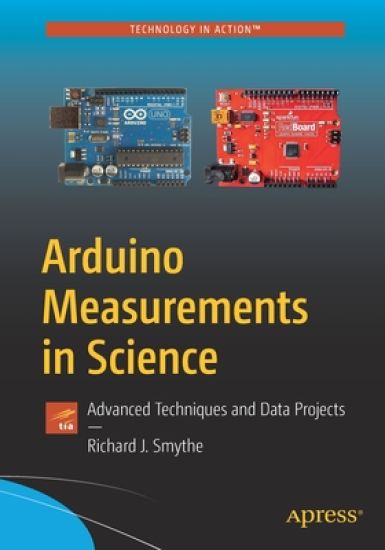
Arduino Measurements in Science

Arduino Measurements in Science

Richard J. Smythe

APress
2021
nidottu
Explore the full capabilities of your Arduino. Whether you need to measure light, heat, mass, force, or conductivity, this book can be used as a complete reference guide for making virtually any scientific measurement with your PC or Linux based system and the Arduino microcontroller.You'll apply the Arduino and sensors to take measurements at the macro-, milli-, micro-, nano- and pico-sensitivity ranges. By working through the projects in this book, you’ll learn how to apply these techniques in the lab or field in areas such as weighing samples at the gram or milligram levels, measuring water temperature to a tenth of a degree, or its conductivity in milli or micro Siemens. With these projects, you can reliably measure, store, and experiment with a wide range of scientific data.Arduino Measurements in Science features a novel approach and several little known techniques to measure data that requires only basic and accessible hardware – perfect for the home or school workshop! What You’ll LearnMake basic scientific measurements with PCs, and Linux based computing systemsReview techniques for weighing measurements down into the double and even single digit milligramUse inexpensive sensors and displays to quantify and validate sensor dataIncorporate weighing scales, electrometers, magnetic and static field detectors, motion and vibration detectors, and moreUnderstand the possible noise and accuracy problems that can occur and best practices to refine your projects See the benefits of data validation for graphical data displayWho Is This Book ForReaders looking to acquire the basic science and engineering skills required to assemble fundamental measurement systems to implement with the simple hand tools found in most home or school workshops.
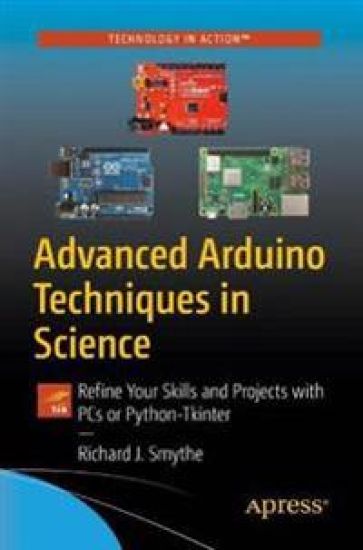
Advanced Arduino Techniques in Science
If you’re already a comfortable programmer, familiar with your single board computer and microcontroller, and are ready to refine your projects, then let’s get started! This book covers advanced methods and techniques for creating, implementing, monitoring and controlling your experiments and projects with your Raspberry Pi and Arduino. Projects will use Python and the Tkinter GUI and will also cover software development for adding real time data display to the Raspberry Pi.You'll review concepts of frequency occurring in nature and the techniques used to measure the frequency of electrically varying signal voltages. You'll also study procedures for safe design, implementation and operation of experimental measurement systems operating at high heats and high temperatures. Throughout the book you'll look at sources and types of errors, and best practices for minimizing and reducing them.Often times there are simple environmental issues hindering what would seem to be simple projects: high temperatures, controlling the power for elevated temperature with the proportional integral and derivative (PID) algorithm, and the limitations imposed by eight bit code, the influence of noise and errors in measured data, and many more. Advanced Arduino Techniques in Science provides the best tools to move past those restrictions. What You’ll LearnImplement an experimental control system and graphical data display for the Raspberry Pi and ArduinoManage experimental control with PID algorithm implementation, tuning and limitations imposed by eight bit digital signalsBuild an analytical front end Examine data smoothing capability of the Kalman filterExplore available methods for measuring both high and low frequency values in electronic signalsWho This Book Is ForEducators, researchers, students, makers, citizen scientists, or hobbyists can all extend their measuring capability or improve upon the quality of their collected data. The book is directed to those with intermediate skills in programming and those who are comfortable with Python programming and Arduino C.
Justice in Lyon

Justice in Lyon

Richard J. Golsan

UNIVERSITY OF TORONTO PRESS
2022
sidottu
The trial of former SS lieutenant and Gestapo chief Klaus Barbie was France’s first trial for crimes against humanity. Known as the "Butcher of Lyon" during the Nazi occupation of that city from 1942 to 1944, Barbie tortured, deported, and murdered thousands of Jews and Resistance fighters. Following a lengthy investigation and the overcoming of numerous legal and other obstacles, the trial began in 1987 and attracted global attention. Justice in Lyon is the first comprehensive history of the Barbie trial, including the investigation leading up to it, the legal background to the case, and the hurdles the prosecution had to clear in order to bring Barbie to justice. Richard J. Golsan examines the strategies used by the defence, the prosecution, and the lawyers who represented Barbie’s many victims at the trial. The book draws from press coverage, articles, and books about Barbie and the trial published at the time, as well as recently released archival sources and the personal archives of lawyers at the trial. Making the case that, despite the views of its many critics, the Barbie trial was a success in legal, historical, and pedagogical terms, Justice in Lyon details how the trial has had a positive impact on French and international law governing crimes against humanity.
Justice in Lyon

Justice in Lyon

Richard J. Golsan

UNIVERSITY OF TORONTO PRESS
2022
pokkari
The trial of former SS lieutenant and Gestapo chief Klaus Barbie was France’s first trial for crimes against humanity. Known as the "Butcher of Lyon" during the Nazi occupation of that city from 1942 to 1944, Barbie tortured, deported, and murdered thousands of Jews and Resistance fighters. Following a lengthy investigation and the overcoming of numerous legal and other obstacles, the trial began in 1987 and attracted global attention. Justice in Lyon is the first comprehensive history of the Barbie trial, including the investigation leading up to it, the legal background to the case, and the hurdles the prosecution had to clear in order to bring Barbie to justice. Richard J. Golsan examines the strategies used by the defence, the prosecution, and the lawyers who represented Barbie’s many victims at the trial. The book draws from press coverage, articles, and books about Barbie and the trial published at the time, as well as recently released archival sources and the personal archives of lawyers at the trial. Making the case that, despite the views of its many critics, the Barbie trial was a success in legal, historical, and pedagogical terms, Justice in Lyon details how the trial has had a positive impact on French and international law governing crimes against humanity.
Pelican Bay: Guard McNamara's Story

Pelican Bay: Guard McNamara's Story

Richard J. McNamara; John Clayton

Createspace Independent Publishing Platform
2013
nidottu
Behind the walls of California's Pelican Bay State Prison an 18 year veteran gives you the stories behind the headlines. In a world were force is the main currency, and wits the only true tool, you will see the ugly underbelly of America's criminal class.Inmates, Administrators, and Officers all bring their share of danger and distress to one othe ugliest and most dangerous jobs humans face: the guarding of inmatesin prison.
The P=NP Question and Gödel’s Lost Letter

The P=NP Question and Gödel’s Lost Letter

Richard J. Lipton

Springer-Verlag New York Inc.
2014
nidottu
? DoesP=NP. In just ?ve symbols Dick Karp –in 1972–captured one of the deepest and most important questions of all time. When he ?rst wrote his famous paper, I think it’s fair to say he did not know the depth and importance of his question. Now over three decades later, we know P=NP is central to our understanding of compu- tion, it is a very hard problem, and its resolution will have potentially tremendous consequences. This book is a collection of some of the most popular posts from my blog— Godel ¨ Lost Letter andP=NP—which I started in early 2009. The main thrust of the blog, especially when I started, was to explore various aspects of computational complexity around the famousP=NP question. As I published posts I branched out and covered additional material, sometimes a timely event, sometimes a fun idea, sometimes a new result, and sometimes an old result. I have always tried to make the posts readable by a wide audience, and I believe I have succeeded in doing this.