Kirjojen hintavertailu. Mukana 11 239 951 kirjaa ja 12 kauppaa.

Kirjahaku

Etsi kirjoja tekijän nimen, kirjan nimen tai ISBN:n perusteella.

1000 tulosta hakusanalla Roderick Beaton

We Are not What We Seem

We Are not What We Seem

Roderick D. Bush

New York University Press
1998
sidottu
An "Indispensable" Book of The Black World Today website A fresh new look at the Black Power movement and its leaders Much has been written about the Black Power movement in the United States. Most of this work, however, tends to focus on the personalities of the movement. In We Are Not What We Seem, Roderick D. Bush takes a fresh look at Black Power and other African American social movements with a specific emphasis on the role of the urban poor in the struggle for Black rights. Bush traces the trajectory of African American social movements from the time Booker T. Washington to the present, providing an integrated discussion of class. He addresses questions crucial to any understanding of Black politics: Is the Black Power movement simply another version of the traditional American ethnic politics, or does it have wider social import? What role has the federal government played in implicitly grooming social conservatives like Louis Farrakhan to assume leadership positions as opposed to leftist, grassroots, class-oriented leaders? Bush avoids the traditional liberal and social democratic approaches in favor of a more universalistic perspective that offers new insights into the history of Black movements in the U.S.
We Are not What We Seem

We Are not What We Seem

Roderick D. Bush

New York University Press
2000
pokkari
An "Indispensable" Book of The Black World Today website A fresh new look at the Black Power movement and its leaders Much has been written about the Black Power movement in the United States. Most of this work, however, tends to focus on the personalities of the movement. In We Are Not What We Seem, Roderick D. Bush takes a fresh look at Black Power and other African American social movements with a specific emphasis on the role of the urban poor in the struggle for Black rights. Bush traces the trajectory of African American social movements from the time Booker T. Washington to the present, providing an integrated discussion of class. He addresses questions crucial to any understanding of Black politics: Is the Black Power movement simply another version of the traditional American ethnic politics, or does it have wider social import? What role has the federal government played in implicitly grooming social conservatives like Louis Farrakhan to assume leadership positions as opposed to leftist, grassroots, class-oriented leaders? Bush avoids the traditional liberal and social democratic approaches in favor of a more universalistic perspective that offers new insights into the history of Black movements in the U.S.
Voices of the Other

Voices of the Other

Roderick McGillis

CRC Press Inc
1999
sidottu
This book offers a variety of approaches to children's literature from a postcolonial perspective that includes discussions of cultural appropriation, race theory, pedagogy as a colonialist activity, and multiculturalism. The eighteen essays divide into three sections: Theory, Colonialism, and Postcolonialism. The first section sets the theoretical framework for postcolonial studies; essays here deal with issues of "otherness" and cultural difference, as well as the colonialist implications of pedagogic practice. These essays confront our relationships with the child and childhood as sites for the exertion of our authority and control. The second section presents discussions of the colonialist mindset in children's and young-adult texts from the turn of the century. Here, works by writers of animal stories in Canada, the U.S., and Britain; works of early Australian colonialist literature; and Frances Hodgson Burnett's A Little Princess come under the scrutiny of our postmodern reading practices. Section Three deals directly with contemporary texts for children that manifest both a postcolonial and a neo-colonial content, and includes studies of children's literature from Canada, Australia, Africa, the Caribbean, and the United States.
Cybercrime and Digital Deviance

Cybercrime and Digital Deviance

Roderick S. Graham; 'Shawn K. Smith

CRC Press Inc
2019
nidottu
Cybercrime and Digital Deviance is a work that combines insights from sociology, criminology, and computer science to explore cybercrimes such as hacking and romance scams, along with forms of cyberdeviance such as pornography addiction, trolling, and flaming. Other issues are explored including cybercrime investigations, organized cybercrime, the use of algorithms in policing, cybervictimization, and the theories used to explain cybercrime.Graham and Smith make a conceptual distinction between a terrestrial, physical environment and a single digital environment produced through networked computers. Conceptualizing the online space as a distinct environment for social interaction links this text with assumptions made in the fields of urban sociology or rural criminology. Students in sociology and criminology will have a familiar entry point for understanding what may appear to be a technologically complex course of study. The authors organize all forms of cybercrime and cyberdeviance by applying a typology developed by David Wall: cybertrespass, cyberdeception, cyberviolence, and cyberpornography. This typology is simple enough for students just beginning their inquiry into cybercrime. Because it is based on legal categories of trespassing, fraud, violent crimes against persons, and moral transgressions it provides a solid foundation for deeper study.Taken together, Graham and Smith’s application of a digital environment and Wall’s cybercrime typology makes this an ideal upper level text for students in sociology and criminal justice. It is also an ideal introductory text for students within the emerging disciplines of cybercrime and cybersecurity.
Creating Built Environments

Creating Built Environments

Roderick Lawrence

CRC Press Inc
2020
sidottu
Built environments are complex, emergent, systemic, and require contextual analysis. They should be understood before reconsidering how professionals and researchers of the built environment are educated and trained to reduce the gap between knowledge, practice and real-world circumstances. There is an urgent need to rethink the role of policy makers, researchers, practitioners and laypeople in the construction, renovation and reuse of the built environment in order to deal with numerous environmental/ecological, economic/financial and social/ethical challenges of providing a habitat for current and future generations in a world of continual change. These challenges are too complex to be dealt with only by one discipline or profession. Combinations of different types of knowledge, knowing in praxis and tacit knowledge are needed.This book presents and illustrates recent innovative contributions with case studies focusing on five strategic domains and the interrelations between them. These transdisciplinary contributions apply concepts, methods and tools that facilitate convergence and concerted action between participants collaborating in policy definition and project implementation. The methods and tools include experiments in living-labs, prototypes on site and virtual simulations, as well as participatory approaches including citizen science, the development of alternative scenarios, and visioning plausible futures.
Creating Built Environments

Creating Built Environments

Roderick Lawrence

CRC Press Inc
2020
nidottu
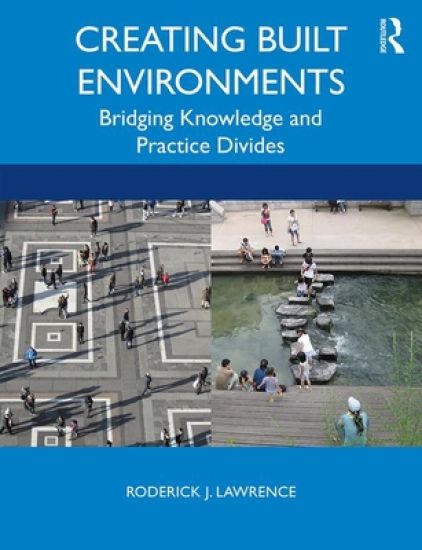
Built environments are complex, emergent, systemic, and require contextual analysis. They should be understood before reconsidering how professionals and researchers of the built environment are educated and trained to reduce the gap between knowledge, practice and real-world circumstances. There is an urgent need to rethink the role of policy makers, researchers, practitioners and laypeople in the construction, renovation and reuse of the built environment in order to deal with numerous environmental/ecological, economic/financial and social/ethical challenges of providing a habitat for current and future generations in a world of continual change. These challenges are too complex to be dealt with only by one discipline or profession. Combinations of different types of knowledge, knowing in praxis and tacit knowledge are needed.This book presents and illustrates recent innovative contributions with case studies focusing on five strategic domains and the interrelations between them. These transdisciplinary contributions apply concepts, methods and tools that facilitate convergence and concerted action between participants collaborating in policy definition and project implementation. The methods and tools include experiments in living-labs, prototypes on site and virtual simulations, as well as participatory approaches including citizen science, the development of alternative scenarios, and visioning plausible futures.
Aberrations in Black

Aberrations in Black

Roderick A. Ferguson

University of Minnesota Press
2003
nidottu
A hard-hitting look at the regulation of sexual difference and its role in circumscribing African American culture The sociology of race relations in America typically describes an intersection of poverty, race, and economic discrimination. But what is missing from the picture-sexual difference-can be as instructive as what is present. In this ambitious work, Roderick A. Ferguson reveals how the discourses of sexuality are used to articulate theories of racial difference in the field of sociology. He shows how canonical sociology-Gunnar Myrdal, Ernest Burgess, Robert Park, Daniel Patrick Moynihan, and William Julius Wilson-has measured African Americans’s unsuitability for a liberal capitalist order in terms of their adherence to the norms of a heterosexual and patriarchal nuclear family model. In short, to the extent that African Americans’s culture and behavior deviated from those norms, they would not achieve economic and racial equality.Aberrations in Black tells the story of canonical sociology’s regulation of sexual difference as part of its general regulation of African American culture. Ferguson places this story within other stories-the narrative of capital’s emergence and development, the histories of Marxism and revolutionary nationalism, and the novels that depict the gendered and sexual idiosyncrasies of African American culture-works by Richard Wright, Ralph Ellison, James Baldwin, Audre Lorde, and Toni Morrison. In turn, this book tries to present another story-one in which people who presumably manifest the dysfunctions of capitalism are reconsidered as indictments of the norms of state, capital, and social science. Ferguson includes the first-ever discussion of a new archival discovery-a never-published chapter of Invisible Man that deals with a gay character in a way that complicates and illuminates Ellison’s project.Unique in the way it situates critiques of race, gender, and sexuality within analyses of cultural, economic, and epistemological formations, Ferguson’s work introduces a new mode of discourse-which Ferguson calls queer of color analysis-that helps to lay bare the mutual distortions of racial, economic, and sexual portrayals within sociology.
The Reorder of Things

The Reorder of Things

Roderick A. Ferguson

University of Minnesota Press
2012
nidottu
In the 1960s and 1970s, minority and women students at colleges and universities across the United States organized protest movements to end racial and gender inequality on campus. African American, Chicano, Asia American, American Indian, women, and queer activists demanded the creation of departments that reflected their histories and experiences, resulting in the formation of interdisciplinary studies programs that hoped to transform both the university and the wider society beyond the campus.In The Reorder of Things, however, Roderick A. Ferguson traces and assesses the ways in which the rise of interdisciplines-departments of race, gender, and ethnicity; fields such as queer studies-were not simply a challenge to contemporary power as manifest in academia, the state, and global capitalism but were, rather, constitutive of it. Ferguson delineates precisely how minority culture and difference as affirmed by legacies of the student movements were appropriated and institutionalized by established networks of power.Critically examining liberationist social movements and the cultural products that have been informed by them, including works by Adrian Piper, Toni Cade Bambara, Jhumpa Lahiri, and Zadie Smith, The Reorder of Things argues for the need to recognize the vulnerabilities of cultural studies to co-option by state power and to develop modes of debate and analysis that may be in the institution but are, unequivocally, not of it.
The Renewal of Trinitarian Theology

The Renewal of Trinitarian Theology

Roderick T. Leupp

Inter-Varsity Press,US
2008
pokkari
Everyone seems to be talking about trinitarian theology these days--theologians, pastors and theologically smart laypeople. If you have felt like an outsider to these conversations, or just wondered why trinitarian theology has generated so much talk, this book is for you. Roderick Leupp describes the renewal of trinitarian theology in recent decades and introduces us to the trinitarian thought of theologians such as Karl Rahner, Karl Barth, J?rgen Moltmann, John Zizioulas, Robert Jenson and Catherine LaCugna. Leupp shows us how trinitarian is an adjective for the very grammar of the Christian faith. And he helps us see how our thinking about the Godhead, the cross, the church, ethics and spirituality can be transformed by trinitarian theology. Writing in a style that is always reflective, often poetic and sometimes deeply personal, Leupp puts theology in conversation with life, making connections we might otherwise miss. And piercingly, he weaves into his reflections on the triune God his own experience of the traumatic injury of his daughter. This is a book that will expand your understanding of the triune God who is Father, Son and Spirit.
Princess Isabel of Brazil

Princess Isabel of Brazil

Roderick J. Barman

Rowman Littlefield
2002
nidottu
As the elder daughter of an emperor whose wife had presented him with no sons, Isabel stood to inherit the monarchy of Brazil with the passing of Dom Pedro II. On three separate occasions, Isabel was named regent, or head of state, when her father was required to leave the country for extended periods. On each occasion, she served as the dutiful daughter, following her father's instructions to the letter and resisting any attempts at personal aggrandizement. During her third regency, as her father recuperated in Europe, rather than accumulate personal power and oppose the forces of republicanism and abolition, Isabel personally led the struggle to pass the Gold Law of 1888 abolishing slavery throughout Brazil, thus ridding the country of one of the institutions upon which traditional monarchical Brazil was based and speeding the downfall of the monarchy, the monarchy she would inherit, in 1889. Princess Isabel of Brazil examines Isabel's role as an extraordinary woman who had access to material wealth and education and power, in patriarchal nineteenth-century Brazil. Professor Barman looks at how her life was constrained by her subordinate roles as daughter, wife, mother, and even as empress-in-waiting, using the fascinating career of Isabel to examine the interplay of gender and power in the nineteenth century. This new book is an excellent resource for courses biography, women's studies, and Latin American history courses.
Plundering Africa's Past

Plundering Africa's Past

Roderick J. McIntosh

James Currey
1996
pokkari
The conclusion discusses specific steps that could be taken to halt the plunder. This text examines why the African past, namely its art and antiquities, is disappearing at a rate perhaps unmatched in any other part of the world. Each essay looks at the international network of looting and trafficking, and theconclusion discusses specific steps that could halt the disappearance of Africa'a cultural heritage. The text presents an indictment of African contributions to the problem, and the contributors include African government and museum officials, members of international agencies, academics and journalists. North America: Indiana U Press
John Knox

John Knox

Roderick Graham

Saint Andrew Press
2013
nidottu
A deeply researched, well-written and comprehensive biography which vividly brings its subject and the milieu of the Scottish Reformation to life – but, even more significantly, the author's approach to Knox is uniquely different to the contemporary preconception of a ranting dogmatic misogynist. This man of action lived a dramatic life – he was a galley slave, an exile, and a man who lived at the very centre of one of the most volatile periods in Christian and Scottish history, keeping his integrity intact.
Bonnie Prince Charlie

Bonnie Prince Charlie

Roderick Graham

Saint Andrew Press
2014
nidottu
Bonnie Prince Charlie is one of the best-known and romantic names in Scottish and British history. As with so many legends, the truth is often obscure and the debate continues to rage over questions of his plans to become Charles III, his wish to make Britain a Catholic country, the battle of Culloden, France’s role in the ’45 Rebellion, whether he ultimately proved to be a coward and how he met his end. Few others have really explored Charles’s motivations. By tackling 12 of the most intriguing myths surrounding Bonnie Prince Charlie, and revealing some little-known and astonishing facts, this book casts new perspective on one of the most turbulent times in Scottish and British history. Ten myths about Bonnie Prince Charlie are explored and, through them, we discover why Charles converted to the Church of England, who Charles’s mysterious wife was, why the Duke of Cumberland was not the most ruthless man at Culloden, why Charles rejected the idea of an independent Scotland and the real reason why Charles wanted to take the British throne.
Molecular Evolution

Molecular Evolution

Roderick D.M. Page; Edward C. Holmes

Blackwell Science Ltd
1998
nidottu
The study of evolution at the molecular level has given the subject of evolutionary biology a new significance. Phylogenetic 'trees' of gene sequences are a powerful tool for recovering evolutionary relationships among species, and can be used to answer a broad range of evolutionary and ecological questions. They are also beginning to permeate the medical sciences. In this book, the authors approach the study of molecular evolution with the phylogenetic tree as a central metaphor. This will equip students and professionals with the ability to see both the evolutionary relevance of molecular data, and the significance evolutionary theory has for molecular studies. The book is accessible yet sufficiently detailed and explicit so that the student can learn the mechanics of the procedures discussed. The book is intended for senior undergraduate and graduate students taking courses in molecular evolution/phylogenetic reconstruction. It will also be a useful supplement for students taking wider courses in evolution, as well as a valuable resource for professionals. First student textbook of phylogenetic reconstruction which uses the tree as a central metaphor of evolution. Chapter summaries and annotated suggestions for further reading. Worked examples facilitate understanding of some of the more complex issues. Emphasis on clarity and accessibility.
On the Highest Hill

On the Highest Hill

Roderick Haig-Brown

Oregon State University
1994
nidottu
Roderick Haig-Brown, an author best known for his classic books on fly fishing, also wrote two novels about life and work in the northwest woods. On the Highest Hill tells the story of Colin Ensley, a shy and solitary young man who is more at home in nature than he is with people. Colin's fate is ruled by two great loves, for a woman and for a place. For both, he must struggle. The story unfolds in logging camps, in bustling Vancouver, on the Canadian prairies, and in wartime Europe, but always returns to the vast forests, mountains, and wilderness valleys of Vancouver Island - where Colin's story begins and where it comes to its violent and tragic end.
Lessons of Everyday Law

Lessons of Everyday Law

Roderick A. Macdonald

Queen's University
2002
nidottu
Problems of discovering and representing reality, of making and transcribing rules into linguistic and other symbolic forms, of fact-finding and interpretation routinely confront policy-makers and lawyers. But, in a sense, everyone is a lawyer because ordinary human interaction is saturated with norms and normative processes, institutions, structures, and cultures. Everyday life thus provides an unlimited supply of images and events that raise some of the most complex issues of legal theory. In Lessons of Everyday Law Roderick MacDonald shows that stories of everyday law are revealing not just for what they can teach about policy-making and law reform but as accounts of practices internal to the little legal systems of everyday life. The norms governing ordinary encounters reveal how human beings make sense of their relationships with each other and translate these relationships into discrete, culturally determined legal forms and values. Most of these small-scale norms can also be found in larger normative settings, such as the official legal system of the political state and the multiple regimes of international law. Lessons of Everyday Law suggests that the stream of influence between the micro-law of everyday life and the macro-law of the world legal order flows both ways. Attending to the normative dimensions of everyday human interaction enriches our understanding of the forms, aspirations, and limits of law -- wherever it is found.